
If you can hold four ideas in your head at the same time, you can see the opportunity.
1) The EU crafting a new (ill thought-through) scheme to tap frozen Russian assets for Ukraine.
2) A Russian concession – forgotten by most: they did make one. An important Reuters article from February:
“Russia could agree to using $300 billion of sovereign assets frozen in Europe for reconstruction in Ukraine but will insist that part of the money is spent on the one-fifth of the country that Moscow’s forces control, three sources told Reuters... While the freezing of the funds has angered Moscow, some of Russia’s most outspoken war hawks have previously acknowledged Russia may eventually part with the frozen reserves, provided that the controlled territories stay within Russia.”
3) Sir Niall Ferguson gave an interview while in Kyiv last week: “I’ve argued here at the Yalta European Strategy conference that we need an Operation Warp Speed for German rearmament.”
4) Marc Andreessen on US robotics, in conversation with Peter Robinson in January:
Marc: “The big industry that follows phones, drones and cars, logically, is: robots. We are on the verge of the robotics revolution we have all seen in science fiction.”
Peter: “And the Chinese are ahead of us there?”
Marc: “Oh, 100%. Now, we have the leading R&D. I’m convinced we have the smartest robotics and AI people – specifically for the design of systems. But we don’t have anything resembling the manufacturing capability at all. It’s not just whether a company can build a robot; it’s whether you have the thousands of companies that make all of the components that go into robots.”
How could these ideas be blended, for maximum Western advantage?
Ukraine is now the most heavily mined country in the world. Agricultural exports from Ukraine are estimated to be $8.9bn lower per year due to landmines (affecting the food security of many African countries), while regional tax revenues are $1.1 billion lesser.
De-mining the territory is projected by the Tony Blair Institute to take ten+ years, and a World Bank estimate: cost $34bn. (Adjusted for inflation, the Manhattan Project cost only $30bn over the course of World War II.)
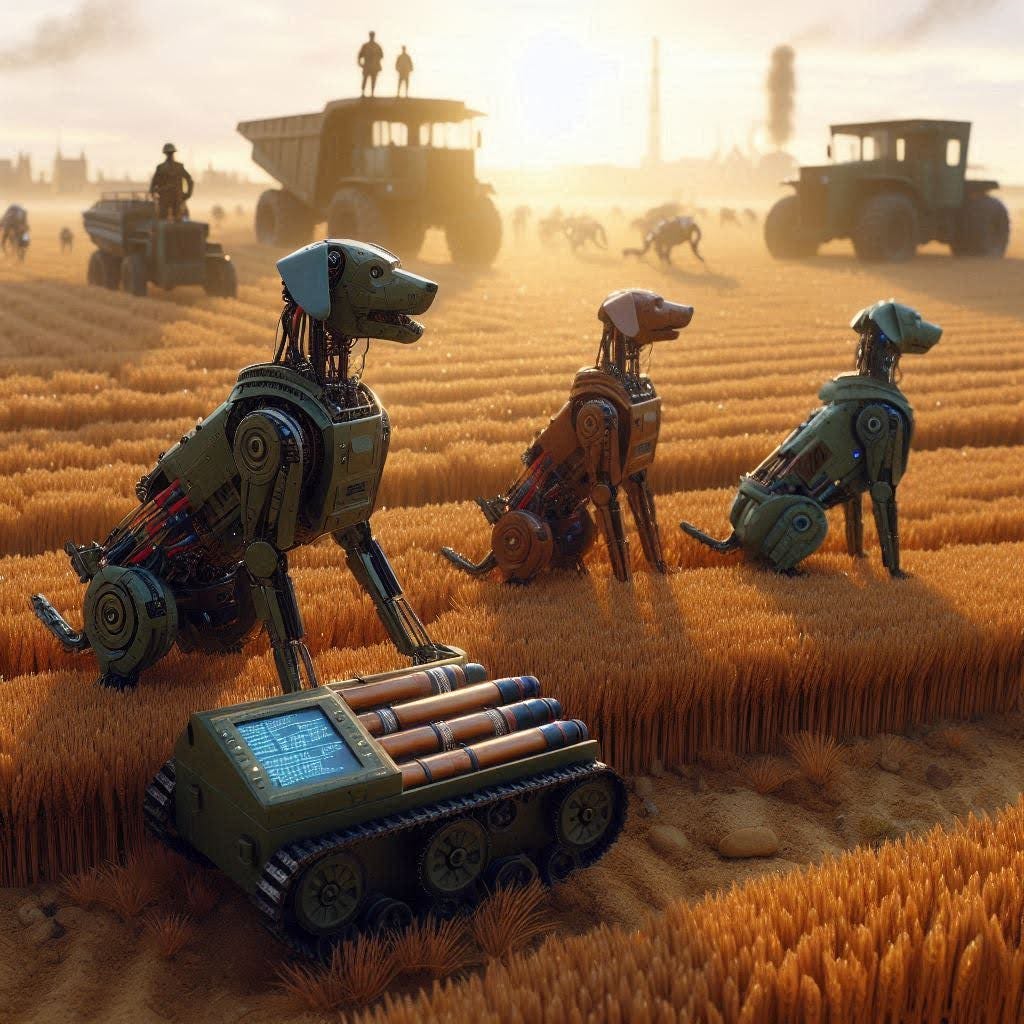
I’ve argued since June: Is there an opportunity for the Trump Administration, in partnership with the EU, to commission the most innovative Western robotics companies: Anduril, Boston Dynamics, Optimus/Tesla, Gecko Robotics, Foundation, as well as lesser-known European equivalents, and emulate the tender process of Operation Warp Speed?
Instead of leaving de-mining to NGOs, task the private sector, and use the problem of landmines as an opportunity to get Western robotics supply chains in gear.
At the All-In Summit two weeks ago, on the way to the final evening’s party, I met (in attendance) a US military veteran who’s now COO of a California-based robotics company. Putting my suggestion to him, his reply:
“Making a treasure hunt to de-mine Ukraine strikes me as a brilliant idea. I think a ton of impressive companies would get really into that. It’s the same kind of incentive structure that makes Bitcoin miners an option.”
Could frozen Russian cash be used as a prize to stimulate Western robotics? Every mine a robot of yours defuses = $/€ cash prize. Robotics companies from any Western countries can enter.
I consider strongly that Russia’s frozen assets should not be used for lethal aid to Ukraine, and military escalation. The optics of this would surely get European banks into hot water, and Belgium is rightly guarded. We should also note: if the EU were to use the frozen funds to continue the war, there will be no funding pot left to finance ultimate reconstruction.
But, a humanitarian, non-lethal call for de-mining the territory feels to me altogether different. Presentation of this matters on the international stage.
That Reuters piece from February again:
“Russia could agree to using $300 billion of sovereign assets frozen in Europe for reconstruction in Ukraine but will insist that part of the money is spent on the one-fifth of the country that Moscow’s forces control, three sources told Reuters.”
Could there be a deal to be made here?
Newly created robotics manufacturing capacity would of course have future dual-use potential. Marc Andreessen: “Everything we’ve just been talking about [on civilian robotics] is also upstream from all of the military applications. It’s that same supply chain that then goes into everything we talked about.”
But the release of frozen Russian funds should, I suggest, be confined specifically to non-lethal de-mining and reconstruction. (I’d actually go further and say: if the funds can’t be used for Ukraine’s military aid, with Belgium continuing to resist; and they’re surely never going to be given back to Russia; the only thing the funds are good for is de-mining and reconstruction.)
Sir Niall in the same interview last week:
“A much more coherent response to the nature of the war that we face [is needed]. I worry that European Generals want to rearm for the war of the 1990s. That’s to say, they’re going to invest in hardware that is obsolete. The war of the future is overwhelmingly a drone war, in which autonomous systems, AI and satellite communications will be crucial. And the Europeans have a long way to go to be competitive with the US in those domains.”
If EU bureaucrats grant themselves the authority to spend $300bn however they like to try and help Ukraine, they will, quite possibly, squander it on past-century relics.
But being straitjacketed (some gentle US assistance) to build agile de-mining robots could instead put European manufacturing in a stronger long-term position. It would get funding to startups, not 20th century primes.
Professor Michael Clarke, by far the best defence analyst I’ve seen regularly on British television, yesterday:
“Looking at the end of this month, a Ukrainian delegation is due in Washington to talk to American industrialists about joint production. Americans are getting interested in helping Ukrainians scale up their innovation production [of drones]… A lot of American entrepreneurs are getting interested in that.”
In stark contrast to the simmering EU scheme (that’s fatally flawed – see comments section below for more), it’s in Russia’s self-interest that the occupied territory gets de-mined.
And an agreement here would unlock the potential of the April-signed US-Ukraine minerals deal. (The shared reconstruction-investment fund to which Ukraine will give half its revenues from future mineral extraction to the US.) If robots can defuse landmines, can they go on to assist with mineral-mining, too? Mining-robotics joint ventures await.
Territorial concessions still need to be made – yes. But there are other creative suggestions there.
The money’s there. Lots of it. And someone’s going to do something with it.
Perhaps de-mining robots are something American industrialists should discuss?
No posts
Comments
Nothing yet. Say the first thing.
Sign in to join the conversation.