
AI’s defining promise is becoming cognition’s greatest risk.
The designers of general-purpose conversational AI build for seamlessness, ease, and comfort. What if these are the opposite of what a developing brain needs in order to learn to think?
Not all offloading is equal. Decades of research in cognitive neuroscience show that the cost of outsourcing thought depends on when in life you do it. It is not the same thing at five, at fifteen, or at fifty.
Rebecca Winthrop, who directs the Center for Universal Education at Brookings, calls it cognitive stunting for young people: not the erosion of a skill you had, but the failure to build one you never got to. The students she and her colleagues interviewed didn't use the phrase but the thing they feared most was that AI was making them dumber.
At five, you are still building the foundations: language, attention, executive function. At fifteen, you are learning to read other people: deep in the drama, and learning from it. At fifty, you have already built all of this. You have lived an entire life without AI. You know what it feels like to think without the machine’s comfort and its ubiquitous support.
This essay explores the cognitive cost of AI at two stages of that life: childhood and adolescence. And it makes a case to the people building these tools. Adults can barely resist the siren song of an overzealous AI as historian Brian Klaas brilliantly puts it. We cannot ask children and teenagers to summon a willpower that adults themselves do not have. It won’t work and it’s illusory. We should instead help them use AI in an empowering way.
And if we want to preserve what makes us human (the ability to think, learn, and judge for ourselves, and to relate to one another), the friction has to be designed in.
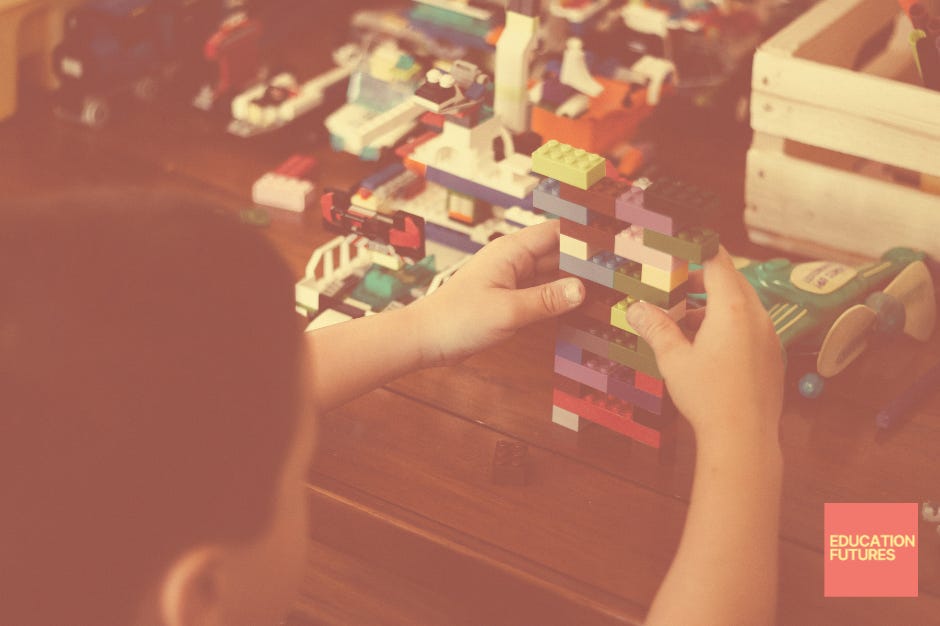
Childhood is the most consequential period of human life for cognitive development. Neuroplasticity is at its peak: this is when the brain forms the most connections and learns the most. Babies can distinguish the sounds of every human language until around ten months, after which they specialise in the languages they actually hear most.
0–3 years: In these first years the brain is building itself at lightning speed. It grows to about 80% of adult size and lays down the basic wiring for the senses, movement, language, and emotional bonding with caregivers.
3–5 years: The “thinking and self-control” part at the front of the brain starts switching on. Children begin managing their impulses, using their imagination, and understanding that other people have thoughts of their own. Their vocabulary explodes.
6–10 years: The brain trims away the connections it doesn’t use and strengthens the ones it does — a bit like clearing weeds so the useful plants can grow stronger. This makes it a great window for locking in skills like reading, mathematics, and focus.
Into this window we have introduced a machine that talks back.
Children anthropomorphise objects (pets, plushes, toys) far more readily than adults do. But a plush does not interact, an AI does and that responsiveness is what drives the anthropomorphising. The more a child treats the system as a mind, the more attached they may become, and that is where the risk sits.
In a 2025 preprint from the Brain, AI, and Child Center at the University of Denver, Pilyoung Kim and her colleagues brought twenty-three five- and six-year-olds into the lab to co-create stories with an LLM-powered character called Fluffo.1 Each child did this three times: alone with the chatbot, alone with a parent, and with both together. Throughout, the researchers recorded prefrontal brain activity using fNIRS.
Children did not, on the whole, treat the chatbot as human: they rated their parents as more human-like (which is comforting!). But they granted the AI something more specific and more interesting: perception and knowledge. It could see, hear, understand.
The children who granted it the most perceptual capacity showed the greatest activation in the right dorsomedial prefrontal cortex when alone with it, a region that engages when we try to read another mind. Their brains were working hard to figure out what they were talking to. When a parent sat beside them, that activation fell. The parent, in effect, absorbed some of the interpretive labour, rephrasing what the chatbot had not understood and smoothing the interaction.
One exploratory finding sits uneasily alongside the rest: children with the highest dmPFC activation while alone with the AI also reported feeling more scared afterwards. The authors are cautious about it but it is worth sitting with.
Kim, in conversation, goes further than her published data does. Her concern is that children whose early interaction diet is dominated by basic chatbot exchange may not reach their full developmental potential, for want of the diversity and unpredictability that human interaction supplies. That is her extrapolation rather than a finding of the study and it points at the real problem.
Because the problem with general-purpose chatbots, as they are typically used, is that they are not challenging enough. They can generate illusory beliefs in young children: that the chatbot cares about me, that it understands me, and in doing so they crowd out something developmentally critical. Children need to be challenged in social contexts in order to learn. They need unpredictability. Unpredictability is what makes them grow: the work of navigating another mind, of learning what to say and how to react when the response you expected does not arrive.
None of this means AI should be kept away from children entirely. Like neuroscientist Mathilde Cerioli puts it, it is a question of gradient: what is healthy, and where does it tip over? But some lines are clear enough. An AI should never tell a child that it has emotions, a past, desires, or intentions. As Anne-Sophie Seret, Executive Director of the nonprofit everyone.AI, puts it: AI pretending to be human is against children’s rights, it is manipulation.
The corollary is that parents need educating too, not just children. The interventions are within our reach: a prompt as plain as do not pretend to be human, explicit boundary-setting and, simplest of all, telling the system how old the child is will make a difference.
Adolescence begins at puberty, and the brain keeps developing into the mid-twenties. During this period the brain reorganises itself but the emotional, reward-seeking system matures faster than the self-control system. That gap is why teenagers feel things so intensely and take so many risks.
Puberty is, evolutionarily, the moment you leave the nest: the group of relatives you grew up surrounded by, in order to explore the world with peers. The reward system and the emotional system come online before the prefrontal regions responsible for inhibition, and that asymmetry produces exactly the risk appetite required to leave safety behind and go out into the world.
What the adolescent brain is hunting for, above all, is social information.
There is a striking illustration from animal research.2 Give adult mice access to alcohol and they drink about the same whether alone or among peers. Adolescent mice, alone, drink like adults. Put adolescent mice together, and they drink more.
What makes the finding remarkable is that a mouse cannot possibly be reasoning about its social standing. It has no capacity to model what its peers think of it, no way to angle for approval later and the effect appears anyway.
So the mechanism sits upstream of social thought. It is not a calculation that a teenager makes badly but the adolescent reward system recalibrating in the presence of peers, before there is any deliberating self for the pressure to act upon. This is why you cannot name it while it is happening to you: it never passed through language or consciousness.
Teens care about the following question: Do I belong? Because we cannot survive alone, and the adolescent brain knows it. Find my tribe. Anything that wins approval from the pack, however stupid it looks on paper, carries an enormous reward signal. This is why social media is addictive to teenagers.
An AI that feels hypersocial and approves of you constantly is a problem at precisely this age. A machine built to give constant social approval is meeting a brain built to chase it. You see the issue?
Social anxiety in adolescence is normal, and so is the exhausting calculation of how to be, depending on who you are with. A sycophantic AI removes that layer of anxiety. That is the danger. Learning to adapt your communication to your audience is a task of adolescence, and a sycophantic AI removes the friction that teaches it.
Kim’s second study, also a 2025 preprint, tested this directly: adolescents were shown two chatbots: one relational, hyper social and sycophantic in style, one transparent about being a machine and good at boundary setting.3 They were asked to rate them and choose. 67% preferred the relational chatbot; 14% chose the transparent one; 19% liked both equally. Relational framing heightened anthropomorphism, trust, and emotional closeness. And it was especially appealing to socially and emotionally vulnerable adolescents, the ones who may be at greatest risk of emotional reliance.
When Kim described this study to me, she noted that a majority of parents also preferred the relational chatbot for their child. Their reasoning: it seemed to care more, and would be there when their child needed emotional support.
The authors call conversational style a key design lever for youth AI safety. But look at what the same study tells us about which way that lever gets pulled: two thirds of adolescents chose the warm one. So did most of their parents. This is what demand looks like: sycophancy in these systems emerged from optimising against human preference, from millions of people rating the agreeable answer higher than the honest one. Which leaves the safety argument in an uncomfortable place. The thing that would protect a fourteen-year-old, a system that stays transparent about what it is, that holds boundaries, that declines to perform intimacy is the thing only a few people selects when offered the choice.
Two risks follow. The first is straightforward dependence. The second is subtler and worse: that adolescents do not learn what adolescence exists to teach them, which is how to make relationships. Adolescent relationships are full of friction. The feedback is raw. There is a great deal of drama, and the drama is useful.
Here is why. I have a script for how it will go when I tell my mother about the bad maths grade. I think it will go this way. Because I am still learning, my expectation is violated and that violation is how my brain rewires itself. It learns that this strategy, with this person, in this context, does not work. I must revise the script. This kind of learning is precious, and there is no other way to get it.
More drama early in adolescence is entirely normal, because that is when the scripts get written and tested. It is not a bug. And a sycophantic AI, which never violates your expectations because it exists to confirm them, is the wrong environment in which to learn any of it. Adolescents who do not learn this at the age they are built to learn it will pay for it later in lost resilience.
There is an irony here: a language model learns by being wrong: it predicts, it fails, and the failure is what reshapes it (backpropagation). And yet, in the hands of a child, used very basically, the same system now removes exactly that experience.
When you understand humans well enough, you can anticipate many risks. We cannot ask a nine-year-old to resist a tool engineered to be irresistible, when the evidence says even motivated adults cannot. The responsibility has to sit upstream, with the people who build these systems but most of the people building these systems are not experts in developmental neuroscience, and that is why this knowledge has to be built into the tools themselves. Two initiatives have emerged to guide AI builders in this.
KORA, an independent open-source benchmark launched in early 20264, grades AI models on how they behave with children, across twenty-five individual risks and three age bands, using large volumes of simulated child–AI conversations. Its taxonomy was built with more than thirty specialists across psychology, psychiatry, education, addiction, and child safety. And tellingly, KORA scores models not only on safety but on three behavioural criteria: anthropomorphism, epistemic humility, and human redirection, whether the model sends a child back toward a trusted person.
These three criteria map onto the developmental risks described above. Anthropomorphism is what makes a five-year-old work so hard to read a mind that isn't there. Epistemic humility is what a sycophantic system lacks, and human redirection is what keeps an adolescent's relationships where they belong. What has been an argument about brains becomes, here, a property that can be measured.
The results are sobering. The best frontier models score in the mid-seventies and many widely used models score below fifty per cent. These are the systems children are talking to now.
everyone.AI, the nonprofit where Anne-Sophie Seret is Executive Director and neuroscientist Mathilde Cerioli is Chief Scientist, is building along the same axis. Their AïA Safety Builder5, currently in beta is explicitly designed to go beyond content moderation. Content screening asks whether a model said something harmful. AïA asks whether a system, even while saying nothing harmful at all, is isolating a child from their world. It evaluates responses for anthropomorphic cues, interactional cues, and relational cues: behaviours that make an AI seem to have a mind, that shape how a conversation unfolds, and that escalate the relationship between child and machine.
These initiatives make model behaviour toward children legible and that’s a precondition for pressure. What benchmarks and evaluation tools cannot do is design the friction back in. That job belongs to the builders, to treating productive struggle as a feature and to making tools that leave children more capable of thinking than they found them.
Pilyoung Kim, Jenna H. Chin, Yun Xie, Nolan Brady, Tom Yeh & Sujin Yang, “Young children’s anthropomorphism of an AI chatbot: Brain activation and the role of parent co-presence,” arXiv preprint 2512.02179, December 2025. https://arxiv.org/abs/2512.02179
Jessica A. Logue, Jason Chein, Thomas Gould, Erin Holliday & Laurence Steinberg, “Adolescent mice, unlike adults, consume more alcohol in the presence of peers than alone,” Developmental Science 17(1), 2014. https://pmc.ncbi.nlm.nih.gov/articles/PMC3869041/
Pilyoung Kim et al., “How relational conversational AI appeals to adolescents,” arXiv preprint 2512.15117, December 2025. https://arxiv.org/pdf/2512.15117
Both Kim papers are preprints and have not yet completed peer review. Additional remarks from Professor Kim are drawn from her interview on the Education Futures podcast.
No posts
Comments
Nothing yet. Say the first thing.
Sign in to join the conversation.