
A New Scroll of LA Jewish News
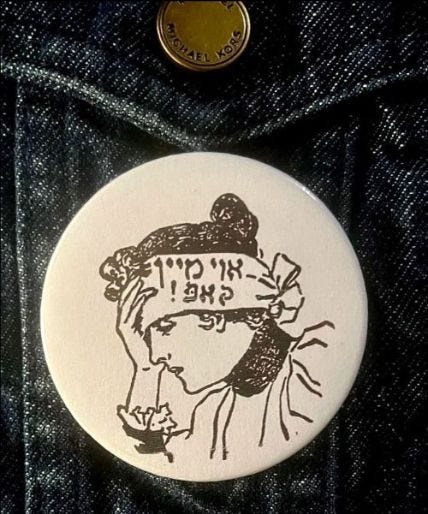
A button made at LA Yiddish Day.
Folks,
Waking up on Black Friday, and rising to the potential of a culturally sanctioned spending spree, we might groan and say Oy mayn kup! Oh, my head! After a day of gratefulness and togetherness, the mood does swing. In the following days, it is estimated we will spend around $20 billion on mostly personal and home goods. But how does this annual outpouring of wealth align with Jewish ideals? Judaism places a very high value on tzedaka, on giving to create a just society. In a time when many Americans are facing food shortages, and lack of other basic needs, when government is pulling back its support, it’s time to turn Black Friday a little blue. We can do this by shopping for others in need, or making a financial donation. Saving you the headache, here are a few Jewish organizations that need your attention:
The Karsh Social Service Center of Wilshire Boulevard Temple
Jewish Family Service LA
Tomchei Shabbos
National Council of Jewish Women
And please remember to subscribe to MegilLA. Beginning our ninth year of publication, we have shown our support of religious freedom, and of Israel, and have photographed resistance to totalitarian action. We have creatively covered the Jewish arts. We have shared stories that you cannot find anywhere else about Jewish Angelenos engaged in politics, business, and the spirituality of everyday life. Through the Archive segment, we have taken you on trips to the past. Please back this effort, I need your financial support to continue.
Happy Thanksgiving
Edmon J. Rodman
////\/\\\\
////\/\\\\
Edmon J. Rodman
At a moment when political and social forces in the U.S. are pushing the public expression of Jewish identity into the margins, LA Yiddish Day gave those who attended something to openly kvell about.
The day-long festival of all things Yiddish, a joint project of Kultur Mercado and Der Nister, was held Sunday, November 23 at Hebrew Union College.
The day’s program, in the spirit of ot azoy, this is the way it’s done, presented a program of music, dance, history and, poetry, all inspired by a language many culture mavens have for decades called dying.
Yiddish culture, however, has proved to be a very lively corpse, and those in attendance felt the revival of its beat.
The day began with Boichik bagels and coffee, and an opportunity to make your own Yiddish button, of which “Redt yiddish mit mir “Speak Yiddish with Me,” seemed to be a favorite.
Indoors, a lively game of Jeopardy in Yiddish was under way, while outdoors, Ethan Kahn and Amie Segal taught a group some lively new-old dance steps.
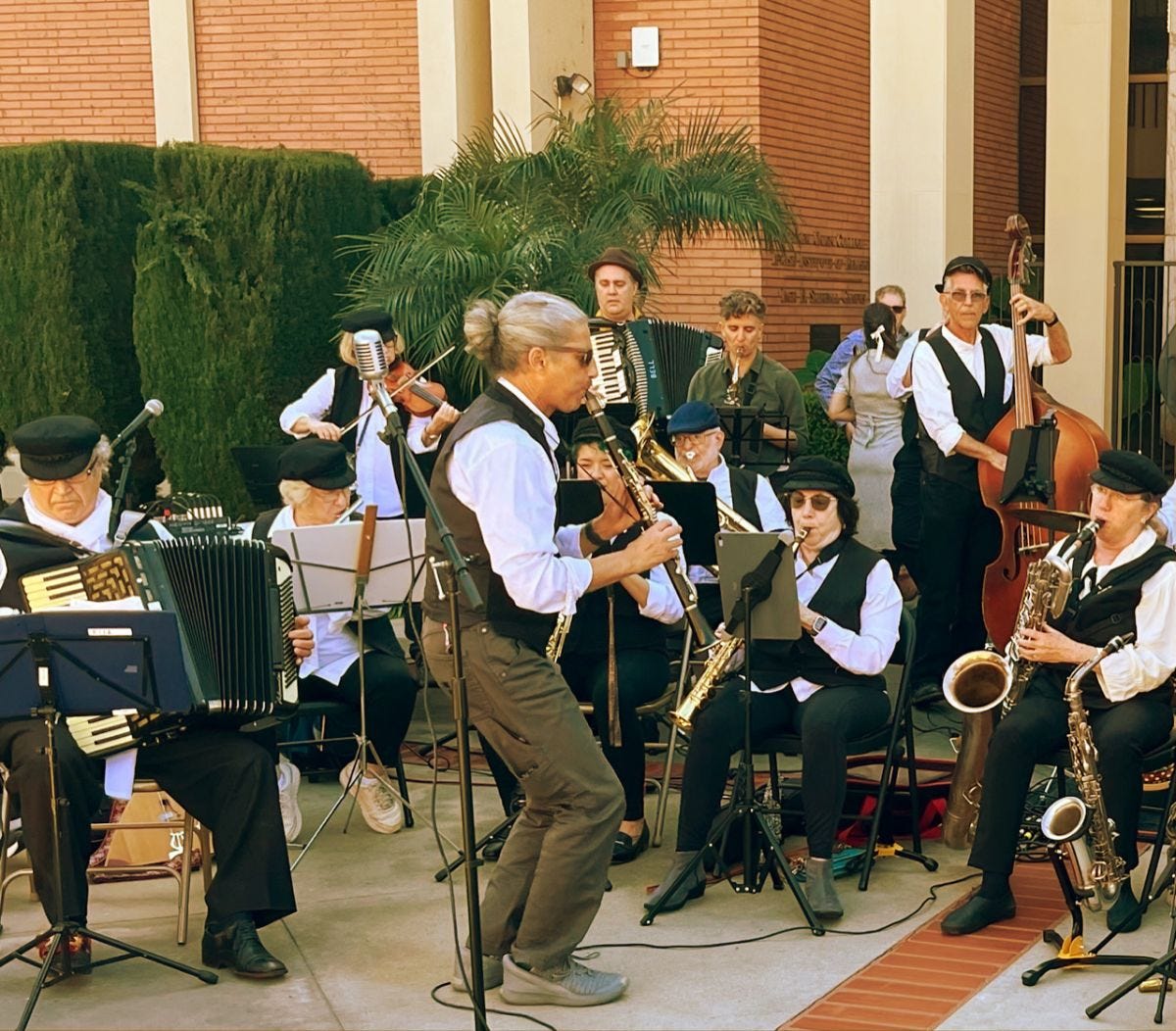
Led by the soulful clarinet playing of Gustavo Bulgach, Kaila (Klezmer Arts Institute of Los Angeles), a klezmer orchestra of around 20 players, including saxophonist Karen Golden, engaged the audience with several lively numbers.
Between songs , Bulgach, looking to pick up the beat, exhorted the audience to “get up and dance.” Mindful of the coming holiday, he explained that “There’s nothing like losing a few pounds before Thanksgiving.”
Lisa Fishman, who performed a Yiddish interpretation of Bob Dylan’s “Blowing in the Wind,” as well as singing a few numbers with Nicholas Hylander,
Other scheduled performers included, Janice Mautner Markham, violinist and co-founder of Mostly Kosher, Cindy Paley, performer, educator and recording artist, Dan Cantrell, Emmy award winning composer and multi-instrumentalist, klezmer group Shiri and the Shiribims, Justin (Moyshe-Tsodek) Goldner, composer, producer, and musical interpreter of Yiddish poetry, and Chloe Shekinah Resler, a multi-instrumentalist, vocalist, and music researcher.
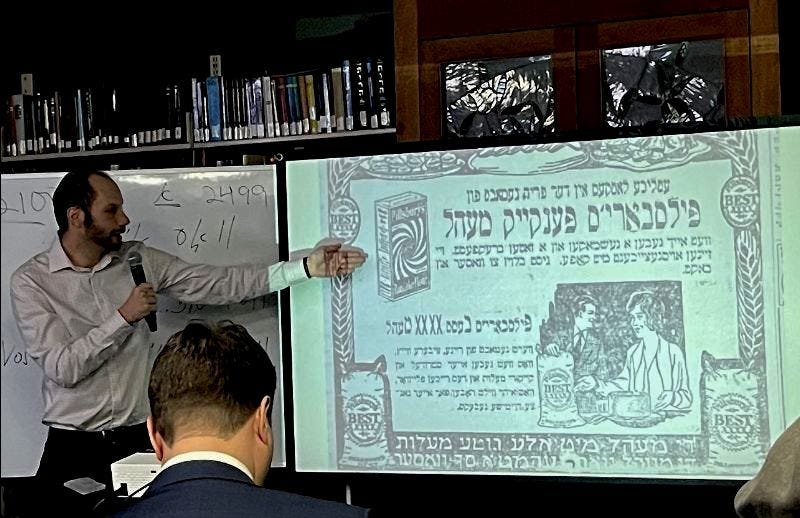
A Yiddish newspaper ad for Pillsbury pancake mix.
Michael Morgenstern, public-programs manager at the Holocaust Museum LA, explored some of the history of the Yiddish press by examining examples taken from columns and advertising that ran in Forverts, known later as the Forward.
Begun by Abe Kahan in 1897, by the 1920s, said Morgenstern, the paper had grown to the “largest Jewish paper in the world.”
He noted that during the early 20th century, when European and Russian Jews were immigrating to America in great numbers, one column in the paper assisted wives, who had been left behind, to locate their missing husbands.
After WWII and the Holocaust, another column as well as personal ads, helped Jews from all over the world locate missing relatives.
A session by Caroline Luce, a historian and professor who teaches at UCLA, presented an almost-forgotten chapter of LA’s Yiddish history. Drawing from her forthcoming book “Yiddish in the Land of Sunshine,” Luce explored the work of radical Jewish woman through the Yiddish poems of LA resident Shifre Weiss.
Other presenters included educator Miri Koral, professor of contemporary Jewish studies Sarah Bunin Benor, Ruth Judkowitz, Harriet Bennish, Malke Morrell, translator Mindy Liberman, Seth (Shloyme) Weisberg, Rebekka Helford, and Zach Golden.
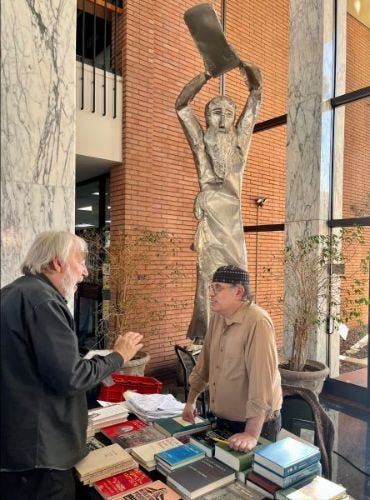
Kenneth Turan, former film critic of the LA Times stopped by Henry Hollander’s book table for a chat.
Bringing the city’s Yiddishists together, who often tread very different creative paths, was a multi-year project.
There had not been a community-organized Yiddish event in Southern California for nearly a decade, and several partners including, Kultur Mercado, Holocaust Museum LA, Der Nister, HUC–Jewish Language Project, the Southern California Arbeter Ring Educational Center, the California Institute for Yiddish Culture and Language (CIYCL), Sholem Community, and Yiddishkayt, needed to have a cultural farbrengen to create and organize the event.
According to Rabbi Henry Hollander of Der Nister, the event came about through the multi-year effort by Kultur Mercado director Aaron Castillo-White.
Adding to that effort was the recent outreach to LA’s Yiddish performance, and cultural communities by both Hollander and Der Nister co-founder Rabbi Zach Golden, as well as many others.
“We got a lot of buy-in right away,” said Hollander. “We knew people who were interested in doing things.”
As for the level of acceptance by the community, by the afternoon “275 people had checked in to the event,” said Castillo-White. “We’re seeing a younger generation coming to Yiddish,” he noted.
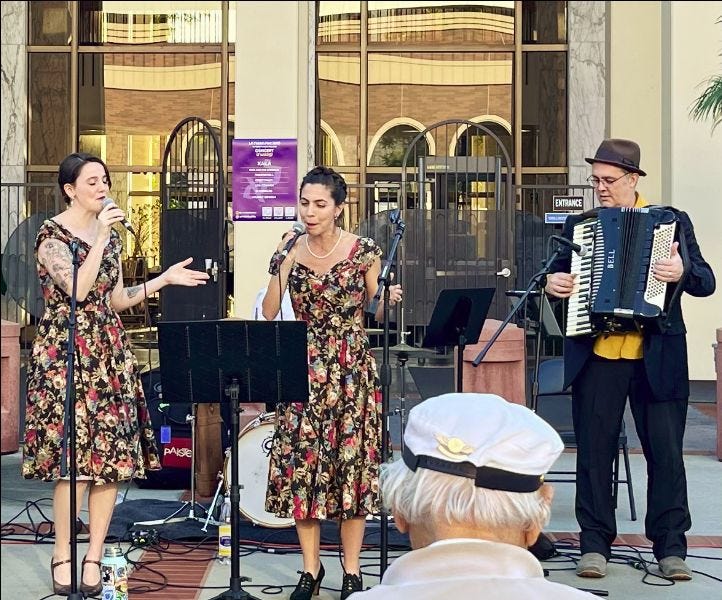
On a gorgeous, sunny LA afternoon, Ilana Zackon and Chloe Shekinah Resler, lead vocalists of Di Svingers, inspired by the Yiddish Swing Movement of the 1930s and 1940s, performed several numbers, including a Yiddish song about Catalina Island.
The catchy melody brought smiles to many in the audience, and like the balance of the day’s presentations and performances, worked to generate a new wave of enthusiasm for Yiddish in LA.
////\/\\\\
////\/\\\\
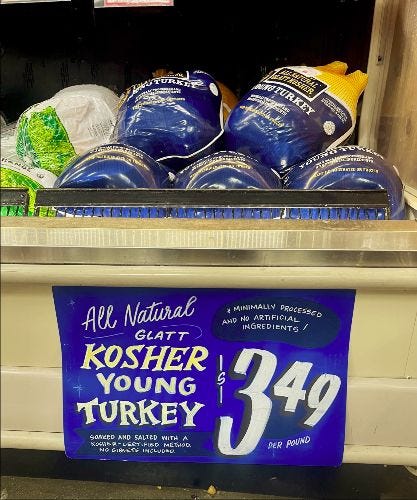
If a low price on a kosher turkey is one of the things you hope to give thanks for this Thanksgiving, then a trip to Trader Joe’s is in order. Once again, TJ’s with a price $3.49 lb. for a whole kosher turkey came in as the lowest price in the LA area.
In fact, TJ’s price for a whole kosher bird is the same as it was in 2023. For a significantly lower TJ price, one needs to look back to the olden days of 2018, before the price hikes of the pandemic and inflation, when Trader Joe’s whole turkeys were priced at $2.99 lb.
In comparison, around town the week before Thanksgiving, whole turkey prices were $4.99 lb. at Western Kosher, and at Koshco, $5.79 lb. at Cambridge Farms, and $6.99 lb. at Beverly Hills Kosher Meats.
Nationally, data from the USDA showed the price for a kosher bird averaged $4.99 with only 18 retailers reporting.
Trader Joe’s holiday birds are not frozen, and are raised in large, open-air grow houses in the U.S. They are considered “All Natural,” since they are “vegetarian fed, given no antibiotics or hormones, and minimally processed,” said the company’s website. Each is soaked and salted with a kosher-certified method, saving on the prep step of brining.
////\/\\\\
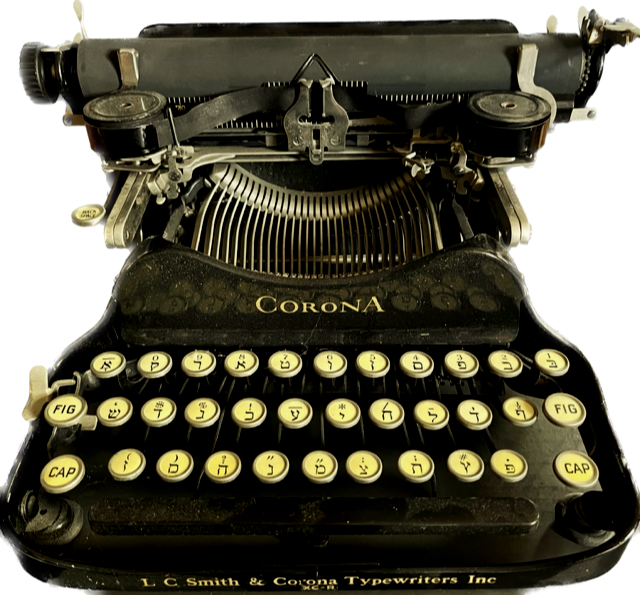
In the late 1920s, generations before the home computer, if you needed to type a letter or poem, or righteous rant in Yiddish, the L C Smith Corona XC-R was the typewriter for you. Small, portable, and able to type in Yiddish or Hebrew, the model featured a fold up carriage, relative light weight, and came in a compact storage case.
The typewriter shown above was found in a yard sale in Midcity. The design’s serial number indicates it was made in 1929, placing its manufacture in the heyday of the Yiddish typewriter; the years between 1910 and 1940.
The typewriter is in working condition, all keys strike cleanly, and the margin bell makes a very nice ding.
Not surprisingly, the period corresponds to a wave of immigration to the US, and Los Angeles, of Yiddish-speaking Jews from eastern Europe.
Designed with a reverse carriage (Yiddish and Hebrew are written and read from right to left), the Smith Corona had a keyboard modified with Hebrew characters.
For typing Yiddish, the keyboard included the Hebrew letter aleph with a kometz underneath אָ , for typing a “u” sound in some Yiddish dialects and an “o” sound in others.
Important in typing Yiddish, the keyboard was also designed to include the letter pey (p) פּ with a dot distinguishing it from the same shaped letter fey (f) פ which is dot-less.
The keyboard also includes a beit (b) with a בּ a dot and, a veit (v) ב which has no dot.
The dots support the standard orthographic need in Yiddish to consistently differentiate between the two sounds.
*The Rodman Archive of Los Angeles Jewish History is a collection of approximately 2000 objects, photos, clothing, art, books, recordings, and ephemera relating to the lives and endeavors of Jewish Angelenos between 1850 and 1980.
////\/\\\\
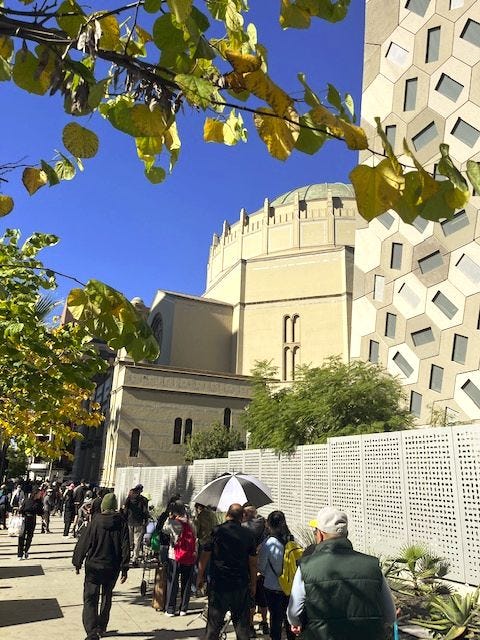
In 2025, when people lined up in front of an American synagogue, it was to safe to assume a protest was brewing. At Wilshire Boulevard Temple on the Sunday morning before Thanksgiving, that was not the case.
Around 11 a.m., hundreds of people, of many ages and ethnic backgrounds stood patiently in a line that went more than half way around the block-long temple, waiting to receive free Thanksgiving meal kits.
Called the Big Give, the food give-away program of 1,000 kits was run by the Karsh Social Service Center of the historic temple.
Not all kits were the same. Each could be “personalized,” allowing a guest to choose “their preferred food items,” those “best suited to their family’s needs and tastes,” said the temple’s website.
Emphasizing this aspect of the program, the day of the event, staff members wore a t-shirt that read “Gravy & Sazón & Curry & Turkey & Veggies & Pie & Community,” indicating the range and hoped for result of the program.
One of those in line was Charles, a fully-employed office worker in his late 20s, who had found out about the program while picking up food at Karsh the week before.
“I work for a living and because of the high cost of living I have to do this every Sunday to supplement my food. Either that, or get a second job, and I already work full time,” he said.
“The rich are getting richer, and us working people are barely getting by. Times are really hard, and I am grateful to the Karsh Center for what they do,” he added.
Supported by donations and the work of volunteers, as well as professional staff, Karsh in the 18th year of the Big Give program, expressed an urgent call for help this year.
“The uncertainty around essential government programs caused by the shutdown creates an urgent need for emergency support of Karsh’s comprehensive programs,” said their website.
////\/\\\\
Comments
Nothing yet. Say the first thing.
Sign in to join the conversation.