
A New Scroll of LA Jewish News
Folks,
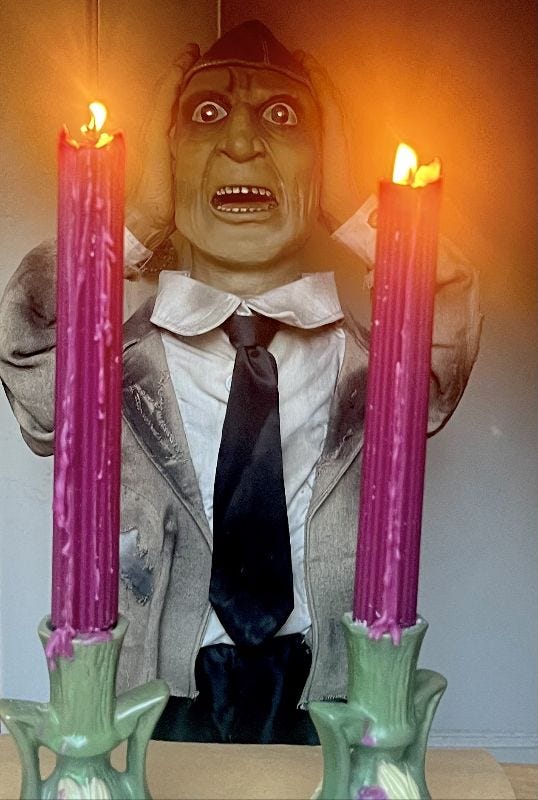
Nothing brings out a good geschrei like Halloween on Shabbat, and this year, the soul-rending shriek is particularly loud. After Gaza, after Epstein, the masks have come off, revealing the antisemitic culture on our college campuses, in our cultural institutions, and progressive organizations. Having grown up in conservative Orange County, I know that antisemitism has always been covered by the thinnest of masks by many on the Right. At a PTA meeting, someone once demanded that my Bronx-born mother show her papers. Today, that mask has come off too with the president declaring some of us “good Jews,” and some of us “bad Jews.” On the Right, examples of “Nazi” misspeaks, and positive “Hitler,” references regularly appear on social media. It is all frightening, and hard to take. For decades, American Jews have dropped their melting pot costumes, and let their Jewishness show, and now many are wondering if it’s time to return to wearing cultural camouflage. To stop publicly wearing kippas. To take down the mezuzah by their door. To keep quiet when someone is calling Jews “colonizers,” or perpetrators of “Genocide.” Or, ignore Jewish students being discriminated against because of their support of Israel. Almost from LA’s earliest years, Jews have given much to make the words “I love LA” ring true, including writing the song. We have helped to create educational and economic opportunities, worked for social justice, made art and music and contributed to a sense of what it means to live here. Mostly, its been treats, and very few tricks. To counter much in the negative headlines, we need to remind our neighbors of this too.
…Let me also remind you to become a paid subscriber. I need your support to continue publishing MegilLA for another year. If you read regularly, or resend to friends, please support with your dollars this kind of creative, committed Jewish Journalism. I need you to pitch in.
Shabbat shalom.
Edmon J. Rodman
////\/\\\\
////\/\\\\
Edmon J. Rodman
Every Halloween, since the fake headstone became a common staple of October 31 front lawn décor, I have searched in vain for a Jewish version. It’s not that I want to buy one, but more of an annual check on how the American market perceives what Jews are ready and willing to buy.
This year, since Halloween falls on Shabbat, I looked with particular interest.
Currently for sale are Christmas tree toppers shaped like Stars of David, kippot and tallitot for a dog’s bark mitzvah, and a World War II Evacuee Girl Costume which looks identical to an Anne Frank Halloween that was written-up in a 2017 Time magazine article.
If you haven’t seen a Halloween graveyard on a neighbor’s lawn, they are often the final resting place of some truly awful humor. Disturbing the dead of night, the foam tombstones are engraved with such non mots as “Rest in Peace Ima Ghost,” “Dee Capitated…Finally, She’s Ahead,” and R.I.P. Colin Sick.”
So, I wondered, why not a Hebrew headstone? Surely, in today’s atmosphere where Jews are accused of genocide and starvation in Gaza, and generally held responsible for all the world’s ills, even by some Jews, there could be space for some relatively mild Jewish-themed prop tombstones.
You would think that a headstone inscribed with something like “Here Lies Cohen With Most of His Colon,” or, “Poor Levi, His Jeans Lasted Longer,” would be slithering off the shelves at Spirit Halloween.
Why not?
Even in this anti-Jewish marketplace (some would say “antisemitic”) the producers and marketers may be worried about blowback, as a Nazi death camp costume received a few years ago.
Or, as I suspect, many Jewish consumers are just not interested, and even less enthusiastic about seeing a Jewish graveyard on their neighbor’s front lawn.
Could it be that the over $11 billion Halloween industry has come to fill our eyes with too much death?
Jewish eyes, this year in particular, filled with returned dead Israeli hostages, and the human and physical destruction in Gaza, have seen enough of the dead.
The Season of Our Joy, Sukkot, is not that far behind us when the death imagery begins. Only a few weeks have passed since we invited into our temporary shelters the ushpizin, the spiritual guests like King David and Queen Esther, when Fredy Krueger, Chucky, Pennywise, and too many grim reapers come knocking.
Yet, not all objects made for this time of year, are out of the realm of Jewish sensibilities, or observance.
Surprisingly, adding a little light to the web of October gloom is Día de los Muertos, Day of the Dead. On November 1-2, in homes in Mexico, and LA, the holiday is observed by family and friends gathering to honor and remember those close to them who have died.
During the weeks leading up to the holiday, shops, restaurants, and public spaces fill with vibrantly colorful takes on human skulls. Part of the observance is the building, or composing of ofrendas, or home altars to honor the dead, and the skeletal imagery often figures prominently in them.
Though intended as a joyful reminder of the vibrancy of human life, I sometimes find all the orbital cavities staring back at me too much to take; even a reminder of my own future in the boneyard.
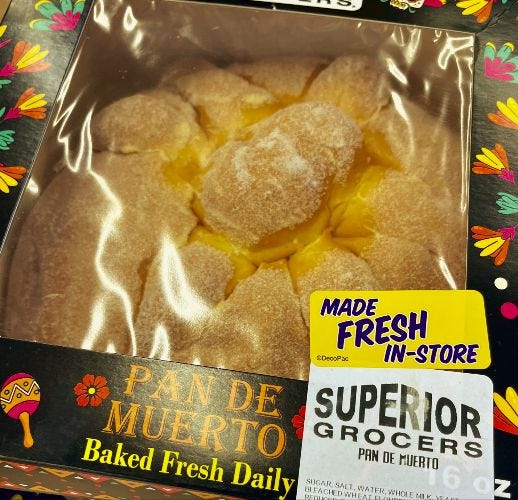
However, within the observance of Día de los Muertos, I have noticed reminders of Shabbat observance and joy too. Candles are a part of the ofrendas, and pan de muerto, bread of the dead, which is placed in the ofrendas, and also eaten, looks a lot like round challah.
Vibrant and strong-scented marigolds, are often placed in the ofrenda as well, and are seen as a guide for departing souls seeking a way back to their family. Flowers, an important part of Shabbat, can represent our way back to beauty and joy.
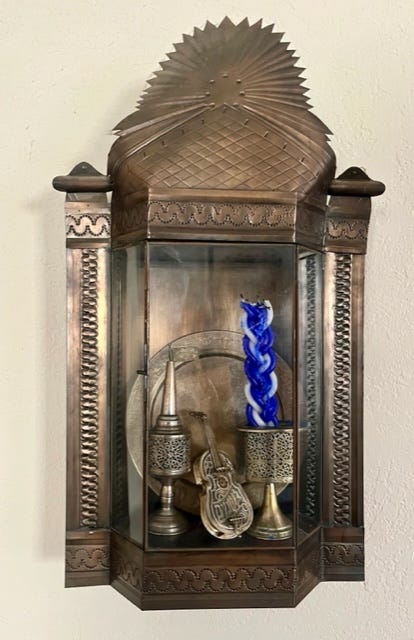
With these connections in mind, my wife and I have adopted an object from the observance of Day of the Dead to our own ethnic needs. Hanging in our living room is a hand-hammered metal ofrenda box, that we use to keep our Jewish ritual objects for the observance of Havdalah: a spice box, wine cup, and candle holder.
Both The Day of the Dead and Havdalah mark and honor important passages, and distinctions. Each involves the kindling of light, the taste of wine, and the sweet smells of life.
////\/\\\\
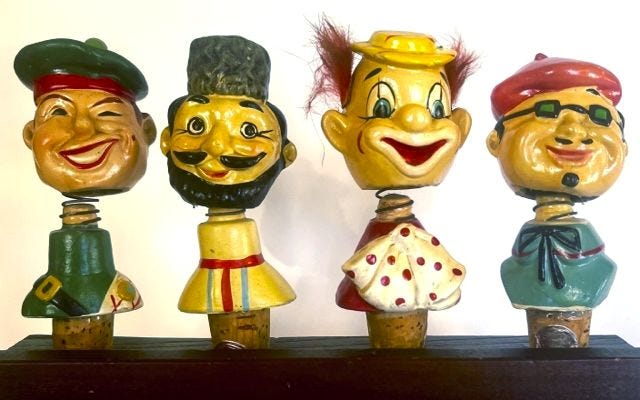
These four mid-1960s caricature ceramic bobblehead bottle stoppers, as fanciful, and odd as any costume you might conjure up for Halloween, were marketed by a ceramics company in Los Angeles called Rubens Originals.
Reuben Steinman, the owner of the company, who opened the business in the mid-1950s, saw the economic and style advantages of sourcing his products in Japan, including the bottle stopper.
Steinman and his wife Charlotte traveled to Japan several times a year, resulting in several lines of fanciful ceramic vases and planters, some which he and his wife designed.
Seeking the imaginative, on one of those trips in the early 1960s, he sourced a line of ceramic bobblehead bottle stoppers including those in the above photo: a clown, a beatnik, a winking Irishman, and a Cossack, as well as several other slightly bizarre designs.
As you raise a bottle corked by one of the figures, it nods its wholehearted approval.
From where did this originality spring?
Reuben Steinman was born into a Jewish family in Montreal Canada in 1914.
At age 11 (around 1925), he and his family moved to Los Angeles, where his father Israel Steinman entered the bag business by starting U.S. Bag and Supply Company..
In 1936, Reuben married Charlotte Levin at Temple Sinai (then located at 4th Street and New Hampshire Avenue). The couple had three children.
Having joined his father’s business, in 1948, by 1950 the US census shows that he was VP of the company.
In 1948, Reuben volunteered to help raise funds the UJWF (United Jewish Welfare Fund), serving in the bags and burlap division.
Reuben Steinman died in Los Angeles in 2002, survived by his wife and children. According to the obituary in the LA Times “Work was an important metaphor during his life.”
Today, several companies are in the business of producing custom bobblehead bottle stoppers, while the originals remain in demand on eBay.
*The Rodman Archive of Los Angeles Jewish History is a collection of approximately 2000 objects, photos, clothing, art, books, recordings, and ephemera relating to the lives and endeavors of Jewish Angelenos between 1850 and 1980.
////\/\\\\
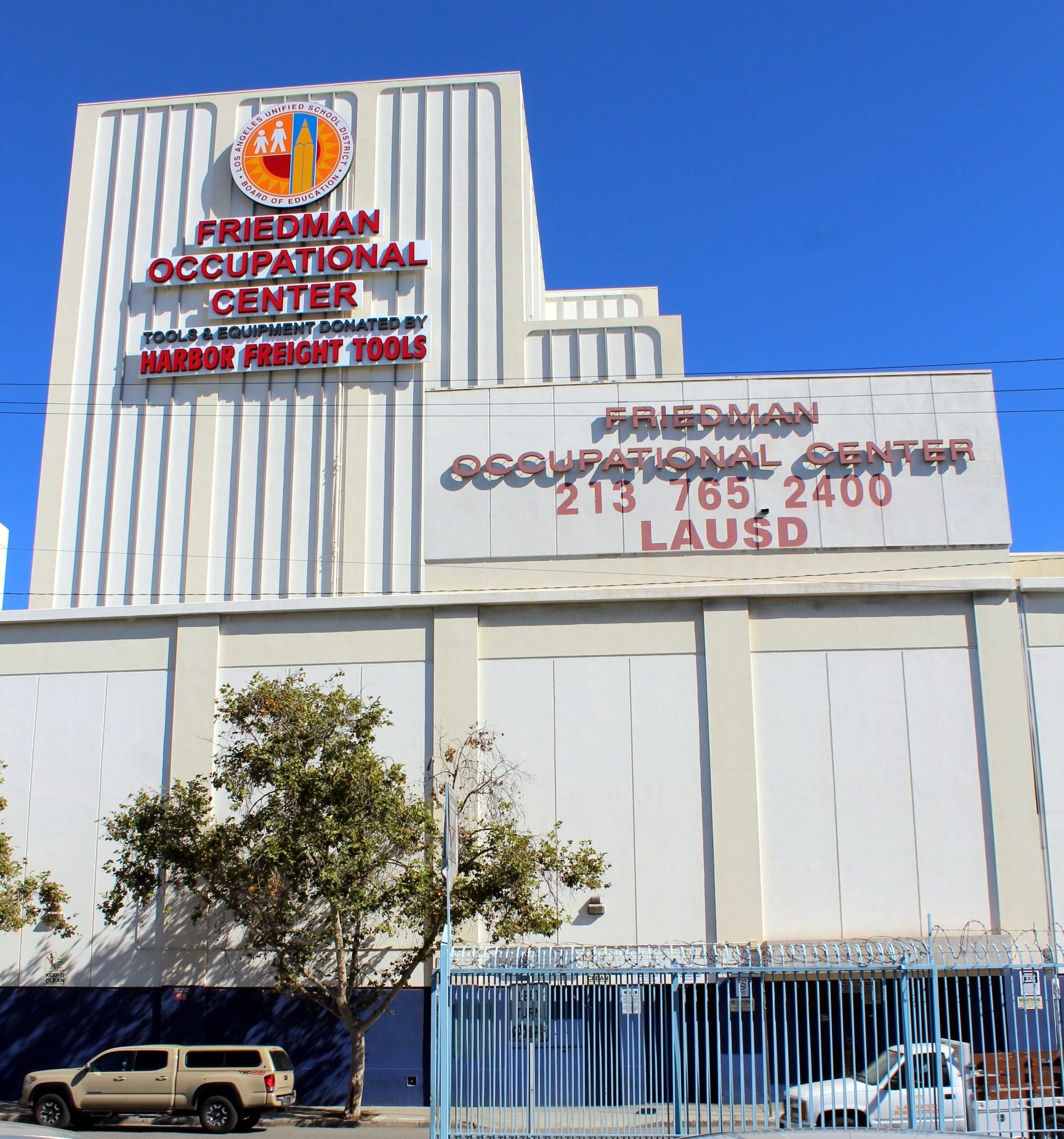
“Go Forth from your native land,” the verse that begins this week’s Torah portion “Lech-L’cha,” marks not only the beginning of our ancestor’s perilous path to a better life, but that of so many of our threatened immigrant neighbors. When God tells Abram to leave his father’s house “to the land that I will show you,” an epic journey begins that expands his world and wealth, and increases awareness in the world about God. “I will make of you a great nation” God says to Abram, “I will make your name great.” In those promises, and the actions they set in motion, begins the story of the Jewish people. It is also the story of many of our neighbors who now are being brutally taken from the community. They too have been told by a voice, whose genesis may be a sense of survival, to leave their native lands. After arriving in LA, contrary to the president’s belief, most want to better themselves. Fortunately, there is a place they can go to make their names if not great, then at least better. Named the Abram Friedman Occupational Center, after a dedicated LAUSD educator and administrator who was Jewish, it is a key site of LAUSD’s Division of Adult Education schools. Located on Olive Street and Venice Boulevard, you may have seen the school’s 10-story, nearly windowless tower from the 10 Freeway and wondered what it was. A hospital? A jail? With ESL classes, a high school diploma program, along with a full complement of vocational training classes, the school is the place of choice for many immigrants, and others, who, like Abram, heard a voice telling them to go forth on a journey of self-improvement.
////\/\\\\
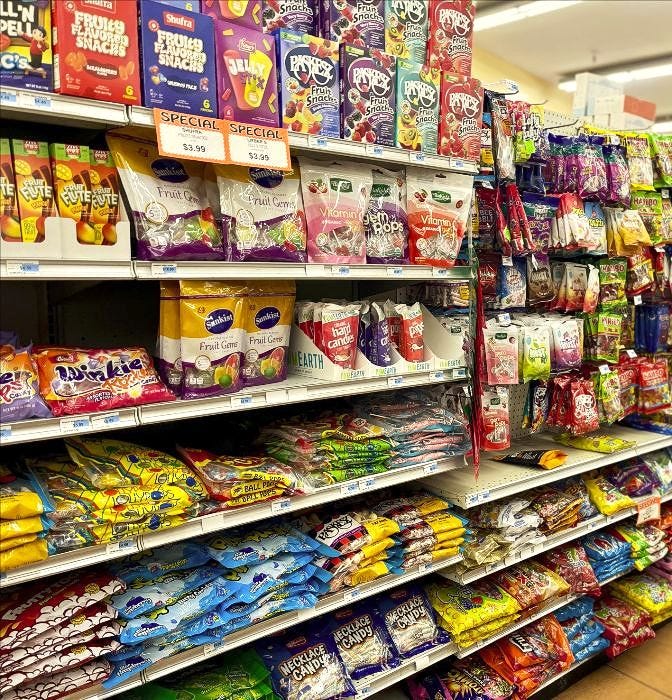
The Week before Halloween, the shelves of Cambridge Farms kosher food market were well-stocked with all kinds of sweet treats: candy necklaces and bracelets, gummies, chews, ropes, pops, and bubble gum. Many were made by Jewish-owned companies, and those produced by the Paskesz have a backstory that begins in early 20th century Hungary. In Mako, Anshel Pazkesz opened a store that sold hard candies and citrus fruit. His son Lazar continued in the food business, specializing in candy and chocolates. Then came the horror of the Holocaust. and the murder of most of Lazar’s family. Lazar survived, and after the war, he remarried and rebuilt his business by selling chocolate. In 1954, he immigrated to New York, where he persuaded a cookie manufacturer to bake kosher cookies. In the 1960s, to produce a line of kosher chewing gum, Paskesz traveled to Denmark by ship to find a gum manufacturer. He returned three weeks later with a sample of a kosher gold gum coin. Today, the fourth generation is preparing to continue the work of creating all that kosher sweetness.
////\/\\\\
Comments
Nothing yet. Say the first thing.
Sign in to join the conversation.