
The following article contains some niche drama, interviews, and investigating which I realize might not be interesting to all my readers.
If you don’t want to read what I have to say (or even if you do, and you want to read other stuff, too,) here are a few other interesting things I’ve read lately:
Should Anna Delvey be allowed to edit her own Wikipedia page?1
Wikimedia Will Not Voluntarily Recognize Union a Supermajority of Its Workers Want
I’ll probably be writing more about the above topics, but for now I wanted to make sure that I was properly serving my readers by getting them on your radar.3
And yes, I am continuing to document my attempts to manipulate AI into saying James Bond is a codename on my teeny little YouTube channel.
Now, here’s the article you’re here to read:
On 12 April 2026, the Wikipedia article entitled Barry Schwartz (technologist) was deleted from Wikipedia, after nearly 20 years of existence. It has been over three months since this event occurred and I have not stopped thinking about it.
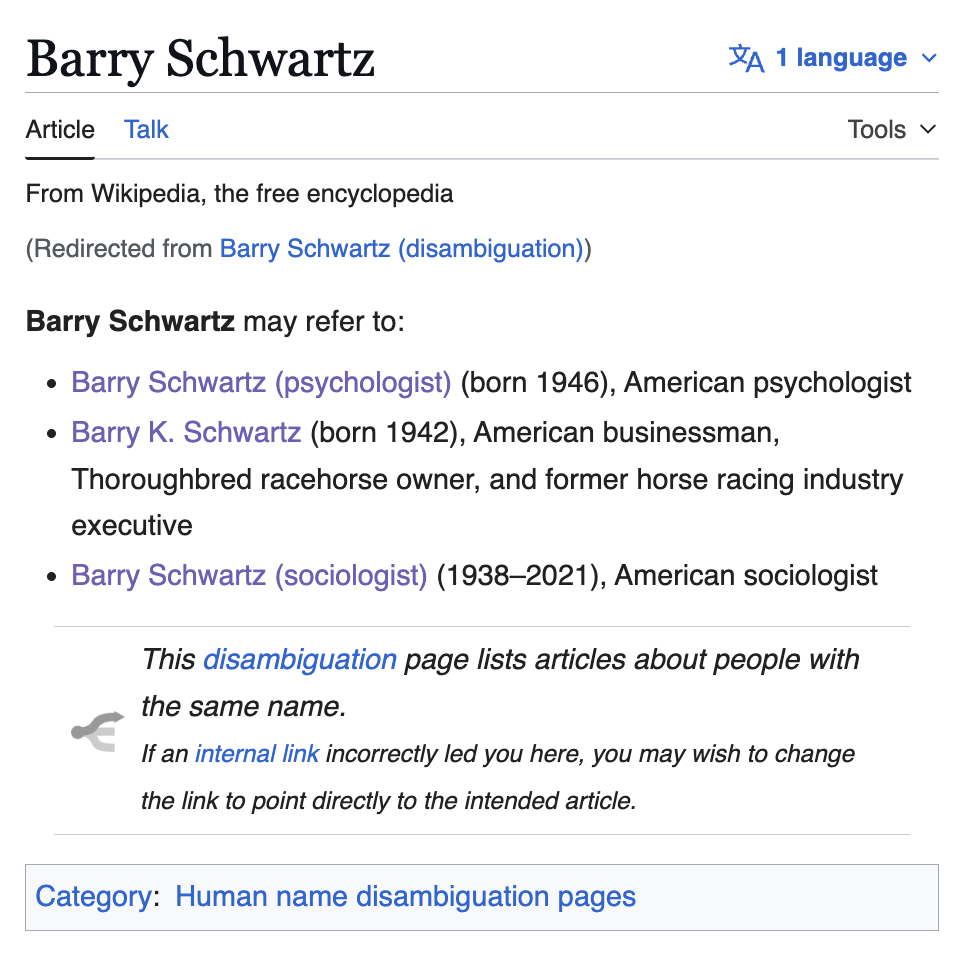
Most ordinary people do not know or care about Barry Schwartz’s Wikipedia article. You know (and possibly care) about Barry Schwartz’s Wikipedia article if:
You are in the SEO industry, in which case you likely heard about it through social media and your personal networks.
You pay close attention to Articles for Deletion (AfD) discussions.4
You read Edit History and you recall when I published “The animosity between SEO and Wikipedia escalates.”
At the end of said post, I wrote:
Note that I have put the word out there on Reddit and LinkedIn that I’m interested in talking to anyone who was involved in this deletion discussion. Consider this to be me doubling down on that. I am ready to write a part 2 of reactions to what I’ve included in here.
So that’s where we are now. This is “The animosity between SEO and Wikipedia escalates: Part 2.”
But if you didn’t read my previous article on it and you don’t want to read it now, let me sum up what you’ve missed:
In 2007, the article “Barry Schwartz (technologist)” was created on Wikipedia. It was nominated for deletion in 2007 and 2011 and survived both times.
It was nominated for deletion for a third time on 28 March 2026. This time, it did not survive, succumbing to deletion on 12 April 2026.
A backlash broke out in the SEO corners of the internet, particularly LinkedIn and the Social Media Platform Formerly Known as Twitter. Many takes were had on websites for and adjacent to the SEO industry.
Jump forward three months and the hubbub has (mostly) settled down. But I haven’t stopped thinking about it, in part because I think there are a lot of lingering questions. Within the last ninety days or so5, I’ve found myself having conversations with various people across both the Wikipedia world and the SEO world about what exactly happened, and why, and how this situation relates to the overall dynamic between the SEO world and the Wikipedia world.
In particular, I’ve been trying to seek either affirmation or rebuttal for my theory on the matter. I previously argued that Barry Schwartz’s article was deleted as the result of a long-standing animosity against the SEO industry amongst Wikipedia editors, owing from years of bad actors doing bad edits on Wikipedia in the name of SEO.
The question is, was I right?
And to answer this, I wanted to get the points of view of those people who might be able to help me understand. In particular, editors who participated in the AfD and any other editors or Wikipedia buffs who I know. Plus people in the SEO industry who feel particularly aggrieved or befuddled by this situation.
People I spoke to for this include:
Moneytrees, an admin who focuses on addressing some of the specific issues within Wikipedia that the SEO industry may be guilty of
Hemiauchenia, an editor who participated in the AfD discussion for Barry Schwartz
Michael Martinez, an SEO strategist and former Wikipedia editor
Eric Barbour, a longtime Wikipedia critic
Smallbones, a Wikipedia editor who also edits The Signpost, Wikipedia’s online newspaper
The man himself: Barry Schwartz
There were many others I reached out to and either did not hear back from or who declined to speak to me. That list includes Gråbergs Gråa Sång (who very politely declined) and BookishReader, the editor who originally nominated “Barry Schwartz (technologist)” for deletion. 6
I have variously referred to this as hubbub or backlash or even drama, and I think it’s important to give some examples of the reactions. One thing is true: if the SEO industry didn’t previously feel animosity toward Wikipedia, it sure does now.
While I discussed these reactions in my first article on this, I largely focused on the AfD discussion itself.
Here are some of the articles written in the SEO world, responding to the deletion of Schwartz’s article:
Prominent SEO Journalist Barry Schwartz’s Wikipedia Page Removed
Wikipedia Deletes World-Famous SEO From Site: An Ode To Barry
Wikipedia SEO Authority Shift: Barry Schwartz’s Page Deletion Impact.
Here is longtime SEOer Glenn Gabe’s take on it, shared on LinkedIn:
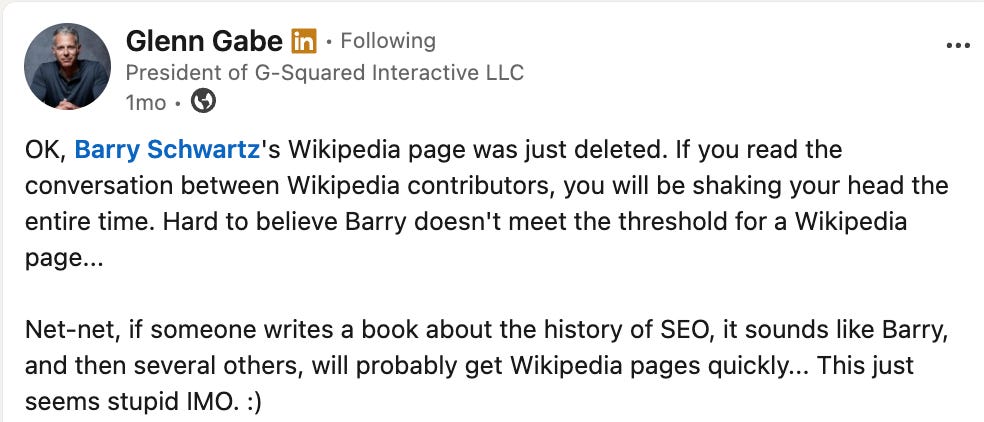
While I was initially tempted to go deeper into the SEO industry’s reaction, I realized that’s not the interesting part at this point (and I largely covered it last time.) I’m more interested in my theory that this page’s deletion was a reaction to the behavior of the SEO industry.
I’m pleased to say that Schwartz responded relatively quickly when I reached out to him. We first began exchanging emails in April.
“I respect the decisions of the Wikipedia editors and trust they are doing what is best for the platform,” he told me via email. Like almost everyone I talk to about Wikipedia, Barry was polite and thoughtful throughout our exchanges.
However, he also isn’t the guy who can give me any real answers to the who or the why or the what. Barry Schwartz is not the person to confirm or deny whether or not Barry Schwartz’s article was deleted because he is part of the SEO world and SEOers are viewed by Wikipedia editors as a pack of vandals and scammers.
Realistically, it’s unfair to ask Schwartz why this happened. He seems as confused as anyone. It’s possible he’s little more than collateral damage in a larger story.
So, let’s turn to that larger story. The big question:
Shortly before publishing “The animosity between SEO and Wikipedia escalates,” I heard from Wikipedia editor Hemiauchenia. I had been posting on LinkedIn and in various subreddits looking for anyone who might have participated in the (now archived) discussion “Articles for deletion/Barry Schwartz (technologist) (3rd nomination).”
I told them that I was:
curious if I’m accurately depiciting the reason for the SEO v. Wikipedia animosity and if that might’ve factored into the POV of any of the editors in the AfD.
Hemiauchenia’s response matches what I heard from a lot of people. Before I provide their actual words, I can sum it up with this: “Not really.”
Sure, Hemiauchenia did agree that “Wikipedians don’t like promotional editing, and people knowledgeable about SEO generally don’t really have much of a reason to write content about how SEO works on Wikipedia and more of a reason to spam.”
They added:
I think a similar antipathy exists to biographies of businesspeople and articles on companies for example because these topics are similarly subject to a lot of promotional editing, which is why NCORP is incredibly strict. I also think part of it is that most Wikipedians are just not very familiar with the subject or the prominent figures within the SEO world.
This point of view was reaffirmed by Moneytrees, a volunteer Wikipedia administrator. An admin, you may recall, has powers that ordinary editors do not.
I asked Moneytrees:
Do you think there is an actual animosity against the SEO industry on Wikipedia? Or is the animosity against all spammers and COI editors and SEO just happens to have a lot of those?
He responded that it’s “a mix, but mostly the second.” Which echoed with Hemiauchenia’s answer. Moneytrees went on:
I don’t think the animus is really that personal aside from a certain crowd of patrollers. I tend to work with more serious issues involving spam, undisclosed paid editing, conflict of interest issues etc, and I don’t think anyone in that space has a particular animosity for SEO stuff. When it’s come up in conversation, it’s usually about “black hat” websites often involved in spamming campaigns. Sometimes these places engage in extortion or are outright scams.
I’ll also note that I mentioned SEO strategist and Tolkien scholar Michael Martinez in my last article on this topic. He initially declined to talk to me about Wikipedia, before independently reading what I’d written on this topic and realized he was open to exchanging some thoughts with me. He told me he no longer edits Wikipedia, but does think the problem is much greater than animosity between non-SEO and SEO contributors. He suggested the eventuality that SEO might be best served on a microwiki, as happens with many fandoms. (Remember, he’s a Tolkien scholar.)
Meanwhile, I got a slightly different point-of-view from Smallbones, former Editor-in-Chief of Wikipedia’s newspaper The Signpost and current writer of The Disinformation Report in The Signpost. I’ve been in touch with Smallbones since early 2025 and I was already familiar with his frustration with all forms of undeclared paid editing.
I wasn’t surprised, then, when he said:
Though there may be a few exceptions, when an SEO firm operates on Wikipedia they are bludgeoning the system. They try to hide or otherwise manipulate information, or put their own spin on it. They are not trying to build a neutral encyclopedia. They are first, last and always working for their employer’s interest and against neutrality. That’s the whole point of their business.
While Smallbones and I had never spoken about the SEO industry before this email exchange, it was more-or-less the POV I expected him to have. And the POV that it seems many editors have: The SEO industry is a scourge on Wikipedia.
Which is why I now need to remind myself of something I’ve said before: Wikipedia is not a monolith. My previous headline on this topic, in which I positioned Wikipedia and the SEO industry against each other as if they are bitter rivals, is not a good headline. The conclusion I reached was too reductive. I’d fallen into a pattern of thinking that I often criticize in others.
Which is why I realized—right now, while writing this—that maybe I still hadn’t answered the question. Who deleted Barry Schwartz’s Wikipedia article? and why?
As mentioned above, editor Hemiauchenia and I exchanged a series of emails about the deletion of the Barry Schwartz article and what might have caused it. After suggesting that I was being myopic in my analysis, Hemiauchenia offered some more considerations.
“I think it hinges a lot on how Wikipedia assesses “notability” to begin with,” Hemiauchenia told me. “I think the article would have been kept if there were clear WP:GNG passing sources that discussed Schwartz’s career in significant detail, even if Wikipedia editors have antipathy towards the concept of SEO and its practitioners.”
A few other things Hemiauchenia said that stuck with me:
“The number of participants in the deletion discussion was pretty low (as typical of AfDs) and I think the article could have been kept if the dice was rolled again and different people had participated.”
“Schwartz’s external posts regarding the AfD on LinkedIn, Twitter, etc could reasonably be construed as canvassing in an attempt to get the article kept, and left a bad taste in people’s mouths.”7
“SEO is quite a niche subject, such that anyone notable within it is sort of like being microcelebrity like an influencer or YouTuber is.”
“…and there’s arguably a similar antipathy within Wikipedia towards biographies of YouTubers and related phenomena.”
Regarding YouTube in particular, Hemiauchenia suggested I look into the case of Paul Harrell’s Wikipedia article and its eventual deletion.
I hadn’t heard of Paul Harrell, but I learned (from a combination of Hemiauchenia and my own research) that:
He was a veteran who ran a YouTube channel focused on guns.
He died of pancreatic cancer.
He announced his own death via YouTube, with a YouTube video titled “I’m Dead.”8 The video is still live, has 1.9 million likes and 25 million views.
The “I’m Dead” video was posted by his brother Roy, who survived him and continues to upload videos to the channel Harrell Brothers In Arms.
Harrell died on 3 September 2024. His article was created shortly thereafter, was nominated for deletion on 8 September 2024 and deleted on 14 September 2024.9
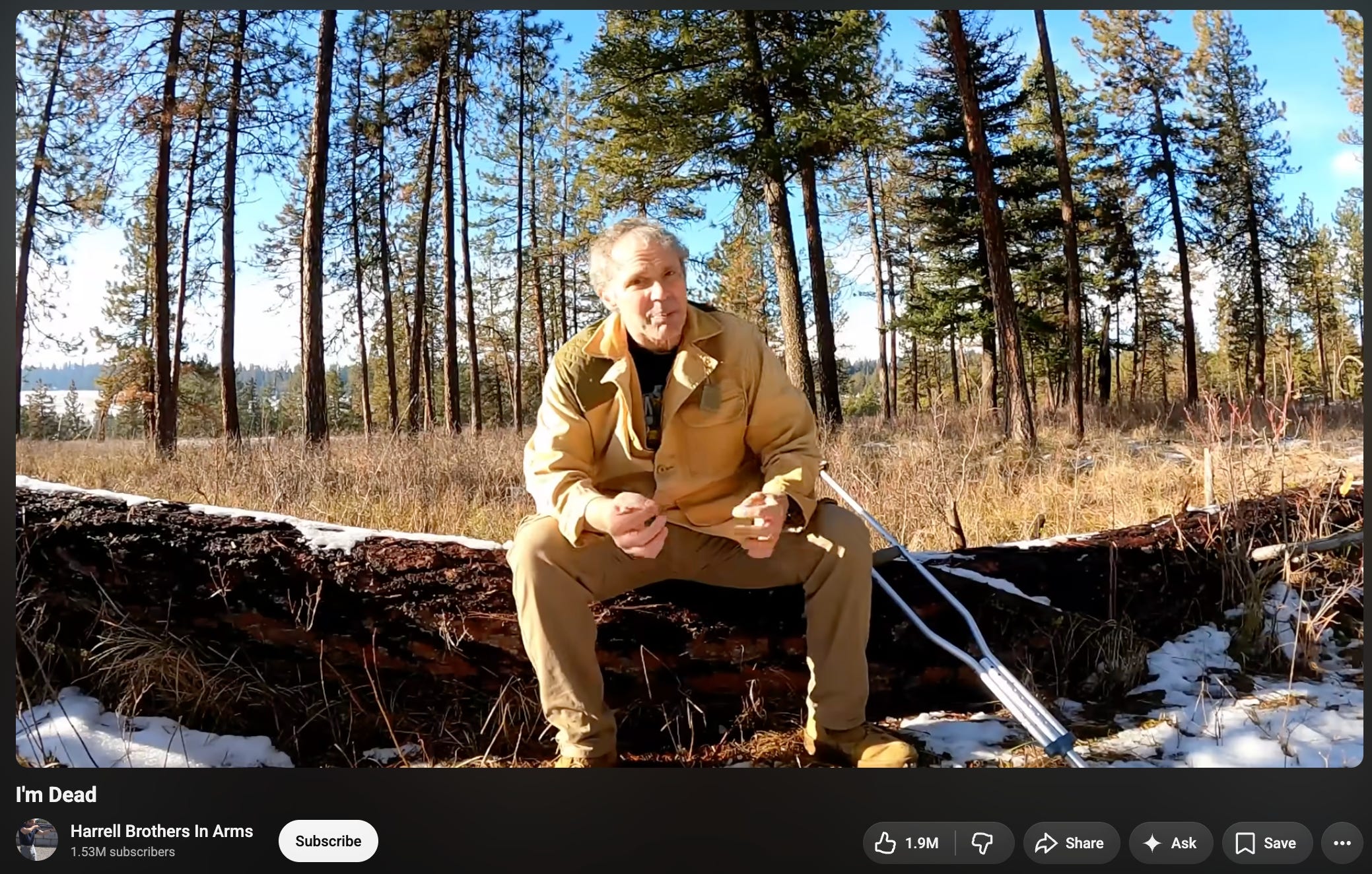
“The article was deleted because the coverage was only around his death and basically none before that,” Hemiauchenia told me. “Does that reflect an antipathy on behalf of Wikipedians towards YouTubers? I could see a compelling argument being made for that.”
This one struck a chord with me, as one of the first articles I ever made was for a YouTube channel. Ironically, it’s also an article I shouldn’t have made because of COI that I didn’t declare at the time.10
I learned during that process (years ago) that views and subscribers and content created by other YouTubers all have no bearing on whether or not a YouTube channel gets an article. It’s all about that press coverage.
“I think you can see how this is relevant to the Schwartz AfD,” Hemiauchenia said to me. “Does this mean that Wikipedia’s assessment of notability is too narrow? I think there’s reasonable disagreement than can be had on that.”
If you’ve been reading this looking forward to the big moment where I finally reach the person who has all the answers, I’ll let you know that I haven’t found it. Probably because it doesn’t exist. Wikipedia is a complicated place.
But I will share my final attempt to get a deeper answer. As mentioned above, I reached out to BookishReader, the editor who originally nominated Barry Schwartz (technologist) for deletion.
I often think about the ideas of deletionism and inclusionism, although I don’t think many other people give these opposing philosophies much thought.
My main evidence that no one much cares about deletionism v. inclusionism much anymore is that the Wikipedia article “Deletionism and inclusionism on Wikipedia” has been tagged in need of updating, while remaining largely un-updated, since 2022.
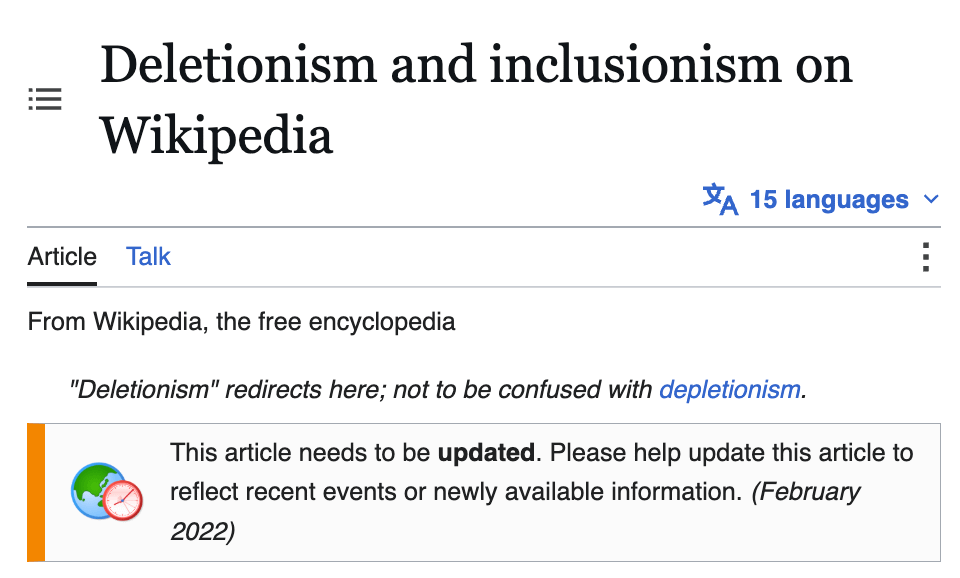
I’ve been thinking a lot about deletionism in the wake of Barry Schwartz’s deletion. I’ve wondered specifically if BookishReader, the editor who nominated Schwartz’s article for deletion, identifies as a deletionist. In fact, I asked BookishReader that question but did not receive an answer.
Here’s what I do know about said editor:
BookishReader is a Wikipedia editor who first started editing Wikipedia approximately three years and, as of this writing, is at 4,729 edits. There are a few things I find interesting about BookishReader:
One of their main activities on Wikipedia is nominating pages for deletion.
Many of their other edits involve creating redirects for non-notable pages that are better covered in other places.
Most, but not all, of their edits are related to the United Kingdom, cricket, Pakistan.
They have new page reviewer rights on the English Wikipedia.
They seem to be good at editing Wikipedia.
Most interesting (to me at least), BookishReader seems to only edit Wikipedia once or twice a month. It looks like they log in, make a flurry of edits lasting hours, and then log back out for another month or so.
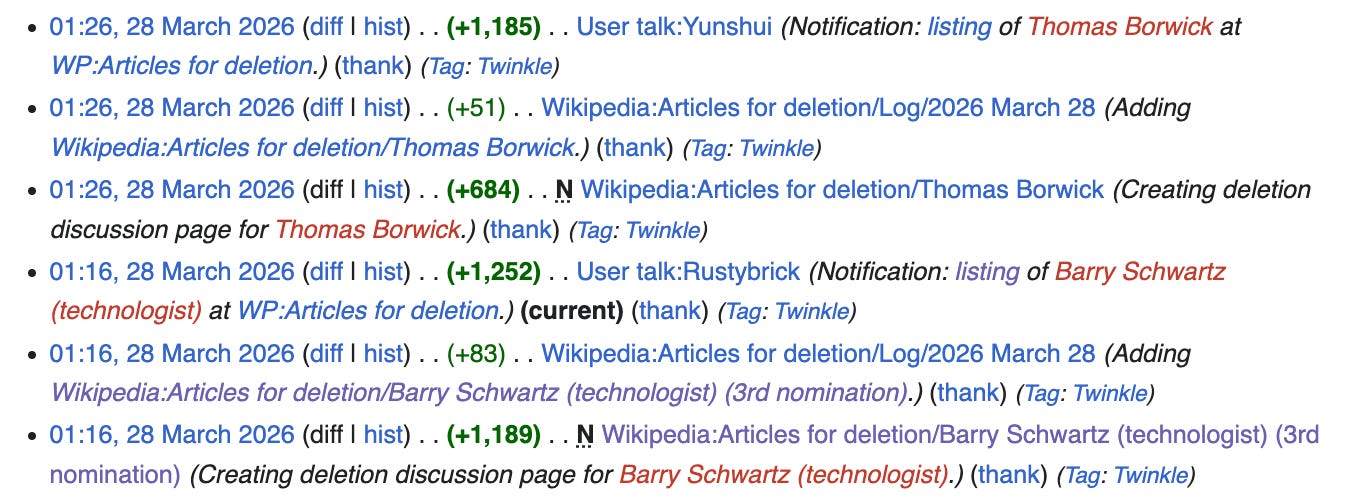
And while very few of their edits have been related to the SEO industry, their nomination for the deletion of Barry Schwartz’s article was paired with two other SEO-related nominations: the company Conductor and the person Thomas Borwick.
I should note, in the name of transparency, that I ended up getting involved in the Conductor AfD and argued for it to be kept. It remains. I did not get involved in the Thomas Borwick AfD, as I had never heard of him and it seemed like probably a good call. That one has been deleted.
After spending some time trying to understand who BookishReader is, I reached out to them via their Wikipedia user talk page on 19 April 2026.
Here was my first overture:
I’d love to get in touch with you about the AfD discussion for Barry Schwartz and the overall dynamic between the SEO industry and Wikipedia. I don’t know if you’ve seen the off-Wikipedia backlash about it, but it has created a real hubbub in the SEO space. I wrote something for my Substack that I think is well-balanced and reasonably accurate that I don’t want to share here (that feels a little too promotional for a Talk page) but I’d send you a link to it if you’re interested. I want to write a followup piece that goes deeper into people’s reactions and motivations around the deletion, whether Keep or Delete. I also notice you’ve nominated a few other SEO- and marketing-related articles about companies and people for deletion (Conductor, Dotdigital, Thomas Borwick, etc). I think there’s a really interesting story here and it’s still ongoing.
I then waited to hear back. Within a day, BookishReader responded with this:
Thanks. If you have any specific questions, I’d prefer to answer them here.
Exciting! We made contact! So here’s what I asked:
Sounds good.
First question: I’m curious about the focus you’ve had on SEO-related articles, in terms of both deletion and editing. Is there a particular interest or concern you have with the current state of SEO-related articles? There are the ones I mentioned above (Barry Schwartz, Conductor, Dotdigital, Thomas Borwick) and I’m curious what’s driving this. Do you have particular frustration with the SEO industry and its past and present actions on Wikipedia? Or is there a different reason that you have made an effort in this particular area? I did notice that you also started AfD discussions for other various startups, especially defunct startups, and technology companies, so I’m wondering if maybe this is just a broader effort to clean up articles in the tech and marketing space and SEO is just one piece of the puzzle.
Related: Are you philosophically a deletionist?
I noticed you edited the Search Engine Watch article but didn’t nominate it for deletion, despite it only having 4 references. Is that an example of an SEO-related article that you think is good and how did you determine that?
For context, and so you know that I’m not attacking you, here is what I’ve written about this topic so far: https://edithistory.substack.com/p/the-animosity-between-seo-and-wikipedia
There is a lot of ill-informed (in my opinion) hubbub around Barry Schwartz’s deletion in the SEO world, and so I thought your POV could be valuable
After I left my second comment on 20 April 2026, BookishReader did not make a single edit on Wikipedia until 28 May 2026. I refreshed and waited during those weeks, wondering when they would respond to me and what I would learn.
Then they started editing again. But for me, no answer.
So I tried again. On June 8, 2026, I left another comment on their Talk page (and tagged them), asking:
Hi BookishReader - I’m going to be publishing a followup on this soon and am curious if you had a point of view you wanted to share.
No answer.
Like I said, this doesn’t end with me answering all the questions about who deleted Barry Schwartz’s Wikipedia article. Or why.
But I did have one other interesting conversation.
On 5 May 2026, I spoke with Eric Barbour on the phone. Barbour is a longtime Wikipedia critic who was once involved with Wikipedia Review, later moderated on Wikipediocracy and is now active on WikipediaSucks. He and I had been exchanging emails for months and it was finally time for us to speak.
We had a long conversation. Like almost everyone I’ve spoken to in the world of Wikipedia, he was polite and thoughtful in our conversation. He’s also funny and intelligent. (And occasionally rude, but not to me.)
While most of our conversation and the topics we covered will appear in future things I write, we did spend some time talking about the complicated, often dramatic topics of conflict-of-interest (COI) editing and paid editing. One of the things he said was that COI editing has been prominent from the very beginning of Wikipedia, and even encouraged by early editors and administrators. I told him I don’t know what the real solution would be for the issue of COI but that it’s definitely messy.
“Nobody knows,” he said.
While talking with Barbour, I also realized that Wikipedia critics, just like Wikipedia editors, are not a monolith. He expressed many opinions that are in direct opposition to some of the most common criticisms you hear of Wikipedia. (Again, this is why I’ll have to write more about this in the future, but let’s just say that he’s not as worried about the deep state as a lot of Wikipedia’s more vocal critics.)
The more I attempt to generalize about Wikipedia and its universe, the more I realize the limitations of such generalizations.
I initially came at this through my own somewhat limited point-of-view, which is that Wikipedia and SEO are the two most important things in the universe and it looked like they were at odds with one another. (They still are at odds, but maybe not as dramatically as I thought.)
Everyone comes to Wikipedia editing or administrating or criticizing with their own set of motivations. One thing I intend to explore further is what specifically motivates individual contributors. If you’re such a person, reach out. I’m always down to talk Wikipedia.
Thanks to everyone who got in contact with me (or allowed me to get in contact with them) for this one. As usual, if you think you have a tip or lead on a good Wikipedia or SEO or internet story, feel free to reach out to me via Wikipedia or email or my website or whatever your preference may be.
This will probably become a thing I do more often.
Discussion here: https://en.wikipedia.org/wiki/Wikipedia:Articles_for_deletion/Barry_Schwartz_(technologist)_(3rd_nomination)
It’s more than 90 days but who is counting?
I did mention the canvassing in my previous article. Something that is never going to help.
I assumed this was a meme but nope, it’s real. His death was announced via a YouTube video called “I’m Dead.”
Here’s a link to the AfD: https://en.wikipedia.org/wiki/Wikipedia:Articles_for_deletion/Paul_Harrell
The YouTube channel in question is Corridor Digital. It is run by friends of mine who I have also collaborated with. I have not edited said article in years because of this COI. It could even be argued that my actions made me an undeclared paid editor.
No posts
Comments
Nothing yet. Say the first thing.
Sign in to join the conversation.