
中文版往下翻👇
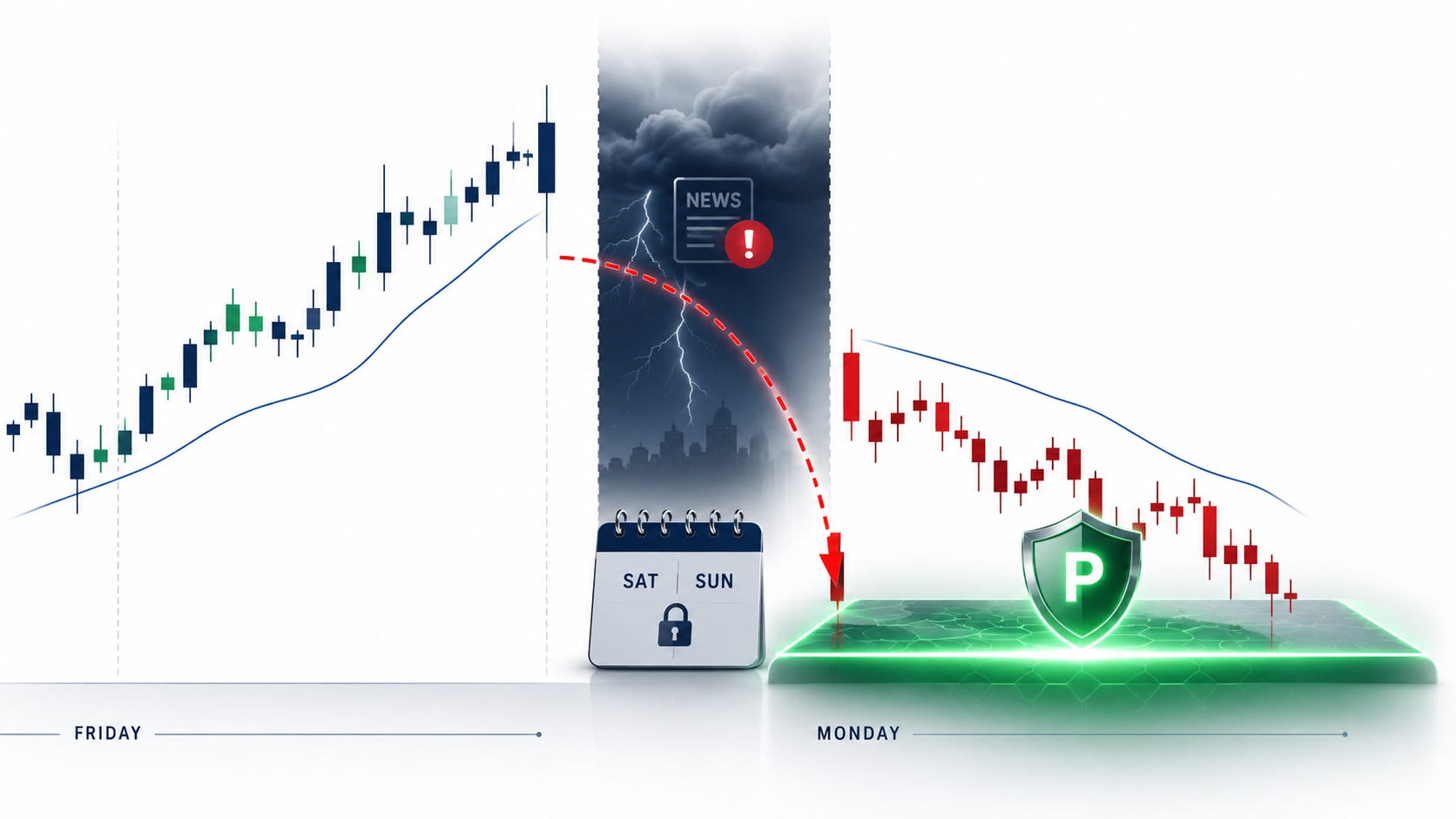
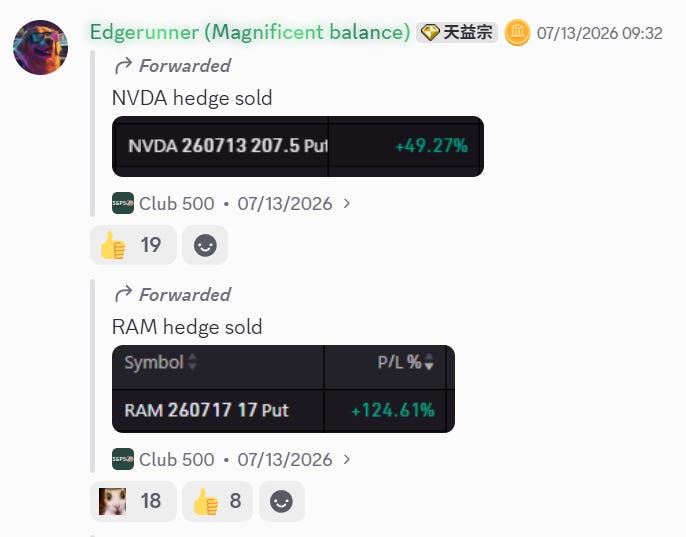
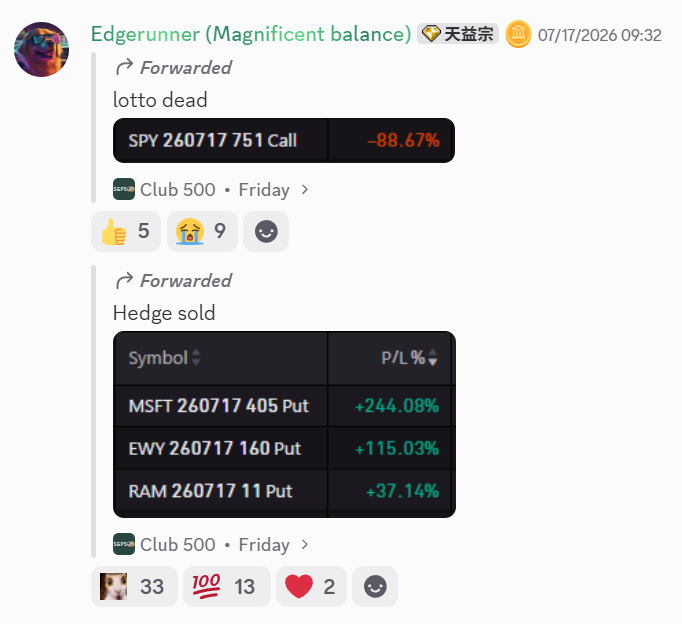
It is Friday, 2:00 p.m. You own 300 shares of a stock at $150 — a $45,000 position.
Last night (Thursday), Middle East ceasefire talks stalled.
A presidential address on the region is scheduled for Next Tuesday evening.
The market closes in two hours and does not reopen for 65 hours. Between now and then, anything can happen, and you cannot trade a single share.
For a small price, you can put a floor under that $45,000 position through the weekend and through Tuesday night. An actual floor that holds no matter what headline hits at 3:00 am Saturday.
There are multiple ways to hedge your portfolio. Today, we’re going to start with put options.
Why is the closed market the whole problem?
Because there are no trading hours over the weekend.
Say you set a stop at $145.
War headlines hit Saturday.
On Sunday, the stock opens at $132 in the overnight market.
Your stop converts to a market order at the open and fills at $132 — not $145.
On 300 shares that is a $5,400 loss, and the stop did nothing, because the price never “touched” $145 in an open market. It teleported past it.
A put is different. A put struck at $142.50 gives you the right to sell your shares at $142.50, no matter where the stock opens — $140, $132, or $120 (And the more the stock withdraws, the higher the value your put option contract is).
The payoff does not care whether the market moved in daylight or overnight. That is the entire point. The put is the only instrument that works while the exchange is dark.
How do you read the option chain?
Open the chain, and you see four things. Your broker shows a row of expiration tabs across the top (dates), a column of strike prices down the side, and for each strike a puts section with a few numbers. You only need four of them:
Bid — what a buyer will pay you (what you get if you sell).
Ask — what a seller wants (what you pay if you buy).
Volume — contracts traded today.
Open interest — contracts that currently exist. This is your liquidity gauge.
Three rules, as hard numbers:
Open interest above ~500. Thin contracts are hard to exit without giving away money. In the worst-case scenario, you may not even be able to sell your put options simply because no one is trading this contract.
Bid-ask spread under ~5% of the option price. If a put shows $2.00 bid / $2.20 ask, the spread is $0.20 on a $2.10 mid — about 10%. Buy at $2.20 and sell instantly at $2.00 and you have lost 10% before the stock moves a cent. That is too wide.
Liquidity is best in the weekly expirations of large-cap stocks and index ETFs — exactly the instruments this strategy uses. If your stock’s weeklies are thin, that is itself a signal to hedge the index instead.
Which expiration do you pick for a weekend? For an overnight?
For a weekend hedge, buy the weekly that expires the following Friday — not the one expiring today, and not a monthly. Here is the logic.
This Friday’s expiry (0 days left, dies at 4:00 p.m. today) is useless. It expires two hours from now, before the weekend risk window even opens. A 5%-out put with two hours of life is nearly worthless (~$0.02) and protects nothing.
A monthly expiration (30+ days out) works, but you pay for weeks of protection you do not need. That same $142.50 put with a month of life costs about $2.80 (illustrative) versus $0.95 for next Friday’s — roughly three times the price for time you will not use.
Next Friday’s weekly (about 7 days out) is the answer. It covers the weekend and the Tuesday speech, and leaves a buffer.
Next Monday’s work too. For some tickers, such as SPY and QQQ, brokers offer Monday expiration contracts (three-day expirations). This is a pretty good option if you are aiming to hedge only the weekend, instead of the whole week.
The general rule:
Buy the expiration that lands after your risk window, plus 2–3 trading days of buffer.
Which strike do you pick when you don’t know what’s coming?
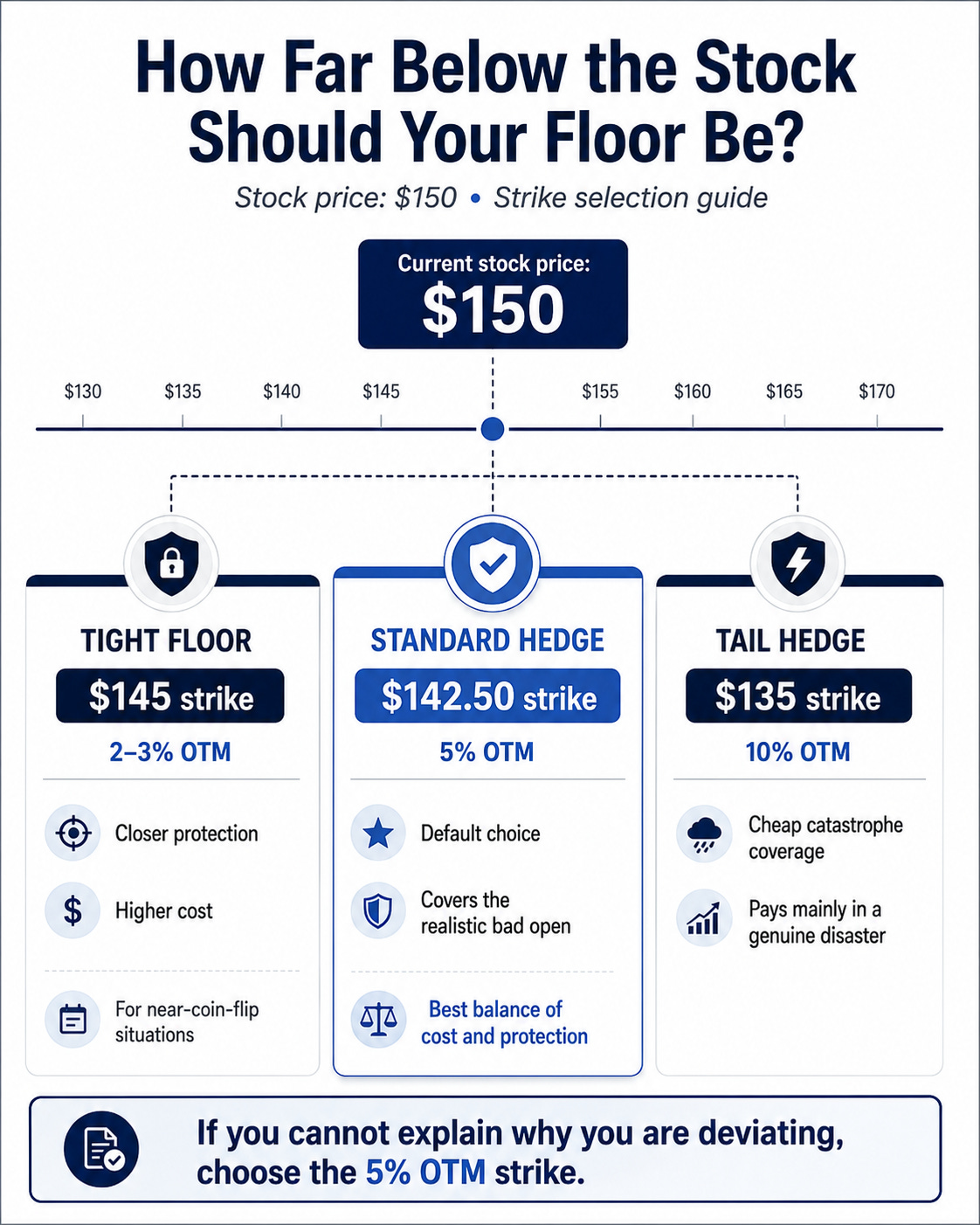
Pick by how bad the open could realistically be, and default to 5% out-of-the-money.
History gives the anchor. Even severe geopolitical shocks usually open the broad indexes down only a few percent: Research shows prior geopolitical events found an average peak-to-trough drawdown of –4.7%, bottoming in about 19 days and fully recovering in about 42 days; its military-conflict-only cut shows the S&P 500 drawing down about 7% and recovering within an average of 55 days.
Single stocks, being less diversified, open a bit wider — call it 3–8%. Opens beyond 10% are rare and reserved for genuine system-level events: SPY gapped down about 8.2% at the open when the market reopened after 9/11 (Sept. 17, 2001) and closed down 7.8%, and the March 9, 2020, COVID open gapped down “about 7%,” These are historical tendencies, not guarantees.
Three presets, tuned to that behavior:
Standard weekend hedge — 5% OTM ($142.50 strike). Covers the realistic bad open. This is the default.
Tail hedge — 10% OTM ($135 strike). Cheap; pays only in a genuine disaster. Buy this when you want catastrophe coverage, not everyday coverage.
Tight floor — 2–3% OTM ($145 strike). For near-coin-flip situations where you think a modest drop is likely and want the floor close.
The rule: if you cannot articulate why you are deviating, buy the 5% OTM. It is the honest middle — real protection against the move that actually tends to happen, at a cost you can absorb several times a year.
How much of your position should you spend on the hedge?
No more than 40% of the move you expect.
Let’s use the example above again: 300 shares at $150, a $45,000 position, and you estimate the weekend move could be 5% — up or down.
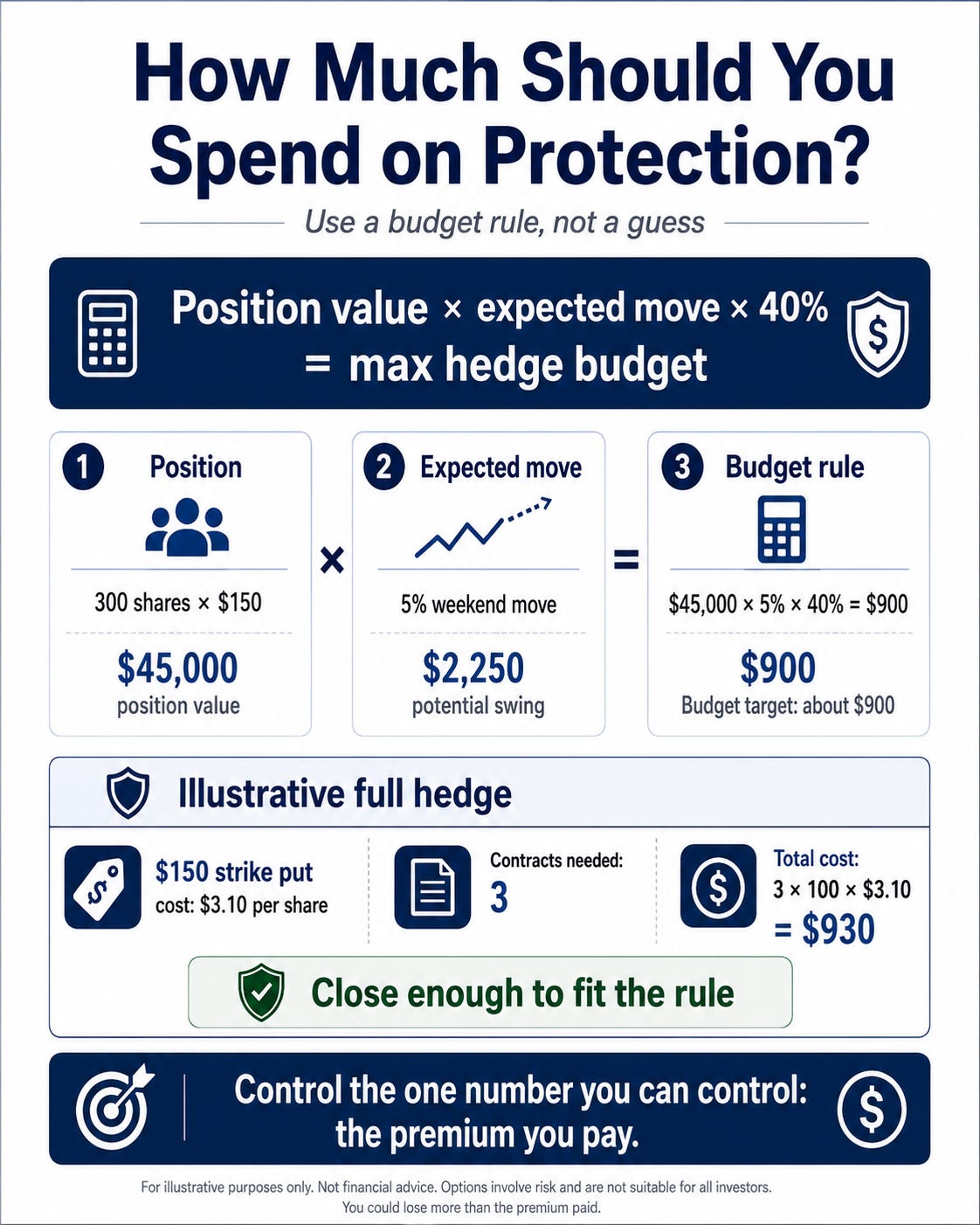
Step 1 — Calculate the moves. 5% of $45,000 = $2,250. That is what the weekend can give you or take from you.
Step 2 — Budget the spending. Your budget is 0.4 × $2,250 = $900. (Why 0.4? Because fair insurance on a move that can go either way costs a bit under half of that move — the derivation is in the endnotes.) The put that protects the full position — the $150 strike, at the current price — costs $3.10 per share in our illustrative chain. You need 3 contracts to cover 300 shares: 3 × 100 × $3.10 = $930. That is right in your budget. You buy them.
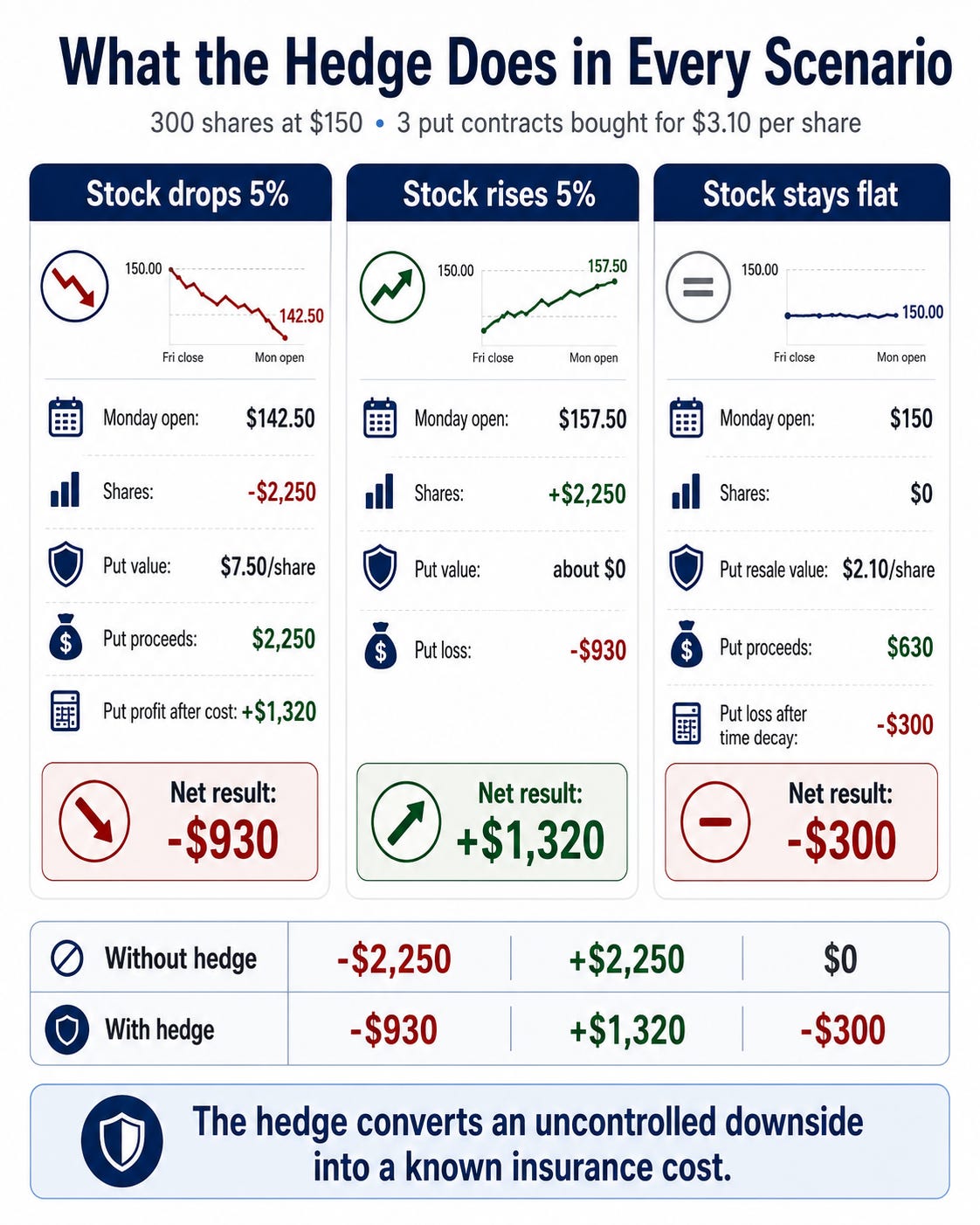
Step 3 — What happens on Monday? Three things can happen: the stock drops, it surges, or it goes nowhere. In every case, you keep your 300 shares — the only thing you sell Monday is the puts. Run all three.
If the stock drops 5%: it opens at $142.50. The put you bought for $3.10 is now worth about $7.50 per share (illustrative). Its price jumped because it carries the right to sell at $150 while the market pays $142.50 — nobody sells that right for less than the $7.50 difference. So sell your 3 puts: 3 × 100 × $7.50 = $2,250 in cash. You paid $930, so the puts made you $2,250 − $930 = $1,320. Your shares — still yours — are down $2,250 on paper. The put profit covers most of it: −$2,250 + $1,320 = −$930. The crash cost you only the price of the insurance, and you never touched the shares.
If the stock surges 5%: it opens at $157.50. The put’s selling price collapses to almost nothing — nobody pays for the right to sell at $150 when the market pays $157.50. Your puts are worth roughly zero, so you lose what you paid for them: $930. Your shares are untouched. The net result of the surge: your shares gained 5% = +$2,250. Take away the $930 you lost on the puts. You are left with $2,250 − $930 = $1,320 in unrealized gains.
If the stock stays flat: it opens Monday at $150, right where it closed. Your shares lost nothing — but the put’s selling price still fell. It was seven days of insurance; three of those days burned off with nothing happening, and buyers pay less for fewer days of protection. The put you bought for $3.10 now sells for about $2.10 (illustrative). Sell the 3: 3 × 100 × $2.10 = $630. The quiet weekend cost you $930 − $630 = $300. That daily drop in an option’s price has a name: theta — time decay. It runs every day you hold an option, whether the market moves or not. It is the rent on the insurance.
Now put the three outcomes side by side.
Without the hedge, the weekend hands you −$2,250, +$2,250, or nothing.
With it: −$930 at worst, +$1,320 at best, −$300 if nothing moves.
The most the insurance can ever cost you is the $930 you paid — about 2% of the position — and a quiet weekend costs less, because you sell back the unused days. That cost is the only number you control, so control it: spend no more than 40% of the move you fear.
One rule to close. This math only pays when the feared move is big. On a calm night when you expect a 1% move, the same insurance costs nearly half of what it protects. A 1% expected move is usually not worth hedging. Save the puts for the nights you fear a 3% move or more — and cap the habit at 2–3% of your portfolio per year. That is only a handful of hedged weekends, which is the point: pick them carefully.
When should you skip the hedge?
At roughly 0.3–0.6% of position value per weekend, hedging all 52 weekends a year costs 15–30% annually — you would convert an occasional gap risk into a guaranteed, grinding loss. Insurance you never stop paying for is just a slow way to go broke.
So use a decision rule: hedge when there is a named catalyst within the closed window, or a clear risk signal. Either it’s political or economic.—a scheduled speech, an ultimatum deadline, an active war with talks in progress, an economic data release. Skip on ambient dread — the vague sense that “things feel shaky.” Markets always feel shaky.
It’s Monday at 9:30 — what do you do now?
Three scenarios, each with an action and the arithmetic.
(a) Flat or gapped up. Sell to close at the open and book the loss as an insurance premium.
(b) The stock gapped below the strike. Observe the market sentiment. If the sentiment is very bearish, it means the stock could go down even more. In that case, you should probably hold the put option, let it roll, and keep increasing in value until the market calms down a bit and may form a reversal. Then you sell the put option and add to the shares, or hold cash and wait.
(c) Partial drop, strike not breached. The stock opens at $145 — down 3.3%, still above your $142.50 strike. The put never went in-the-money, but it gained anyway, from the move toward the strike and from the volatility pop. So now is the time to sell it and take profits.
Some final thoughts
It is almost impossible to correctly time the market. Nobody knows when the market will deliver another 12-day surge in a row or a 5%+ sharp withdrawal.
But history has already proved one thing: whether it’s the Nasdaq, Dow Jones, or S&P 500, after major withdrawals, the US stock market always surges back and goes higher.
If you are holding companies with great potential and great fundamentals, it is always a good idea not to give up your positions, but to hedge and use the gains of those hedges to add to your shares.
Disclaimer: The preceding content is informational only and based on the information available at the time of creation. It is not an offer or solicitation, nor is it financial or legal advice. It does not take your financial circumstances and objectives into account and may not be suitable for you.
Thanks for reading! This post is public so feel free to share it.
现在是周五下午两点。你持有 300 股某只股票,每股 150 美元 —— 总仓位价值 45,000 美元。
昨晚(周四),中东停火谈判陷入僵局。
下周二晚间,总统将就该地区局势发表讲话。
距离收盘还有两小时,之后市场将休市 65 小时。从现在到重新开盘之间,什么都有可能发生,而你一股都交易不了。
只需花一小笔钱,你就能为这 45,000 美元的仓位托底,安然度过周末乃至周二晚间。这是一道实实在在的底线 —— 哪怕周六凌晨三点爆出任何头条新闻,底线都在。
对冲投资组合的方法有很多。今天,我们先从看跌期权(Put Option)讲起。
因为周末没有交易时段。
假设你在 145 美元设了止损单。
周六传来战争相关的新闻。
周日,这只股票在夜盘市场直接开在 132 美元。
你的止损单在开盘时自动转成市价单,最终以 132 美元成交 —— 而不是你设定的 145 美元。
300 股算下来,亏损就是 5,400 美元。止损形同虚设,因为在可交易时段内,股价从来没有 “触碰” 过 145 美元 —— 它直接跳空跌穿了。
看跌期权不一样。一张行权价为 142.50 美元的看跌期权,赋予你以 142.50 美元卖出股票的权利 —— 无论开盘价是 140、132 还是 120 美元都有效(而且股价跌得越多,看跌期权合约的价值就越高)。
收益不关心市场是白天动还是隔夜动。这就是核心意义:看跌期权是交易所休市期间唯一还能发挥作用的工具。
打开期权链,你会看到四个要素。券商界面顶部是一排到期日标签(日期),侧边是一列行权价,每个行权价对应看跌期权的几组数据。你只需要关注四个:
买价(Bid)—— 买方愿意出的价(你卖出时能拿到的钱)
卖价(Ask)—— 卖方想要的价(你买入时要付的钱)
成交量(Volume)—— 今日成交的合约数
未平仓量(Open Interest)—— 当前存续的合约总数,这是你的流动性指标
三条硬规则,用数字说话:
未平仓量最好在 500 以上。 合约太稀薄,平仓时容易亏钱。最糟的情况是,你甚至根本卖不掉手里的看跌期权 —— 因为没人交易这个合约。
买卖价差控制在期权价格的 5% 以内。 如果一张看跌期权买价 2.00 美元、卖价 2.20 美元,中间价是 2.10 美元,价差 0.20 美元 —— 大约 10%。你 2.20 美元买入,立刻 2.00 美元卖出,股价还没动你就亏了 10%。这个价差太宽了。
大盘股和指数 ETF 的周度期权流动性最好—— 这也正是本策略适用的标的。如果你持有的股票周度期权流动性很差,那本身就是一个信号:不如直接对冲指数。
做周末对冲,买入下周五到期的周度期权—— 不是今天到期的,也不是月度的。道理如下:
本周五到期的(剩余 0 天,今天下午 4 点到期)—— 毫无用处。两小时后就到期了,周末风险窗口还没开启就作废了。一张剩余两小时、虚值 5% 的看跌期权几乎一文不值(约 0.02 美元),保护不了任何东西。
月度到期的(30 天以上)—— 能用,但你要为不需要的好几周时间买单。同样一张行权价 142.50 美元的看跌期权,月度的大约要 2.80 美元(示例),而下周五到期的只要 0.95 美元 —— 价格差不多是三倍,多出来的时间你根本用不上。
下周五到期的周度期权(约 7 天后)—— 正解。覆盖了周末和周二的讲话,还留有缓冲。
下周一到期的也可以。 某些标的(比如 SPY 和 QQQ)券商会提供周一到期的合约(三天期)。如果你只想对冲周末、不需要整周保护,这也是个不错的选择。
通用原则:
买入的到期日要落在你的风险窗口之后,再留出 2–3 个交易日的缓冲。
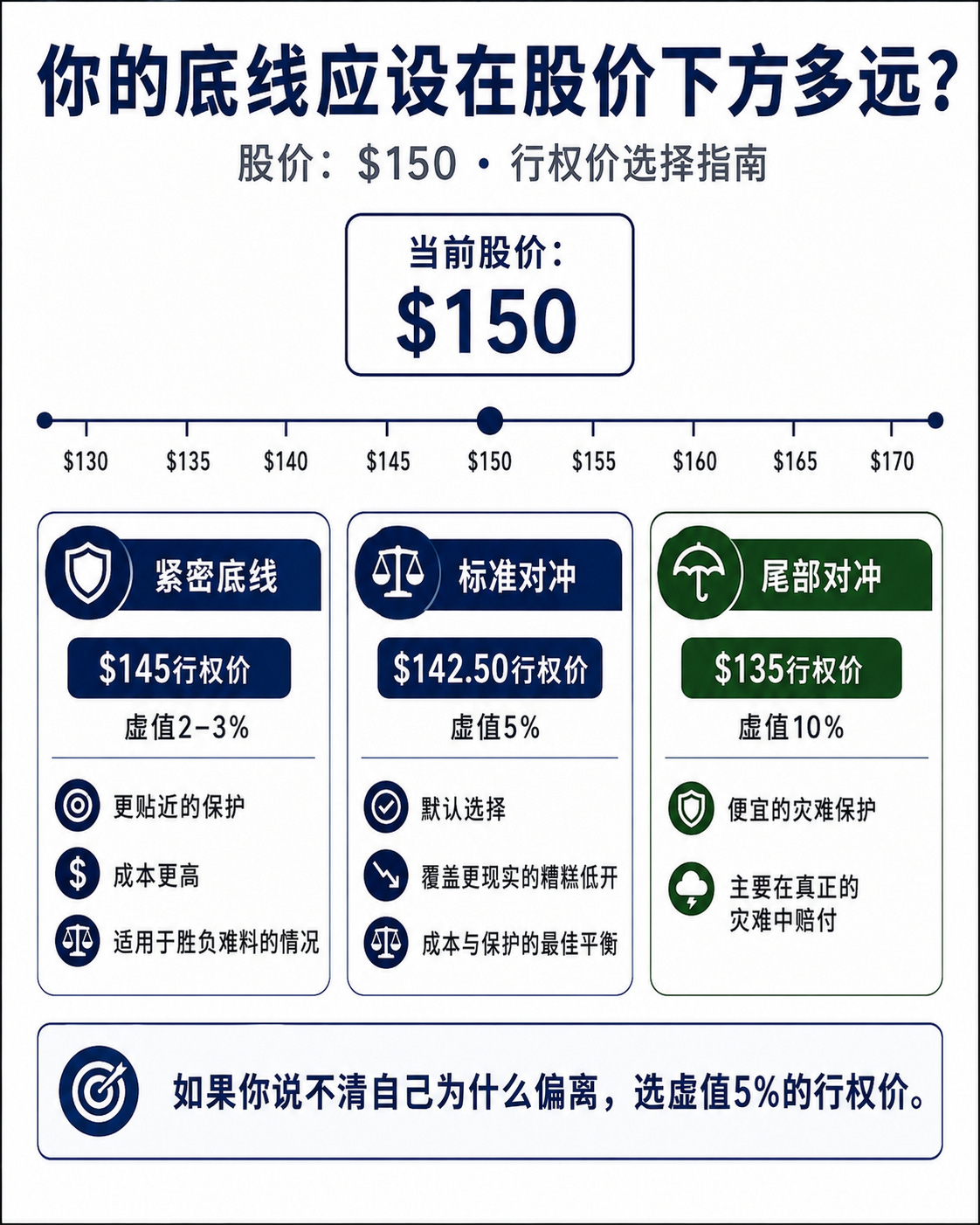
根据实际可能的开盘跌幅来选,默认选虚值 5% 的档位。
历史数据是锚。即便严重的地缘政治冲击,大盘指数开盘通常也只跌几个百分点:研究显示,过往地缘事件中,标普 500 从高点到低点的平均回撤为–4.7%,约 19 天触底,约 42 天完全收复;仅统计军事冲突的话,标普 500 回撤约 7%,平均 55 天内恢复。
个股分散度较低,开盘跌幅会大一些 —— 大概 3–8%。开盘跌超 10% 的情况很罕见,只发生在真正的系统性事件中:9・11 之后市场重新开盘时(2001 年 9 月 17 日),SPY 跳空低开约 8.2%,收盘跌 7.8%;2020 年 3 月 9 日新冠疫情开盘跳空 “约 7%”。这些是历史规律,不构成保证。
对应三种预设档位:
标准周末对冲 —— 虚值 5%(行权价 142.50 美元) 覆盖现实中可能出现的糟糕开盘。默认选这个。
尾部风险对冲 —— 虚值 10%(行权价 135 美元) 便宜;只有真出大事才会赔付。买这个是为了应对灾难,不是日常保护。
紧密托底 —— 虚值 2–3%(行权价 145 美元) 用于概率接近五五开的场景:你觉得小幅下跌很有可能,想要底线离现价近一些。
规则:如果你说不出为什么要偏离默认档位,就买虚值 5% 的。这是最实在的中间选择 —— 用一年能承受好几次的成本,对冲真正大概率会发生的波动。
不超过你预期波动幅度的 40%。
还用上面的例子:300 股,每股 150 美元,仓位 45,000 美元,你估计周末波动可能是 5%—— 涨跌都有可能。
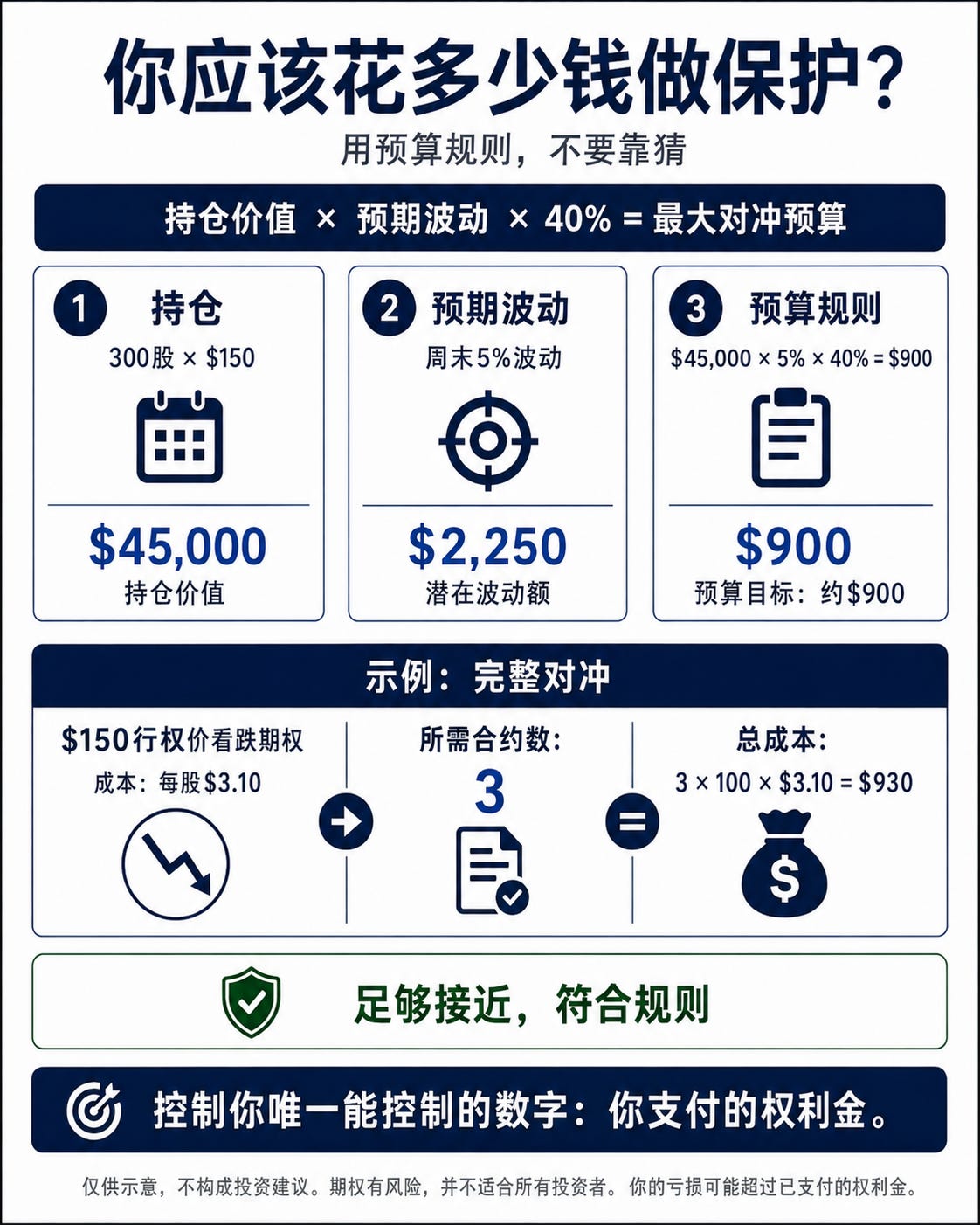
第一步:算波动金额。 45,000 美元的 5% = 2,250 美元。这就是周末可能赚或亏的钱。
第二步:设定预算。 你的预算是 0.4 × 2,250 = 900 美元。(为什么是 0.4?因为对双向波动的合理保险,成本大约不到波动幅度的一半 —— 推导见文末注释。)
在我们的示例期权链中,平值看跌期权(行权价 150 美元)保护全部仓位,每股成本 3.10 美元。300 股需要 3 张合约:3 × 100 × 3.10 = 930 美元。刚好在预算内,买入。
第三步:周一开盘会怎样? 三种可能:股价下跌、大涨、或者横盘。无论哪种情况,你都继续持有 300 股 —— 周一唯一要卖的是看跌期权。我们逐一推演:
开盘 142.50 美元。你花 3.10 美元买的看跌期权,现在每股价值约 7.50 美元(示例)。价格跳涨是因为它赋予你 150 美元卖出的权利,而市场价只有 142.50 美元 —— 没人会以低于 7.50 美元差价的价格卖出这个权利。
卖出 3 张看跌期权:3 × 100 × 7.50 = 2,250 美元现金。成本是 930 美元,所以期权赚了 2,250 − 930 = 1,320 美元。
你的股票 —— 还在手里 —— 账面亏了 2,250 美元。期权利润覆盖了大部分:−2,250 + 1,320 = −930 美元。暴跌只让你付出了保险费,而且你一股都没动。
开盘 157.50 美元。看跌期权的价格跌到几乎为零 —— 市场价 157.50 美元,没人会为 150 美元卖出的权利付钱。你的期权基本归零,亏掉了成本 930 美元。股票不受影响。
大涨的净结果:股票涨了 5% = +2,250 美元。减去期权亏损的 930 美元,剩下 2,250 − 930 = 1,320 美元的浮盈。
周一开盘还是 150 美元,跟收盘一样。股票没亏 —— 但看跌期权的卖价还是跌了。这本来是七天的保险,三天过去了什么都没发生,剩余天数越少,买家愿意出的价就越低。
你 3.10 美元买的期权,现在大约能卖 2.10 美元(示例)。卖出 3 张:3 × 100 × 2.10 = 630 美元。风平浪静的周末让你亏了 930 − 630 = 300 美元。
期权价格每天下跌的现象有个名字:Theta(时间损耗)。只要你持有期权,它每天都在消耗,不管市场动不动。这就是保险的租金。
把三种结果放在一起对比:
不做对冲: 周末结果可能是−2,250、+2,250,或者不赚不亏。
做了对冲: 最差−930,最好 + 1,320,横盘−300。
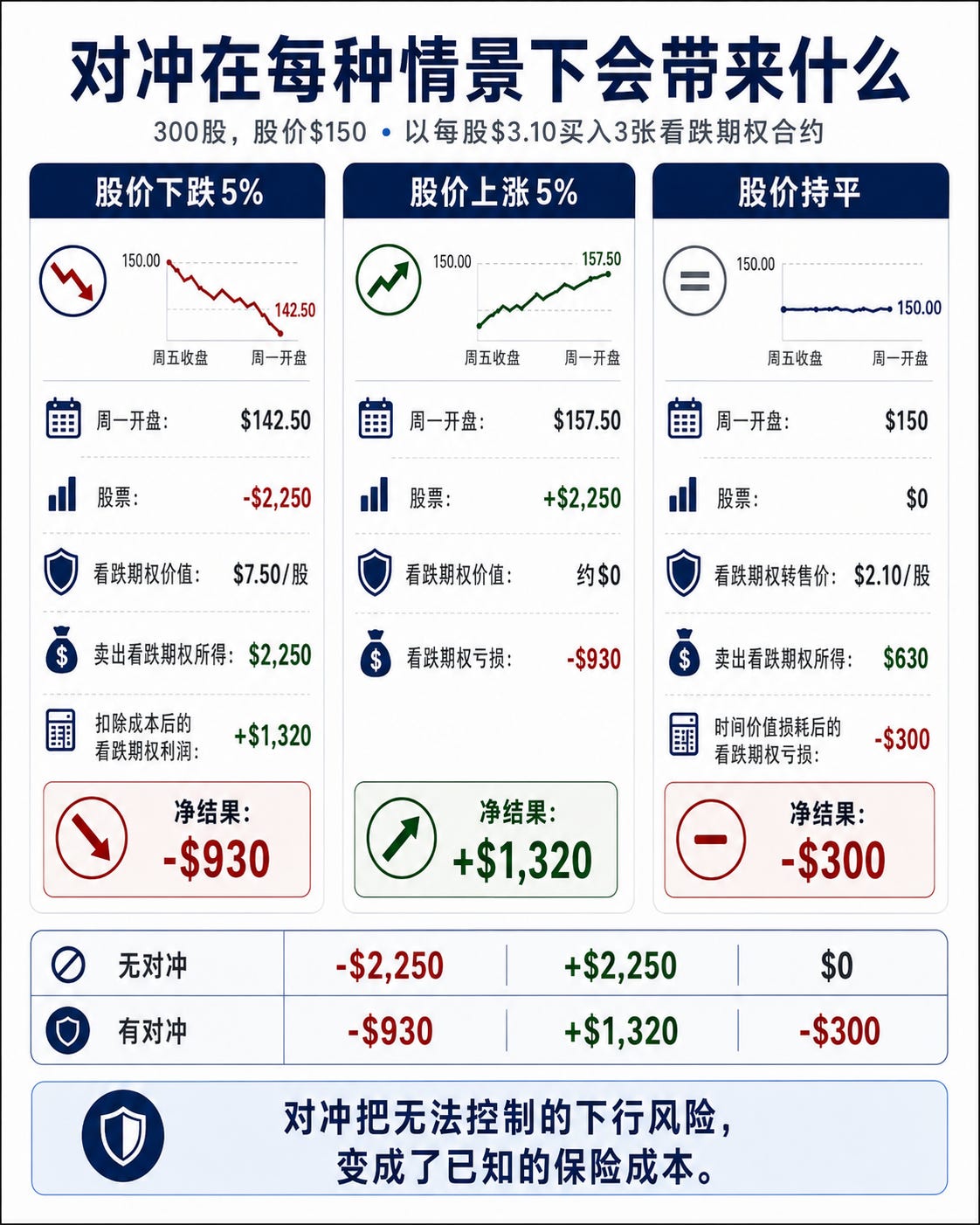
保险最多让你亏掉付出的 930 美元 —— 大约仓位的 2%;如果风平浪静,亏损还更少,因为你卖掉了没用完的时间。这个成本是你唯一能控制的数字,所以控制好它:对冲花费不超过你担心的波动幅度的 40%。
最后一条规则:这套算法只在预期波动够大时才划算。平静的夜晚,你预计只波动 1%,同样的保险成本几乎占到保护金额的一半。1% 的预期波动通常不值得对冲。把看跌期权留给你担心波动 3% 以上的夜晚 —— 并且每年对冲的总成本控制在投资组合的 2–3% 以内。一年也就对冲那么几个周末,重点在于:精挑细选。
每个周末对冲成本约占仓位的 0.3–0.6%,一年 52 个周末全对冲的话,年化成本就是 15–30%—— 你把偶发的跳空风险变成了确定的、持续的亏损。停不下来的保险,本质上就是慢慢破产。
所以用一条决策规则:休市窗口内有明确的催化事件,或者有清晰的风险信号时才对冲。 要么是政治的,要么是经济的 —— 预定的讲话、最后通牒的截止日、正在进行的战争伴随谈判、重要经济数据发布。
不要因为 “隐约不安” 就对冲 —— 那种 “感觉市场不稳” 的模糊预感。市场永远都让人觉得不稳。
三种情形,各有对应操作和算法:
(a)平开或跳空高开。 开盘就平仓卖出,把亏损记成一笔保险费。
(b)股价跳空跌破行权价。 观察市场情绪。如果情绪非常悲观,意味着股价可能还会继续跌。这种情况下,你应该继续持有看跌期权,让它继续增值,直到市场稍微企稳、可能出现反转时再卖出。然后用期权盈利加仓股票,或者持有现金观望。
(c)部分下跌,未跌破行权价。 股价开在 145 美元 —— 跌了 3.3%,还在你的行权价 142.50 美元之上。看跌期权虽然没变成实值,但因为股价向行权价靠近、加上波动率上升,也已经升值了。这时候就该卖出获利了结。
精准地判断市场涨跌几乎不可能。没人知道市场什么时候会连涨 12 天,也没人知道什么时候会突然跌 5% 以上。
但历史已经证明了一件事:无论是纳斯达克、道琼斯还是标普 500,大幅回撤之后,美股总会反弹并创出新高。
如果你持有的是潜力大、基本面优秀的公司,不轻易放弃仓位、而是通过对冲来保护,再用对冲的盈利去加仓,永远是一个好思路。
免责声明: 以上内容仅供参考,基于创作时的可得信息,不构成投资邀约或招揽,也不构成财务或法律建议。内容未考虑您的个人财务状况和投资目标,可能不适合您。
Thanks for reading! This post is public so feel free to share it.
No posts
Comments
Nothing yet. Say the first thing.
Sign in to join the conversation.