
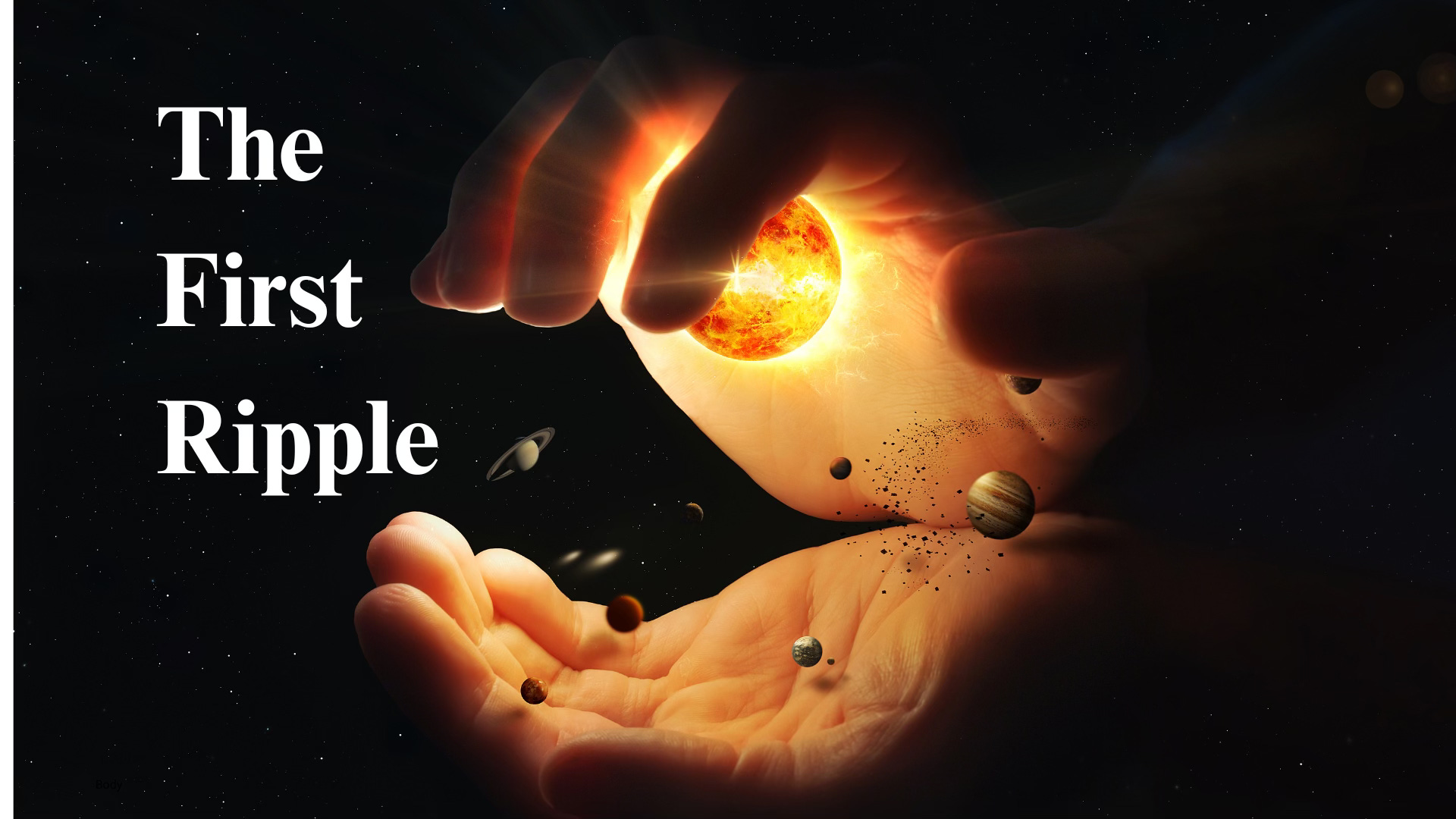
We tend to imagine beginnings as dramatic.
A flash.
A bang.
A moment when nothing suddenly becomes something.
But in the ancient Hindu understanding, especially in the teachings of Samkhya, there is no such moment.
There is no absolute beginning.
There is only what always is.
They speak of two eternal realities: Prakriti and Purusha.
Prakriti is everything that can change. Matter. Energy. Thought. Emotion. The unfolding universe itself. It is movement, possibility, expression.
Purusha is something entirely different. It is pure awareness. Silent. Still. Unchanging. It does not act. It does not move. It simply witnesses.
And here is the first surprise:
Neither of them begins.
They are both eternal.
So the question shifts.
It’s no longer “How did the universe begin?”
It becomes “How did experience begin?”
Before anything we would recognize as a universe, Prakriti exists in perfect balance. Its three underlying qualities—clarity, activity, and inertia—are held in equilibrium. Nothing rises. Nothing falls. There is no time, no change, no form.
Purusha, meanwhile, simply is. Not thinking. Not observing an object. Just pure awareness without content. No story. No identity. No “you” or “me.”
And in that state, nothing happens.
Because nothing can happen.
Then something subtle—almost impossible to describe—occurs.
Not an explosion.
Not a force.
Not even a decision.
The lighthearted part of me wants to say, “Oh my God, the very first relationship, like boy meets girl. This should be fun/interesting.” LOL
Meanwhile, in the presence of Purusha, Prakriti is, in a sense, “seen.”
And in being seen, its perfect balance is disturbed. (Must be the first time man didn’t take the trash out). lol
This is what might be called the first “friction”—though it is not friction in the physical sense. Nothing collides. Nothing pushes.
From that disturbance, everything unfolds.
First comes Mahat, a kind of cosmic intelligence—the organizing principle within nature. Then arises Ahamkara, the sense of “I,” the beginning of identity. From there, mind, senses, and the material world emerge.
A cosmic intelligence, and the sense of “I” emerge.
Meaning mind, senses and matter emerge.
The universe, as we experience it, is born.
But here is the deeper insight:
Consciousness itself does not begin.
It feels to us as though consciousness starts inside our brain, sometime after we are born.
But in this view, that’s not quite right.
Consciousness is already present—like sunlight.
The mind is like water.
When the sunlight reflects on the water, an image appears. Movement, color, distortion. And we say, “That is me.”
But the sun is not in the water.
And the water is not the sun.
In the same way, Purusha is not the mind.
But reflected through it, it appears as a personal self.
So, where is the true beginning?
Not in time.
Not in space.
Not in matter.
The moment stillness is noticed.
The moment reflection becomes identity.
The moment the infinite looks like something finite.
And some traditions go even further.
In Advaita Vedanta, even the distinction between Prakriti and Purusha dissolves. Both are expressions of a deeper unity called Brahman—the ultimate reality beyond all categories.
In that view, the universe is not created at all.
It is appearing.
A kind of cosmic play.
A dance of awareness with itself.
So perhaps the question isn’t:
“Where did consciousness come from?”
Perhaps it is:
And perhaps the real mystery is not out there at the beginning of the universe…
…but right here, quietly noticing these words.
This particular essay is beyond the practical and relies on what has been passed down through the ages, and comes from great sages and seers.
However, speaking in general terms regarding other information tied to Advaita Vedanta and other Indian belief systems, which incorporate Hinduism, I have come to believe, as the seers tell us, that Advaita Vedanta and many other Hindu systems are a science, not a belief. Meaning they can be proved.
Vedanta is considered a science, unlike religion, which is primarily based on beliefs and perspectives. And we can prove them for ourselves. All we have to do is inquire within and observe ourselves, our mind, our ego, and our thoughts.
Thanks for reading!
Until next time…
Shanti, Eddie
Comments
Nothing yet. Say the first thing.
Sign in to join the conversation.