
You will know, if you’ve read Material World, that there are many different flavours of oil: sweet and sour, heavy and light, gloopy Canadian tar sands and light, clear fracked crude. You will also know, if you’ve read much of my subsequent stuff here, that such things actually turn out to have outsize, sometimes geopolitical significance. But did you know that something similar also goes for natural gas?
When it first comes out of the ground, natural gas can also be sweet or sour, depending on its sulphur content. It can be wet or dry, depending on how many other liquids have come up in the pipes alongside the gas. Natural gas from Algeria is decidedly different (richer and heavier) than the stuff that comes from Trinidad as a consequence of the variety of organic material laid down millions of years ago and the conditions under the ground since then.
I learnt this a month or so ago, touring round the Isle of Grain LNG terminal, while filming a documentary for Sky News. The film itself (which I’d love you to watch if you have a moment) is really about something else, about the fate of the North Sea and the question, significant here and, I think, actually of some international import, of whether Britain should be doing more drilling in future.
But as is always the way when you’re filming these things and trying to compress it all into a finished film (even a mammoth 30 minute film - mammoth, at least, by Sky News standards), some of the interesting, chewy, nerdy stuff ends up on the cutting room floor. So it was with the various different flavours of natural gas.
But such things are actually quite consequential. Consider the gas in Groningen, the first great gas field of Northern Europe in the Netherlands. Groningen gas naturally contains an unusually low methane content and quite a lot of nitrogen. The upshot is that most Dutch appliances - boilers and gas cookers - are designed to work with this low-calorific, gas. However, the Groningen field was recently closed. Since gas from elsewhere has a far higher methane content, the Dutch network operators have had to build vast nitrogen production facilities to blend it into the imported stuff and make it “taste” a little more like Groningen gas. This is quite an expensive operation, since producing nitrogen is very energy-intensive. But given the alternative is to ask the country to buy new boilers, it was considered the least bad solution to an awkward problem of what economists would call “path dependency”.
Something similar goes for the UK, where the particular flavour of the gas in the southern North Sea - the gas that really started Britain’s era as a hydrocarbon producer - happens to be pretty lean and dry. When the powers-that-be began to lay down Britain’s national gas grid in the 1960s and ‘70s, they did so with that flavour of gas in mind. Even today, the UK gas network (or rather, the boilers and cookers plugged into it) is designed for a very particular flavour of gas, with a very particular calorific rating. If one of the LNG tankers coming into Isle of Grain to unload gas from Algeria were to send that gas straight into the grid, it would raise the risk of something bad happening: older cookers leaking carbon monoxide, sooting up, and generally not working properly.
And so in Britain this foreign gas also has to be treated to bring it into line with British standards. Surprising as it might sound, this is the single most energy-intensive process at the Isle of Grain terminal. Given LNG is already considerably more carbon intensive than the sort of gas you pipe directly from a gas field into your system, this sort of thing matters.
It matters all the more today, and will matter still more in the coming decades, since one of the consequences of the rapid decline of North Sea oil and gas production is that Britain is coming to depend on LNG imports even more than in the past.
To put it another way, if the only thing you cared about was carbon emissions, you could make a strong case that the green thing to do is to try to squeeze as much gas out of the North Sea as possible. This will sound counter-intuitive for many people, but it is the logical consequence of the energy transition. Even in the best-case scenario, it will take decades to reduce Britain’s dependence on gas down to a level consistent with net zero carbon emissions. As Material World readers know, there are some fossil fuel processes that can be relatively easily decarbonised (electric cars are a genuinely decent, by many yardsticks superior, substitute for petrol ones, for instance). But when it comes to other things: the production of fertiliser for instance, or the grid-scale intermittency support we need for when the wind isn’t blowing and the sun isn’t shining, the greener alternatives aren’t quite there yet.
So while the amount of gas Britain is consuming is going down, and will continue to go down as more people buy heat pumps and more renewable power becomes available, we still need rather a lot of it. And so the question of where that gas will come from is rather important. Especially since, well, as you already know, not all gas is alike. And since Europe has now committed to importing less gas from Russia, that means more gas shipped in in the form of LNG from elsewhere. And since LNG is far more carbon intensive (even before you get to the extra steps to convert and blend that gas into a form palatable for the UK grid), that means more pollutive not to mention more expensive gas.
All of which raises two questions (well, actually plenty more than that but let’s stick to the two biggest ones): first, is there really much more gas left in the British half of the North Sea and, second, what does this all do to Britain’s net zero commitments?
Let’s take the second question first, since this gets to the knotty, uncomfortable reality. If you presume that the world is really committed to net zero and that carbon emissions are going to fall everywhere in the coming years, consistent with a glidepath to 1.5 or 2 degrees of extra global warming, then you could make the strong case that more North Sea gas production will be better for the environment than gas from elsewhere. Why? Because more domestic gas production in the UK means we have to ship in less LNG from elsewhere and since LNG takes a staggering amount of energy to liquefy and ship (you need to reduce the temperature of the gas to -162 degrees celsius - this is challenging physics), it is surely more efficient to produce the gas domestically and just ship it through the existing infrastructure.
But while this would mean lower global emissions it would nonetheless mean more of those carbon emissions happening in the UK than elsewhere. From the perspective of carbon emissions, this ought to be entirely irrelevant, after all the atmosphere couldn’t care less which country is pumping more CO2 into it than the other. However, politicians (and the various climate frameworks they’ve signed up to) fixate instead on domestic carbon emissions. So, yes, by this yardstick, more North Sea drilling would be bad for the UK’s domestic emissions and humiliating for the politicians who promised to reduce it at a particular speed.
However, more germane and I think a more serious objection to more North Sea drilling comes back to something else, something a little less about physics and thermodynamics and a bit more about the gloopy world of geopolitics. If you believe that Britain has a leadership role in global climate politics - and given this country has pushed towards net zero faster than any other developed nation that seems like a fair notion - then actually the decision over the North Sea is of outsize importance. It is, you might say, not just about the North Sea. If many other nations see that the country that led the push towards net zero is now committing to a different path, might they follow suit?
In other words, might the very act of promising more North Sea drilling send a signal that changes the global trajectory of carbon emissions? If so, that completely topples the logic I’ve laid out above. It would mean more domestic gas production in the UK actually raises global carbon emissions rather than cutting them. So, this isn’t exactly simple.
So how about the other issue, the question of whether Britain actually has enough gas to exploit in the first place? The conventional wisdom, as you will know, is that the North Sea is a “mature”, “declining” basin, which is hard to disagree with. The question is whether this means, as many assume, that its path of decline is somehow set in stone. And it so happens we have a rather helpful natural experiment right across the international maritime border in the form of Norway.
One of the people we spoke to in the course of making our film was Wood Mackenzie, the leading oil and gas consultancy who arguably know more about the prospects for the North Sea than anyone else. And one of the charts they showed me showed the starkly diverging paths between UK and Norwegian oil and gas production.
While UK North Sea output has declined rapidly since the peak in 1999, in Norway output peaked in 2004 and then, critically, stayed relatively high. The lines on that Wood Mac chart diverged. Anyway, one of the great things about AI is that it enables you to make pretty good websites pretty easily, so in the following weeks I used Claude to make a site pulling the publicly available data on oil and gas production in the various UK and Norwegian North Sea fields, and the end result was a rather helpful website. You can find it here.
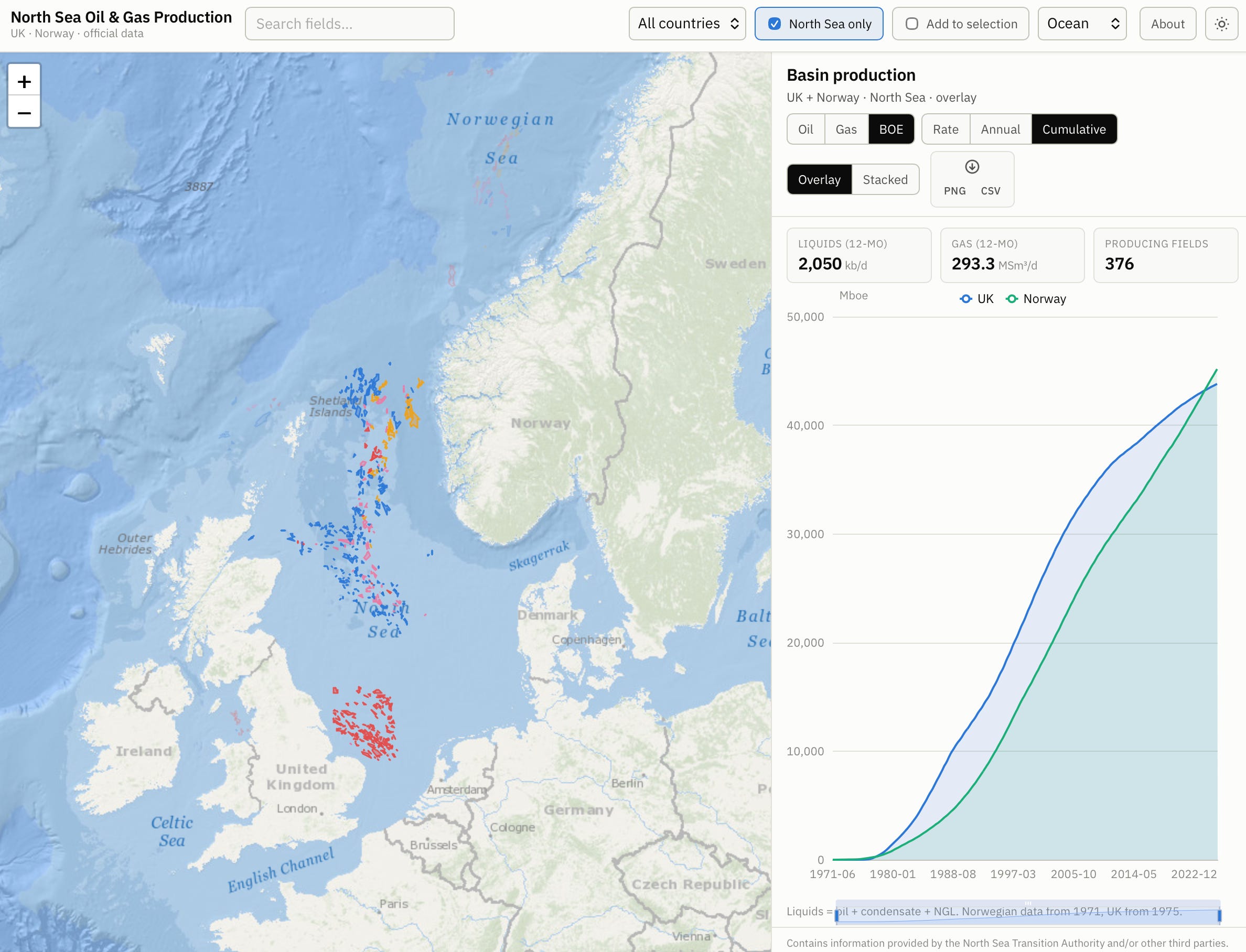
I’d encourage you to look at the numbers yourself (and do let me know any thoughts that occur in the comments) but one striking thing I found is that for all that we are often told that the UK section of the North Sea is simply more “mature” than Norway’s, implying that we have “withdrawn” our share of oil and gas earlier, actually when you tot up the total cumulative output of each side of the basin (see the chart above, right), it turns out Norwegian output has now overtaken the UK. In other words, this isn’t just about maturity, it’s about something else.
Either the UK’s side of the North Sea simply has less oil and gas available, or this comes down to politics and economics, down to the differences in the way Norway runs its side versus Britain. I’m not sure there is yet a definitive answer to this question, but it seems like a reasonable one to ask. Would the UK, with a regime similar to Norway, be able to produce as much oil and gas as Norway?
These are questions that most politicians have sought not to ponder in the past decade or so. But they are relevant all over again. And they are relevant not just for the UK, but because many people see the North Sea as a sort of test case for the future of the industry - not to mention for global climate policy. Anyway, do watch the film we made, which has far more detail on all of this, Do check out the maps and charts and be assured, this is an issue we’ll come back to again soon.
A reminder that if you pre-order my forthcoming new book Trade World between now and Sept 2 and email me at preorder@edmundconway.com attaching a proof of purchase, I will send you an exclusive essay containing bonus material that didn’t make it into the final edition of the book.
No posts
Comments
Nothing yet. Say the first thing.
Sign in to join the conversation.