
The story of a packet of fish fingers begins where you’d probably expect it to begin: on a boat many miles off the Scottish coast, with fishermen pulling up a trawling net containing a load of white fish. The waves are high, the wind is biting. When the net comes up it contains a writhing mass of haddock, whiting, monkfish and cod. This is the cod that will eventually turn up on your or your children’s plate, having been processed and breaded along the way.
But the interesting bit - the disturbing bit, you might say - is what happens next. Because instead of being sailed straight to land and thence to a supermarket, this cod is about to embark on a startlingly long journey. This journey, a journey about which most people tucking into their fish fingers today are almost completely oblivious, tells you rather a lot about the way the modern world - what I like to call the Trade World - really works. And not just that. Follow this cod on its way and you begin to see why so many regions in Europe and America feel like they have been “left behind”; you begin to see why it is so difficult to take on Vladimir Putin and the Russian economy... all from a simple pack of fish fingers.
We’ll get to all of that in due course but, for the time being, let’s follow the cod. The one we’re focusing on today is caught in Scottish waters. It is gutted and iced on the boat and the vessel carries its catch back to Peterhead, the biggest whitefish port in Europe. So far, so logical. At this stage, the cod is barely a few miles from some of the supermarkets that will end up stocking the fish fingers it is destined to become, one of these days.
But the cod’s journey is only just beginning. For, having been sold on the auction floor, the cod is blast-frozen and loaded into a refrigerated trailer where it is carried down to a bigger port, a port like Immingham, just next to Grimsby. It is loaded, alongside a lot of other white fish, into a refrigerated shipping container - a reefer as it’s called - which takes it south to Rotterdam. At this point you’re perhaps wondering why on earth this fish that was caught off the UK and will later be sold in the UK, is travelling hundreds of miles south. But hold your horses. Because at Rotterdam, our cod and its container are transferred onto a bigger ship - one of those vast ones you sometimes see in newspapers but rarely see in real life.
By now it’s some weeks since the cod was actually caught but, in the suspended animation of frozen food transport, that hardly matters. The container ship leaves Rotterdam and heads out on a journey that will take it 14,000 nautical miles. It sails out of the Channel, down past the Bay of Biscay and south, beyond the Canary Islands and the equator. It rounds the Cape of Good Hope and sails across the Indian Ocean, passing through the Strait of Malacca. It docks in Singapore, but our container stays on board as others are unloaded. Eventually, weeks after leaving Europe, our container arrives in China. There, in a plant in Shandong, the fish is semi-thawed and is filleted, de-boned, skinned and refrozen. This is why it came all the way to China. What came in as a gutted cod leaves as blocks of white fish.
Filleting a fish is a tricky business, especially once the fish is frozen. It’s one of those jobs machines have yet to master, and so turning cod into a block of white fish involves rather a lot of human labour. Decades ago, most of that labour (at least for British fish fingers) happened in the UK, much of it in Grimsby, which established itself as the hub of Britain’s industrial fish industry.
Precisely who invented the fish finger is one of those topics folks in the business can debate for hours on end, but one thing most of them agree on is that the production of this iconic food was first industrialised in Grimsby. And, having taken Britain by storm, fish fingers (or “fish sticks” as they’re rather more prosaically known in North America) proceeded to conquer the world. And you can see why: the process turns a food that can sometimes be tricky to eat, with bones, skin and all, into a homogenous, identical product (and one that can be easily cooked in the oven and scoffed with your fingers).
But over time, consumers came to demand that their fish fingers should get cheaper. And one of the biggest costs in this entire supply chain was human labour. And so the most labour-intensive parts of the fish finger supply chain were gradually shifted offshore. Most of the plants in Grimsby doing this fiddly filleting were closed down. But many of the jobs went. Those who bewailed the demise of the industry were drowned out. After all, there were still (as you’ll see) some jobs left further up the supply chain. And, more to the point, the fish fingers were much cheaper than they would have been.
And that was thanks in part to the fact that in the second half of the 20th century it became cheaper and cheaper to ship stuff from one side of the world to another. The invention of containerisation, the digging of canals in Suez and Panama, the enforcement of freedom of navigation around the high seas, the construction of massive ships capable of carrying more in a single journey than the entire Elizabethan English merchant fleet could carry in a year: it all contributed to making it incredibly cheap to send goods to the other side of the planet. So, when China entered the World Trade Organisation at the start of this millennium then all of a sudden workers in Grimsby and Great Yarmouth were in direct competition with workers in Shandong.
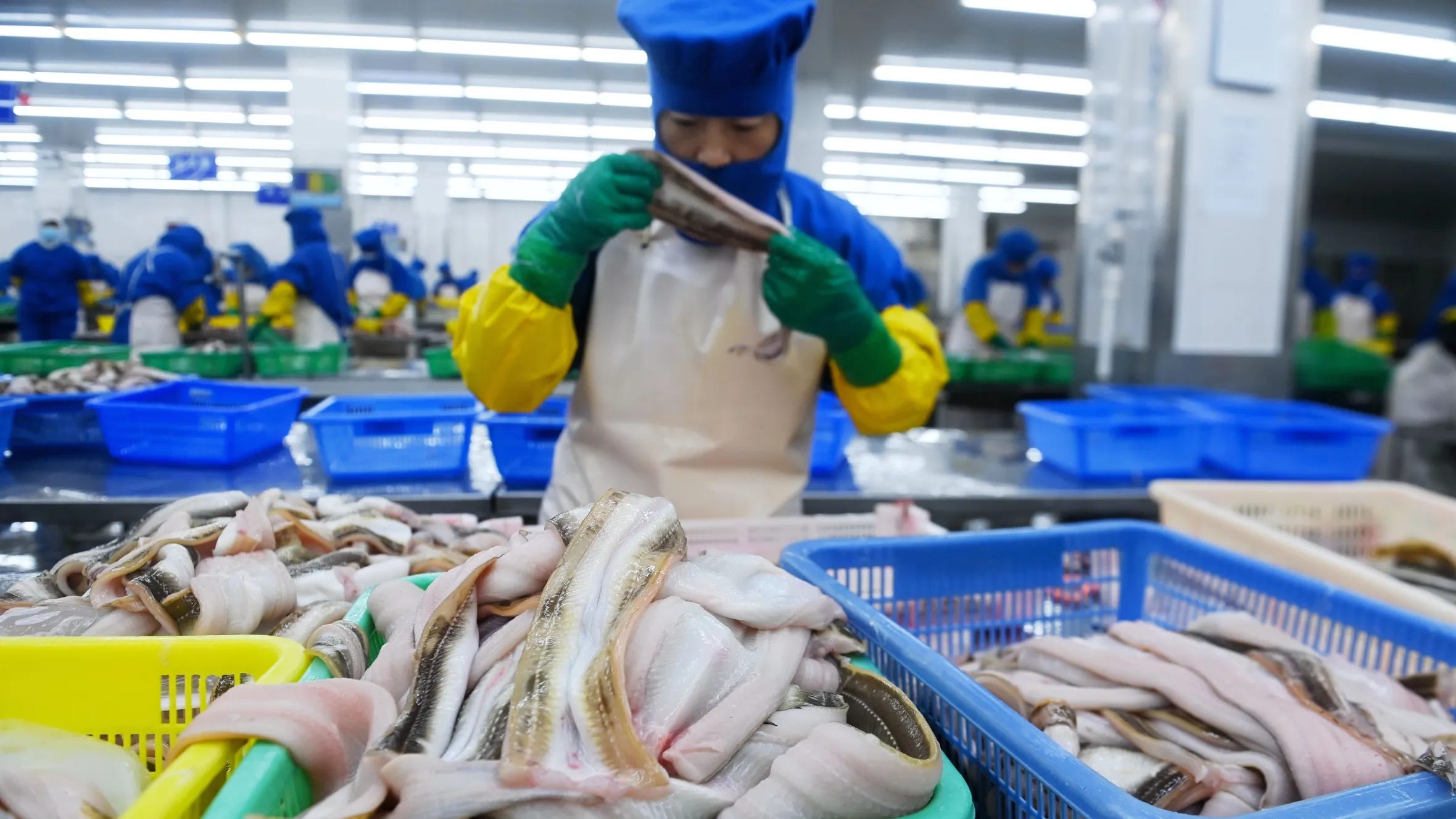
All of which helps explain why Shandong has managed to establish itself as the world capital for the processing of white fish. What Shandong has that most other regions don’t is lots of very cheap labour, some of it allegedly is thanks to the transporting of Uyghur workers from Xinjiang province. And it has scale: by establishing itself as a factory for the world, rather than just its local market, it benefits from enormous economies of scale.
And so, if you’re eating a fish finger in Europe (or for that matter a filleted white fish), know that there is a decent chance that it was skinned and filleted in Shandong. Having been processed there, our cod is now essentially a big block of frozen white fish. It is loaded back into a reefer and shipped all the way back around the world to Europe. Sometimes that route involves going via the Suez Canal, depending on how nervous freighters and their insurers are about the Houthi rebels in the Red Sea. Sometimes it means going all the way around Africa. But eventually, the block of fish ends up where it began its journey months earlier, back in the UK. It has travelled around 30,000 nautical miles - and all just for one stage in the supply chain.
The block of fish is sliced into fingers, each of which is breaded in a plant in Grimsby, which boxes it up and sends it on to a supermarket. And here’s the clever thing: because of the nature of the food labelling rules in Europe, all the food producers need to tell you is where the fish was caught and, if they want to share it, where the very final stage of production happened. And since the journey to and from China happened in the middle of the supply chain rather than at the beginning or the end, it’s essentially invisible to the consumer. As far as the packaging is concerned, this was fish caught in the North Sea and “made in Britain.” That it took a detour around the world need never be mentioned.
If that feels a little, well, disconcerting, then here’s something else that might put you off your fish fingers. Rather a lot of UK fish are actually Russian. In one sense, this seems a little odd. Russian fish imports to the UK were slapped with steep 35 per cent tariffs shortly after the invasion of Ukraine, with the result that UK imports from Russia fell nearly to the floor. But here’s the thing: since most of that Russian fish doesn’t actually get shipped directly to Britain but instead joins the same route as our cod, carried in a container ship to Shandong and processed into a big block of white fish there, it can come into the UK without any punitive sanctions at all. It’s a little like the Russian oil that gets processed in Indian refineries and then sent to the UK, except this time very few (with a few honorable exceptions are even aware of it.
There is another coda to this story, by the way, which is that recently the fish industry in China has been dealt a severe blow by the tariffs imposed by the US. The result of this has been the migration of much of the fish processing industry to Vietnam. Whether this constitutes a genuinely new industry or just another warehouse the fish passes through on its journey (as the White House has warned, in regard to other items) is another story. The overarching point, though, is that seemingly local fish has become an exquisitely internationally traded item.
This, like it or not, is the reality of the world we live in today. It is the logic of supply chains which are designed to focus nearly entirely on price and a world where cost trumps nearly everything else. It is the product of a system that pays surprisingly little attention to the hidden journeys everyday products take on their way to us. But the thing about the backstory of fish fingers is that it’s hardly unique.
In fact, the world economy looks very different from the perspective of its underbelly than it does from the top down vantage point most politicians and journalists peer down from. In the Trade World, as I call it, seemingly fresh food might travel around the world before ending up on your plate. In the Trade World, the real backstory of the jeans or the jumper you’re wearing is wildly different from what it tells you on the label. In the Trade World, invariably the company whose logo is on your car (or your computer) never had much to do with actually making it.
That might all sound topsy-turvy, but, as you’ll have seen from our round-the-globe journey of fish fingers, the truth about the world around us is often stranger than fiction.
In the coming weeks I’ll share more wild stories from the Trade World with you. But there are far, far more like the above in the actual book (as it happens I actually didn’t even have space for the entire cod story in the finished manuscript!). So please do order a copy. I promise you’ll enjoy it. And a reminder that if you pre-order Trade World between now and Sept 2 and email me at preorder@edmundconway.com attaching a proof of purchase, I will send you an exclusive essay with even more bonus material.
Finally, if you want to hear more stories in person, I’ll be doing a bit of a book tour in the coming months. Full dates here. First stop next week is Chorleywood, where I’ll be talking about the extraordinary story of British bread - and the part this little town played in our national story. Come along and say hello!
No posts
Comments
Nothing yet. Say the first thing.
Sign in to join the conversation.