
Have you ever wondered why billionaires need your tax dollars to build their stadiums?
The new Buffalo Bills stadium was initially estimated to cost $1.4 billion. New York taxpayers are covering about $850 million of the construction cost (with $600 million coming from New York State and $250 million coming from Erie County). The Pegula family, worth roughly $5 billion, is contributing around $550 million. They reportedly threatened to move the team to Austin, Texas, if their demands were not met. When the franchise value inevitably jumps by a billion dollars because of the shiny new publicly funded building, that appreciation accrues entirely to the Pegulas. The taxpayers who paid for it get nothing. No equity. No share of the upside. Nothing.
To put it into perspective, Erie County’s entire annual budget for roads, bridges, and public works is roughly $116 million, 1/7th of what it just handed to a billionaire family for a football stadium. That money is gone. The roads will wait.
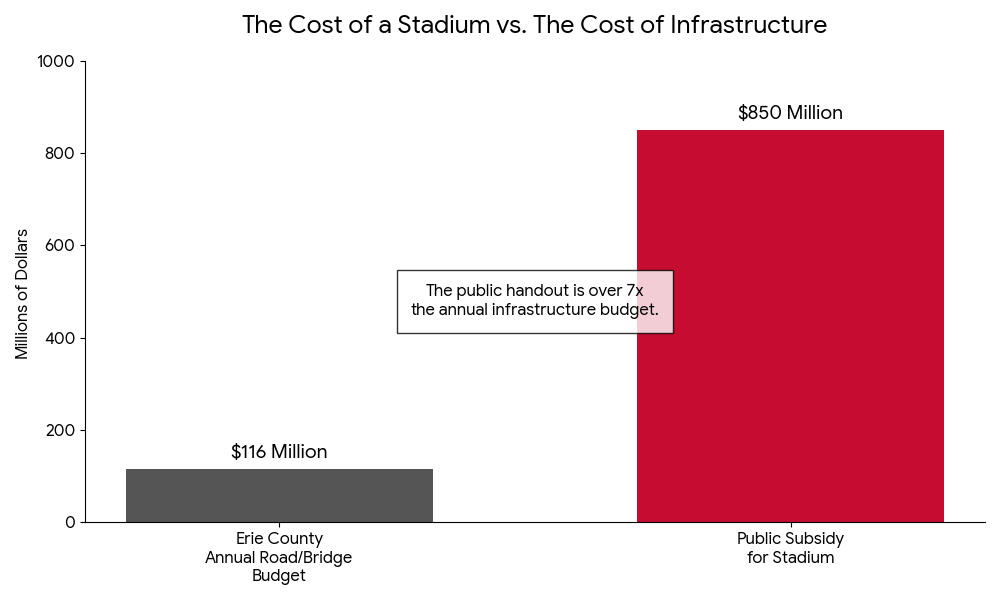
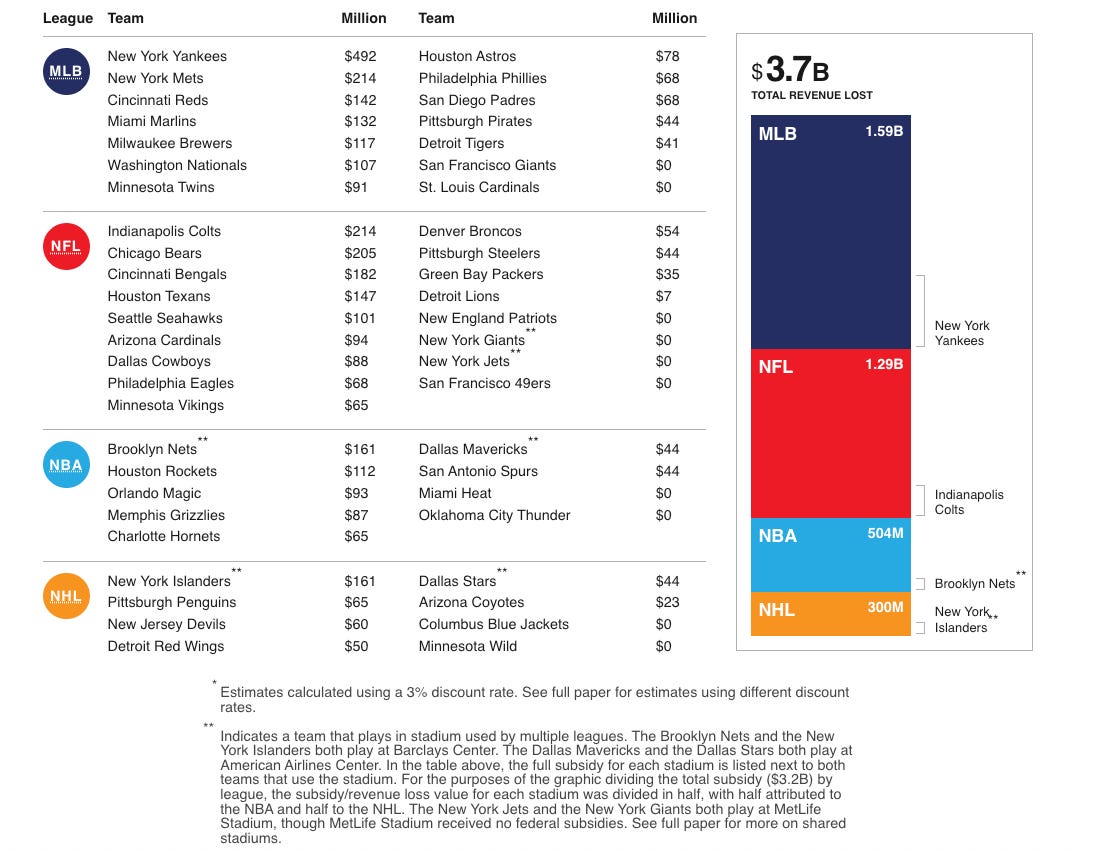
This is not a Buffalo problem. This is the model. Sacramento committed $284 million for Golden 1 Center to keep the Kings. Milwaukee put up $250 million for Fiserv Forum without it, the Bucks were as good as gone. Across North American professional sports, taxpayers have contributed tens of billions of dollars to stadium and arena construction over the past three decades. In virtually every case, the public bears a disproportionate share of the cost and receives a negligible share of the return.
This essay is about how monopoly power operates in American sports and why our political institutions are structurally incapable of resisting it.
The NBA & MLB have thirty teams. The NFL has thirty-two. These numbers are not determined by market demand, since at least a dozen additional cities could support an NBA franchise tomorrow. The leagues know this, and yet they keep the number of teams artificially low for the same reason De Beers keeps diamonds in a vault: scarcity is the product.
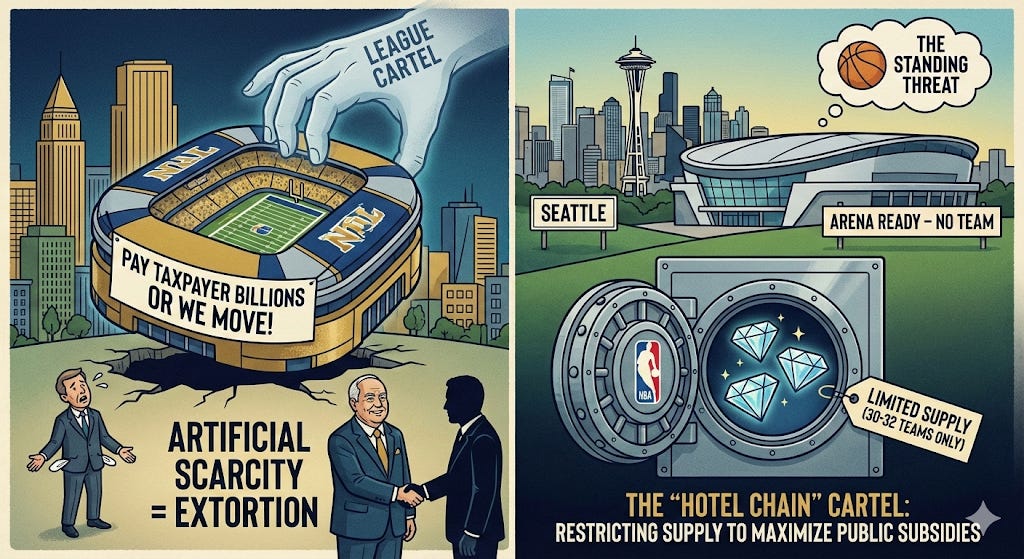
This is a cartel. Thirty independently owned businesses coordinate to restrict output, divide geographic markets through exclusive territorial rights, and collectively leverage their artificial scarcity against cities competing for franchises. In any other industry, this would trigger immediate antitrust enforcement.
Imagine thirty hotel chains agreeing to cap the total number of hotels in America at thirty, carving up exclusive territories, and then telling each host city that if it doesn’t provide a tax-funded building, the hotel will move to a city that will. The Department of Justice would be filing suit faster than you could google “Paris Hilton”.
Professional sports leagues get away with it because of a combination of limited statutory exemptions, cultural sentimentality, and the fact that their owners are among the most prolific political donors in the country.
The artificial scarcity is the engine of the entire extortion dynamic. Because there are always more cities that want teams than teams that exist, any city with a franchise faces a credible relocation threat from cities without one. Seattle has a renovated arena and no NBA team. That fact alone functions as a standing threat against Portland, Sacramento, and every other small-market franchise whose ownership might want a better deal. Commissioner Adam Silver never has to say a word. In fact, he just has to not say “we won’t let this team leave,” and the leverage operates on its own.
What makes the stadium subsidy racket particularly galling is that this is not a close call. It is not a topic where reasonable economists disagree. It is one of the most thoroughly settled questions in applied economics. Decades of peer-reviewed research from Stanford, Brookings, Smith College, and dozens of other institutions have concluded, nearly unanimously, that public stadium subsidies do not generate net new economic activity for host cities.
The leagues know this, which is why they don’t engage with the academic literature. Instead, they commission their own impact studies from consulting firms whose methodology is designed to produce favorable numbers. These studies count every dollar spent within a radius of the stadium as “generated” by the stadium, including businesses that predated it by decades. They assume visiting fans would have otherwise spent nothing, anywhere, on anything. The resulting figures are enormous, unserious, and extremely effective in city council presentations at eleven o’clock on a Tuesday night when everyone just wants to go home.
Every argument you’ve heard in favor of stadium subsidies has been studied and debunked. Here they are, one by one.
“Stadiums create jobs.”
They do. The question is what kind. The vast majority of stadium employment is part-time, seasonal, game-day work: ushers, concessions workers, parking attendants, security. These are not the kind of jobs that sustain a middle-class household. Economists Dennis Coates and Brad Humphreys studied every major professional sports facility built in the United States over a thirty-year period and found no statistically significant positive effect on employment or per capita income in host metropolitan areas. The finding was not “the effect is small.” The finding was that it doesn’t exist in the data. The high-paying jobs, the architects, engineers, and construction workers, are temporary and vanish once the building is finished. If a city wanted to create jobs with a billion dollars, there is virtually no worse way to do it than building a stadium.
“But the area around the stadium booms. Look at all the restaurants and bars.”
When someone spends $200 on dinner and drinks near the arena on game night, that’s largely money they would have spent somewhere else in the same metro area, at a different restaurant, at a movie, at a concert, at a bar in a different neighborhood. Economists call this the substitution effect. The spending near the stadium comes at the expense of spending elsewhere in the city. It’s not new economic activity. It’s relocated economic activity. Victor Matheson at College of the Holy Cross and Robert Baade at Lake Forest College have documented this extensively: the predicted “ripple effects” in team-commissioned feasibility studies systematically fail to materialize in actual post-construction data. Sean Dinces describes how the boom around the stadium is visible, but the corresponding decline in other neighborhoods is diffuse and invisible. Politicians point to the new restaurants near the arena. Nobody holds a press conference for the ones that closed across town.
“The team generates tax revenue that pays back the investment.”
In theory, the income taxes, sales taxes, and property taxes generated by the team and its surrounding activity should offset the public subsidy over time. In practice, this almost never happens. A Brookings Institution analysis found that for every public dollar spent on stadium subsidies, the local economy sees roughly thirty cents in return. You are not breaking even. You are not making a risky bet that might pay off. You are lighting seventy cents of every dollar on fire and handing the ashes to a billionaire. That’s the rate of return on the “investment” your mayor is celebrating at the press conference. The gap is structural: much of the highest-value economic activity in a stadium, player salaries, luxury suite revenue, naming rights, accrues to the franchise and its employees, many of whom don’t live in the host city. Many stadium deals also include tax abatements and exemptions for the team itself, which means the city is simultaneously funding the building and excusing the primary tenant from contributing to the tax base. It is difficult to design a worse investment if you tried.
“The team brings national visibility and prestige to the city.”
This is the “civic identity” argument, and it’s the most emotionally resonant defense of public subsidies. It’s also the one that economists have the hardest time engaging with, because it’s not really an economic claim. It’s a cultural one. There’s no question that sports teams are part of civic identity. The problem is using that emotional attachment to justify a financial transaction that would be rejected on its merits. If the mayor proposed spending a billion dollars on “civic prestige” with no measurable economic return, no equity for the public, and no accountability for how the money is used, the proposal would be laughed out of the room. Wrapping it in a basketball team doesn’t change the underlying math. It just makes the math harder to see. It’s also worth noting that civic identity is precisely the emotional lever the leagues exploit. The more deeply a city identifies with its team, the more leverage the owner has in subsidy negotiations. The “prestige” argument isn’t a defense against the extortion. It’s the exact mechanism of extortion.
“The owner is putting up hundreds of millions of their own money. That’s a partnership.”
When an owner puts up 30%, and the public puts up 70%, that is not a partnership. It’s a leveraged buyout in which the junior partner takes all the equity. In any real partnership, contributions are proportional to ownership. If the Pegulas are contributing $350 million to a $1.4 billion stadium, their “partnership” entitles them, in any normal business context, to about 25% of the asset. Instead, they own 100% of the asset and 100% of the revenue it generates. The word “partnership” is doing an enormous amount of work in these deals, and it’s doing it dishonestly. The owner’s contribution is not a sign of shared commitment. It’s the minimum amount necessary to make the deal politically viable, the threshold below which even the most cooperative city council would balk.
“If we don’t pay, another city will, and we’ll lose the team.”
This is the only honest argument in favor of public subsidies, and it’s the one that proves the entire system is broken. It is an explicit admission that cities are operating under duress. “Pay, or we’ll leave,” is not a partnership. It’s not an investment opportunity. It’s a threat, enabled by a cartel that maintains artificial scarcity precisely to create this leverage. The correct response to this argument is not to pay. It’s to change the system that makes the threat credible, through antitrust enforcement, interstate compacts, federal legislation, and the alignment of incentives described in this piece. Capitulating to extortion guarantees more extortion. It has never once led to the extortion stopping.
“This is just how the market works.”
No. This is how a monopoly works. A market would have competing leagues, free entry of new franchises, and no coordinated supply restriction. What we have instead is a cartel that fixes the number of teams, divides territories, and collectively bargains against cities from a position of manufactured dominance. Calling this “the market” is like calling a protection racket “the insurance industry.” The vocabulary is borrowed from legitimate commerce, but the underlying structure is coercive.
Economists Roger Noll and Andrew Zimbalist have spent careers studying all of this. Their conclusion is blunt: public stadium financing is almost never a good deal for taxpayers. The word “almost” is generous. They have yet to find the exception. The fundamental dishonesty is the framing of stadium subsidies as “investments.” An investment implies a return. When a city builds a bridge, it owns the bridge. When a city builds a school, it owns the school. When a city builds a $2 billion arena, it owns nothing. The building is effectively given to a private billionaire who captures all the revenue from tickets, luxury suites, naming rights, concessions, and most importantly, the appreciating value of the franchise itself. The public’s “return” is the intangible feeling of being a major league city, which cannot be deposited in a bank account or used to fill a pothole.
If every city in America collectively refused to subsidize stadiums, owners would fund their own buildings and professional sports would continue exactly as before. Television contracts, which now dwarf gate revenue, would still be worth tens of billions. Fans would still buy tickets. The product would be identical. The only difference would be that billionaires would pay for their own infrastructure, the way every other business in America does.
But no individual city can make this choice alone. That’s the trap.
The dynamic is a textbook prisoner’s dilemma. The collectively rational outcome, where no city subsidizes, is unstable because any single city can defect by offering a sweetheart deal to lure a team. And because the leagues maintain a permanent surplus of willing cities through artificial scarcity, there is always a defector waiting in the wings. Las Vegas will offer what Portland won’t. Oklahoma City will offer what Seattle wouldn’t. The result is a race to the bottom in which cities compete to transfer the most public wealth to private billionaires, and the only winners are the owners who designed the game.
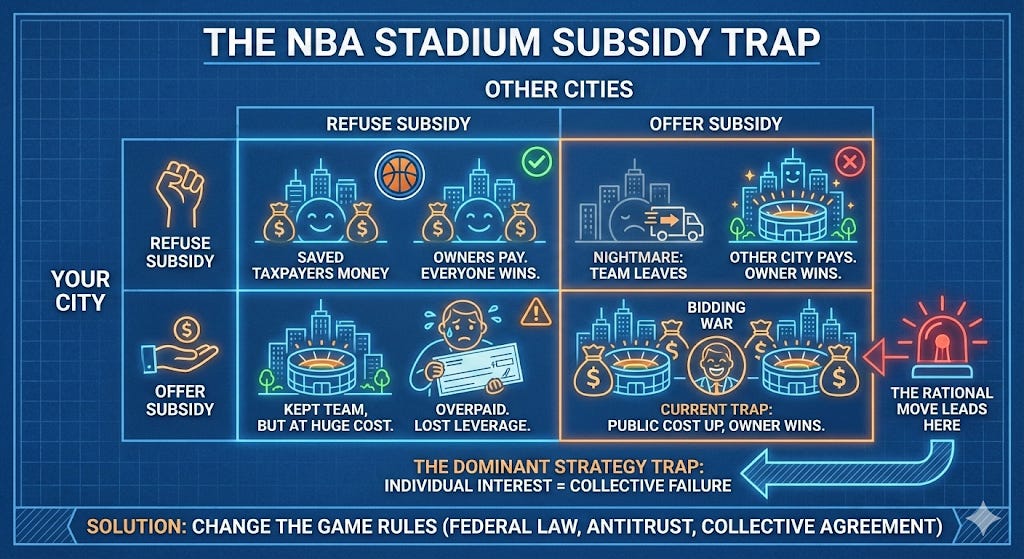
The political incentives reinforce this perfectly. A mayor who “saves” a team is a hero. A mayor who “loses” one is politically dead. The cost of the subsidy is diffuse, spread across millions of taxpayers in amounts too small for any individual to get angry about. The cost of losing a team is concentrated, emotionally devastating, and career-ending. No rational politician would choose fiscal responsibility over keeping the team, because the voters who care about the team care intensely, and the voters who care about the subsidy barely notice it.
The owners understand this asymmetry better than anyone. For many of them, it’s the primary reason they bought a franchise. The team isn’t the basketball operation or the football operation. The team is the leverage they have over an entire city full of taxpayers.
Once you see the core design flaw, every bad outcome becomes predictable, and every solution becomes obvious.
Right now, the incentives of team owners and fans are perfectly misaligned. Fans want their team to stay, invest in the community, and build something lasting. Owners want maximum leverage, which means the threat of leaving must always be cheap and credible. The entire stadium subsidy machine runs on this misalignment. Moving is easy. Staying is what costs money, your money. The owner’s ideal position is to be perpetually almost leaving, because that’s when the public funds flow fastest.
Think about how perverse this is. The system actively rewards owners for threatening the communities that support them. An owner who builds deep roots, invests his own money, and commits to a city for generations is, under the current structure, a sucker. The smart play is to keep one foot out the door at all times, because that’s the posture that triggers public subsidy. Loyalty is punished. Disloyalty is subsidized.
Every reform worth pursuing shares a single principle: make it expensive for owners to leave and cheap for them to stay. Flip the incentive structure, and the extortion collapses on its own.
The most direct version: if the public funds 70% of an arena, it should own 70% of the asset, or hold a proportional equity stake in the franchise. This is how investment works in literally every other context on earth. A venture capitalist who puts up 70% of the capital owns 70% of the company. When cities put up 70% of a stadium, they receive zero equity and zero share of appreciation. When the franchise sells for multiples of its purchase price, appreciation driven substantially by the publicly funded building, the entire gain goes to the owner.
But equity does something beyond fairness. It changes the calculus of relocation. An owner who would forfeit a billion-dollar public equity stake by moving thinks very differently from an owner who can walk away clean. Suddenly, staying is the profitable move and leaving is the costly one. The incentives flip.
Green Bay proves this works at the deepest level. The Packers are community-owned. They can’t leave. And because they can’t leave, they never need to threaten to leave, which means they never need to extort the public for a new stadium. The alignment between the team and its community is total, and the franchise is one of the most valuable and beloved in professional sports. The NFL’s response was not to celebrate this model but to ban any other team from adopting it. The NBA never allowed it in the first place. Community ownership would eliminate the leverage dynamic entirely, and the owners know it.
Short of equity, every mechanism should be designed around the same principle. Clawback provisions triggered by franchise sale ensure that an owner who builds value in a publicly funded arena and then cashes out must share the upside with the public that created it. Revenue-sharing agreements that escalate over time make a long tenancy more profitable than a short one. Relocation penalties, written into every public financing deal, that require an owner to repay the full public investment plus a premium if the team moves within thirty years, make leaving punishingly expensive.
The point is not to trap owners. It’s to align their financial interests with the community’s interests. When staying is more profitable than threatening to leave, owners will stay and invest. When the cost of departure is high enough, the relocation threat loses its power, and with it the entire leverage structure that drives public subsidies.
Cities could also form interstate compacts, agreements among the top forty or fifty metro areas pledging not to offer public subsidies beyond a defined threshold. This kills the prisoner’s dilemma overnight. If no city is willing to offer a billion-dollar giveaway, owners can’t play cities against each other. This is not utopian. It is essentially what the European Union does with state aid rules, prohibiting member states from engaging in destructive subsidy competition. There is no structural reason American cities couldn’t do the same.
These reforms would transform the landscape. But none of them address the root cause: the monopoly power that makes the extortion possible in the first place.
Which brings us to the part of this story you probably haven’t heard.
The popular assumption is that professional sports leagues have broad antitrust immunity. This is wrong, and the fact that most people believe it is one of the great unexamined advantages the leagues enjoy.
Baseball has a blanket antitrust exemption, established in a 1922 Supreme Court case where Justice Holmes concluded that baseball wasn’t interstate commerce. This is one of the most widely ridiculed decisions in American legal history. It was wrong when it was decided and it’s farcical now. But it’s never been fully overturned.
Here’s what matters: the other leagues don’t have this exemption. The NFL, NBA, and NHL have a narrow statutory exemption under the Sports Broadcasting Act of 1961, which permits them to collectively negotiate television contracts. Beyond that, they are subject to the Sherman Antitrust Act like any other business.
And in 2010, the Supreme Court made this unmistakably clear.
In American Needle v. NFL, the Court ruled unanimously, nine to zero, that NFL teams are not a single entity for antitrust purposes. They are separately owned, independently managed businesses capable of conspiring in violation of Section 1 of the Sherman Act. Justice Stevens wrote the opinion. It was not close. It was not ambiguous.
Read that again, because its implications are enormous and almost completely unexplored.
If NFL teams are separate entities capable of antitrust conspiracy when they collectively license their trademarks, they are equally capable of conspiracy when they collectively restrict the number of franchises, enforce territorial exclusivity, and coordinate leverage against host cities to extract public subsidies. The legal logic is identical. The only difference is that nobody has applied it.
The relocation threat itself is arguably actionable under Section 1. When the NBA maintains artificial scarcity by refusing to expand to markets that could support teams and then uses the resulting leverage to extract hundreds of millions in public subsidies, that is a coordinated restraint of trade. Cities are paying supracompetitive prices, in the form of subsidies, for a product whose cost is artificially inflated by collective supply restriction. In antitrust terms, this is cartel pricing. The “price” just happens to be paid in tax dollars rather than on an invoice.
There’s also precedent. In the 1980s, when the NFL tried to block Al Davis from moving the Raiders from Oakland to Los Angeles, Davis sued under antitrust law and won. The jury found that the NFL’s franchise relocation restrictions constituted an unreasonable restraint of trade. If restricting movement violates antitrust law, enabling strategic relocation threats as a coordinated bargaining tactic against cities is at least equally suspect.
So why hasn’t anyone sued?
Oakland already did. They lost. But how they lost, and why, is actually the most important part of this story.
In 2018, after the Raiders announced their move to Las Vegas, Oakland filed an antitrust suit against the NFL and all 32 teams. The city made almost exactly the argument laid out in this piece: that the league is “an unambiguous cartel” whose rules “restrict the supply of new teams to prospective cities,” and that this artificial scarcity was used to extract public subsidies Oakland couldn’t afford, ultimately driving the team away. They sought over $240 million in damages.
The Ninth Circuit dismissed the case. The court acknowledged that Oakland had standing to sue, accepting that the city plausibly would have kept the Raiders but for the league’s conduct. But it ruled that the conduct itself didn’t amount to an unreasonable restraint of trade under Section 1 of the Sherman Act. The core problems were two. First, the court said Oakland had only shown that a single producer, the Raiders, refused to deal with it, which isn’t a group boycott. Second, the court found Oakland’s damages “highly speculative and exceedingly difficult to calculate.” How do you prove what would have happened in a hypothetical competitive marketplace? Would new teams have entered? Would they have chosen Oakland? The chain of causation had too many speculative links.
The Supreme Court declined to hear Oakland’s appeal in October 2022, without comment.
So the legal theory failed. Does that mean the leagues are untouchable?
No. But it means the next challenge has to be smarter about how it’s constructed.
Oakland’s suit was framed around a single relocation event, asking the court to work backward from “the Raiders left” to “the NFL’s structure caused it.” That framing invited exactly the speculation the court used to dismiss the case. A more viable theory would target the systemic practice itself: the coordinated restriction of franchise supply combined with the collective use of relocation threats to extract public subsidies across dozens of cities over decades. That’s not one team refusing to deal with one city. That’s a pattern of coordinated conduct affecting every host city in the country, with quantifiable public costs running into the tens of billions.
The American Needle precedent still stands. The Supreme Court ruled unanimously, nine to zero, that NFL teams are separately owned businesses capable of conspiring under the Sherman Act. That hasn’t been overturned or narrowed. What Oakland’s case showed is that the application of that principle to relocation specifically is harder than the principle itself might suggest. The theory needs to be constructed not around a single team leaving a single city, but around the league-wide practice of supply restriction and subsidy extraction as a coordinated scheme.
There’s also a completely different legal path that has already proven it works.
When the Rams left St. Louis, the city didn’t file an antitrust suit. It filed a breach of contract claim, arguing that the Rams and the NFL violated the league’s own relocation policies, which require teams to demonstrate good faith efforts to remain in their host city before moving. St. Louis won. The case settled for $790 million. That’s real money, extracted from the league through existing legal frameworks, without needing to establish new antitrust doctrine.
Oakland could pursue the same theory against MLB for the Athletics’ departure. MLB has its own relocation policies. The A’s spent years in bad faith negotiations, systematically disinvesting in the Oakland product while angling for a Las Vegas deal. The city invested $200 million in stadium renovations in 1995 to bring the Raiders back, and proposed a $1.3 billion plan for the A’s. If there’s a case that the league’s relocation process was violated, that’s a contract claim that doesn’t require reinventing antitrust law.
The legislative path is also live. After the A’s relocation was announced, Congresswoman Barbara Lee introduced the “Moneyball Act,” which would require relocating baseball teams to compensate the state and local governments that invested in them. Separate bipartisan legislation was introduced in the Senate to revoke MLB’s antitrust exemption entirely. Neither has passed, but the A’s move has generated more Congressional interest in the antitrust exemption than any event in decades. Stadium subsidies are one of the rare issues where populist left and populist right agree: progressives hate the wealth transfer to billionaires, and conservatives hate the crony capitalism and government waste. The political ingredients for federal action exist even if the catalyst hasn’t arrived yet.
And on the subsidy side itself, the Nevada State Education Association has sued to block the $380 million in public funds allocated for the A’s new Las Vegas stadium, arguing the bill authorizing the financing is unconstitutional. Their argument is simple and devastating: every dollar spent building stadiums is a dollar not spent on public education. That case is still being litigated.
So where does this leave us?
The legal landscape is harder than the pure theory might suggest, but it’s far from hopeless. The antitrust path requires a more sophisticated construction than Oakland’s first attempt. The contract path has already produced a $790 million result. The legislative path has bipartisan potential. And the direct challenge to stadium subsidies themselves is being fought right now by teachers in Nevada.
The leagues are not invulnerable. They’re just well-defended. And every failed challenge teaches the next plaintiff what to do differently. Oakland’s Raiders suit failed on the theory that a single city being “priced out” is too speculative to constitute antitrust injury. Fine. The next suit should focus on the systemic scheme: thirty-two owners collectively restricting supply and collectively benefiting from the resulting subsidy extraction, with damages measured not by one city’s loss but by the tens of billions transferred from taxpayers to owners across the entire system over thirty years.
That’s not speculative. That’s an accounting exercise.
Someone still needs to file it.
The NBA just signed a television deal worth $76 billion. That money flows to owners, not to the cities that built the arenas where the games are filmed. Not to the fans that buy tickets, jerseys, and invest their precious time and energy. NFL franchises are worth $4 to $8 billion each, valuations inflated substantially by publicly funded stadiums. These owners are not struggling. They do not need help. They simply prefer your money to their own, and the structure of American sports governance lets them take it.
Every dollar of public money that goes to a billionaire’s stadium is a dollar that doesn’t go to schools, transit, housing, or parks. Every arena deal structured without public equity is a wealth transfer from the many to the few, blessed by elected officials whose incentives point in the wrong direction.
But this is not an essay about hopelessness. It’s the opposite.
The core problem is an incentive misalignment so simple a child could spot it: it is currently free for owners to threaten to leave and expensive for the public to make them stay. Loyalty is punished. Disloyalty is subsidized. The system pays billionaires to behave like extortionists and then acts surprised when they do.
Every solution, equity stakes, clawback provisions, relocation penalties, interstate compacts, antitrust enforcement, works by reversing that equation. Make staying profitable. Make leaving costly. Align the owner’s financial interest with the fan’s emotional interest. That’s it. That’s the entire reform agenda in one sentence.
The economics are clear. The legal precedents exist. The policy tools are available. The ideal plaintiff is sitting right there in the East Bay with nothing left to lose and every reason to fight.
For decades, the leagues have counted on the public not understanding how the game works. The artificial scarcity, the prisoner’s dilemma, the antitrust vulnerability, the fact that a single lawsuit from the right city could crack the whole structure open. They’ve counted on your emotional attachment to your team being stronger than your willingness to see the system clearly.
They’ve been right so far.
The question is whether that holds.
Sources:
Dennis Coates and Brad Humphreys, “The Effect of Professional Sports on Earnings and Employment in the Services and Retail Sectors of US Cities,” Regional Science and Urban Economics, 2003. Also their broader survey: “Do Economists Reach a Conclusion on Subsidies for Sports Franchises, Stadiums, and Mega-Events?” Econ Journal Watch, 2008.
Roger Noll and Andrew Zimbalist, Sports, Jobs, and Taxes: The Economic Impact of Sports Teams and Stadiums, Brookings Institution Press, 1997. This remains the foundational text.
Victor Matheson, “Is There a Case for Subsidizing Sports Stadiums?” Journal of Sports Economics, various years. Matheson’s work at Holy Cross is among the most accessible for non-economists.
Robert Baade, “Professional Sports as Catalysts for Metropolitan Economic Development,” Journal of Urban Affairs, 1996. Baade’s longitudinal data showing no positive relationship between stadiums and regional economic growth is devastating.
Ted Gayer, Austin Drukker, and Alexander Gold, “Tax-Exempt Municipal Bonds and the Financing of Professional Sports Stadiums,” Brookings Institution, 2016. This is the source for the roughly thirty-cents-on-the-dollar return finding.
The National Bureau of Economic Research (NBER) has published multiple working papers on stadium subsidies, virtually all reaching the same conclusion. Search their database for “stadium subsidies” and you will find no support for the proposition that they work.
No posts
Comments
Nothing yet. Say the first thing.
Sign in to join the conversation.