
If you’ve watched the NBA over the past quarter-century (congratulations, you’re old), you’ve noticed the game has changed.
Tune into a nationally televised Wednesday game and your favorite team’s best player is sitting out with “knee soreness.” Every team runs the same offense — five guys standing around the three-point line launching 25-footers. Your team has been openly, shamelessly terrible for three straight years, and the front office keeps telling you to “trust the process.” You’re paying $200+ for lower-bowl seats to watch guys you’ve never heard of lose by 30.
These seem like separate problems, but they’re not. They’re all rational responses to the same underlying incentive structure, one that systematically rewards the exact behavior that makes the product worse:
Load management isn’t laziness. It’s what happens when a $55 million player’s health matters more than any individual game out of 82.
Tanking isn’t cowardice. It’s what happens when one transcendent draft pick is worth more than five years of competitive mediocrity.
Three-point homogenization isn’t a lack of creativity. Every team has access to the same analytics, and the math says the same thing to all of them.
The good news: if the problems are structural, the solutions are structural. You don’t need to scold players into caring about January basketball. You need to redesign the system so that caring about January basketball is the smart play. Every new incentive structure will itself be optimized by rational actors looking for edges. Thirty front offices staffed with Ivy League MBAs and former quants will spend all summer trying to game whatever system you build.
The test of a good reform isn’t whether it looks elegant on paper. It’s whether it remains robust when those people get their hands on it. The following is a proposal designed to survive that stress test.
The “NBA is dying” narrative is popular but mostly wrong. It’s also partly right, and understanding why both things are true simultaneously is essential context for what follows.
The peak of NBA viewership was Michael Jordan. The 1998 Bulls-Jazz Finals averaged 29 million viewers, and Game 6 drew nearly 36 million — the most-watched basketball game in history. After Jordan’s retirement, viewership dropped by a third almost overnight and has never recovered. The move from NBC to ESPN/ABC in 2002 cost another 23%. By 2003, regular-season games averaged about 1.58 million viewers, and that number has barely changed in twenty years — fluctuating in a narrow band between 1.5 and 1.9 million, with two notable spikes (LeBron’s Miami years hit 2.5 million; the Warriors dynasty provided a smaller bump) and one notable trough (the COVID bubble bottomed out at 1.36 million).
So the NBA didn’t gradually bleed viewers over two decades like many have suggested. It fell off a cliff after Jordan, stabilized, and has held roughly steady while the television medium underneath it collapsed. Primetime TV has lost about 40 million viewers over the same period. Cable penetration dropped from 76% of households in 2015 to around 56% today. Streaming now accounts for over 46% of all TV viewing. The NBA’s audience didn’t disappear. The delivery mechanism did.
The proof came this season. The 2025-26 campaign opened with a new $76 billion media deal that put games on NBC, Peacock, Amazon Prime Video, and ESPN — critically eliminating every cable-exclusive game (there were 77 last year). The result was immediate: viewership up 89% year-over-year, the best opening month in 15 years, Christmas Day ratings up 45%. The basketball didn’t change. The distribution did.
If the numbers are up, then what’s the problem? The problem is that this rebound masks a genuine product problem. The numbers are inflated by novelty (the NBA on NBC is back!), by 130 million Amazon Prime subscribers who weren’t watching before, and by Nielsen methodology changes that make year-over-year comparisons unreliable. When that novelty fades — and it will — the underlying product issues will reassert themselves. Distribution reform without product reform is a sugar high.
Those product issues are what this proposal addresses.
Each game is 1.2% of the schedule. That’s not enough for any single game to matter, and the math gets worse when you factor in player economics. A max player making $55 million represents roughly $670,000 per game. But the actual cost of that player isn’t his per-game salary — it’s his option value. A franchise player’s health is tied to the team’s championship window, which is tied to franchise valuation, now north of $4 billion for most teams. When the medical staff says playing your center on the second night of a back-to-back after a cross-country flight increases his soft tissue injury risk by some meaningful percentage, you sit him. The expected cost of a catastrophic injury — a torn ACL, an Achilles rupture — dwarfs the marginal value of winning a January game against Charlotte.
This isn’t just cautious. It’s rational. The incentive structure tells teams the regular season is a cost center, not a product. And under the current math, they’re right.
Basketball is the most individual-impact sport among the major leagues. One transcendent player can drag a mediocre roster to the conference finals. LeBron did it in Cleveland. Luka did it in Dallas. Wembanyama is doing it in San Antonio right now.
The draft is how you get those players, and the lottery system — even after the 2019 reforms — still massively rewards being terrible. The three worst teams each have a 14% chance at the number one pick and over a 50% chance of landing in the top four. The 10th-worst team has a 3% chance at number one. The difference between terrible and mediocre in expected draft value is enormous.
Every front office that isn’t a contender faces the same binary: be mediocre, pick 10th-15th every year, and run on the treadmill of first-round exits indefinitely — or be terrible for a couple years, maximize lottery odds, and hope to land the franchise-altering prospect. Nobody remembers the team that won 38 games five years in a row. Everyone remembers that the Spurs tanked in 2022-23 and got Wembanyama.
The treadmill of mediocrity is the actual death sentence. Tanking is the cure. And until you change that calculus, it will continue.
The analytics revolution correctly identified that corner threes, layups, and free throws are the highest-value shots. Every front office has the same data and reaches the same conclusion: space the floor, generate threes, hunt mismatches in ball-screen action. Teams now average a record 37.4 three-point attempts per game, with the Warriors shooting 45 a game — just over 50% of their total attempts. In December 2024, the Bulls and Hornets combined to miss 75 threes in a single game. A brick every 38 seconds. That’s not basketball.
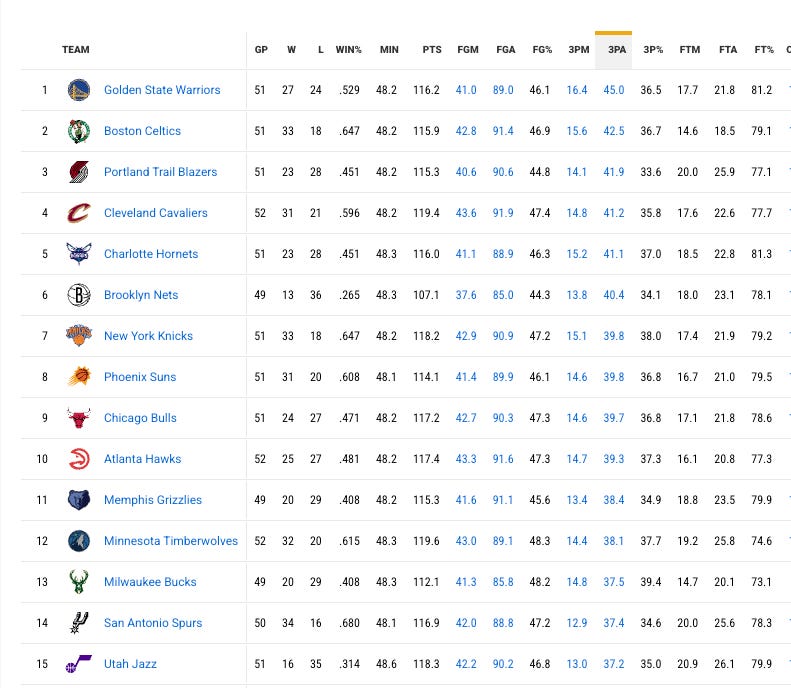
This is called a Nash equilibrium: no individual team benefits from deviating from the optimal strategy, even though the collective product suffers from everyone running the same offense. When the Celtics play the Cavaliers, and both teams launch 50 threes, the game looks the same as when the Warriors play the Timberwolves and both teams launch 50 threes. Stylistic diversity — the thing that makes individual matchups compelling, the thing that used to make “Knicks vs. Pacers” feel completely different from “Lakers vs. Kings” — has been optimized out of the league.
But the three-point line is only one factor in this convergence, and maybe not even the most important one. The 2001-02 illegal defense rule changes opened up ball-screen actions by eliminating zone restrictions. The “freedom of movement” emphasis made it nearly impossible to physically contest ball-handlers. The switch-everything defensive paradigm — itself a response to five-out spacing — made post-ups inefficient against good teams. The current offensive homogeneity is a product of the entire rule ecosystem, not just the distance from the basket to the arc. Any reform that focuses exclusively on the three-point line is treating one symptom while ignoring the disease.
These reforms are designed as an interlocking system. Each one reinforces the others, and the package is more robust than any individual piece. Buckle up.
Play every team twice — once home, once away — for 58 games. Why 58? Because the logic should dictate the structure. Twenty-nine opponents times two is 58. It’s clean and short enough to change the load management calculus significantly without being so short that the league hemorrhages revenue beyond recovery.
Each game now represents 1.7% of the season instead of 1.2% — a massive 42% increase in the marginal value of every contest. With 24 fewer games, back-to-backs after cross-country flights get dramatically reduced, and players can play a higher percentage of a shorter season than they currently play of the longer one. Start in late November, finish in late March, playoffs April through June. The NBA stops competing head-to-head with the NFL during October and November — a battle it has been losing for two decades.
The money problem. Twenty-four fewer home games means roughly $50-70 million per team in lost gate revenue annually, or $1.5-2.1 billion across the league. Per-game viewership should rise when each game carries more weight, and the freed-up October-November window creates space for a lucrative international exhibition series. But the honest answer is that the financial case depends on assumptions about elasticity that can’t be proven in advance.
The labor problem. The NBPA will view fewer games as a reduction in earning potential regardless of what compensation guarantees say on paper. The CBA negotiation needs a hard floor on total player compensation with escalators, probably sweetened with concessions on guaranteed contracts and free agency. This negotiation will be brutal. It is also not impossible — a shorter season with guaranteed compensation and healthier careers is a deal the union can accept, especially when the alternative is watching stars break down in their early thirties from an 82-game grind that everyone privately acknowledges is too long.
The top seed in each conference skips the first round and advances directly to the second round. Seeds 2-6 are locked in, and seeds 7-10 compete through the play-in for the final spot. First round: 2v7, 3v6, 4v5 — three series, three winners, re-seeded into the second round against the 1-seed and each other.
Right now, the difference between the 1-seed and the 3-seed is home court in a potential conference finals — worth maybe 55-60% win probability per home game. Not enough to make a team think twice about resting a star in game 50.
A first-round bye is categorically different. It means skipping a four-to-seven game series against a dangerous lower seed — and first-round upsets happen. The 2023 Heat knocked off the top-seeded Bucks. The 2007 Warriors stunned the Mavericks. Eliminating that minefield while your second-round opponent grinds through a physical series is a transformative advantage.
Imagine game 53 of 58. Your team is one game ahead for the 1-seed. Your best player has minor knee soreness — the kind that currently earns an automatic rest day. Under the bye system, the cost of dropping to the 2-seed and having to play a full extra series vastly exceeds the risk of playing through manageable soreness. The incentive flips completely. And “can the Thunder hold onto the 1-seed?” is a story that sustains engagement deep into March — right now, the regular-season narrative is dead by the All-Star break.
The rust problem. Rest isn’t purely beneficial — teams off long layoffs can look sluggish. But NFL bye teams win their subsequent playoff game roughly 65-70% of the time, significantly above baseline. The physical toll of a playoff series is enormous, and the scouting advantage of watching your opponent grind through a first round while you prepare is real. NBA teams already experience 2-3 day gaps between playoff games; extending that to a week-plus with full-intensity practice is different in degree, not in kind. If bye teams consistently underperform in the first few seasons, the league revisits. But the default assumption, supported by decades of NFL evidence, should be that rest helps more than it hurts.
There’s a fairness objection: a team that survives the play-in and a grueling first-round series, then faces a rested 1-seed, has a legitimate complaint. But this asymmetry is the incentive, not a flaw. The lower seed had a path to avoid that fate — win more regular-season games.
The revenue cost is real: two fewer first-round series means roughly $55-88 million in lost annual revenue (about 11 fewer games at $5-8 million each). The bet is that the remaining games are more compelling and higher-rated because the regular season actually mattered. That bet is defensible but not certain.
The Cup champion earns a guaranteed top-four seed in their conference’s playoff bracket, regardless of regular-season record.
Why not a bye? Because giving the Cup winner a bye creates a distortion: dominant teams already holding the 1-seed have no reason to care, while mediocre teams can backdoor into a bye through a short, variance-heavy tournament. A top-four seed guarantee is valuable enough to matter — home court through at least the first round — without warping the entire structure.
This creates fascinating strategic dilemmas. Does a conference leader invest in the Cup or preserve energy? Does a 6-seed go all-in for a guaranteed top-four spot? The Cup stops being an exhibition with a goofy trophy and becomes a competition with real consequences — and it matters most for teams in the 5-10 range, exactly the teams that currently have the least to play for.
Create a Star Availability Index tracking what percentage of eligible games each team’s top-three earners actually play.
Baseline: 85% availability earns the standard media revenue share.
Above 90% earns a bonus up to 5%.
Below 80% takes a haircut up to 5%.
Major injuries (ACL tears, fractures, surgical recovery) are excluded by an independent medical panel. “Knee soreness” and “rest” count against you.
The NBA fined the Spurs $250,000 for resting players in 2012. Pop probably spent more than that on wine that year. A 5% media revenue adjustment is worth several million annually — enough to get ownership’s attention without incentivizing teams to run genuinely hurt players onto the floor. It’s a blunt instrument for a nuanced problem, but it will eliminate the most egregious cases of healthy stars sitting out nationally televised games for “rest.”
The three-point line needs to move back 18 inches, from 23’9” to approximately 25’3”. The expected value of an average three (currently about 1.08 points per attempt) drops closer to the expected value of an average two (about 1.00), and that single shift reopens the mid-range game that analytics has optimized out of basketball.
But moving the arc back creates a corner problem that has to be addressed, because ignoring it would undermine the entire reform. The corner three is currently 22 feet — shorter than the rest of the arc because the sideline prevents extension. That geometric accident has made it the most efficient shot in basketball: higher percentage, shorter distance, same three points. Duncan Robinson’s entire career exists because of it. If you push the above-the-break line back 18 inches but can only push the corner back 6-8 inches, you’ve widened the efficiency gap and every smart offense responds by hunting corners even more aggressively. You haven’t solved homogeneity — you’ve created a different monoculture.
The cleanest solution: make the corner a two-point zone. Redraw the three-point line as a uniform arc and let it intersect the sideline where it intersects. A wide-open corner 22-footer is still a good shot — it’s just a high-percentage two, not the most valuable three in basketball. This breaks the five-out orthodoxy because corner defenders can sag off slightly, which changes help rotations, driving lanes, and the entire offensive calculus. The floor doesn’t collapse — it restructures, and that restructuring is what creates space for different philosophies to emerge.
The concern that eliminating corner threes congests the interior is real but mitigated by the companion reforms below — if defenders are required to maintain man-to-man positioning, they can’t simply camp in the paint when their man is in the corner.
Three-point geometry alone isn’t sufficient. Elite shooters will adjust their range within two seasons. The deeper drivers of offensive sameness are the “freedom of movement” foul standard that made physical perimeter defense impossible, and the switch-everything defensive paradigm that killed post-ups and pick-and-roll diversity. Two additional changes:
Allow more physical perimeter defense. Recalibrate foul standards to permit more physicality contesting ball-handlers — not 1990s hand-checking, but a meaningful shift. If defenders can be more physical, driving becomes harder, mid-range pull-ups become more valuable, and teams diverge in offensive approach. Enforced through referee training and points of emphasis, exactly the way the 2021-22 crackdown on foul-baiting was implemented.
Reintroduce a modified zone restriction. Require at least three defenders to maintain man-to-man positioning at all times, with only two in help or zone. This constrains switch-everything by forcing teams to fight through screens or live with mismatches, which makes post-ups viable again and reopens driving lanes. Referees already know how to call this — it’s how illegal defense was officiated before 2002.
These rules also solve the corner congestion concern: man-to-man requirements keep defenders honest on their assignments, maintaining floor spacing through defensive structure rather than through the gravitational pull of a corner three.
Together — a uniform arc with no corner threes, more physical defense, and a partial zone restriction — the Knicks can grind you out with mid-range pull-ups the way the Garden is supposed to look, the Celtics can rain threes from 25 feet, and the Nuggets can run everything through Jokic in the post. Each matchup feels distinct, which is exactly what the league has lost.
All rule changes can be announced 18 months before implementation, tested in the G-League for a full season.
The reforms above fix the top and middle of the league. But they do essentially nothing for the bottom. A team that’s 8-22 at the halfway point doesn’t care about byes or Cup stakes. They care about lottery odds. And under the current system, the rational move is to lose as much as possible.
Tanking is the NBA’s most cynical pathology because it’s the one that treats the paying customer with open contempt. Trust the Process. Be patient. Suffer now, and maybe in four years we’ll be good. The 2019 lottery reform — flattening odds so the three worst teams share equal 14% chances at the top pick — was a half-measure. Teams still tank. They just don’t need to set the all-time loss record to do it.
The structural fixes — flattening the bottom five teams’ lottery odds to equal chances (roughly 11% each), imposing a hard salary floor at 90% of the cap with dollar-for-dollar redistribution penalties, and restricting tanking mechanisms like mid-season buyouts and two-way roster manipulation — are all necessary. But the most promising idea is creating genuine second-half stakes for non-contenders.
At the two-thirds mark of the season, the six teams with the worst records enter a Competitors’ Bracket — a round-robin drawn from the remaining schedule, with matchups given premium broadcast windows. The bracket winner earns a modest lottery odds bonus (an additional 3% chance at the top pick). The bracket loser takes a penalty (minus 2%). This inverts the second-half incentive entirely. Instead of the late-season shutdown — where your best players mysteriously develop “soreness” every night, and the front office is openly rooting for losses — the worst teams are competing against each other for a tangible reward while facing a tangible penalty for continued losing.
Desperation basketball is genuinely compelling television. “Bad team fights for its life” is a better story than “bad team rolls over and waits for the draft.” And it gives fans of bad teams something to care about in March besides mock drafts and ping-pong ball probability tables.
Any serious reform proposal has to reckon with the fact that the NBA is increasingly a global league. Its fastest-growing revenue streams are international media rights and merchandise. Its talent pipeline is more global than ever — Wembanyama, Giannis, Jokic, Luka, SGA are all international players carrying their franchises. And the competitive landscape is shifting: European leagues are retaining more talent, and the prospect of a rival league backed by sovereign wealth (the Saudis have entered the chat in every other sport) is no longer far-fetched.
A 58-game season starting in late November creates a natural October window for international play. The league should formalize this with an annual NBA Global Series — not the current ad hoc preseason games in random cities, but a structured two-week international window featuring eight teams playing competitive exhibition games across four international markets: London, Paris, Tokyo or Shanghai, and a rotating fourth city. These games would count toward the Star Availability Index (incentivizing teams to bring their real rosters, not a bunch of end-of-bench guys), generate significant international revenue, and build the global fanbase that insulates the NBA against domestic viewership fluctuations.
More strategically, a robust international presence serves as a competitive moat. If the NBA has established relationships with international broadcasters, arena operators, and fan bases across every major market, it becomes much harder for a rival league to gain traction. The league should be thinking about international expansion not as a marketing opportunity but as competitive defense against threats that haven’t fully materialized yet but clearly will.
Most reform proposals treat the NBA’s audience as monolithic. It isn’t.
Devoted team fans who watch 40-plus games a year benefit unambiguously from a shorter, higher-stakes season with more star availability.
Casual national viewers who tune in for marquee matchups and Christmas Day benefit from the narratives these reforms generate — the bye race, the Cup, the late-season drama.
International fans who consume the NBA through highlights and social media benefit from more star availability and a dedicated international window.
The one group that loses is fantasy and betting consumers, who want volume — more games, more stat lines, more prop bets. A 58-game season is objectively less product for them. The counterargument is that games with real stars playing are better betting products than games featuring rest-day lineups, and that new markets around the Cup and Competitors’ Bracket partially offset the lost volume.
But the league should be honest that this proposal optimizes for the fans in the arena and on the couch, not the ones refreshing DraftKings.
The test of a reform package isn’t whether each piece is individually clever. It’s whether the pieces create a coherent system where the rational choice at every competitive tier also produces the best product. Here’s how these reforms interact:
For contenders: The bye incentive and Cup stakes make every regular-season game meaningful. The SAI creates financial pressure against load management. The rule changes create stylistic diversity that makes each matchup distinctive. Stars play because playing is the smart move, not because someone guilted them into it.
For middle-tier teams: The Cup provides a path to a guaranteed top-four seed, which means teams in the 5-8 range have something to play for beyond “making the playoffs and losing in the first round.” The competitive treadmill — the 38-win purgatory that currently drives teams to blow it up and tank — becomes less of a dead end because the Cup offers a genuine structural advantage that doesn’t require being the best team in the conference.
For bad teams: Flattened bottom-tier lottery odds eliminate the reward for being worse than other bad teams. The Competitors’ Bracket creates second-half stakes. The salary floor ensures financial investment in the roster. You can still be bad through genuine rebuilding, but you can’t engineer your way to the bottom and profit from it.
For fans: A 58-game season starting in late November means every game carries weight, the product doesn’t compete with football, and the compressed schedule creates urgency. Rule changes produce stylistically distinct matchups — you can tell the difference between a Knicks game and a Thunder game with the sound off. Star availability requirements mean you actually see the players you bought tickets to watch.
For broadcast partners: NBC, ESPN, and Amazon are paying $76 billion over eleven years. These reforms increase the value of that investment: higher per-game viewership, more meaningful games in broadcast windows, stars present for nationally televised matchups, and a playoff structure that creates multiple overlapping narratives — the bye race, the Cup, the Competitors’ Bracket — sustaining interest across the full season instead of letting it flatline after the All-Star break.
The NBA’s greatest asset is that people love basketball. The sport itself — the athleticism, the creativity, the drama of five-on-five competition at its highest level — is as compelling as it’s ever been. What’s broken isn’t the game. It’s the system around the game. The incentive structure has drifted into a place where resting your star is smarter than playing him, losing on purpose is smarter than competing, and shooting the same shot as every other team is smarter than doing anything different.
Every new system will be gamed. That’s the deepest lesson of the current NBA: rational actors optimize whatever structure you give them. The question isn’t whether the new equilibrium will be perfect — it won’t — but whether it’s better than the current one. A league where teams fight for byes, compete in a Cup with real stakes, play meaningful games through March, field distinct offensive styles, and keep their stars on the floor — that’s a better equilibrium than what we have now, even after every front office has found every edge within it.
Adam Silver has shown a willingness to experiment. The play-in tournament, the NBA Cup, the new broadcast deal — these were real innovations. But the problems go deeper than any of those addressed. The league has a window right now, with a generational media deal generating enthusiasm and a new wave of transcendent talent — Wembanyama, Flagg, SGA, Edwards, Brunson — ready to carry the product forward. The question is whether the league uses that window for structural reform that gives those stars a system worthy of their talent, or rides the sugar high until the next decline forces the same conversation all over again.
The game deserves a system as good as its players.
No posts
Comments
Nothing yet. Say the first thing.
Sign in to join the conversation.