
In many places, I’ve explained that my partial conversion from budget dove to budget hawk is motivated by two developments. Neither party evinces any concern, beyond mostly empty lip service, about the worsening fiscal outlook, and, more worrisome—the thrust of this post—the interest rate environment may well be turning lastingly less friendly. Those two elements comprise a recipe for an unsustainable fiscal path.
Add to that the risk from a new Fed chair who, at least in these early days of his reign, is spooking bond markets with his man-of-mystery schtick, leading to higher risk and inflation premia on interest rates.
This matters less when you’re a country servicing public debt that’s, say, 40% of GDP. But when your debt ratio is 100%, as is ours, that’s about $32 trillion, meaning an extra point on the interest rate costs north of $300 billion in debt service.1
What is the interest rate on the public debt? The average maturity of US debt is around 5-6 years, and you can see how spread has expanded over the past year.
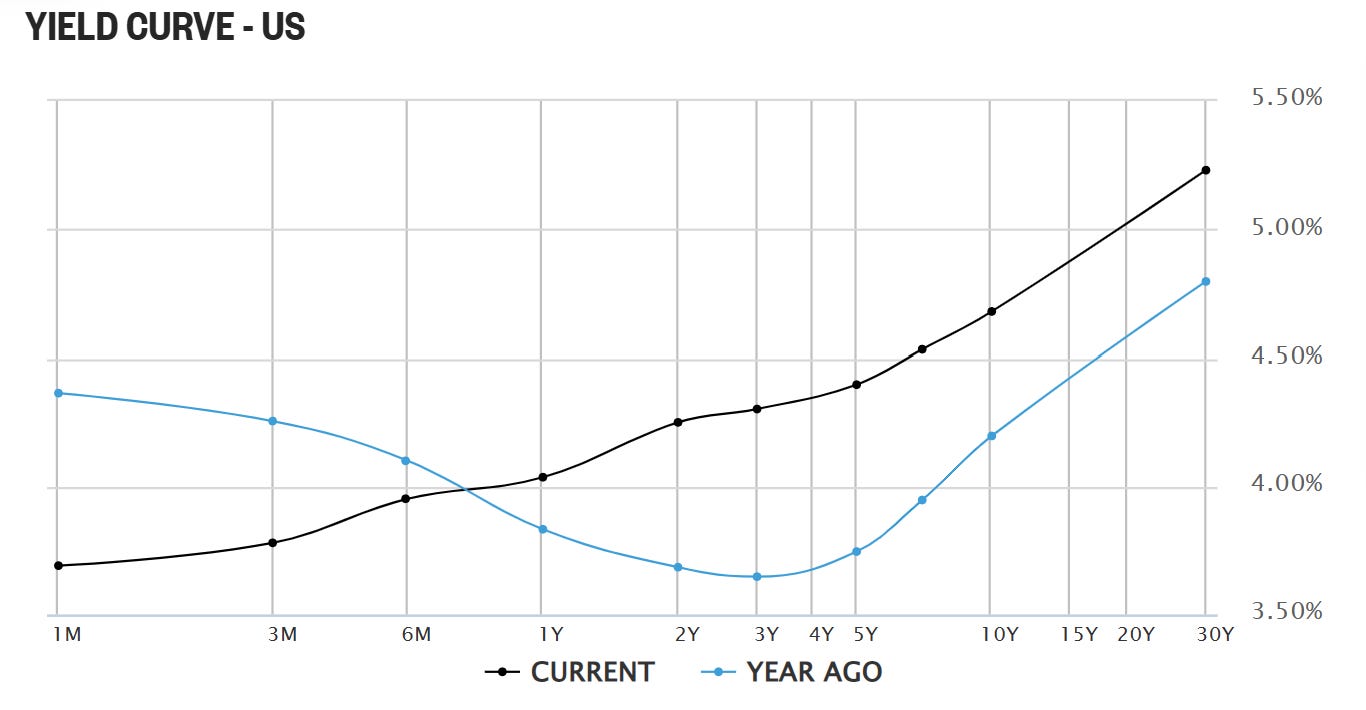
The always sharp Tobin Marcus from Wolfe Research wrote about this the other day (paywalled), noting that “Higher yields both reflect and exacerbate the unsustainable US fiscal situation.”
With the federal debt at 100% of GDP and rising, and deficits at an unsustainable 6%+ during an expansion, there are increasingly important negative feedback loops between high deficits and high interest rates. We've long argued that the grim fiscal outlook will not cause a near-term crisis, but that it will be a source of secular upward pressure on the long end of the yield curve, which is now playing out. And in the other direction, higher rates are a bigger and bigger driver of deficits themselves. Net federal interest expense as a share of GDP is at historic highs and will keep rising indefinitely, and so will the average interest rate on the debt. And we believe the risk to those already-unpalatable projections is to the upside.
Yep.
Those of you who track such things may be thinking, “but doesn’t CBO have the interest rate on the debt inching up slowly and less scarily than you’re arguing here?”
Kinda. Here’s CBOs 10-year projection of the interest rate on the debt.
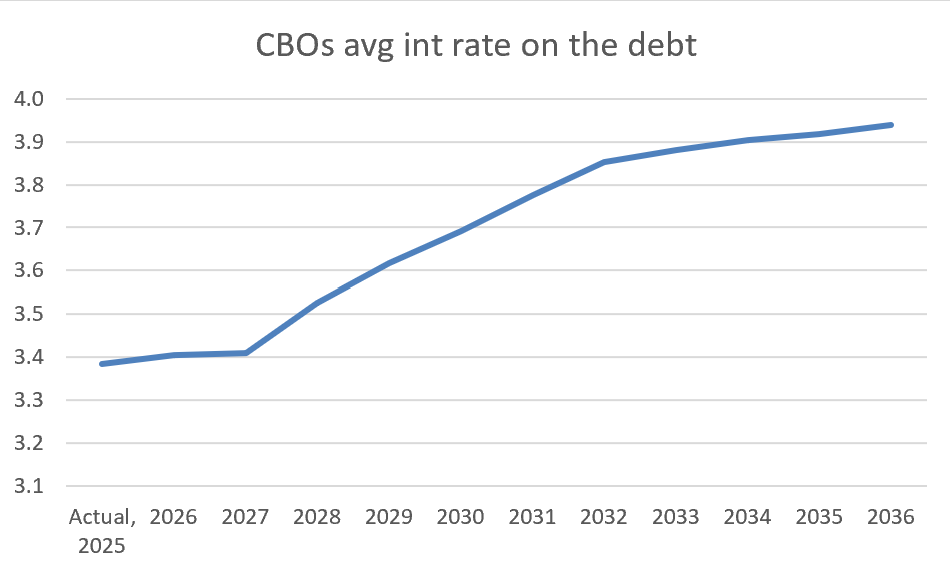
It grows by about 50bps (half a percent point), which ain’t nothing, taking debt service/GDP from 3.2%—already above the long-term average of about 2%—to 4.6%.
My point here, and I believe this is widely accepted by fiscal nerds on all sides of this debate (correct me if you disagree, budget wonks!), is that there’s upside risk to this forecast, which in turn generates upside risk to the debt trajectory.
To be sure, CBO knows what they’re doing, and interest rates are impossible to forecast. Did you forecast Trump starting a war that shut down the Strait that raised inflation that raised the inflation-risk premium on today’s interest rates?
Or did you pencil in a new Fed chair who disdained forward guidance to the point that market investors got spooked and insisted on a Fed/Warsh risk premium? To be fair, let’s not over-torque on this point. Warsh is new on the job, and there’s time for him to recognize his mistake, which I’d put very simply as the following.
He doesn’t want to lead the markets but if you’re an advanced economy with a central bank, that bank sets the short-term rate (relook at the yield curve above; Fed rate hikes at the time are evident in the year-ago line at the short end). The longer-term rates are short-term plus risk, inflation, etc. premia (i.e., extra basis points on the yield), so the Fed’s in there too. Like it or not, markets need to hear from the Fed to set rate expectations. Full stop.
Here’s how Jan Hatzius, Goldman Sachs chief econ summarized this the other day
Participants in short-term interest rate markets—where the Fed matters most—price what they think the Fed will do, not what it should do. This will remain true if the FOMC provides less information about its thinking, except that markets then have less information and potentially more inaccurate beliefs on which to base their thinking. Such a shift will not provide policymakers with a more reliable source of information about the real economy.
This creates upside rate risk, which is not what we want to see given the magnitude of our stock of public debt. This new-Fed-chair pressure could easily fade if Warsh takes on the many critiques of his positioning, and even if he doesn’t, he’s but one of 12 who votes on Fed interest rate policy. But, as Tobin stressed, there are many more entrenched factors pushing rates above CBO’s already climbing trajectory, not the least of which is the debt itself. Bobby Kogan and I raise related concerns regarding large and growing primary deficits (i.e., deficits sans interest payments, meaning policy-driven deficits).
Bottom line, when your carrying this much debt, you really don’t want to do stuff that puts upward pressure on interest rates.
The dynamics/timing of this are complicated by the fact that higher market rates take time to filter through the existing fixed-rate debt. The higher rates take hold as the debt rolls over so the impact grows cumulatively.
No posts
Comments
Nothing yet. Say the first thing.
Sign in to join the conversation.