
Hi readers, this is a repost of one of my most important EcoCult articles. Someone was asking me questions about the GOTS Organic certification and Pact, so I figured it deserved a revisit two years later, with some updates based on more recent research.
When EcoCult reader Kristen messaged me to tell me her big order of certified organic cotton clothing had given her a serious allergic reaction, I was shocked. And yet, I wasn’t totally surprised.
Kristen, who developed a chemical sensitivity in 2021 from toxic mold exposure in her home, ordered a big box of leggings, underwear, and other clothing for her and her teenage daughter in late 2023. She chose Pact, “specifically because it’s organic,” she told me, believing that a GOTS-certified organic label meant the cotton pieces would be free of harmful chemicals.
That didn’t turn out to be the case. “The first thing I noticed was the chemical smell,” she told me over the phone when I followed up. She started trying things on for size, and, “the fourth thing I put on, that’s when I started having hives and my lips started swelling and my throat started getting itchy. So I immediately took everything off. I put the box outside on the back porch, because I just couldn’t even be around the smell.”
When Kristen called Pact’s customer service, the first person she talked to wasn’t much help. She got cut off, so she called back, and she said the second representative she talked to told her at least a couple of other people had called to complain about the same thing.
Maybe it was a fluke, or only a few things in the order were contaminated. So, she sent the whole box back and put in a smaller order. But that new order also caused her to get itchy. Even after she washed some of the items 10 times, they still had the smell. (She got a full refund after she called again.)
She’s not the only one who has reacted to “organic” fabrics. In mid-2022, Lyndall in Canada was ready to start her small zero-waste fashion business and so ordered two bolts of a linen-and-organic-cotton blend from an online shop. She told me the story by email.
“I didn’t specifically look for organic cotton, that was just a nice bonus, but I definitely wanted to avoid synthetic fibres because they’re uncomfortable to wear and bad for the environment. Thrilled with my new purchase, I began sewing skirts for Fall markets. I was tired and felt icky, but put that down to the pressure of the time crunch and sewing bringing up some fashion school trauma.”
“In January of 2023, I did a photoshoot with some of the linen/organic cotton skirts, and my energy levels and mood crashed. At first I thought it was because I’d stayed up late, or triggered more of that fashion school trauma, but I didn’t bounce back. My energy and health declined further. I was suffering from brain fog, restless sleep, aching joints, unable to do more than the absolute basics of living like keeping myself fed and clean.”
“It wasn’t until May that I discovered I have Mast Cell Activation Syndrome. . . and then I was almost immediately able to identify the cause of my malaise: the linen/organic cotton fabric I had purchased for my business. Thankfully, I have a degree in fashion, and knew from my textiles course that just because a fibre is organic and natural, that says nothing about the chemicals involved in manufacturing, dyeing and finishing the fabric. I suspect I was reacting to a finishing chemical. (The reactions halved when I washed one of the skirts.)”
“I stuffed every piece of The Bad Fabric into plastic containers, bags or tubs, and my MCAS flare eased somewhat, but it wasn’t until I moved every single scrap and thread of fabric I could find out of my apartment (and treated my MCAS) that I began to feel like myself again.
Kristen and Lyndall’s experiences confirmed something I long suspected: that “organic” — at least when it comes to fashion — doesn’t necessarily mean non-toxic.
You see, in my book on toxic fashion — and in subsequent interviews about it — I would say that shoppers should look for three labels: Oeko-Tex, bluesign, and to a lesser extent GOTS Organic. Those are the words I would use: “to a lesser extent.”
I knew that the main point of organic certification is to assure shoppers that the cotton (it’s almost always cotton) was grown organically: without the use of pesticides, genetically modified seeds, or synthetic fertilizers. And for many consumers who believe that the biggest risk of wearing cotton clothing is exposure to pesticides, that is the assurance they want.
It’s also the completely wrong way to think about clothing chemical safety.
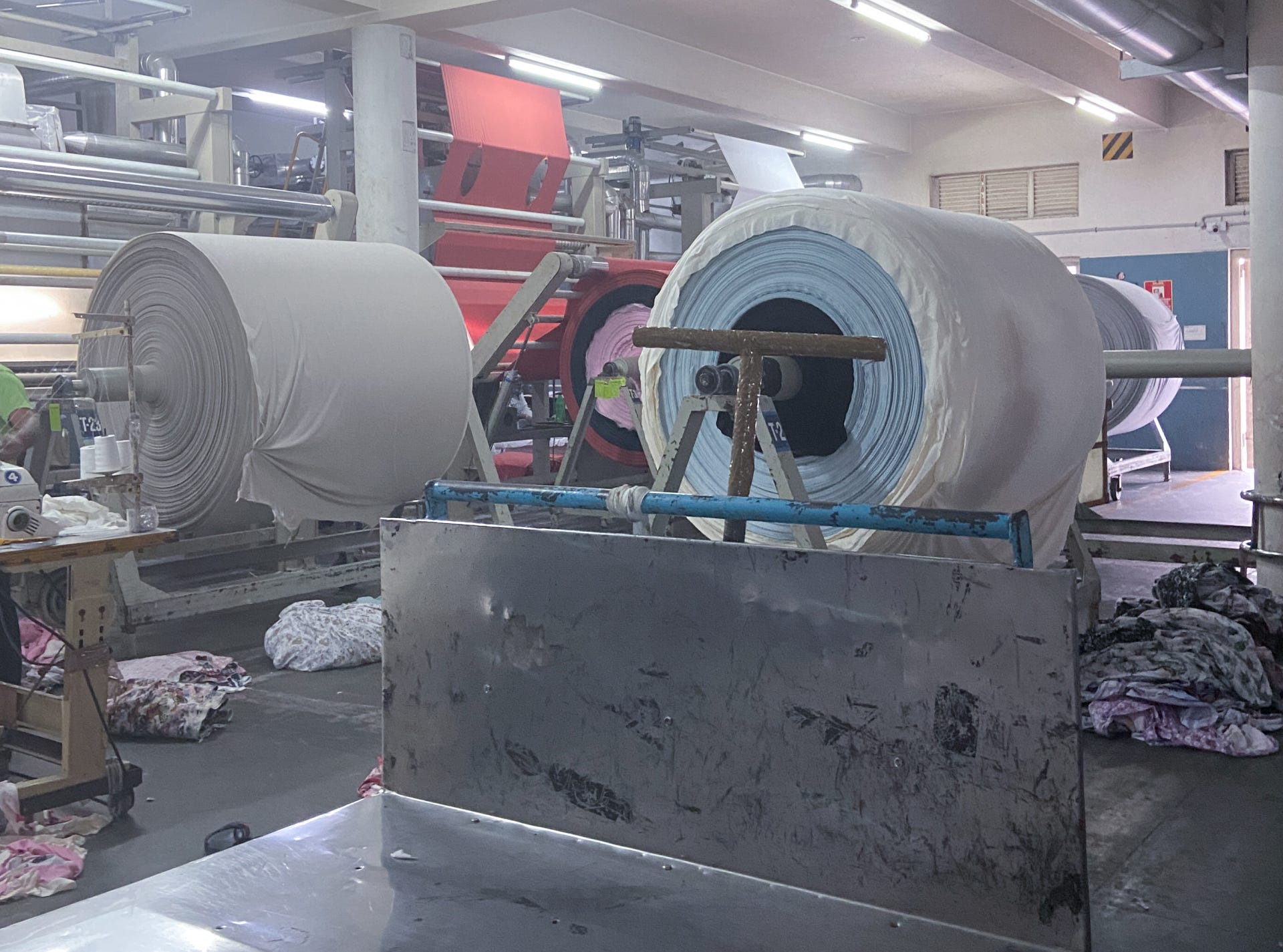
Cotton is so heavily processed between being picked from the plant and put in a box as a finished t-shirt, that testing shows that pesticides applied are long, long gone by time you put it on. The cotton is cleaned multiple times with chemical surfactants, sizing chemicals are applied for the spinning process, then stripped back off again with other chemicals. The woven cotton is dyed and finished with more chemicals for hand feel or for performance, such as being wrinkle-free or stain-resistant. And then it might come into contact with pesticides and fungicides in the warehouse or boat — long, long after it has left the fields of Gujarat or Brazil, but not long before you try it on.
In other words, you should be way more worried about what happens to the cotton after the fields. But the organic label is mainly concerned with what happens in the fields. That’s great for the farmer! (As long as it’s not faked by fraudulent middlemen.) But it doesn’t help you, the end consumer.
Now, I knew all this before. The reason why I still referenced the GOTS Organic label (the only label for organic cotton accepted in the US) as a potential help to consumers looking for non-toxic fashion, is that it also purports to assure consumers that all the chemicals used in manufacturing and finishing are safe.
GOTS requires any product labeled as organic to have moved through only GOTS-certified suppliers, including the gin, the spinner, the mill, the dyehouse, and the garment factory. In GOTS’s own words, it’s, “a comprehensive and rigorous standard that addresses various facets of textile production to ensure consumer safety, environmental responsibility, and worker well-being…This framework ensures high safety standards throughout the entire processing chain of organic fibres, up to consumer products.”
Now, you might think that GOTS only allows “organic” dyes on clothing certified as organic. That would imply natural, plant-based dyes that have been grown organically. Nope. Almost all dyes used today are from petrochemicals. That doesn’t mean they are all toxic. It does mean there are tens of thousands of petrochemicals, many of them never studied for safety, that could be used in, on, and around natural-fiber clothing.
GOTS instead prohibits the use of chemicals that are known to be harmful. It has a manufacturer restricted substance list (MRSL) which prohibits certified suppliers from using any flame retardants, PFAS, or dyes that are toxic, allergenic, or carcinogenic. It requires suppliers to only use GOTS-certified chemical products. And it sets “strict limits for chemical residue, going beyond industry practices to ensure lower contamination levels.”
This is all a great start. But how is this ban on certain substances enforced
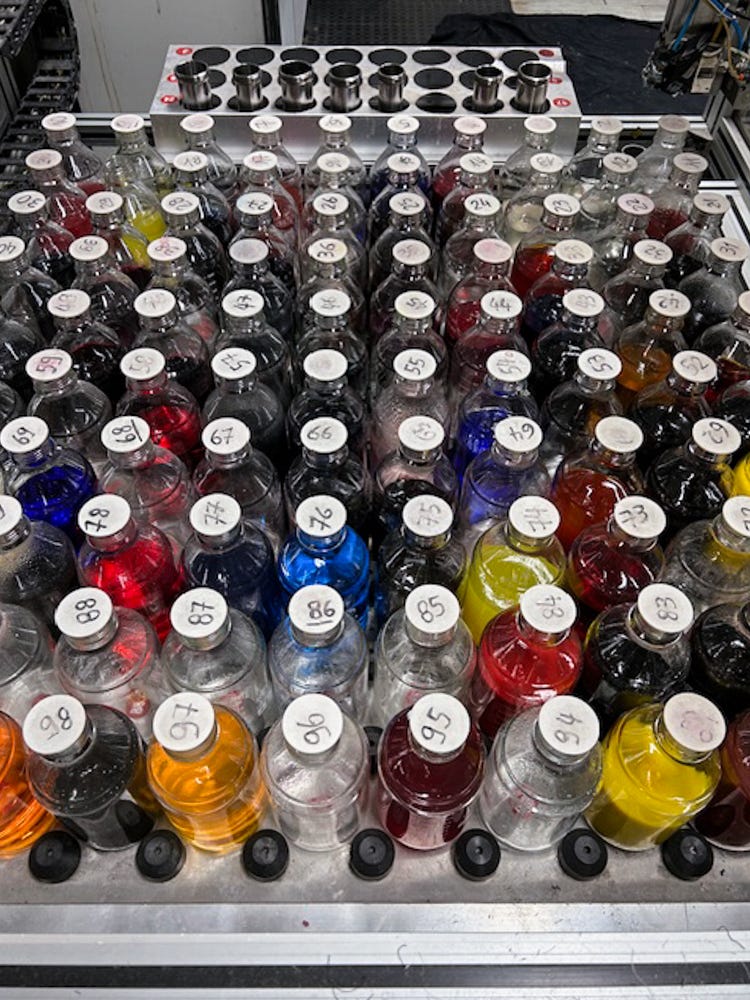
I spoke to Mauro Molteni, co-owner with his brothers of a GOTS-certified dyehouse in Italy that dyes both natural and synthetic fibers, about the certification process. “You have to send to the institute the dyes and other chemistries you want to use,” he said. This documentation is mainly safety data sheets (SDS).
Safety data sheets don’t tell you what chemicals are in the barrels or bags of dye you’ve bought from a chemical company. That’s all proprietary. It merely tells you whether it is toxic and in what ways, how to handle it safely, and what to do if you get it on your skin or in your eyes, etc.
Molteni has a chemistry degree, and a dim view of safety data sheets, which he has found to be not only inaccurate, but contradictory, saying one thing in one section about the safety of the chemical product, and something completely different further down. He’s actually called up a chemical company before to tell them to correct an SDS.
GOTS also relies on third-party certification companies to conduct yearly in-person audits of suppliers, and suppliers like Molteni need to keep documentation of the GOTS-approved chemicals they are using.
I asked Molteni if anybody from GOTS or the certification company had ever popped by to check if he was using the chemicals he said he was going to use, and not sourcing cheaper, contaminated ones.
“No, nobody,” he said.
Maybe that’s because they didn’t need to. Molteni is in Italy, which is already governed by a stringent regulatory regime on chemical usage called REACH. It would be difficult for Molteni to get away with buying and using banned, hazardous substances, such as dyes with heavy metals. “In India, it should be the same, but I’m not so sure,” he said.
That’s because in India it’s easy to buy chemicals that are banned in Europe and the US, chemicals that are definitely not allowed by GOTS. And things are so chaotic in India when it comes to certifications, that it was recently decided that no fabrics coming out of the entirety of India and Bangladesh would be certified to Textile Exchange’s organic or recycled standards.
By the way, all of Pact’s certified organic products are made in India.

The reason I recommend looking for Oeko-Tex labels is because Oeko-Tex Standard 100 requires that facilities, materials, and products be tested against its restricted substance list once a year, to ensure that no hazardous contaminants have snuck in. Oeko-Tex is not a perfect system, as I outline in my book. But it is focused on the actual substances present and the safety of the final product, and tests are done by a small, centralized network of approved labs.
bluesign is not a consumer-facing certification, but a company that partners with brands and suppliers to help them practice safe chemistry and avoid hazardous substances. It is, by all accounts, a robust, detailed, hands-on, and trustworthy system. Molteni, for example, said bluesign inspectors do follow-up and do random checks and tests of dyehouse to be sure they are following the correct protocol and using approved chemical products.
GOTS, by contrast, focuses on paperwork and documentation, which in some countries can easily be gamed, and relies on local certifying bodies, which can easily be corrupted, to decide when and what products to check and test at dyehouses, all at that local company’s discretion. Molteni says his products have never been tested by the local certifying body as far as he knows.
“We follow the rules for professional ethics but trust me it’s pretty easy to show something that is like a sleight of hand,” Molteni wrote to me by email. “For example, a receipt has approved dyes A, B, C, but you can use A, B and X that isn’t approved. It would be almost impossible to find it on a finished product.”
A GOTS representative told me that a central Quality Assurance Unit, “organises annual residual chemical testing of certified products randomly picked from global retail stores.” When I asked the GOTS representative how many tests are conducted and what the failure rate is, she said, they recently hired two full-time staff members and it is “currently in the building phase… the number of tests conducted by our internal unit is still relatively low. These figures are not yet representative enough to be shared with the public.”
GOTS also has a system where one can submit a complaint about suspected fraud, and the GOTS representative pointed me toward a list of companies that have been banned from GOTS for fraudulent activity. Most were cotton processors, not dyehouses, and all had been banned for some version of passing off regular cotton as organic. None had been banned for using restricted or hazardous chemicals.
Molteni also told me something interesting about the limits of hazardous substances in the GOTS MRSL, which are usually measured in milligrams of substance per kilogram of material. For example, the GOTS MRSL Version 6 says that no more than .2 milligrams per kilogram of arsenic is allowed in textiles and accessories in GOTS-certified products.
“They can put in water and dilute it to bring it under the limit,” Molteni said. In other words, the chemical is still there. It’s just at a lower ratio, so it’s technically allowed. “There is no difference, it is the same,” he said. That’s especially concerning when we’re talking about endocrine disruptors — researchers believe there is no safe level of exposure to hormone-disrupting chemicals like phthalates, BPA, and PFAS. Some textile chemistry experts will say that as long as it’s under the limit, it’s safe. But I found in researching my book that those limits are often pretty arbitrary, rather than based on studies and human toxicology.
“When we talk about health, it is not possible there’s a grey area, it’s black or white for me,” Molteni said.
Molteni has the GOTS certification because at this point, he has to have some sort of certification to get any business. But it hasn’t done anything to make his particular dyehouse better for human health. “For me, nothing changed before GOTS and after GOTS,” he said. “I think most of it is marketing.”
We actually don’t know if the “organic” cotton-linen blend Lyndall ordered was certified by GOTS. In Canada, unlike in the US, there aren’t regulations around what textiles you’re legally allowed to call “organic,” and the website where she ordered her fabric doesn’t mention GOTS.
In any case, Lyndall got in touch with the company, which offered her store credit for the value of the fabric, which she’ll use to buy Oeko-Tex-certified fabric.
“Now, whenever I see linen or organic cotton listed as ‘healthy’ or ‘clean’ fabrics I want to laugh darkly, or yell at my screen, because there’s so much more to a textile than just the fibre content,” she wrote. “I reacted to organic cotton; I need to know about the dye and finishes.”
At EcoCult, in order to recommend a brand as non-toxic, we have a policy of requiring at least one more layer of protection from a brand on top of a GOTS organic label:
Does the brand know the dyehouse(s) where the fiber is dyed and finished?
Does the brand have products randomly tested? If they are part of AFIRM, they do.
Does the brand source from bluesign-approved suppliers?
Does the brand have products with Oeko-Tex certification or source from Oeko-Tex-certified suppliers?
By itself, the “organic” label on clothing is not enough to guarantee it’s safe for you, or your family, to wear.
If this interested you, then you can really nerd out and have all your questions answered by reading my book To Dye For: How Toxic Fashion Is Making Us Sick—and How We Can Fight Back.
What Happened to Pact?
·
November 8, 2025
Hey friends, I’m rerunning with some edits and updates a piece Anabelle wrote two years ago for the old website before I moved to Substack. It seems like some newer members of our community haven’t picked up on this disappointing story yet. I’m making it free for all readers, but the weekly reading links are at the end, behind a paywall. Thank you for supporting our work, so we can continue to support you!
Which Fashion Certifications Can You Trust?
·
November 2, 2025
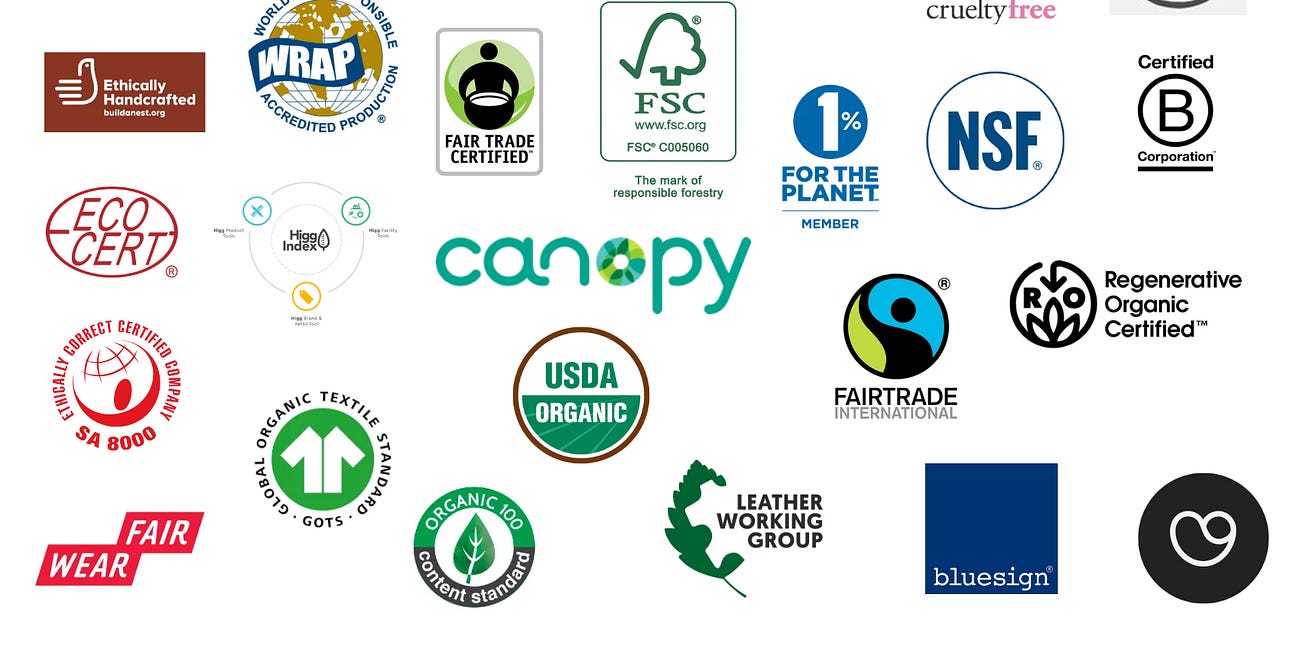
I gave a keynote last week to the Just Zero Waste-Free Future conference, and among the many great questions was one that I didn’t have time to answer in full. It’s the question of sustainable, ethical, and non-toxic certifications for fashion. And it’s a crucial one.
Comments
Nothing yet. Say the first thing.
Sign in to join the conversation.