
Dearest readers,
I’m so happy you’re here. I would much rather give you the information you need via the written word—something you can dive into at your leisure, save, refer back to, explore, share—than do short form videos or produce a podcast. Maybe that will change, but I find this mode of communication so much more nourishing and helpful.
It’s also more accurate, if I’m honest. It’s so easy to make a factual mistake when doing a video or podcast, and it’s much harder to go back and fix the error.
My favorite form of communication is books, however. God, I love a nonfiction book. I like making notes in the margins, dog-earing the pages, going back to it to find information, transferring quotes and lists to my notebooks.
Video content is not great for conveying detailed information. I’ve saved so many Instagram videos about gardening and home renovations, for example. I haven’t gone back to them. Some of them are simply half-baked ideas from people DIYing their way through their first crack at homesteading. If all those ideas had been thought through over years and put into a book…well, I would be able to make much better use of them. I have made much better use of them, by reading books on food forests and garden planning and rustic home design for the cold northern climates.
The year I wrote my book To Dye For was one of the most satisfying times of my life. I discovered so much more because I had a year to read other books, travel to India, interview experts and regular folks about fashion and its toxicity. I got to take out rare books on fashion history at the Bryant Park library and read them in a quiet room surrounded by other scholars with brass light fixtures and solid wood tables—what a treat! And because this was a book, I could pay someone to fact check it and point out things I got wrong. I would never have learned so much or made the connections I did if I were creating short-form video content.
Still, I don’t read as much as I used to. And I hate that.
In this week’s essay “They don’t want you to read,” Anne Helen Petersen points out that we’re not reading as much because the internet architecture keeps shoving video in your face and hiding good writing from you. Also, someone interviewed Ann Friedman about the book she didn’t get to write—even though she is famous and has a bajillion subscribers!
I’m still thinking about the book my publisher turned down on toxic homes. I’ll write it someday, I promise you that. I’m just waiting for the right time.
In the meantime, I downloaded the Libby app and went to my local library to get a card. And while I was there, I picked up a copy of Barbara Kingsolver’s Prodigal Summer. Instead of picking up my phone, I’ll finish my summer by diving back into her luscious descriptions of nature and love.
What are you reading this summer? Tell me in the comments!
Wish this author acknowledged women’s rain gear at all, but I’m happy this is regarded as a topic worthy of the men now: In the quest for PFAS-free rain gear, cotton is making a comeback.
Researchers are pointing out how the chemicals used in clothing can have a huge effect on its environmental impact: whether it biodegrades or can be recycled, for example. “The most sustainable textile is not necessarily the one made from a natural fibre. It is the one designed, manufactured, used and managed responsibly throughout its entire life cycle.”
Don’t just “deal with it.” A good essay about fit.
The Australian government is realizing that disperse dyes aren’t good for us.
Why people are embracing visible repairs to clothing.
The last jacquard silk weavers (in Europe).
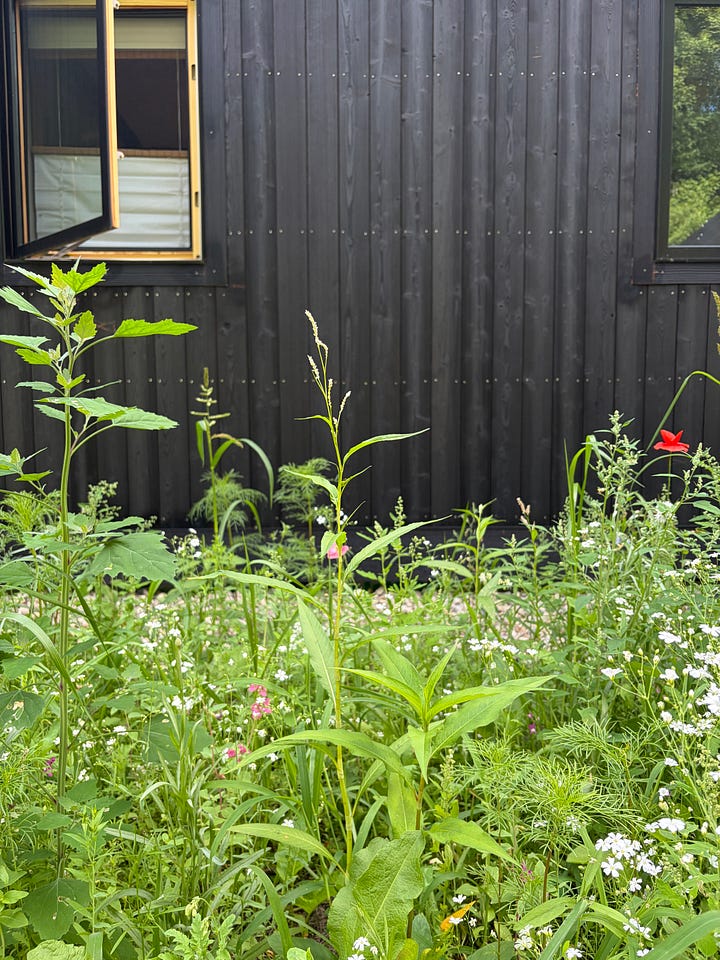
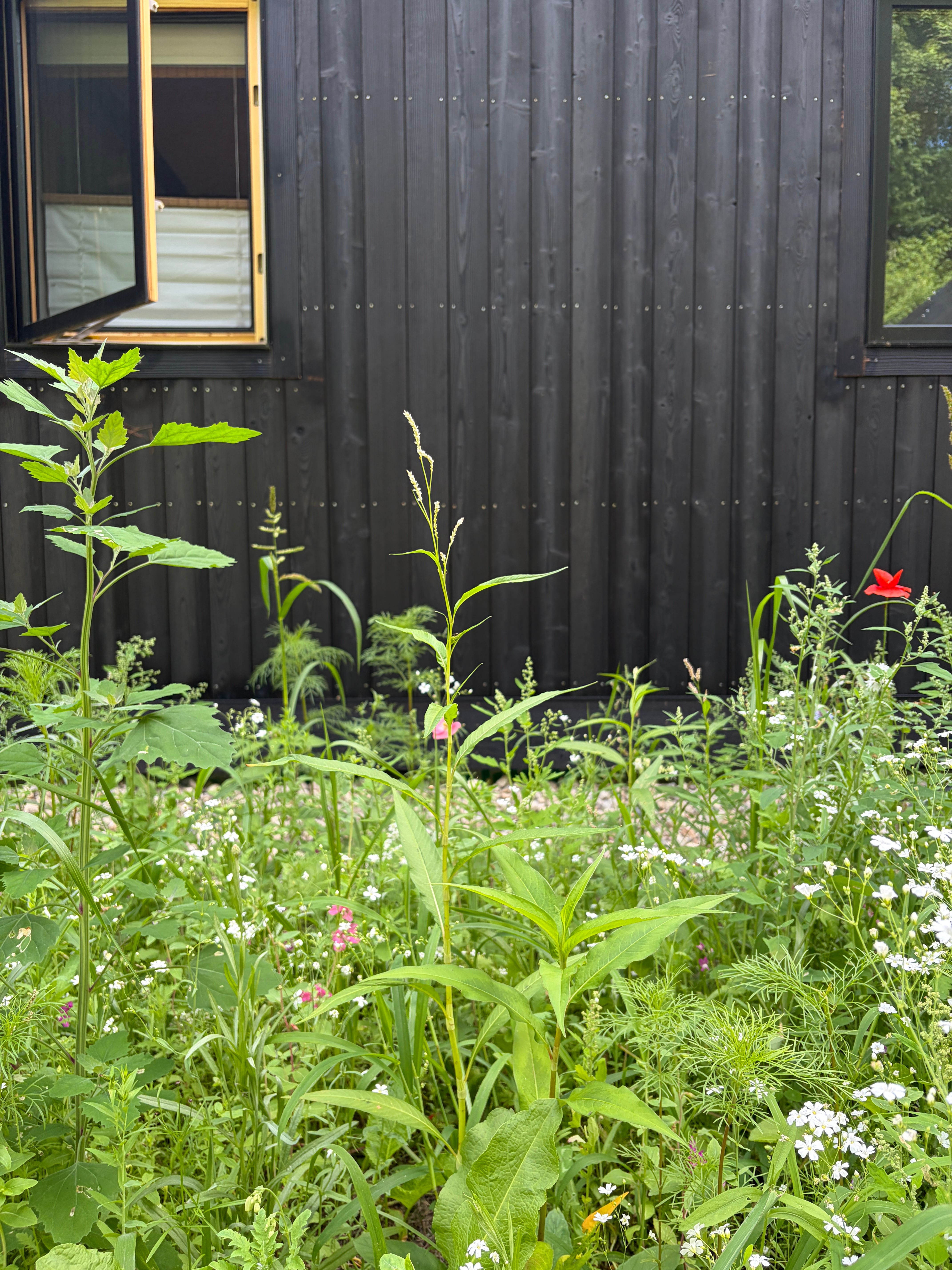
In June, after much construction, the excavator came and used the piles of rocks to build me a rock wall. He also smoothed out the dirt so the water flows away from the house, the culmination of a multiyear journey to stop the flow of water into my basement, and cut off the chance for moisture and mold to attack this house.
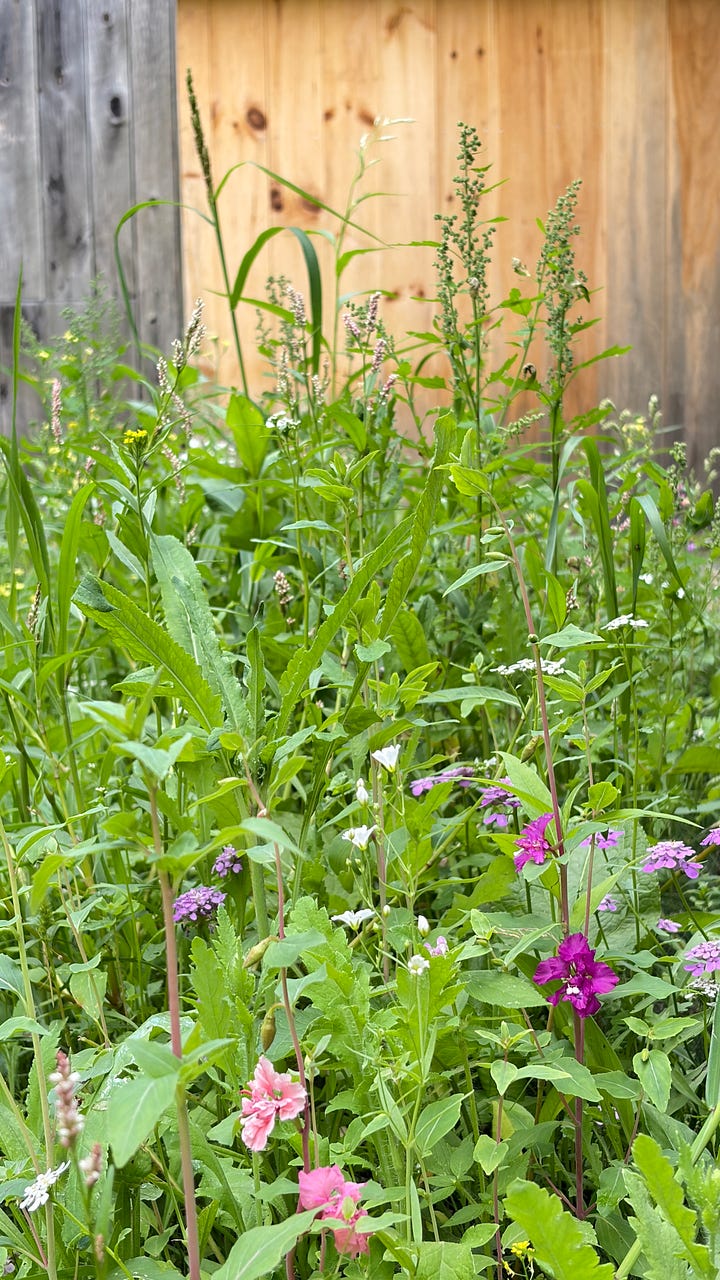
When faced with a lot of bare dirt, rather than seed it with turf grass, I seeded it with fescue and wildflowers. Here are the results so far!
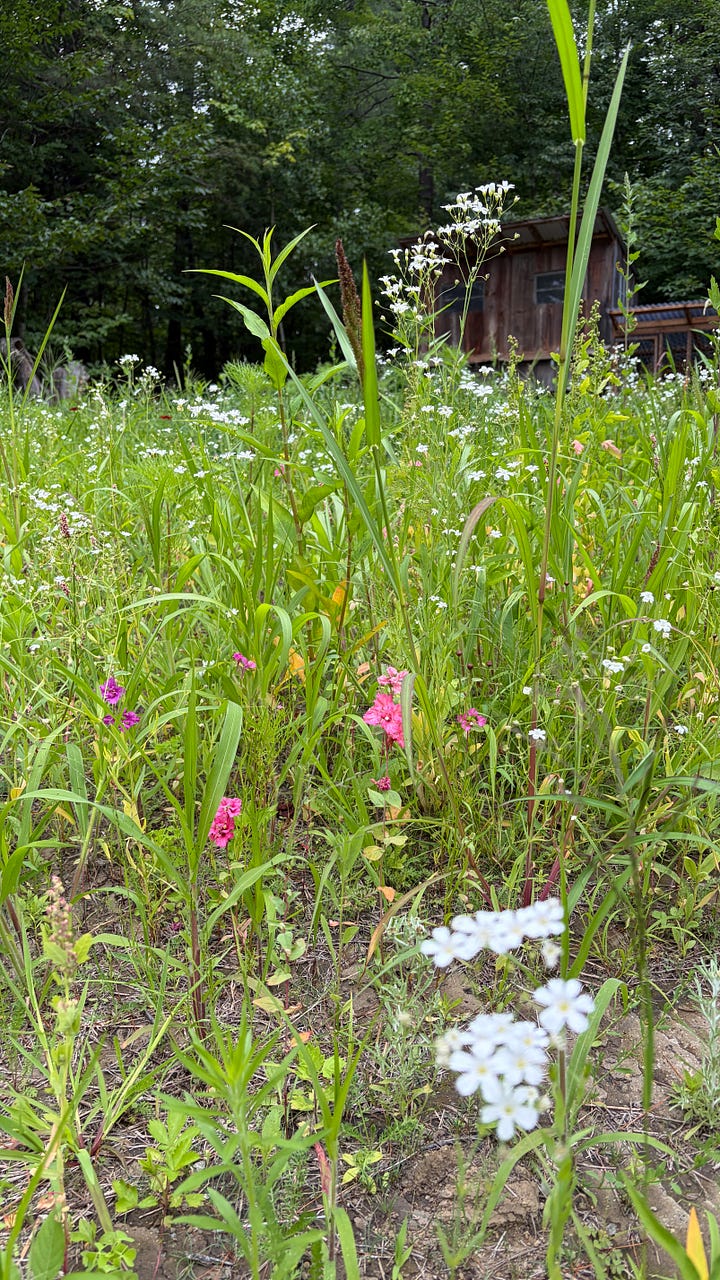
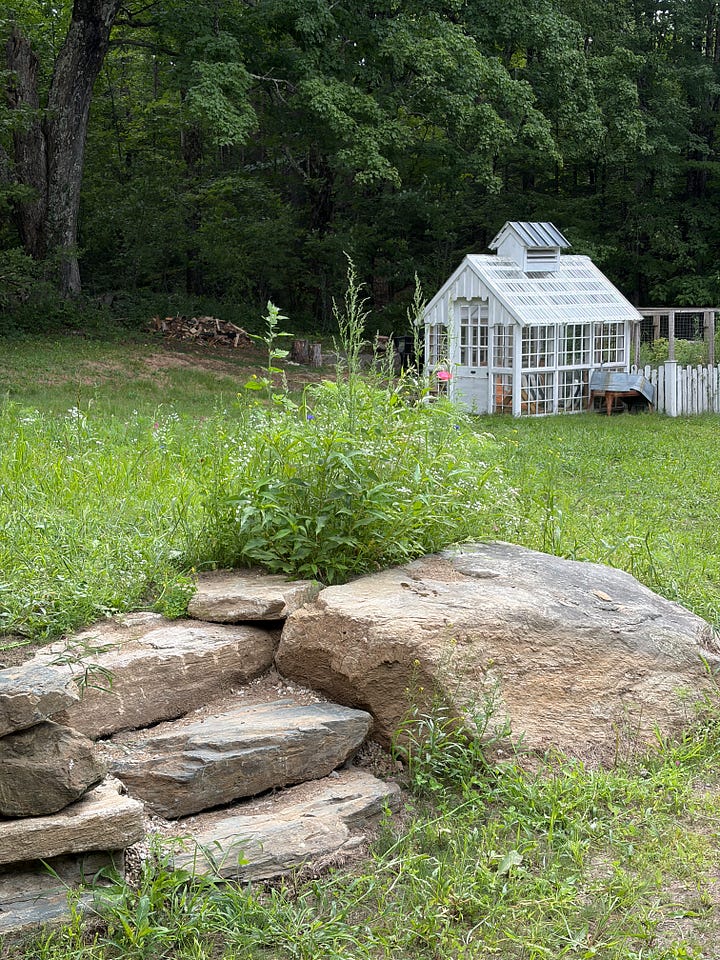
I’m still trying to set up my little electric robot mower (like a Roomba for grass). In the meantime I went out yesterday to scythe paths through the wildflowers. My cousin woke up from his nap and was so confused. He saw that “something had happened” but wondered why he didn’t hear a motor whining outside of his window!
I collected any wildflower I scythed to make little bouquets for my mom, who is visiting. No pesticides, no fertilizer, no gasoline, no noise—just beautiful natural little things for my loved ones.
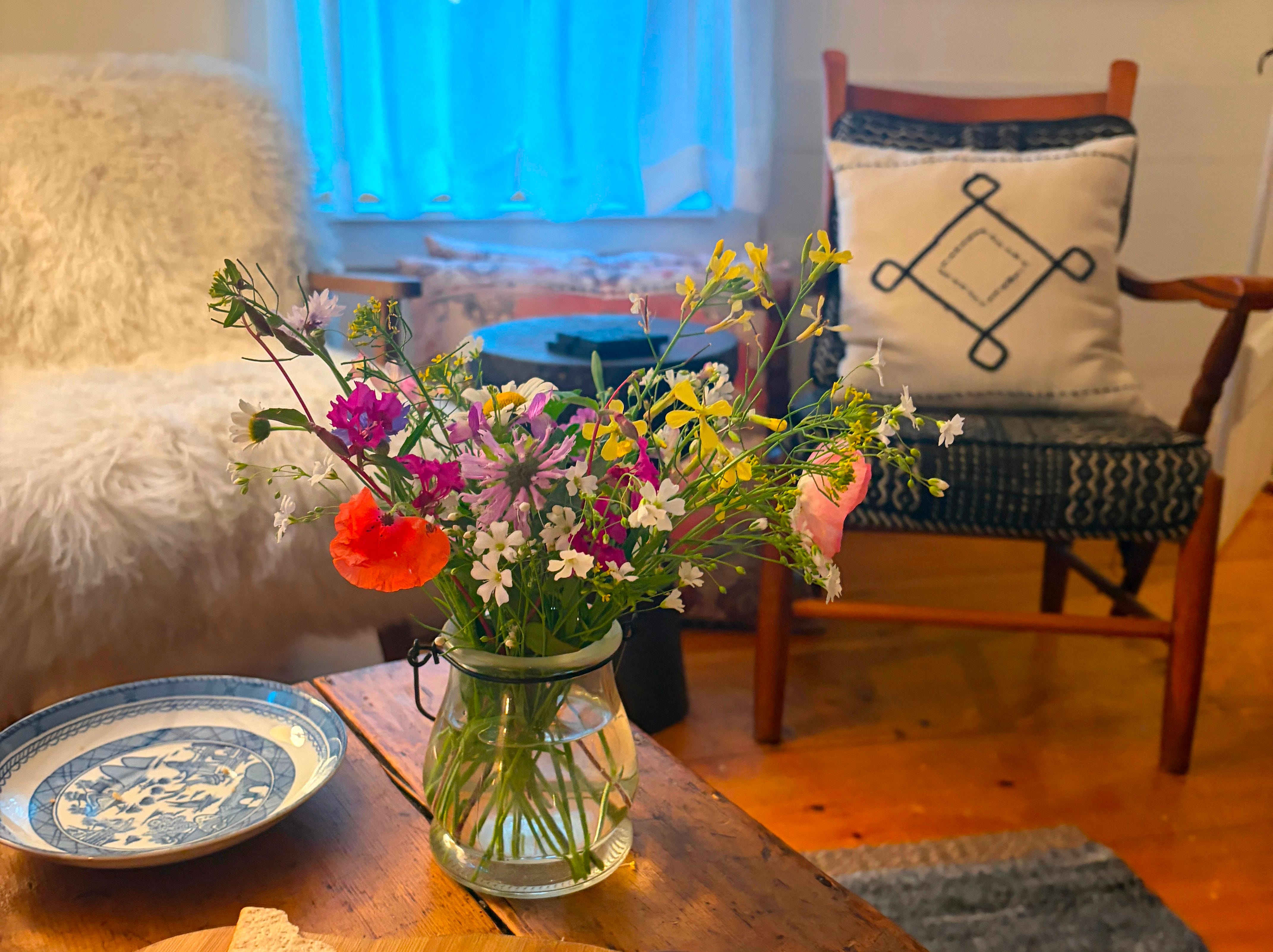
What are you growing in your garden? Tell me in the comments!
Vindication for my mold-poisoned girlies: A study suggests that the threat of mold-related illnesses is vastly underappreciated.
A study showed unequivocally that replacing gas stoves with electric/induction can help people with asthma. Unfortunately, the Trump administration cut off its funding partway through. “If 1,100 more households had participated as originally planned, it would have resulted in 900 people with better-controlled asthma and 84 fewer people who would go to the emergency room or be hospitalized.” I think we’re going to look back on gas stoves as abominations. Here’s another story about the study.
American homes need heat pumps, not space heaters.
It’s in a bit of a grey area, but you might be able to go out and buy plug-in “balcony solar” right now!
…If your HOA doesn’t prohibit clean energy. HOAs often also require turf grass instead of native plants, prohibit clotheslines, and have other arcane rules that keep you from making a little eco-friendly, pollinator paradise. But they don’t have to. Start a revolution in your neighborhood—run for the HOA!
Everyone is talking about this newsletter Worse on Purpose. I just subscribed and I’m super pumped about what I’m going to learn.
How Crocs avoids paying any U.S. tax: It claims it’s based in Malta.
Culture Study’s Buy It for Life forum this week is worth the Patreon subscription by itself.
A judge just ruled that misleading recycling arrows on packaging is protected free speech.
NYT is back with another banger on emerging research on chronic inflammation. Make sure to read the comments!
This story isn’t just about ticks and disease. It’s also about emerging theories about our nervous system, mast cells, and allergies. A must-read.
Hating on farmers markets as elitist is missing the mark.
The Trump administration wants to block citizens from suing to enforce environmental laws.
Water contamination from agriculture is emerging as a top issue in the Iowa midterms, even as the EPA backs off assessing nitrates for their link to cancer.
Funding for public health projects has been stripped from black communities because “DEI”.
The EPA says it wants to tackle PFAS but it’s doing the opposite.
All bodies of water in England are polluted with toxic chemicals.
All your cyclospora questions answered.
Articles that get into the weeds or are behind a paywall.
Reformation just went public at a valuation of $886 million. | BoF
A group of researchers just confirmed that the global reptile skin trade is actually pretty sustainable. | Sourcing Journal
The flood of fakes on Vinted. | Financial Times
Fashion for Good is on the hunt for effective PFAS alternatives. | WWD
Researchers say they have a metal-free fixation technique for natural dyes using a biopolymer. | EcoTextile News
Circular brand Mud Jeans has filed for bankruptcy. | EcoTextile News
Comments
Nothing yet. Say the first thing.
Sign in to join the conversation.