

Last week, I published The Protestant Dilemma. The basic gist of the dilemma is this: Protestants take for granted that the 27-book New Testament canon they received from the Western tradition includes all and only those books that ought to be included as Scripture. The problem, though, is that this tradition that they received came from bishops and popes and councils that also repeatedly endorsed what Protestants dismiss as late “accretions.” One cannot sensibly rely on those so prone to theological error, including, as I argued initially, in the very context of canon discernment (they endorsed the deuterocanon Protestants reject) in the absence of a reason to rehabilitate their reliability. So, either the people who gave Protestants the tradition that they now take for granted were unreliable, in which case Protestants can’t rely on their work (i.e., the 27-book New Testament), or else they were reliable, in which case Protestants should doubt their Protestantism. (See the essay for a more thorough expression and defense.)
If that reasoning holds, it looks like those who maintain their Protestantism have to open the canon for investigation. Will conducting their own evaluation of the seven disputed New Testament books and the four disputed books that were ultimately excluded from the New Testament yield the same 27-book canon on which unreliable popes and bishops and councils settled? Good luck.
A flurry of Protestant responses to the dilemma followed after Cameron Bertuzzi published a couple of videos about it. (As of today, the original video has 83,000 views.) The responses, we’ll see, are underwhelming. Many, for example, try to downplay the evidence that Christians disputed some of the books that are now in our New Testament, for centuries.
Not all that followed was critical, though. It’s a happy coincidence that Bart Ehrman recently confirmed many of the historical details on which the dilemma depends in response to some of the same voices who have been trying to escape it. And some friends made interesting points that bolster the argument.
Let’s see how the dilemma has held up after I add some friendly material that tightens up the argument a bit.
The overwhelming majority of Protestants open their New Testament and reflexively rely on it without investigating whether the books ought to be there. They do so despite (often not knowing) the fact that the New Testament canon is the result of centuries of disputes before bishops and popes and councils took sides in those disputes for their jurisdictions. The rest, as they say, is history.
A friend made an additional observation that fortifies the dilemma on this point. On virtually every issue on which Christians could read the data multiple ways, Protestants have split.1 Should we baptize infants? Does baptism save? Can one lose one’s salvation? Is mortal sin a thing? Does the Bishop of Rome enjoy primacy? Is Christ really present in the Eucharist? Are there three orders—bishop, priest, and deacon? The list goes on, and the answer: It all depends on which Protestant you ask.2
Here’s the key point: Christians not only could, but did, read the data about whether this or that book ought to be in or out of our New Testament in multiple ways. Like the other controversial questions, we should expect, then, that Protestants would be split on the New Testament canon, some resolving a dispute about a particular book in this way, and some resolving it the other way. But they don’t split. The best explanation for this anomaly is that they are (wittingly or unwittingly) relying on the authority of the (at least Western) Church to determine the canon. Dissenters amongst the main Protestant groups about the New Testament canon would be some evidence that Protestants arrived at their canon independently. But we don’t find this division. Instead, we conspicuously find more unanimity than existed in the primitive church.
As my friend says, the very unanimity of Protestants on the New Testament canon thus shows that they’re relying on bishops and popes and councils who existed centuries later.
One more interesting piece of evidence on this issue: The Church of the East, which broke from the Catholic Church around the Council of Ephesus (AD 431), preserved a 22-book New Testament canon that persists to this day. Each of the five books excluded from this Eastern canon were amongst the seven disputed books: 2 Peter, 2 & 3 John, Jude, and Revelation. Conspicuously, the Church of the East that broke away from the Catholic Church in the fifth century preserved a different canon from the Church of the West, around when the Church of the West had already settled on the 27-book New Testament.3 By contrast, the Protestant schism occurred more than 1,000 years later, long after the 27-book New Testament had become firmly established in the West. No surprise, then, that the Protestant canon mirrors the canon it inherited from the Church of the West. It’s therefore difficult to avoid the conclusion that Protestants rely on the historical judgment of the Church of the West as to the New Testament canon. A stark reminder that the Catholic Church is the mother church of the reformers of the 16th century.
As the evidence makes plain, there were no fewer than seven books now in our New Testament that many early Christians rejected: 2 Peter, Hebrews, 2 & 3 John, James, Jude, and Revelation. There are at least four more that some believed to be Scripture but that the Church later excluded: The Shepherd of Hermas, 1 Clement, the Epistle of Barnabas, and the Didache. I focused on these books because they pose a simple and unique problem: If early, orthodox Christians doubted whether they should be in the New Testament, how does the Protestant know that he is right and they were wrong?
What about the undisputed books? I suspect there’s a dilemma lurking with respect to them as well. Consider, for example, the undisputed Pauline letters.4 These letters were ultimately included in the New Testament principally because early Christians believed that they were Pauline.
But how do we know that they’re Scripture even if Pauline? Here’s another point my friend made: Not everything Paul wrote is Scripture. Consider some evidence I put in the original essay: Some Christians thought that the apostle Barnabas wrote the Epistle of Barnabas but they nevertheless kept it out of the canon. So there’s a logical gap, supported in the tradition, between “an apostle wrote X” and “X is Scripture that ought to be in the New Testament.”
Imagine, now, that you have no prior knowledge of Paul’s work but that you have found everything he had ever written. How likely is it that you’d preserve and keep as Scripture all and only the Pauline works that are Scripture? Would you guess, correctly, that the epistle in which he wishes that his enemies would “emasculate themselves!”5 is one of the inspired ones? Or would you guess, correctly, that the epistle in which Paul says that only he is speaking, “not the Lord,”6 is of the Holy Ghost?
The deeper problem here is that it isn’t obvious that we can reliably tell, just by reading or by knowledge of authorship, whether a particular work is inspired. Nor is it obvious that Protestants could or would arrive at the same 27-book canon of inspired writings if they reviewed the writings de novo. Catholics don’t have this problem precisely because, in our paradigm, we can and must rely on the authority of the Church, which has told us which writings are inspired and which aren’t.
Protestants, too, can (and, it turns out, do) rely on the Church. But then they should consider coming back home to it.
Enter Protestant philosopher Chris Cloos. He has been the most vocal critic on this website and, it turns out, X. I’ve already had a fairly lengthy exchange with Cloos here, and readers can judge for themselves how that turned out for some of his objections. Here I’ll say a bit more, though I don’t want what follows to call into question my appreciation for Cloos’s willingness to engage, so I’ll just make that unambiguous here: Thanks.
Cloos complains that there is a “third option” I never consider: “the books themselves are the ground of my entitlement to believe I have the right ones.” He adds that “God made minds such that they can perceive … the formal reason of divine faith that Scripture is inspired.” He asserts that his “belief that Hebrews is God's word is based on properties Hebrews has.” Cloos thinks that he is entitled, by this option, to “take for granted” that “our New Testament includes all and only those works of Scripture that compose the New Testament.”
Unfortunately, Cloos doesn’t tell us what “properties” should lead to a belief that a particular work is Scripture. I suspect that if Cloos’s view were not so underdescribed, it would amount to nothing beyond what I already addressed and rejected as untenable. (Or, at a minimum, application of the test that is composed of these properties would be vulnerable to what has already been said.7) And it’s hard not to see in “God created our minds such that we can perceive his voice” a fancier way of saying “burning in the bosom told me,” or something near enough. (Has Cloos read 1 Clement, the Epistle of Barnabas, the Didache, the Shepherd, and the deuterocanon, I wonder? How did he conclude that God wasn’t speaking to him in those works but that He was in Jude or 3 John, say, works of just a few lines and in some of which an apocryphal writing is quoted?) As I explained in the original essay, this isn’t really a live option in the face of all the evidence we have to suppose that inferences from “the text itself” are likely very unsafe indeed.
Consider just a bit of that evidence. Cloos imagines that God has given him the mind to “perceive” Scripture reliably based on what is in the text of the “books themselves.” It is unfortunate that St. Irenaeus did not receive such a mind—he believed that the Shepherd of Hermas is Scripture. It is unfortunate that St. Athanasius did not receive such a mind—he believed that Esther is not Scripture. I could give many other examples, but I hope the point is clear: Even if everything Cloos says were true (about the books themselves being the ground of our belief in them), the same evidence that constitutes the Protestant dilemma would make untenable our taking for granted that other men got all the disputes right and that we’d do the same. If people like St. Irenaeus or St. Athanasius didn’t have the right minds, how can Cloos be so sure he has? It seems a bit strange to suppose that some Protestants have an epistemic advantage over the saints who lived in the second, third, and fourth centuries.
Maybe he’d say that they did have the right minds, they just sometimes failed to use it to discover the truth about Scripture. Quite. We’re back to the dilemma: In the light of the centuries of disputes in which orthodox Christians disagreed despite Cloos’s properties (whatever they are) being in the texts (or not), we are not entitled to imagine that we individuals would just happen to arrive at all and only the authentic New Testament books or that their number would be the same 27. Indeed, as I wrote above, if this were the method Protestants actually deploy (discerning books like Hebrews for themselves based on the properties therein), then, in the light of how we know debates played out, we’d expect Protestants to come to different conclusions about the disputes, with some getting it right and others (like some of the second-century saints) getting it wrong. But we don’t find that. Instead, Protestants overwhelmingly arrive at the very same books that the Western Church arrived at, even while other Christians and churches arrived at different books. The reason, of course, is that when Protestants open their Bibles, they find 27 books in the newer part of it. The reason is not that Protestants uniformly have an epistemic advantage over the early saints when inferring inspiration from internal properties.
Cloos is free, I suppose, to believe that it was just a happy coincidence that an otherwise unreliable Church (including on the canon) happened to arrive at the same New Testament canon he arrives at by whatever his proposed exercise amounts to. He is also free to imagine that his method is reliable given the properties in each of the disputed works, despite all the evidence that saints for centuries missed what he can see plainly from the text alone. (It should be evident, I hope, that I don’t think one can sensibly believe or imagine these things.) It is clear, though, that the overwhelming majority of Protestants, whether they know and admit it or not, have, as a matter of fact, relied on the Church of the West’s decisions for their New Testament canon. They are not epistemically entitled to do so whilst maintaining the Protestantism that entails the unreliability of that Church.
Origen’s corpus is a treasure trove of evidence of early Christian beliefs. He is also not a church father. The reason is that orthodox Christians recognize that he fell into significant error.
It is therefore a tad odd that some Protestants seem to think that Origen is the silver bullet against the Protestant dilemma, an argument that cautions against reflexively trusting sources one thinks are prone to err.
Ruslan, a popular Protestant Youtuber, responded to Bertuzzi’s video about Ehrman’s confirmation of much of the basic history behind the Protestant dilemma. Here’s the response:
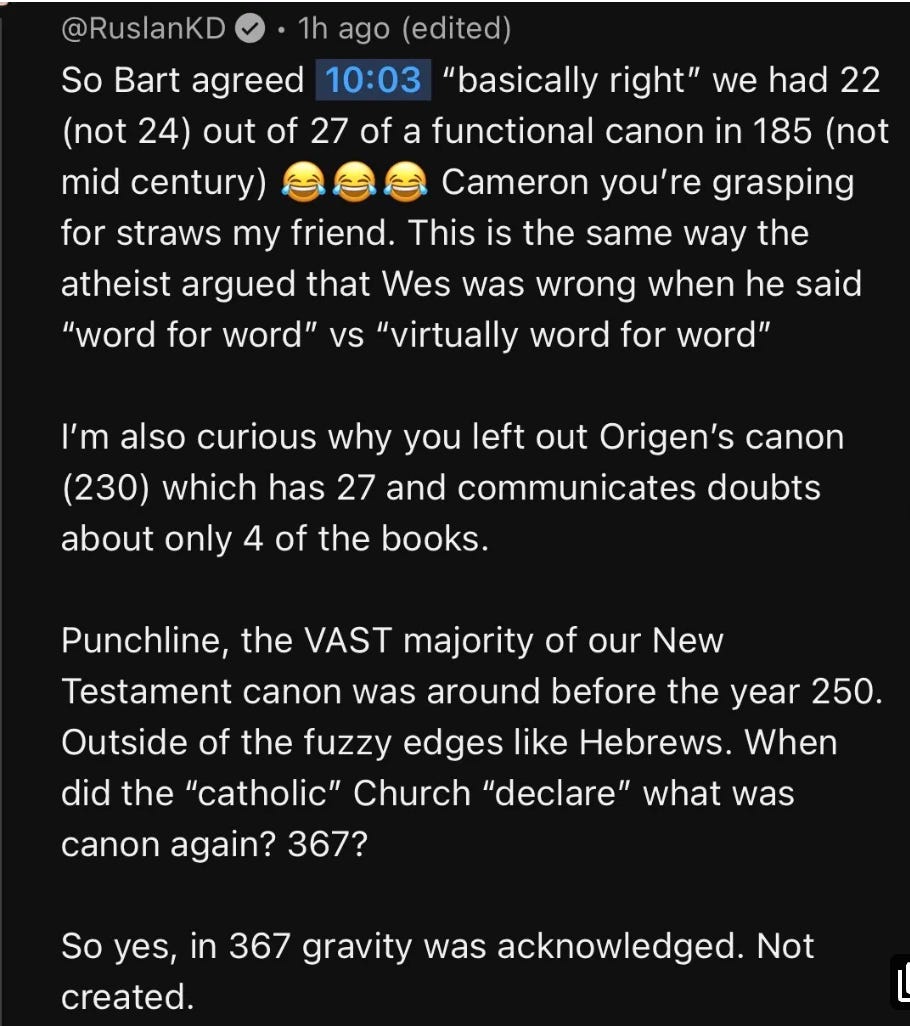
As you can see, Ruslan posted this in response to Ehrman’s correcting Wes Huff about the development of the New Testament canon. The first paragraph downplays Huff’s mistaken assertion that the second-century Muratorian Fragment recognizes 24 books of our New Testament (it’s 22, as Ehrman pointed out). The second paragraph refers to “Origen’s” canon, which apparently “has 27 and communicates doubts about only 4.” And the third downplays the disputed books as on the “fuzzy edges” of the canon. Let’s address each of these points in turn.
First, Ruslan incorrectly downplayed the fact that the Muratorian Fragment omits five books that are now in our New Testament. Even if we should be impressed by the fact that it omits “only” five, we know, on the authority of other sources, that a total of seven were disputed in the church as a whole (for this, see the original essay). The Muratorian Fragment is an anonymous source—we don’t know from whom it came—so Protestants cannot assume that its views as to two of the seven were universal.
Worse, Ruslan downplayed the fact that the Muratorian Fragment included no fewer than two books that Protestants reject: The Apocalypse of Peter and the Wisdom of Solomon. Here’s what Ruslan said in response to Bertuzzi’s raising the point:

This response is mistaken. Here’s what the Fragment says about the Apocalypse of Peter after the author gets to the category of apocalypses:
We receive only apocalypses of John [= Revelation] and Peter, though some of us are not willing that the latter be read in church.8
As you can see, although the author acknowledges that the Apocalypse of Peter was disputed, he and others received it, right next to Revelation. The fact that an author recognizes that a book is disputed doesn’t mean that he didn’t regard it as Scripture or canonical; as we’ll see, Origen, too, acknowledges disputes about some books that would later become part of our New Testament. The reason the author’s aside is so probative is that at least some early Christians resolved an early dispute differently from us. Has Ruslan read the Apocalypse of Peter? How does he know the author got that one wrong?
Here’s what the Fragment says about Wisdom:
Moreover, the Epistle of Jude and two of the above-mentioned (or, bearing the name of) John are counted (or, used) in the catholic [Church]; and [the book of] Wisdom, written by the friends of Solomon in his honour.9
Here the author clearly puts Wisdom in the canon. He says, expressly, that Wisdom is counted, and he says so right next to Jude and 1 & 2 John, without distinction. Bruce Metzger, a recognized Protestant authority on the development of the canon, says that the Fragment lists “the Wisdom of Solomon” amongst “those books accepted universally.”10
Second, Ruslan appeals to what he calls “Origen’s canon” without stopping to ask whether Origen was right about the disputed books and those on the other side wrong. As I wrote, this is odd, since, I presume, Ruslan would not reflexively trust that Origen got things right on other matters.
Indeed, in Origen’s list, he makes an error with which reformed baptists or non-denominational Protestants presumably disagree. Here’s what he says about 1 & 2 Peter:
And Peter, on whom the Church of Christ is built, ‘against which the gates of hell shall not prevail’ (Matt. xvi. 18), has left one acknowledged Epistle; possibly also a second, but this is disputed.11
(It’s somewhat amusing that some Protestants must rely on a list that recognizes Peter as the Rock on which Christ built his Church!)
More importantly, Origen confirms that our New Testament was disputed in his day. 2 Peter, as we saw, was disputed at an early date. He confirms, likewise, that John “left also an Epistle” and “it may be, a second and a third; for not all say that these are genuine.”12 As to Hebrews, he says that only “God knows” who wrote it, but reports that some in his day thought “that Clement, bishop of the Romans, wrote the Epistle.”13 (Again, it would be quite amusing if it turned out that the third Bishop of Rome after Peter wrote a book Protestants accept as part of their canon!)
Moreover, Origen accepted as Scripture works that aren’t in our New Testament. As I explained in the original essay, Origen said that the Shepherd of Hermas was “a scripture that seems to me very useful and, in my opinion, divinely inspired”14—in conflict with the Muratorian Fragment. He appeared to believe this, in part, based on his belief that this Hermas was the Hermas Paul mentioned in Romans 16:14.
Far from confirming our 27-book canon of inspired Scripture, then, Origen confirms instead that there were significant disputes even in his day. Scholars recognize that St. Athanasius, not Origen, was the first to list our 27-book canon as the New Testament canon.15 Ehrman confirms the same. Ruslan’s suggestion that Origen produced an earlier 27-book canon list is mistaken.
Third and finally, Ruslan dismisses the problem of the disputed books with the phrase “fuzzy edges like Hebrews.” Protestants in a live-streamed response to Bertuzzi’s first video suggested that things wouldn’t be so bad if the Church mistakenly put some books into the New Testament. Removing some of the disputed books would apparently change nothing for them!
Of course, the problem with all this (apart from the equanimity with which at least some Protestants would throw at least some Scripture out with the authority of the fourth-century Church) is that one cannot sensibly dismiss all of the disputed books that made it into the canon as “fuzzy” or unimportant—works we could do without—even if works like 3 John or Esther could be thrown under the bus without changing much doctrinally.
In conversation, Ethan Muse amusingly retorted that works dismissed on the “fuzzy edges” of the canon include Hebrews and the Revelation of John—so only the single most important biblical foundation for the Protestant Reformers’ critique of the Holy Sacrifice of the Mass and minor details like all of eschatology. Other than that, nothing much would change.
Overall, then, the Protestant dilemma is in good shape. The responses to it have so far been invariably underwhelming. There doesn’t seem to be a plausible way to resist the conclusion that we rely on our 27-book New Testament because bishops and popes and councils, over time, settled early disputes in particular ways. Those same bishops and popes and councils, though, endorsed “accretion” after “accretion” that Protestants reject.
I mean conservative, Reformation or, if one must use the word, classical Protestants. I mean here to exclude those Protestants who have already opened the canon and started removing books based on critical historical investigation. (The founder of Protestantism, Martin Luther, complicates this distinction because he had doubts about some of the New Testament canon.)
Strictly speaking, the answer depends on what is true, but you get the point: Protestants have different answers to these questions.
Some Protestants will sometimes appeal to Roman Catholic categories and say that the Church had not dogmatically defined the canon until the Council of Trent in the 16th century. True, but irrelevant. The point is that Western councils at Rome, Hippo, and Carthage, and bishops and popes like Augustine, Damasus I, Innocent I, and Gelasius, had already established the Western consensus long before Trent.
By “undisputed” I don’t mean the letters that modern scholars don’t dispute. Rather, I mean the thirteen letters that early orthodox Christians took themselves to know came from Paul. (Modern scholars now dispute the authenticity of some of them.)
If orthodoxy is one of the properties, for example, then Cloos’s view is circular, since whether something is orthodox will presumably depend on what’s in Scripture, which is precisely what one is trying to figure out about the work in question. It may also yield overinclusion, too. Does Cloos think, for example, that 1 Clement is not orthodox?
Transl. by Bruce M.Metzger, The Canon of the New Testament (OUP, 1997), 307.
Metzger, The Canon of the New Testament, 307.
Metzger, The Canon of the New Testament, 199.
Metzger, The Canon of the New Testament, 308 (emphasis added).
Metzger, The Canon of the New Testament, 308.
Metzger, The Canon of the New Testament, 309.
Origen, Commentary to the Epistle to the Romans, Book X, sec. 31.
Brakke & Gwynn, The Festal Letters , 231; Oxford Dictionary of the Christian Church 282.
No posts
Comments
Nothing yet. Say the first thing.
Sign in to join the conversation.