
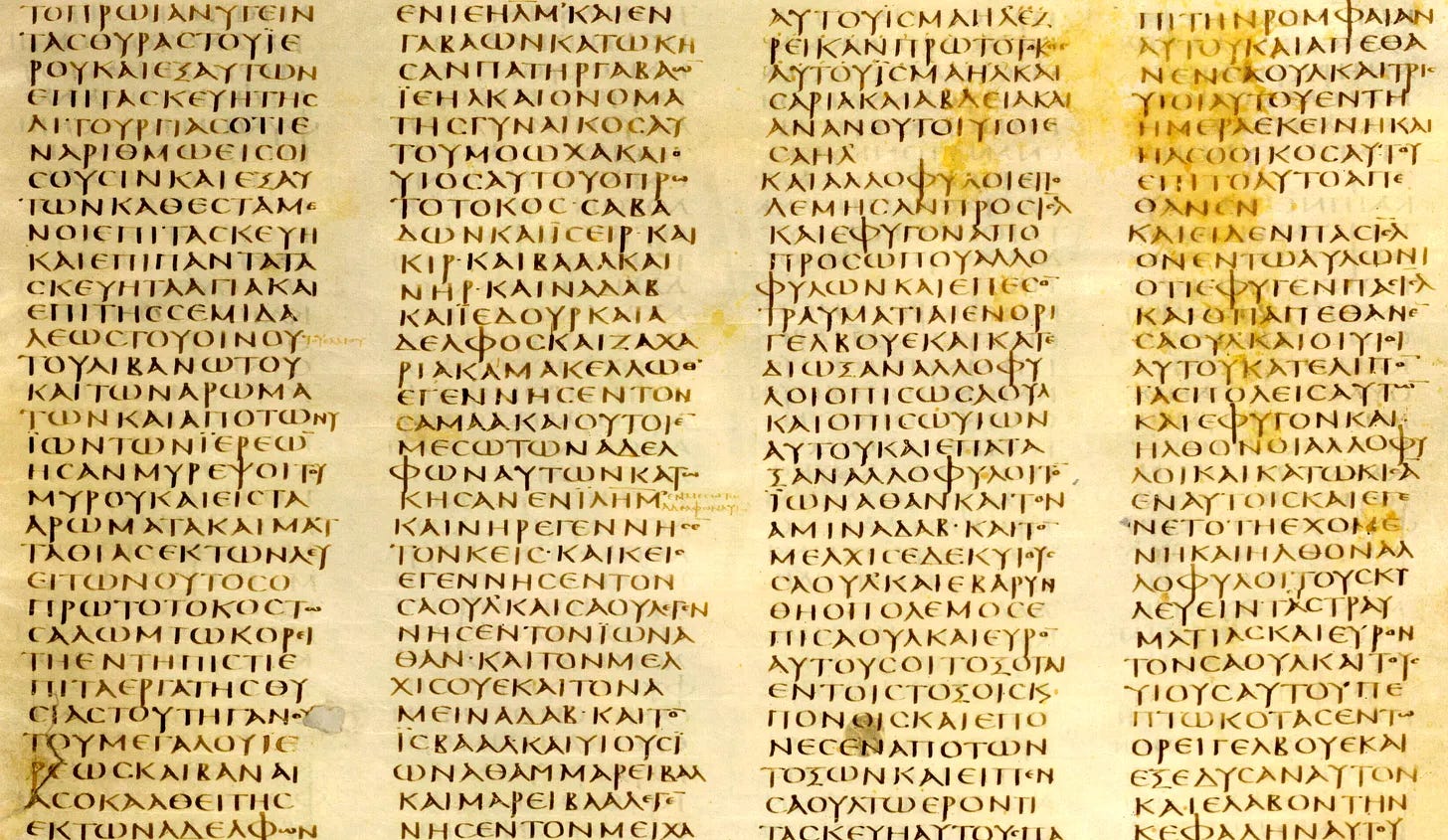
Anyone who is interested in Catholic and Protestant polemics likely knows about the canon debate: How do we know that a particular canon is the canon of Scripture?
The Catholic answer is simple: Christ established a Church, which has infallibly defined the canon of Scripture. We can know that the books that should have been excluded were excluded, and that the books that should have been included were included, because God protects the Church from error.
Protestants, obviously, have a different answer. Sola Scriptura—one of the Protestant distinctives—is the doctrine that Scripture is the only infallible rule of faith. You may have heard Protestant apologists say that we don’t need an infallible list of the infallible books that constitute Scripture. They have to say so because there is no table of contents in Scripture itself, and because the Church that gave us the table of contents is fallible. Let’s assume for argument’s sake that the apologists are right: The Bible’s table of contents is fallible. Still, the Protestant is at least committed to the proposition that the New Testament’s table of contents is reliable. Sola Scriptura requires that Christians be able to literally rely on the scriptura for rules of faith.
I contend that Protestants face a dilemma even if we take infallibility off the table. To see why, let’s consider just the 27 books of the New Testament. And let’s focus, in particular, on seven of the 27, the ones that were disputed for centuries before the Church and her bishops stepped in to pick a side (we’ll soon identify them).
Here’s the dilemma:
Either the Catholic Church and her bishops aren’t reliable or else they are.
If they aren’t, then your 27-book New Testament isn’t reliable, either.
If they are, then you shouldn’t be Protestant.
So,
Either your 27-book New Testament isn’t reliable, or else you shouldn’t be Protestant.
Either horn of the dilemma is bad news for the Protestant: If he maintains his Protestantism, he must seriously doubt the reliability of the New Testament. If he maintains the reliability of the New Testament, he must, at a minimum, seriously doubt his Protestantism. Importantly, nothing in this argument depends on the necessity of having an infallible Church.
The basic idea is this. Whatever you think of the reliability of the Catholic Church and her bishops, it is undeniable that they resolved the key disputes that led to the New Testament canon. It was the bishops who recognized that this or that book should be excluded from the New Testament. And it was the bishops who recognized that this or that book should be included. At the end of that centuries-long process, the Catholic Church and her bishops settled on a 27-book New Testament canon at times when the same institution and people believed all sorts of things Protestants regard as “accretions.” In the light of the primary sources we’ll review, Protestants are committed to that process being very unreliable indeed.
Here’s how this essay will proceed. In Part 1, we’ll look at the evidence of the first three centuries of church history and conclude that the New Testament canon was unsettled by the fourth century. In Part 2, we’ll look at the evidence of the fourth and fifth centuries, when the 27-book New Testament canon was formally recognized by the bishops and, of particular importance, the Church of Rome. In Part 3, we’ll see that the same Church that settled on the 27-book canon, from the fourth century on, accepted many teachings that Protestants reject, including teachings about the canon. Finally, in Part 4, we’ll conclude that the evidence of Parts 1 to 3 constitutes the Protestant Dilemma.
The New Testament didn’t fall from the sky. Originally, different works that are both in and out of our New Testament circulated around the Roman world. Some claimed to be written by the apostles, and were. Some claimed to be written by the apostles, and weren’t. Some didn’t claim to be written by anybody, but were thought to be written by apostles or their companions. And some were really anonymous—we haven’t the foggiest idea who wrote them. No single one of these works has a complete list that identifies the authoritative writings of the apostolic era.
The Church had to work out which books were authentic and Scripture, and which weren’t. That process took a lot of time. For the first few centuries of the Christian history, orthodox Christians doubted the scriptural status of at least seven books that ended up in the New Testament. In the same period, some orthodox Christians believed that some books that were ultimately excluded from the New Testament constituted Scripture. We’ll cover both sets of books. The question for us will be how we can know that the New Testament reliably includes all and only the books that are authentic and Scripture.
Our main source is Eusebius, the great church historian of the fourth century and bishop of Caesarea. Eusebius reports that, in his day, no fewer than seven of the 27 books that the Church ultimately decided to put under the cover of the New Testament were disputed—more than two centuries after the death of the last apostle. Eusebius and other sources confirm that there were a handful of books that were ultimately excluded but that many early Christians regarded as Scripture or, at a minimum, as highly authoritative.
Let’s see what our sources say about the status of the disputed books, both included and excluded. As we do so, ask yourself how we can know that the Church correctly included and excluded each of the disputed works we consider.
James & Jude
Our New Testament includes the epistles of both James and Jude. After giving an account of the martyrdom of James, Eusebius tells us that both epistles were disputed in his day:
Such is the story of James, to whom is ascribed the first of the so-called General Epistles. To be sure, its authenticity is doubted, since not many of the early writers quote it, as is also the case with the epistle of Jude, which is also one of the seven called general. Still, these two letters have been used regularly, like the others, in most of the churches.1
Eusebius tells us that Clement of Alexandria supplied “evidence from the disputed writings,” including “the epistle” of Jude.2
By Eusebius’s day, then, most churches had received James and Jude as authentic, but not all. Their authenticity remained in doubt amongst some orthodox Christians. We must ask ourselves how we can know that the majority view centuries after the death of the last apostle was right and the doubters wrong.
2 Peter
Our New Testament includes both 1 and 2 Peter. Eusebius tells us that 1 Peter was authentic but rejects 2 Peter and other writings that claimed to be associated with Peter:
Of Peter, one epistle, named as his First, is accepted, and the early Fathers used this as undisputed in their own writings. But the so-called Second epistle [of Peter] we have not regarded as canonical, yet many have thought it useful and have studied it with the other Scriptures. However, the Acts and the Gospel bearing his name, as well as the Preaching and Revelation called his, we do not know at all among the traditional catholic writings, since no church writer either in early times or in our own has used their testimony. … These, then, are the books attributed to Peter, of which I recognize only one epistle as genuine and accepted by the early Fathers.3
By the fourth century, 2 Peter was, at a minimum, still disputed in the Church if not outright rejected by significant numbers as inauthentic. Origen confirms that there were doubts in his day, about a century earlier.4
To be sure, 2 Peter claims to be written by Peter.5 But, as Eusebius points out, other works we know to be spurious were also associated with Peter. Yet again, we must ask ourselves how we can know that the proto-orthodox doubters were wrong in the face of uncertainty that existed in days far closer to the apostolic era than our own.
(In another post, I argued that there are no decisive reasons to think that 2 Peter is a forgery. But I concluded that, given the messiness of the evidence and the doubts that persisted for centuries, we should be agnostic about 2 Peter’s authenticity unless we rely on the Church’s authority.)
Hebrews
Our New Testament includes Hebrews. Eusebius tells us that Hebrews was doubted in his day:
Paul was obviously the author of the fourteen letters, but some dispute the epistle to the Hebrews in view of the Roman church’s denial that it is the work of Paul, and I will relate what our predecessors have said about it at the proper time. His so-called Acts are not among the authentic books.6
As Eusebius explains, Hebrews was doubted at an early day because early Christians didn’t know who wrote it.
“Gaius, a very learned man, published” a dialogue “at Rome in [Pope] Zephyrinus’s time” (c. AD 199-217).7 Gaius attacked “his opponents” for “devising new scriptures,” but he “mention[ed] only thirteen epistles of the holy apostle [Paul], not including that to the Hebrews with the rest.”8 “[F]or even to this day,” Eusebius reported, “some at Rome do not consider it the apostle’s.”9
Origen reported doubts about the authorship of Hebrews too:
The diction in Hebrews does not have the rough quality the apostle himself admitted having [2 Cor. 11:6], and its syntax is better Greek. The content of the epistle is excellent, however, and not inferior to the authentic writings of the apostle. … If I were to venture my own opinion, I would say that the thoughts are the apostle’s but the style and construction reflect someone who recalled the apostle’s teachings and interpreted them. If any church, then, regards this epistle as Paul’s, it should be commended, since men of old had good reason to hand it down as his.10
“But who wrote the epistle,” Origen famously added, “only God knows.”11 Origen identified a couple of theories about authorship: “Traditions reaching us claim it was either Clement, Bishop of Rome, or Luke, who wrote the Gospel and the Acts.”12 Clement of Alexandria “attribute[d] [the epistle] to Paul but says that it was … carefully translated by Luke for the Greeks.”13 Tertullian thought that Barnabas wrote Hebrews.14
Eusebius confirms that different theories were still on the table a century later, in his day:
I have recorded by name only those whose tradition of apostolic teaching still survives to our time in their writings. Such writings, of course, include … the epistle of Clement, recognized by all, which he wrote in the name of the church at Rome to the Corinthians. In this he reflects many thoughts from the epistle to the Hebrews and indeed makes verbal quotations from it—proving clearly that it was not of recent origin—and for this reason too it has seemed natural to include it among other writings of the apostle. For Paul had written to the Hebrews in their native language, and some say that the evangelist Luke, others say that this same Clement translated the writing. The truth of the latter shows in the similar phraseology of Clement and Hebrews and the lack of any great difference in thought in the two works.15
Eusebius, then, seemed to regard Hebrews as canonical,16 but acknowledges doubt.
Overall, tradition acknowledged uncertainty about the author of Hebrews, with the Church of Rome rejecting Pauline authorship and others endorsing Clement, Bishop of Rome, Luke, or Barnabas as candidates.17
The Johannine Epistles & Revelation
Our New Testament includes three epistles that John supposedly wrote and his Revelation. Eusebius tells us that only one of the three epistles was undisputed and that there were serious doubts about Revelation too:
Of John’s writings, in addition to the Gospel, the first of his epistles has been accepted as authentic both in past and present,18 but the other two are disputed. As to the Revelation, opinions are evenly divided. Early writers will be cited subsequently on all these issues.19
Justin Martyr “cite[d] the Revelation of John, stating that it was the work of the apostle.”20 Irenaeus made use of Revelation.21 Origen thought that John “wrote the Revelation.”22
The Patriarch of Alexandria, Dionysius the Great (c. AD 190-264), confirmed that Revelation was disputed: “Some of our predecessors rejected the book altogether, criticizing it chapter by chapter as unintelligible, illogical, and its title false.”23 The reasons apparently included that Revelation
is neither John’s nor a ‘revelation’ in any sense, since it is veiled by its thick curtain of incomprehensibility, and its author was neither an apostle nor saint nor even church member but Cerinthus, the one who founded the ‘Cerinthian’ sect and wanted to attach to his own forgery a name that commanded respect.24
Against these earlier Christians, Dionysius accepted Revelation as canonical: “I, however, would not dare reject the book, since many brethren hold it in esteem, but since my intellect cannot judge it properly, I hold that its interpretation is a wondrous mystery.”25 Still, Dionysius agreed with the earlier doubters that John the apostle could not have written Revelation: Though Revelation “is by a John—some holy, inspired writer—I will not deny. But I do not agree that he was the apostle, the son of Zebedee, the brother of James, who wrote the Gospel according to John and the general epistle.”26 His reasons were that “the Gospel and the Epistle have the same characteristics,” but “Revelation is completely different from these writings and has hardly a syllable in common with them.”27
Doubts about Revelation appear to have persisted well into the fourth century, particularly in the East. For example, around AD 350, Cyril of Jerusalem excludes Revelation from his New Testament list.28
Dionysius refers to “the Epistle,” perhaps implicitly concerning doubts about 2 and 3 John in the century before Eusebius wrote. And, indeed, Origen tells us that John “has left an epistle too, of very few lines, and perhaps a second and third, though these are disputed.”29
We’ve seen so far that many early Christians disputed no fewer than seven books that the Church ultimately decided to put in the New Testament, notwithstanding early doubts about their authenticity. Many Christians don’t know about the proto-orthodox books that the Church excluded from the New Testament but that were regarded as highly authoritative by early Christians. The question for us is how we can know that the Church correctly excluded these books, at least some of which were plausibly written by people who knew or were even ordained by the apostles.
1 Clement
Our New Testament excludes 1 Clement even though, according to Eusebius and others,30 a companion of the apostles wrote it. The letter was a formal remonstrance by the Church of Rome to schismatics at Corinth who had deposed their bishops. Eusebius confirms that the letter was regularly read publicly in the first couple of centuries of church history:
Clement succeeded Anencletus after twelve years as Bishop of Rome. In Philippians [4:3], the apostle describes him as a colleague in the words “with Clement and the rest of my coworkers, whose names are in the book of life.”
In the name of the church at Rome, Clement composed one recognized epistle, long and wonderful, and sent it to the church of the Corinthians, where there had been dissension. This letter was read publicly in many churches both in days of old and in our own.31
The date of 1 Clement is uncertain, though in my view it is certainly of first-century origin. Most scholars put it around AD 96, but internal evidence suggests a much earlier date.32 For example, Clement speaks of Jerusalem temple sacrifices as ongoing even though the Romans destroyed the temple in AD 70.33 If Clement wrote 1 Clement around AD 70, 1 Clement would be well within the apostolic era. Either way, though, 1 Clement is very likely of the apostolic era (John died at the end of the first century).
We already saw from Eusebius that Clement “very likely” used Hebrews in 1 Clement,34 and that this is some evidence that Clement may also have written both 1 Clement and Hebrews. It is interesting that both 1 Clement and Hebrews are formally anonymous (they don’t identify the author). But in the case of 1 Clement (unlike Hebrews) our external evidence is strong that Clement wrote it. Writers invariably attribute the letter to him while betraying no doubt whatever about authorship—the opposite is true of Hebrews. For example, Dionysius, sometime Bishop of Corinth, confirms that Clement wrote 1 Clement in a letter he wrote to Soter, Bishop of Rome, c. AD 160s:
We read your letter today, the Lord’s day, and shall continue to read it frequently for our admonition, as we do with the earlier letter Clement wrote on your behalf.35
Here, Dionysius confirms at once that an apostolic man wrote 1 Clement and that 1 Clement was read in church on the Lord’s day “frequently.”
The authority asserted in 1 Clement is striking. The great Protestant patrologist J.B. Lightfoot famously saw 1 Clement “as the first step towards papal domination.”36 Clement—twice—wrote that the Church of Rome spoke with the authority of God when it commanded a foreign church to end its internal schism. Clement warns rebels who “should disobey what has been said by him through us,”37 and commends those who would “obey what we have written through the Holy Spirit.”38
It is perhaps no surprise, then, that our evidence confirms that there was more or less a centuries-old practice of regarding 1 Clement as authoritative enough to be read alongside Scripture in church. Eusebius tells us that Clement of Alexandria “included evidence from the disputed writings,” including “the epistle” of Clement.39 The so-called Eighty-Five Apostolic Canons include 1 Clement in its New Testament canon.40 And even as late as the fifth century Codex Alexandrinus included 1 Clement alongside Scripture.
The Shepherd of Hermas
Our New Testament excludes The Shepherd of Hermas, even though Paul identifies a Hermas in his own writings.41
But since the same apostle in the salutations at the end of Romans refers to a Hermas, the reputed author of The Shepherd, that book has also been rejected by some and therefore should not be placed among the accepted books. Others, however, have deemed it indispensable, especially for elementary instruction. Accordingly, it has been used in public worship, and I have found it quoted by some of the earliest writers.42
“The Shepherd was generally well received in the early church.”43 In the second-century, Irenaeus expressly “accepted” The Shepherd as “Scripture.”44 Clement of Alexandria affirmed that God “spoke to Hermas by revelation.”45 Origen thought that the Hermas that Paul mentioned in Romans 16:14 “is that writer of the book called ‘The Pastor’ [= The Shepherd], a scripture that seems to me very useful and, in my opinion, divinely inspired.”46 The fourth century theologian Didymus the Blind apparently regarded The Shepherd as canonical.47 And the fourth-century Codex Sinaiticus includes The Shepherd with the books of the New Testament, confirming that there was a more or less prolonged period in the early church during which many Christians regarded it as authoritative.
Not everyone agreed. The Muratorian Fragment (about which more later) says this:
But Hermas wrote the Shepherd very recently, in our times, in the city of Rome, while bishop Pius, his brother, was occupying the [episcopal] chair of the church of the city of Rome. And therefore it ought indeed to be read; but it cannot be read publicly to the people in church either among the prophets, whose number is complete, or among the apostles, for it is after [their] time.48
Origen acknowledges that it “seems to be despised by some.” After he became a Montanist heretic, Tertullian rebuked Pope St. Callistus for using The Shepherd, apparently to justify forgiving adulterers:
But I would yield my ground to you, if the scripture of the Shepherd, which is the only one which favours adulterers, had deserved to find a place in the Divine canon; if it had not been habitually judged by every council of Churches (even of your own) among apocryphal and false (writings); itself adulterous, and hence a patroness of its comrades; from which in other respects, too, you derive initiation; to which, perchance, that Shepherd, will play the patron whom you depict upon your (sacramental) chalice, (depict, I say, as) himself withal a prostitutor of the Christian sacrament, (and hence) worthily both the idol of drunkenness and the brize of adultery by which the chalice will quickly be followed, (a chalice) from which you sip nothing more readily than (the flavour of) the “ewe” of (your) second repentance! I, however, imbibe the Scriptures of that Shepherd [= Christ] who cannot be broken.49
In the light of the other evidence, it’s not true that The Shepherd was uncontroversially “false”—Tertullian was obviously deploying hyperbole. But this hostile witness confirms that some orthodox Christians, including, apparently, the Pope and the Church of Rome, did not regard it as canonical (consistent with the Muratorian Fragment’s testimony). Like many of the books in our New Testament, The Shepherd was accepted and rejected by some as Scripture at an early day.
The Epistle of Barnabas
Our New Testament excludes the Epistle of Barnabas. The epistle, like 1 Clement and Hebrews, is internally anonymous—the author doesn’t name himself. But like 1 Clement and unlike Hebrews, the uniform testimony of our external sources is that Barnabas wrote the epistle, an “attribution that is explicitly found in some manuscripts.”50 Barnabas, of course, was a close companion of Paul and, with him, an apostle51 who featured prominently in the Council of Jerusalem.52
The dating of the Epistle of Barnabas is controversial. If Barnabas wrote the epistle, then it cannot have been written after the first century. Modern scholarship rejects the traditional attribution to Barnabas (as it rejects traditional authorial attributions generally) and gives a range of AD 70 to 135.53 Scholars begin at AD 70 because of apparent references to the destruction of the temple,54 but most recently the epistle has been dated to around AD 40 notwithstanding those references.55 Either way, the epistle may well have been written within the apostolic era, as the tradition had it.
The epistle was highly respected in the early church. Eusebius tells us that Clement of Alexandria “included evidence from the disputed writings,” including “the epistle” of Barnabas.56 Clement repeatedly refers to the author of the epistle as “the Apostle Barnabas.”57 He also acknowledges “the apostolic Barnabas”—“a fellow-worker of Paul”—as a “witness” of sound doctrine “who in person preached the word along with the apostle in the ministry of the Gentiles.”58 Tertullian may have regarded “the Epistle of Barnabas” as “more generally received among the Churches than the apocryphal Shepherd for adulterers,” which we saw was well received.59 Origen likewise acknowledges Barnabas as the epistle’s author, and calls it a “catholic”60 or “general” epistle.61 (Recall that there are seven Catholic epistles in the New Testament, and Origen elsewhere applies the term “catholic” “to 1 Peter and 1 John.”62)
Barnabas continued to be valued in the fourth century. Didymus the Blind apparently regarded the epistle as canonical, and acknowledged Barnabas as its author: “Barnabas, likewise, who along with Paul was himself appointed apostle for the uncircumcised, sent a letter to those with faith in the Gospel.”63 Jerome agreed that “Barnabas the Cyprian, also called Joseph the Levite, ordained apostle to the Gentiles with Paul, wrote one Epistle, valuable for the edification of the church,” but said it was “reckoned among the apocryphal writings.”64 Eusebius thought that the epistle was “not canonical,” along with (potentially) Revelation, James, Jude, 2 Peter, and 2 & 3 John.65 Along with The Shepherd, the fourth-century Codex Sinaiticus includes the Epistle of Barnabas with the books of the New Testament.
Thus, like many of the books in our New Testament, the epistle was accepted and rejected by some as Scripture at an early day.
Didache
Our New Testament excludes the Didache, or Teachings of the Twelve Apostles. This first-century treatise is a kind of catechism or manual that tells the reader about church teaching and practice, from the immorality of abortion66 to the Eucharist,67 baptism,68 and church order.69
The Didache was thought to be authoritative from an early period. Clement of Alexandria appears to have regarded the Didache as “Scripture”:70
[H]e who appropriates what belongs to the barbarians, and vaunts it in his own, does wrong, increasing his own glory, and falsifying the truth. It is such as one that is by Scripture called a “thief.” It is therefore said, “Son, be not a liar; for falsehood leads to theft.”71
Clement appears to be quoting from the Didache: “My child, do not be a liar, since lying leads to theft.”72 Origen may have used the Didache “as Scripture, and there is evidence that during the following century it continued to be so regarded in Egypt.”73 Eusebius, however, did not regard the Didache as canonical.74
Thus, like many of the books in our New Testament, the Didache was accepted and rejected by some as Scripture at an early day.
Here we’ll consider two canon lists that conflict with our New Testament (though there are others): The second-century Muratorian Fragment and the Eusebian list of the fourth century. The upshot will be that, from an earlier period to a still later period, the New Testament canon was unsettled, consistent with what we’ve already seen.
Muratorian Fragment
The Muratorian Fragment (aka Muratorian Canon) is, as the names suggest, a fragment that the historian Fr. Ludovico Muratori discovered and that includes a list of the New Testament canon. It is “the oldest … known list of New Testament and early Christian writings.”75 We don’t know who wrote it, but it was probably written around Rome.
Scholars tend to date the Fragment to the end of the second century, around AD 170-200. But the Fragment itself suggests an earlier date. It says “bishop Pius … was occupying the [episcopal] chair of the church of the city of Rome” “very recently, in our times.”76 Because Pius was the Bishop of Rome from AD 140-150s, the Fragmentist probably did not write much later than “about A.D. 160 or earlier.”77 Ask yourself, could you say that the September 11, 2001, attacks happened very recently? Probably not, which implies that 25 years after Pius is too long. (In general, one should deduct a few decades from the received wisdom of scholarship, because scholars generally have a bias in favor of implausibly late dates.)
The Fragment, then, provides evidence of what some early Christians believed about the New Testament canon. What does it say? It identified “those books accepted universally” in the church78: The four Gospels, Acts, thirteen Pauline epistles, Jude, two Johannine epistles, the Wisdom of Solomon, the “apocalypses of John [= Revelation] and Peter.”79 As we saw, the Fragment rejected The Shepherd, but acknowledged it as an orthodox work that “still ought to be read privately.”80 The Fragment rejects several works as heretical. And, finally, it fails to mention 1 Peter, 2 Peter, James, Hebrews, and one Johannine epistle.
The upshot is that our earliest list of the New Testament canon disagrees significantly with both Catholic and Protestant Bibles. It includes the Apocalypse of Peter, which both Catholics and Protestants reject. It includes the Wisdom of Solomon, which Catholics accept but Protestants reject. And it fails to include five works that ended up in both Catholic and Protestant Bibles.
The Eusebian List
By the fourth century, Eusebius preserves his own canon list. It differs from the Fragmentist’s list, but it still diverges both from the Fragment and from our current New Testament canon. Eusebius separated the works into three categories: The Recognized Books, the Disputed Books, and the Rejected Books.81
The Recognized Books include much of our New Testament:
At this point it may be appropriate to list the New Testament writings already referred to. The holy quartet of the Gospels are first, followed by the Acts of the Apostles. Next are Paul’s epistles, 1 John, and 1 Peter. The Revelation of John may be added, the arguments regarding which I shall discuss at the proper time. These are the recognized books.82
The Disputed Books also include much of our New Testament:
Those that are disputed yet known to most are the epistles called James, Jude, 2 Peter, and the so-named 2 and 3 John, the work of the Evangelist or of someone else with the same name.83
Eusebius adds other orthodox works that “would all be classified with the disputed books, those not canonical yet familiar to most church writers, which I have listed separately to distinguish them from those writings that are true, genuine, and accepted in the tradition of the church”84:
[T]he Acts of Paul, the Shepherd [of Hermas], the Revelation of Peter, the alleged epistle of Barnabas, the so-called Teachings of the Apostles [Didache], as well as the Revelation of John, if appropriate here; some reject it, others accept it, as stated before. In addition, some have included the Gospel of the Hebrews in the list, for which those Hebrews who have accepted Christ have a special fondness.85
Finally, there are the Rejected Books, which were generally regarded as heretical works that the Church never used, like the Gospels of Peter and Thomas.86
Overall, then, Eusebius “accepted twenty books as authoritative Scripture,” by the fourth century, but included amongst what he termed ‘the disputed writings’ … the epistles now known as James, Jude, 2 Peter, and 2 and 3 John, and also expressed doubts regarding Hebrews and Revelation.”87 “On the other hand, certain writings, such as the Ep. of Barnabas or the ‘Shepherd’ of Hermas, were admitted by individual Churches, though rejected by the majority.”88
The upshot of all this history is that, even by the first half of the fourth century, the New Testament canon was still unsettled.
If our New Testament had not been recognized by Eusebius’s day, when was it first recognized and by whom? And when did disputes about the disputed books, both included and excluded, finally dissolve? The answer, it turns out, is that Catholic bishops, beginning in the second half of the fourth century and into the fifth, recognized all and only the 27 books we now have in our New Testament. The rest, as they say, is history.
As we’ve seen, we lack a New Testament “list containing precisely the twenty-seven books of the current New Testament canon” from before AD 367.89 In that year, Athanasius, sometime Patriarch of Alexandria, wrote a letter in which he declared “the approved Scriptures for the Egyptian Church.”90 Athanasius included the following preface before his list, in the style of the preface to the Gospel of Luke:
Inasmuch as certain people have attempted to set in order for themselves the so-called apocryphal books and to mix these with the divinely inspired Scripture, about which we are convinced it is just as those who were eyewitnesses from the beginning and assistants of the Word handed down to our fathers, I too decided, because I have been urged by genuine brothers and instructed from the beginning, to set forth in order the books that are canonised, transmitted, and believed to be divine, so that those who have been deceived might condemn the persons who led them astray, and those who have remained pure might rejoice to be reminded (of these things).91
After listing what Athanasius takes to be the Old Testament canon (it is not identical to either Catholic or Protestant canons), he names the books “of the New Testament:”
[T]hese are the four Gospels, Matthew, Mark, Luke, and John; then after these, Acts of the Apostles and seven letters, called “catholic,” by the apostles, namely: one by James; two by Peter; three by John; and after these, one by Jude. After these there are fourteen letters by the apostle Paul, written in this order: first to Romans; then two to Corinthians; and after these, to Galatians; and next to Ephesians; then to Philippians and to Colossians; and after these, two to Thessalonians; and that to Hebrews; and immediately, two to Timothy, one to Titus, and finally that to Philemon. And again, the Revelation of John.92
Athanasius next mentions other books “which are not canonised, but have been appointed by the fathers to be read to” prospective converts.93 These include the “Wisdom of Solomon, Wisdom of Sirach, Esther, Judith, Tobit, and what is called Teaching of the Apostles [= Didache], and the Shepherd.”94
The canon was still unsettled. As you can see, Athanasius excluded several works that are in the Catholic deuterocanon, but he also excluded Esther, which is in Protestant bibles. And “not everyone in the Church was ready to follow the opinion of the bishop of Alexandria.”95 Gregory of Nazianzus, for example, omitted Revelation from his list.96
A series of councils of Catholic bishops, and popes, also confirmed the 27-book New Testament that we have.
In AD 382, a council “was assembled in the city of Rome by the Catholic bishops” and Pope Damasus I.97 The council declared “the divine Scriptures, what the universal Catholic Church accepts and what she ought to shun.”98 The council’s New Testament canon follows:
Likewise the order of the writings of the New and eternal Testament, which the holy and Catholic Church supports. Of the Gospels, according to Matthew one book, according to Mark one book, according to Luke one book, according to John one book.
The Epistles of Paul [the apostle] in number fourteen. To the Romans one, to the Corinthians two, to the Ephesians one, to the Thessalonians two, to the Galatians one, to the Philippians one, to the Colossians one, to Timothy two, to Titus one, to Philemon one, to the Hebrews one.
Likewise the Apocalypse of John, one book. And the Acts of the Apostles one book.
Likewise the canonical epistles in number seven. Of Peter the Apostle two epistles, of James the Apostle one epistle, of John the Apostle one epistle, of another John, the presbyter, two epistles, of Jude the Zealot, the Apostle one epistle.99
Pope Innocent I (AD 401-417) confirmed the same 27-book New Testament canon.100 Toward the end of the fifth century, Pope Gelasius I likewise confirmed our New Testament canon before condemning a list of rejected books as follows: “These and [writings] similar to these, which … all the heresiarchs and their disciples, or the schismatics have taught or written …, we confess have not only been rejected, but also banished from the whole Roman Catholic and apostolic Church.”101 The council “under Damasus” and later bishops of Rome thus “gave a complete list of the canonical books of both the OT and the NT … which is identical with the list given at the Council of Trent” in the 16th century.102
A series of North African synods likewise confirmed our 27-book New Testament. “The first council that accepted the present canon of the books of the New Testament was the Synod of Hippo” in AD 393.103 The Synod of Carthage confirmed the same canon in AD 397, concluding “that the Church beyond the sea [= Rome] may be consulted regarding the confirmation of that canon.”104 And in AD 419, another Synod of Carthage confirmed the 27-book New Testament canon, concluding as follows:
Let this be sent to our brother and fellow-bishop, Boniface [of Rome], and to the other bishops of those parts, that they may confirm this canon, for these are the things that we received from our fathers to be read in church.105
*
As we’ve seen, no extant authority for the first 300 years of church history recognized our 27-book New Testament or the Protestant 66-book canon. The only councils to recognize the canon of any major church relatively early on recognized the 73-book Catholic canon. We’ll now turn to why all this is bad news for Protestantism.
The upshot of our investigation so far is that some Catholic bishops—from Athanasius to popes to the bishops of early councils—settled on our 27-book New Testament canon after centuries of disputes about included and excluded books. Even in the fourth and fifth centuries there were still orthodox believers who would’ve thought that our canon is either under- or over-inclusive. We have our New Testament canon because the views of some bishops—and in particular the Bishop of Rome—won out.
That’s bad news for Protestantism. Most Protestants take for granted that our New Testament includes all and only those works of Scripture that compose the New Testament. But, in the light of history, we are not entitled to take that for granted unless we either (a) accept the reliability of the Church and her bishops or (b) roll up our sleeves, examine each dispute for ourselves, and independently come to the same conclusion at which the Catholic Church arrived. We’ll focus here on (a) and next on why (b) is untenable.
The short of the matter is that Protestants cannot accept the reliability of the fourth or fifth-century bishops because, around this time, they taught many doctrines Protestants reject. To borrow one of Gavin Ortlund’s favorite words, accretions abounded in the fourth- and fifth-century Church. Protestantism thus entails its unreliability.
I’ll cover just a few examples to illustrate the point, but many more could be given.
Protestants are committed to the unreliability of the Church and her bishops at discerning the canon of Scripture more generally, which all but excludes relying on them for our New Testament canon. Let’s briefly review our sources.
Protestants love to cite Athanasius. The reason seems to be that he endorses our New Testament canon and excludes much of the deuterocanon that the Catholic Church includes in its canon. Of course, other bishops disagreed with Athanasius. Augustine, for example, included the deuterocanonicals.106
In any event, Protestants cannot take for granted that Athanasius’s canon includes all and only those works that ought to be included the New Testament canon. As we saw, Athanasius did not end the disputes about the disputed books, and other bishops disagreed with him about the 27-book New Testament canon he endorsed.107 It’s unclear why Protestants, most of whom deny the authority of bishops, can assume that one bishop who “stamped his leadership on the Egyptian Church” and claimed “the right not only to interpret Scripture but to define what was Scripture” happened to get everything right and other bishops got everything wrong.108
It turns out, though, that Protestants can’t even think Athanasius got everything right. Athanasius declared that Esther is “not canonised” even though the Protestant canon includes it.109 And he declared that Baruch is among “the books of the Old Testament” even though the Protestant canon excludes it.110 In the very area of canon discernment, then, Protestants are committed to Athanasius being errant. They cannot therefore assume that this particular bishop correctly included the seven books that are in our New Testament but that were disputed for centuries.
Nor can Protestants assume that this particular bishop correctly excluded 1 Clement, the Shepherd, the Epistle of Barnabas, and the Didache. Indeed, Athanasius groups the Didache and the Shepherd with Esther as “books which are not canonised, but have been appointed by the fathers to be read to those who newly join us.”111 Protestants are not entitled to assume that he correctly put the Didache and the Shepherd in that category while they know that he made at least one mistake in that very list.
What about the early councils and popes? This evidence is even worse for Protestants. Although these bishops confirmed our 27-book New Testament canon, they rejected the Protestant Old Testament. Indeed, the Council of Rome, the North African synods, and Popes Damasus I, Innocent I, and Gelasius affirmed the Catholic Bible, with the deuterocanon, that the later Council of Trent would dogmatically define against Protestants.112 Because Protestantism entails that these bishops were very unreliable indeed, Protestants obviously cannot trust that they resolved all of the centuries-old disputes about the New Testament correctly.
Protestants cannot depend on the reliability of bishops who rejected their canon.
We have our 27-book New Testament canon because of the preeminence of the Church of Rome under the Bishop of Rome. But Protestants cannot rely on that church or the others in communion with it. In the fourth and fifth centuries, many of the same bishops that resolved the canon disputes also had beliefs about the Bishop of Rome that are flagrantly incompatible with Protestantism. It would be odd, therefore, for Protestants to assume that they made invariably correct decisions about the New Testament canon even while they rejected the defining aspect of Protestantism.
Notice, first, that the North African synods we considered sent their canon list to the Bishop of Rome for confirmation. Those bishops were not alone. The bishops at the Council of Sardica (c. AD 343-344), which Athanasius attended, believed that the Bishop of Rome had appellate jurisdiction over bishops elsewhere, “[f]or this will seem to be best and most fitting indeed, if the priests from each and every province refer to the head, this is, to the chair of PETER the apostle.”113 Indeed, the “right of appeal had recently been exercised by Athanasius” himself, who went to the Bishop of Rome for relief.114 Obviously Protestant pastors recognize none of this before they endorse a particular canon publicly.
We saw that Pope Innocent I was amongst the first bishops to declare our New Testament canon. In a letter to the North African bishops, he and, by extension, the bishops in communion with him, recognized the primacy of the Church of Rome:
[Y]ou have confirmed that reference must be made to our judgment, realizing what is due the Apostolic See [= Rome], since all of us placed in this position desire to follow the Apostle, from whom the episcopate itself and all the authority of this name have emerged. Following him we know how to condemn evils just as (well as how) to approve praiseworthy things. Take this as an example, guarding with your sacerdotal office the practices of the fathers you resolve that (they) must not be trampled upon, because they made their decisions not by human, but by divine judgment, so that they thought that nothing whatever, although it concerned separated and remote provinces, should be concluded, unless it first came to the attention of this See, so that what was a just proclamation might be confirmed by the total authority of this See.115
Boniface I (c. AD 418-422) declared that “it has never been allowed that that be discussed again which has once been decided by the Apostolic See.”116 These words were spoken at the Council of Ephesus (AD 431):
No one doubts, but rather it has been known to all generations, that the holy and most blessed Peter, chief and head of the Apostles, the pillar of the faith, the foundation stone of the Catholic church, received the keys of the kingdom from our Lord Jesus Christ the Savior and Redeemer of the human race, and that the power of binding and loosing sins was given to him, who up to this moment and always lives in his successors, and judges.117
Gelasius I, another Bishop of Rome who recognized our 27-book New Testament, likewise affirmed:
[T]he holy Roman Church has not been preferred to the other churches by reason of synodical decrees, but she has held the primacy by the evangelical voice of the Lord and Savior saying: Thou art Peter, and upon this rock I will build my Church, and the gates of hell shall not prevail against it, and I will give unto thee the keys of the kingdom of heaven, and whatsoever thou shalt bind on earth, it shall be bound also in heaven, and whatsoever thou shalt loose upon earth, it shall be loosed also in heaven [Matt. 16:18 f.]. … Accordingly the see of PETER the Apostle of the Church of Rome is first, having neither spot, nor wrinkle, nor anything of this kind [Eph. 5:27].118
Fourth- and fifth-century clergy, including those on whom Protestants often rely for their canon, believed in the perpetual virginity of Mary, another alleged accretion. Athanasius called “Mary Ever-Virgin.”119 Jerome wrote extensively in defense of the perpetual virginity of Mary.120 Augustine believed that Mary “determined to continue a virgin.”121 Pope Siricius (c. AD 392) affirmed the doctrine too.122
Fourth- and fifth-century clergy believed in infant baptism, another alleged accretion. The “opinion” of the North African bishops “in council” was that infants should be baptized.123 Cyprian of Carthage was not especially ambiguous:
[B]y us no one ought to be hindered from baptism and from the grace of God, who is merciful and kind and loving to all. Which, since it is to be observed and maintained in respect of all, we think is to be even more observed in respect of infants and newly-born persons, who on this very account deserve more from our help and from the divine mercy, that immediately, on the very beginning of their birth, lamenting and weeping, they do nothing else but entreat.124
The same practice obtained at Alexandria, where Origen reported that “baptism of the Church is given for the forgiveness of sins” “to infants.”125
Many fourth- and fifth-century clergy believed that clerics should be celibate, another alleged accretion. The Council of Illiberi (c. AD 300-306) declared as follows:
It is decided that marriage be altogether prohibited to bishops, priests, and deacons, or to all clerics placed in the ministry, and that they keep away from their wives and not beget children; whoever does this, shall be deprived of the honor of clerical office.126
Pope Siricius asserted “the authority of the Apostolic See” to “cast out” clergy who failed to comply with the rule of clerical celibacy.127
Fourth- and fifth-century clergy believed in the threefold order of bishops, priests, and deacons, another alleged accretion. Needless to say, by that period the threefold order was universal in the Church. Around AD 251, there was “one bishop of the Catholic Church [of the city of Rome]” and “forty-six priests,” and “seven deacons.”128 Athanasius, himself a bishop, confirms that episcopacy was also the norm in the Egyptian Church, where there were between 90-100 bishops.129 The Council of Nicaea (AD 325) had this to say:
It has come to the knowledge of the holy and great Synod that, in some districts and cities, the deacons administer the Eucharist to the presbyters, whereas neither canon nor custom permits that they who have no right to offer should give the Body of Christ to them that do offer. And this also has been made known, that certain deacons now touch the Eucharist even before the bishops. Let all such practices be utterly done away, and let the deacons remain within their own bounds, knowing that they are the ministers of the bishop and the inferiors of the presbyters. Let them receive the Eucharist according to their order, after the presbyters, and let either the bishop or the presbyter administer to them. Furthermore, let not the deacons sit among the presbyters, for that is contrary to canon and order. And if, after this decree, any one shall refuse to obey, let him be deposed from the diaconate.130
Fourth- and fifth-century clergy purported to forgive sins after confession and penance, another alleged accretion. Tertullian, while a heretic, mocked the Bishop of Rome for an “edict” he “published”: “Evidently the Supreme Pontiff, because he is the bishop of bishops, declares: I forgive the sins of adultery and fornication to those who have performed the penance.”131
The Apostolic Tradition preserves a prayer that a bishop was supposed to say at the ordination of another bishop:
Father, you know the heart; grant that your servant, whom you have chosen for oversight, should shepherd your flock and should serve before you as high priest without blame, serving by night and day, ceaselessly propitiating your countenance and offering the gifts of your holy church. And let him have the power of high priesthood, to forgive sins according to your command, to assign duties according to your command, to loose every tie according to the power which you gave to the apostles, to please you in gentleness and with a pure heart, offering you the scent of sweetness.132
“The documents of the fourth and fifth centuries abound in references to the Church’s practice of remitting sins committed after baptism.”133
The upshot is that, if Protestantism is true, the Catholic bishops who first settled on our 27-book New Testament unreliably discerned truths of the faith, including truths about the canon. In the light of all the false doctrines they allegedly taught (many more examples could be given),134 Protestants must believe that these Catholic bishops were frequently errant while believing that the New Testament canon on which they settled is inerrant. But Protestants cannot sensibly trust that the bishops, as it were, ran the table, resolving centuries-old disputes the right way every time. On the other hand, if the bishops were reliable discerners of truths of the faith, then Protestants should doubt the Protestantism that conflicts with the beliefs and practices of the fourth- and fifth-century Church.
Without trusting in the reliability of a Church the Protestant is committed to thinking unreliable, how can he know that all and only those books that ought to be in the New Testament canon are in the Protestant New Testament canon? He can point to a work’s being written by an apostle. But that criterion won’t do, because Mark, Luke, Acts, and Hebrews weren’t written by apostles. Nor can he simply point to a work’s being written by someone who knew apostles. Protestants exclude 1 Clement, The Shepherd, the Epistle of Barnabas, and the Didache even though early Christians attributed them to apostolic men.
We saw that seven books of the New Testament were disputed by early Christians for centuries: Hebrews, 2 Peter, 2 & 3 John, James, Jude, and Revelation. How do Protestants know that the later bishops resolved these disputes correctly in every case when earlier Christians disagreed? How is the Protestant in a position to know, just by reading these works, that they are inspired. How is the Protestant in a position to know that Peter, John, James, and Jude really wrote the disputed works in the face of early doubts?
We also saw that the later bishops excluded 1 Clement, the Shepherd, the Epistle of Barnabas, and the Didache. How do Protestants know that the early Christians who believed that these works were inspired got it wrong, and that the later bishops who got so much else wrong stumbled over the truth on this question? As we saw, the same Clement who knew Peter and Paul and was ordained by them wrote 1 Clement. Some early Christians thought he wrote Hebrews too—an epistle Protestants include in their canon despite early doubts. How do they know 1 Clement is not inspired, especially while thinking that Hebrews is? The Shepherd was likewise written by someone many early Christians thought was the Hermas Paul knew, and it was frequently cited as Scripture. How do Protestants know that someone like Irenaeus did so erroneously? Many early Christians thought that Paul’s companion, Barnabas, wrote an epistle. Why do Protestants confidently exclude it from the canon when they include others of Paul’s companions?
How can the Protestant, sitting 2,000 years after the relevant works were written, know that books whose inspiration early Christians disputed were inspired (or not)? Is it a burning in the bosom he experiences when reading the New Testament? What if one experiences the same, as early Christians did, when reading the excluded books?
Maybe the Protestant will say that, although the Holy Ghost let the Church adopt accretion after accretion, it guided the same Church to discern the canon of Scripture. That hypothesis flies in the face of a mountain of history. As we saw, nobody affirmed the Protestant view of the canon in the first three centuries of church history.135 (That lack of early evidence is usually what leads Protestant apologists to dismiss views as “accretions.”) When the bishops met together early on to discern the canon, they affirmed the Catholic Bible that Protestants rejects. “The Holy Ghost guided misguided Catholic Bishops to the truth” is not a plausible way to save the Protestant canon.
The Catholic answer to these questions is simple: Christ established a Church we can trust to definitively resolve disputes. The same canon—Old and New Testaments—that began to be recognized in the fourth century is the same canon the Catholic Church dogmatically defined at the Council of Trent, 1200 years later, in the wake of the Protestant schism. Catholics can know that that canon is correct despite early doubts because Catholics, unlike Protestants, can maintain that the Church that gave us the canon is reliable.
But the Protestant is adrift in a sea of very messy history. There’s an obvious way to safety.
Edit 1: I have corrected some typos and took the word “Infallibility” out of the title for the section on the primacy of the bishop of Rome.
E.H. 3.23, transl. Paul L. Maier, Eusebius: The Church History (Kregel, 1999).
Origen tells us that “Peter, on whom Christ’s church is built, left one authentic epistle and possibly a second, which is doubted.” E.H. 6.25.
Irenaeus quoted from Hebrews in the second century. E.H. 5.24. Eusebius tells us that Clement of Alexandria “included evidence from the disputed writings,” including “the epistle to the Hebrews.” E.H. 6.13.
Interestingly, Eusebius reports that Papias “used evidence from 1 John and 1 Peter”—confirming an early date for these works. E.H. 3.39.
Metzger, The Canon of the New Testament, 311.
E.H. 3.15-16. Tertullian reported that Clement was ordained by Peter, and Irenaeus confirmed that Clement was with the apostles at Rome. See Tertullian, Prescription against Heretics 32; cf. Irenaeus, Against Heresies 3.3.3.
A.H. 3.3.3
See Thomas J. Herron, Clement and the Early Church of Rome (Steubenville: Emmaus, 2018), 11-42; Clayton N. Jefford, The Apostolic Fathers and the New Testament (Hendrickson, 2006), 19; Jonathan Bernier, Rethinking the Dates of the New Testament (Grand Rapids: Baker Academic, 2022), 246.
1 Clem. 41 (“Not just anywhere, brothers, are the continual daily sacrifices offered, or the freewill offerings, or the offerings for sin and trespasses, but only in Jerusalem. And even there the offering is not made in any place, but in front of the sanctuary at the altar, the offering having been first inspected for blemishes by the high priest.”).
See Michael W. Holmes, The Apostolic Fathers (Baker, 2007), 37.
J. B. Lightfoot, The Apostolic Fathers, Vol. 1 Part 1: Clement (London: Macmillan, 1889), 69-70.
Metzger, The Canon of the New Testament, 225, 313.
Holmes, The Apostolic Fathers, 444. “The Shepherd of Hermas was used as Scripture by Irenaeus, Tertullian (before his conversion to Montanism), Clement of Alexandria, and Origen.” Metzger, The Canon of the New Testament, 188.
Origen, Commentary to the Epistle to the Romans, Book X, section 31, transl. The Fathers of the Church, vol. 104 (Catholic University Press, 2002), 296.
Robert C. Hill, The Fathers of the Church, vol. 111 (Catholic University Press, 2006), 9.
Transl. by Bruce M.Metzger, The Canon of the New Testament (OUP, 1997), 307.
James Carleton Paget, “The Epistle of Barnabas,” in P. Foster (ed.), The Writings of the Apostolic Fathers (T&T Clark, 2007), 73. See also David Lincicum, “The Epistle of Barnabas,” in P. Foster (ed.), The Apostolic Fathers (Zondervan, 2025), 136 (“The Epistle of Barnabas is ascribed to Barnabas in our earliest full manuscript … and early Christian tradition consistently connects the text with Barnabas.”).
Holmes, The Apostolic Fathers, 373.
John Finnis, “Redating Barnabas,” Journal of Theological Studies, vol. 75 (2024).
Tertullian, On Modesty 20. Reference here to the epistle is uncertain because Tertullian may have had in mind Hebrews, which he attributes to Barnabas.
Lincicum, “The Epistle of Barnabas,” 136.
Metzger, The Canon of the New Testament, 188.
Didymus, Commentary on Zechariah 10, transl. Robert C. Hill, The Fathers of the Church, vol. 111 (Catholic University Press, 2006), 9, 241.
See Kurt Niederwimmer, The Didache (Fortress Press, 1998), 7.
Didache 3:5, transl. Holmes, The Apostolic Fathers, 349.
Metzger, The Canon of the New Testament, 187.
Holmes, The Apostolic Fathers, 446.
Transl. by Metzger, The Canon of the New Testament, 307.
Samuel Prideaux Tregelles, Canon Muratorianus: The Earliest Catalogue of the Books of the New Testament (Oxford: 1867), 64.
Metzger, The Canon of the New Testament, 199.
Metzger, The Canon of the New Testament, 199, 305-307.
Metzger, The Canon of the New Testament, 199.
Eusebius’s categories are more complicated, in part because he himself seems unsure where to put certain works, but also because he seems to merge categories together. See Metzger, The Canon of the New Testament, 203-204.
David Brakke & David M. Gwynn, The Festal Letters of Athanasius of Alexandria (Liverpool University Press, 2022), 231.
E. A. Livingstone (ed.), The Oxford Dictionary of the Christian Church (3d ed. OUP, 2005), 281-282.
Brakke & Gwynn, The Festal Letters , 231; Oxford Dictionary of the Christian Church 282.
Brakke & Gwynn, The Festal Letters , 231.
Letter 39.16, transl. Brakke & Gwynn, The Festal Letters , 239.
Letter 39.18, transl. Brakke & Gwynn, The Festal Letters , 240.
Letter 39.20, transl. Brakke & Gwynn, The Festal Letters , 240.
Letter 39.20, transl. Brakke & Gwynn, The Festal Letters , 240-241.
Metzger, The Canon of the New Testament, 212.
Metzger, The Canon of the New Testament, 212, 313.
Denzinger, The Sources of Catholic Dogma (Loreto, 2019), 30.
Denzinger, Sources of Catholic Dogma, 33.
Denzinger, Sources of Catholic Dogma, 34.
Denzinger, Sources of Catholic Dogma, 42.
Denzinger, Sources of Catholic Dogma, 69.
Oxford Dictionary of the Christian Church 282; Denzinger, Sources of Catholic Dogma, 244-245.
Metzger, The Canon of the New Testament, 314.
Denzinger, Sources of Catholic Dogma, 40; Metzger, The Canon of the New Testament, 315.
Metzger, The Canon of the New Testament, 315.
Brakke & Gwynn, The Festal Letters , 231.
See Brakke & Gwynn, The Festal Letters , 39-40.
Letter 39.20, transl. Brakke & Gwynn, The Festal Letters , 240-241.
Letter 39.17, transl. Brakke & Gwynn, The Festal Letters , 240.
Letter 39.20, transl. Brakke & Gwynn, The Festal Letters , 240-241.
Oxford Dictionary of the Christian Church 282.
Denzinger, Sources of Catholic Dogma, 28-29.
Giles, Documents Illustrating Papal Authority (SPCK, 1952), 101
Denzinger, Sources of Catholic Dogma, 44.
Denzinger, Sources of Catholic Dogma, 48.
Denzinger, Sources of Catholic Dogma, 49-50; Richard Price, The Council of Ephesus of 431: Documents and Proceedings (University of Liverpool Press, 2020), 378.
Denzinger, Sources of Catholic Dogma, 68.
Denzinger, Sources of Catholic Dogma, 39.
Origen, Homilies on Leviticus 8, transl. Gary Barkley, The Fathers of the Church, vol. 83 (Catholic University Press, 1990), 158.
Canon 33, Denzinger, Sources of Catholic Dogma, 25.
Denzinger, Sources of Catholic Dogma, 38-39.
Denzinger, Sources of Catholic Dogma, 22.
Brakke & Gwynn, The Festal Letters , 30-31.
Denzinger, Sources of Catholic Dogma, 21.
Apostolic Tradition 3, transl. Alistair Stewart, On the Apostolic Tradition (St Vladimir’s Press, 2015), 73-74.
J.N.D. Kelly, Early Christian Doctrines (Harper, 1978), 436.
For a helpful compilation of quotations from the fathers, see Jimmy Akin, The Fathers Know Best (Catholic Answers Press, 2010).
Jerome is a possible exception at the end of the fourth century, flanked on either side of his time by writers who came up with different lists.
No posts
Comments
Nothing yet. Say the first thing.
Sign in to join the conversation.