
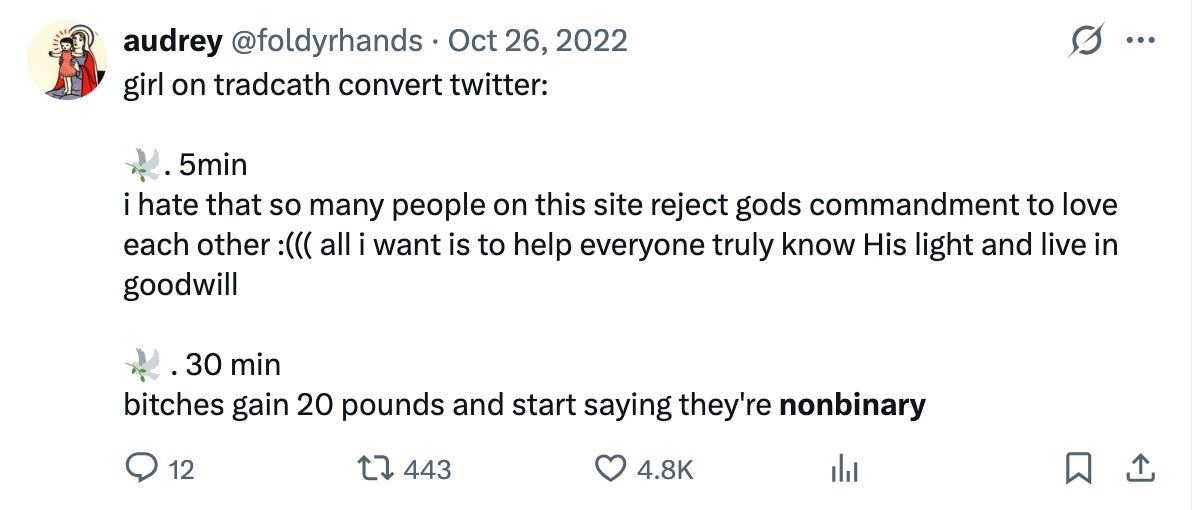
I’ve never lost sense of the dramatic irony of posting this somewhat auspicious tweet in 2022, nearly four years ago. I used to be active on Twitter, before it became awful, and at that point I was mostly posting about niche fragrance, ironically self-identifying as a Jewish American Princess despite only ancestrally being from Long Island and having grown up Reform Jewish in the Bible Belt. I remember this tweet being used as a rhetorical gotcha by some of my friends in the replies of people on, hosting, or adjacent to the podcast Red Scare, and at the time I found those moments really funny despite knowing almost nothing about Christianity. It was of course, an almost omnisciently prophetic dig, and still remains true despite most semblance of performative Catholicism’s cool-girl mystique having trickled down from subculture into the mainstream, and having joined fully with a much larger current of young people converting to traditionalist denominations of Christianity seemingly in search of a greater personal vocation and communities unanimously imbued with conservative politics. That said, a good portion of my internet presence now revolves around being a catholic Christian convert, and I’ve now had people preemptively attempt to use my own tweet against me, given that with your eyes squinted a lot of what I post these days could be lumped in with the digital consequences of the very trend cycle I once ridiculed. I get it - God’s timing is weird. I gave this article a kind of stupid clickbait title precisely because I want to address this to people on the outside of the greater Church body and even outside of mainstream religion entirely. To be frank, I understand why a lot of what I post these days probably seems weird, and why it might leave a bad taste in your mouth. Most days I wear a gold cross necklace my sponsor gave to me at my baptism, and watching United States press conferences, I feel sick to my stomach watching Karoline Leavitt, a self-professed cradle Catholic, wear a similar necklace while viscously lobbing ad-hominem attacks in defense of what could genuinely be called a Biblical cabal of evil. A lot of young people shy away from taking on this sort of worldview, identifying the devil in irksome personal habits. It’s easy for men to be Christian when sin is about trying to not jerk off, and it’s easier for women to be Christian when the devil lives in showing shoulders and the condom isle at CVS. Put simply, I don’t think God gives a shit about those things when today The IDF bombed a girl’s school in Southern Iran, killing hundreds.

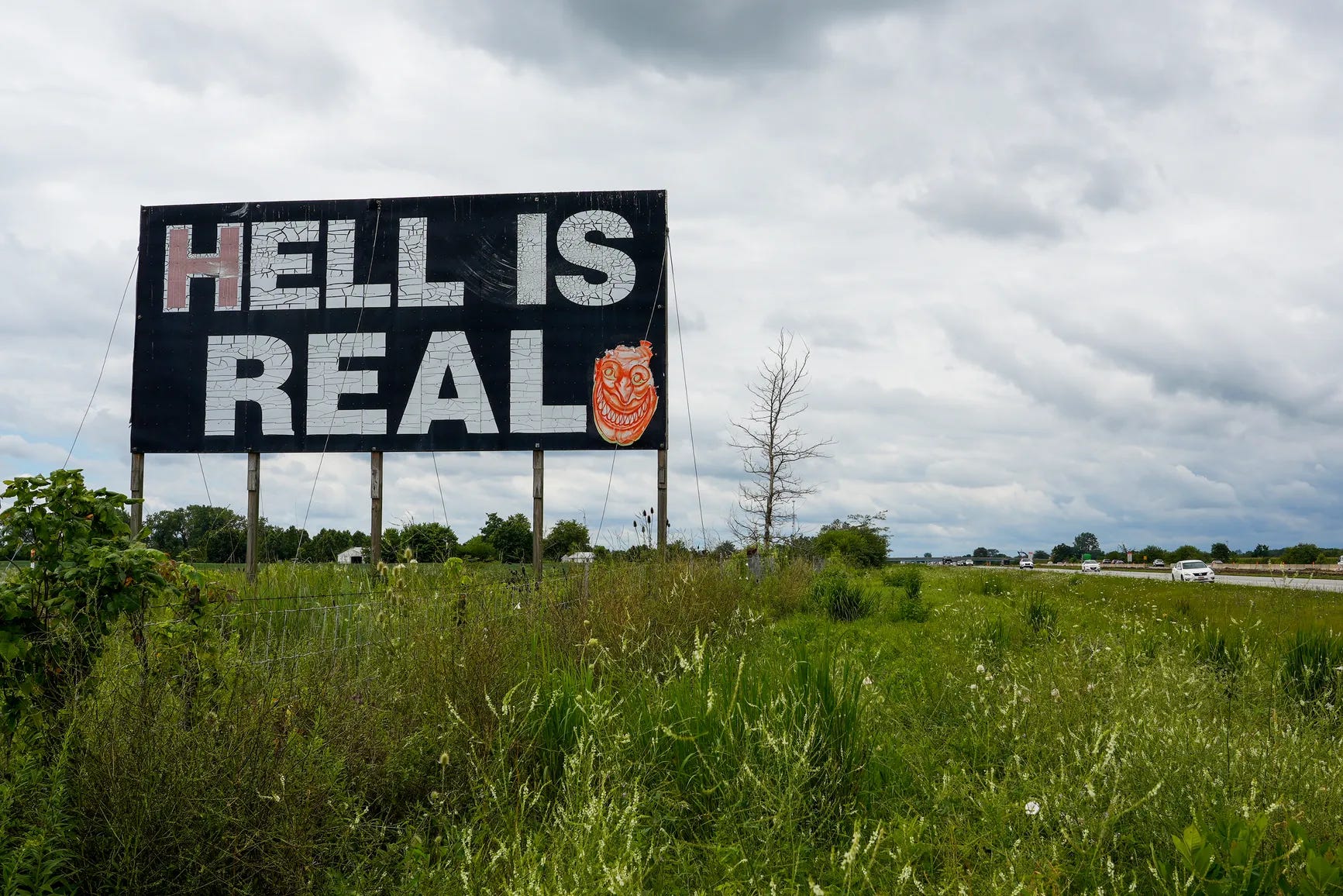
I shy away from saying this outright to a lot of my atheist friends, but I know in my heart that Hell is real, and that sin exists and ought to be confessed in both private reconciliation and public admissions during worship. When I was a catechumen in the Russian Orthodox church, I was taught that sin is the conscious turning away from God’s will, and the harm in sin is not an inherent power to specific actions, but rather the situational tendency of mankind to stubbornly turn itself away from God’s infinite and unconditional love and mercy. Needless to say, I’ve read the Church fathers, and Gregory of Nyssa’s pseudo-universalism is where I derive my soteriology. As a devout Anglican, I am quite easily able to reconcile a belief in Hell with a believe in God’s eternal love. This dichotomy, one butchered by uptight Presbyterians and backwoods Evangelicals alike, is one of the most misunderstood doctrines of the Christian faith. I would argue that most of the trauma imparted by the institutional church in the Western World – from Colonization to indoctrination – stems from individual Christians’ incorrect understanding of Hell as a separate place somehow apart from God. Amidst giant HELL IS REAL billboards looming over Midwest Interstate 71, St. Isaac the Syrian’s voice rings clear as the waters of Baptism, writing:
I also maintain that those who are punished in Gehenna (eternal Hell) are scourged by the scourge of love. For what is so bitter and vehement as the punishment of love? I mean that those who have become conscious that they have sinned against love suffer greater torment from this than from any fear of punishment. For the sorrow caused in the heart by sin against love is sharper than any torment that can be. It would be improper for a man to think that sinners in Gehenna are deprived of the love of God. Love is the offspring of knowledge of the truth which, as is commonly confessed, is given to all. The power of love works in two ways: it torments those who have played the fool, even as happens here when a friend suffers from a friend; but it becomes a source of joy for those who have observed its duties. Thus I say that this is the torment of Gehenna: bitter regret. But love inebriates the souls of the sons of Heaven by its delectability. (Homily 72.)
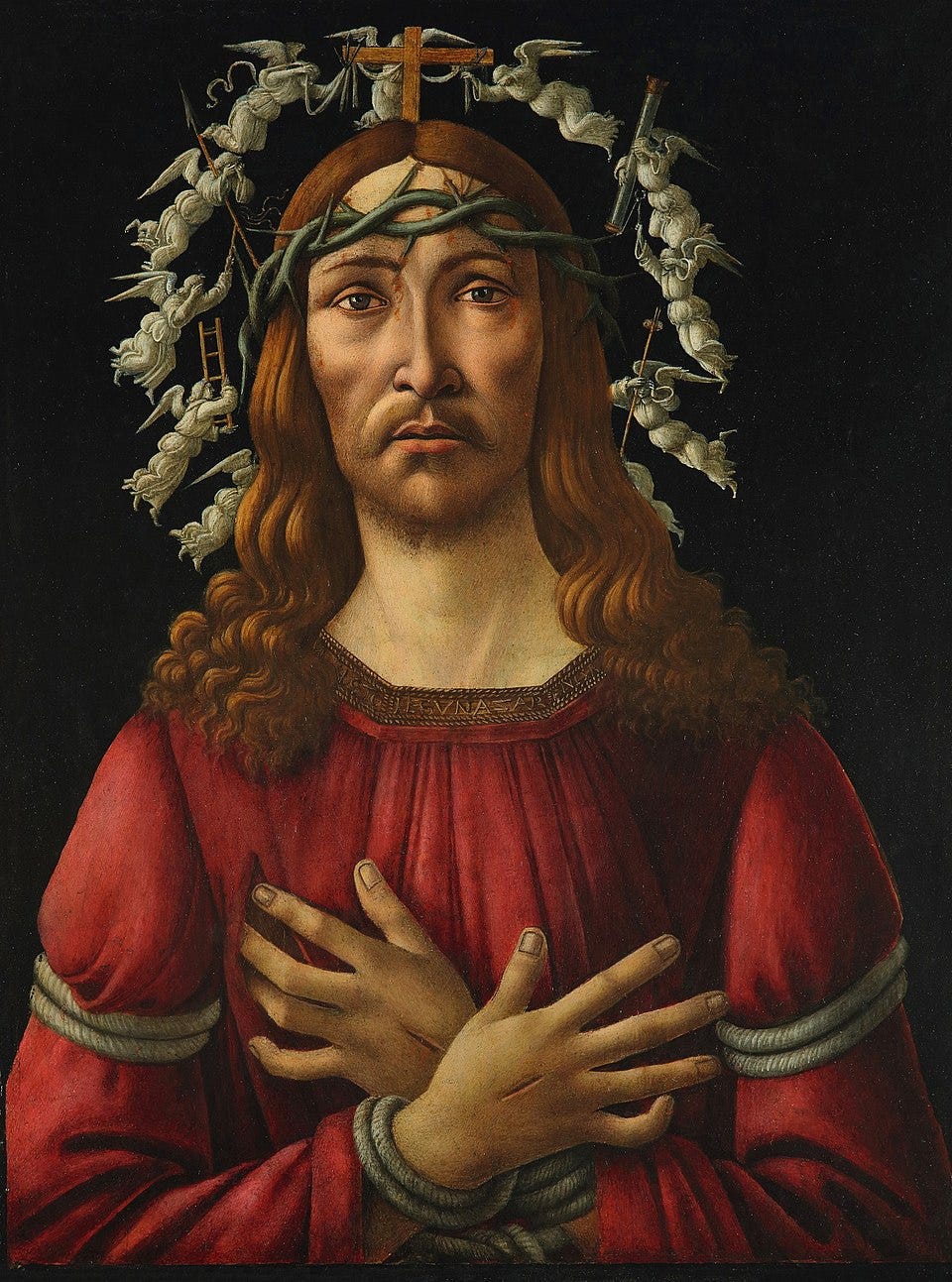
Hell is like a teenager, sad and confused, slamming the door in their mom’s face. Sulking in their poster-plastered room we sob, slitting our wrists, popping benzos, posting implicating expletives on LiveJournal, and doing everything in our power to hurt the person who loves us most. Protestant poet laureate John Darnielle of The Mountain Goats sings in Cry for Judas - “Sad and angry, don’t know how to behave. Still won’t know how, in the darkness of the grave.” If this line of thinking makes me a woke liberal Protestant, call me Martin fucking Luther. Yes sin primarily exists in personal decisions, but its face is most clearly visible in societal prejudice and institutional violence. A lot of Orthodox believers I talk to wince at statements like that, but my own church brethren in Mainline Protestant denominations like the Episcopal Church and the ELCA often espouse this idea more passionately than they even espouse the divinity of Jesus Christ. Needless to say, I believe the The Nicene Creed verbatim, and the simple answer as to why I converted to Christianity is that through a number of mystical and interpersonal experiences, I came to believe that a man born thousands of years ago in Bethlehem was truly the Son of God. This isn’t enough for most people, and it’s certainly not enough to differentiate my testimony of faith from millions of people who confess the same faith in clean brick buildings and send immigrants to die like livestock in concentration camps next-door. Needless to say, the punchline here is that the internet didn’t make Catholic, because I’m an Episcopalian. I know this confuses many people, because I adore the smells and bells of High Church Protestantism, and am an enthusiastic altar server in my very Anglo-Catholic parish. That said, as a woman, in many traditional Catholic churches I wouldn’t even be allowed to join the altar guild, much less to serve alongside female priests and deacons. This is in essence the reason why it’s easier for me to stay in the church most commonly associated with John Green and WASPy performative liberals than it is for me to lie about my sexuality to priests who can’t tell because I wear maxi skirts and Mary Janes in the service of joining the self-described One Holy Roman Catholic and Apostolic Church. Anglicanism, as one of the first historically Protestant churches, has never asserted itself as the one true form of Christianity. As the 100th Archbishop of Canterbury Michael Ramsey once beautifully articulated, the Anglican communion “is not sent to commend itself as ‘the best type of Christianity,’ but by its very brokenness to point to the universal Church wherein all have died.” This is the church I confess membership to. This is the Creedal Church, and this is the body of believers within which it’s alarmingly difficult to find many modern-day Christian converts obsessed with the ipso-facto nature of authority. Internet Christians who prioritize soaring aesthetics over inward experience infuriate me not because they’re joining the right saving faith for the wrong reasons, but because they frequently pray hollow prayers in gorgeously designed Gothic cathedrals. The whole amount of performative Catholicism and young people fetishizing conservative Christian traditions without a sincere and godly desire to do good works amounts to a delicately embellished pen-and-quill hand-written letter that says absolutely nothing. In my own spiritual development, I have found it infinitely more Godly, more Christ-like no matter your denomination or religious tradition, to follow the path of humility: practicing true and honest faith in rehabbed cafeteria buildings found in strip malls and bland tiny wooden church-halls. If those in gilded bishop’s cathedra and ergonomic desktop computer chairs revile you, know they hated Him first.
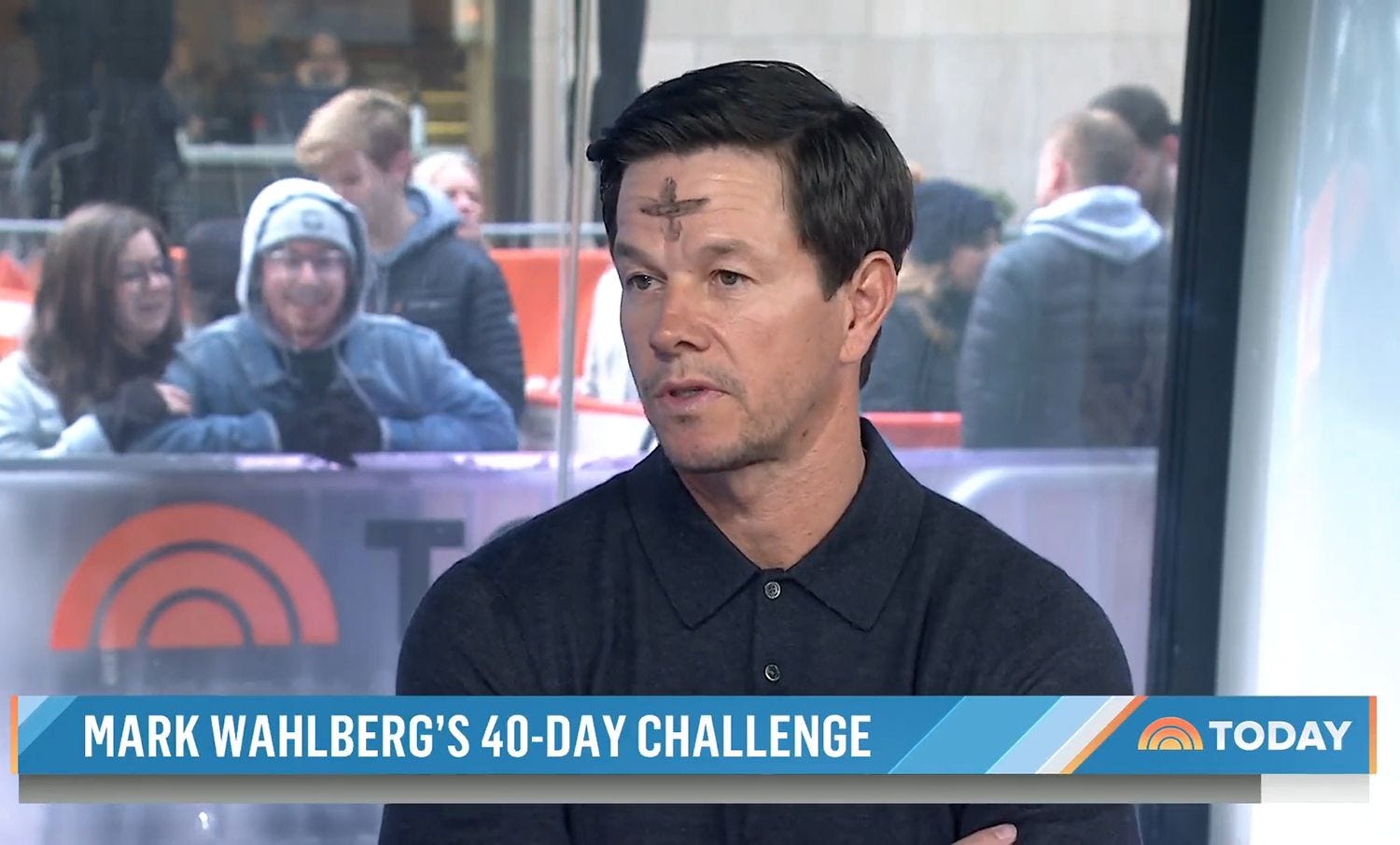
The worst thing about internet Catholicism is it’s a complete and utter misnomer. It became abundantly obvious to me during the COVID pandemic that the Christian religion rarely happens online. Religion may be discussed on the internet, but every single connection to divinity I’ve ever felt in my life has been away from keyboards and screens. Either in a Church, a Mosque, a Shrine, a Gurdwara, or in a field of wildflowers off the side of the road. It’s a very evangelical Protestant sort of mindset to believe - as many Americans do - that religion can be done alone. From my Jewish ancestry to my lower-case c four marks catholic beliefs, religion has always been a set of actions done as communal prayer. The Eucharistic liturgy is not just one aspect of my faith, it is the source from which it flows. It is from this jointly piloted prayer that I enter into unseen fellowship with everyone – people I disagree with, people who hate me, and people who defile God’s name with every waking breath. Ultimately, behind all my judgement of other’s assumed faith is the reality of my own hopeless death in sin. Maybe ultimately, through Purgation, everyone will be reconciled to God. Maybe Pope Francis was right to hope Hell might be empty – but in the meantime I live my own Christian faith in big buildings full of tradcath converts, cradle Catholic atheists, practicing homosexuals, amateur heterosexuals, soldiers, tired night nurses, alt-right extremists, crunchy anarchists, racist podcasters, raw milk homesteaders, sheltered Episcopalian grandmothers, niche internet micro-celebrities, multi-millionaires, homeless people, bible thumping Baptist preachers, and babies who have no idea where they are. At a certain point, it just matters if your prayers are sincere. And from one lost human desperately trying to find in-dwelt meaning in the world around myself to another, let’s just say it’s easy to tell when they aren’t.
‘Eat your Lipstick’ is mostly a perfume blog entirely by Audrey Robinovitz.
Audrey Robinovitz (@foldyrhands) is a multidisciplinary artist, altar girl, and self-professed perfume critic. Her work intersects with the continued traditions of fiber and olfactory arts, post-structural feminism, and radical orthodox theology. At this very moment, she is most likely either smelling perfume or taking pictures of flowers.
No posts
Comments
Nothing yet. Say the first thing.
Sign in to join the conversation.