
You and I both know the immediate, knee-jerk answer to this question - and given my plan to stay employed in the industry as long as I reasonably can, my very livelihood depends on a long-term financial future for luxury fragrances and candles. It’s something the market itself has risk-evaluated, ever-present in Givaudan ADR stock (of which I am a proud shareholder). A good many people stand to lose a lot of money if for some reason people stopped buying expensive perfume, and beyond that – a number of broader business enterprises got their big break catching viral waves of perfume popularity. That said, I have to admit the frivolity of perfume has been on my mind a lot lately. As ICE kidnappings ravage my home in Chicago and the broader USA - as campaigns of state-sanctioned genocide deepen abroad, it often feels existentially difficult to spend all my time selling and writing about luxury perfume. That said, the Lipstick Effect is real - and I often explicitly notice uptick in customers, in “treating myself” purchases and security blanket retail therapy when the world feels especially hostile and fraught. In fact, I would say both of my day-to-day occupations: perfume shopgirl and high-church Episcopalian altar server are semi-public services that often provide assurance and comfort to people who stand to lose very little. I try my best to involve myself in my own parish’s ministry to local migrant populations, and I try to welcome everyone into my store with non-judgmental kindness, but the reality is I spend most of my life around Chicago’s upper class, and when I think about my own future security, or when I think about the lives of my friends and neighbors in Uptown and South Carolina and the world, the view down can be dizzying. This is not to say I don’t love what I do, because I don’t ever take for granted the opportunity to work with like-minded people and to make a living talking with countless strangers about something I truly love. It’s just that perfume collecting as a lifestyle seems to have gotten even bigger than I was expecting it to, largely due to the internet, and from what I can tell people around me and in higher-up places than me are trying to draw up explanations for this growth they can use to better optimize their selling strategies, and these things seem almost comically simple from my perspective as both an online fragrance personality and IRL fragrance employee.
Moreover, as big business slowly but surely starts to move its attention and its money onto mercurial gestation-sites for culture like the internet, these communities, which once just felt like a disparate satellite network of friend groups and solo-investigators now hold lasting consequences on the lives and pockets of people who are entirely unplugged. I sounded the alarm cautiously on Fragrantica two years ago, which now seems to have somewhat spurned a principled boycott as the moderators of that website spiraled even more explicitly into paranoid fascism. I don’t think Fragrantica exists in a vacuum, however - and the sheer fact that fragrance collecting is an expensive hobby, and that money has to come from somewhere, means political conservatism is a common feature to this pastime, not a bug. This general sentiment, that the perfume boom is starting to feel bloated and overdone, has been echoed before, notably by Cat Zhang in an article I quite enjoyed on The Cut. It was weird to see her getting impulsive hate comments from people about this, because I think the things she brought up were entirely reasonable critiques of overconsumption and exploitative marketing. In fact, I actually intend to take some of her points further than she did. The global fragrances and perfumes market grew from 33.85 billion USD in 2025 to 36.24 billion USD in 2026. This year alone, billions of dollars have accelerated this industry into beauty’s most promising investment. I think it’s senseless for me to try and argue to you that collecting perfume is somehow a politically progressive hobby, but its also senseless to pretend as if it isn’t a practice laden with needless overconsumption, and a community that often thinks itself to be somehow ‘above’ politics, when in fact it is sustained on the backs of some of the most profitable industries. Perfume doesn’t really do anything inherently utilitarian, but rather becomes worth a lot of money because it is something people who are making that money elsewhere want to spend it on. It is the definitive commodity, it is textbook Marx. He writes in Capital, that “the mystical character of commodities does not originate, therefore, in their use value.” But rather, the substance of the commodity is attached to the completed product ipso facto. Marx uses the language of religious devotion to describe how the manufactured fetish convinces us as consumers that it has inherent value, and I think this degree of adoration is apt.
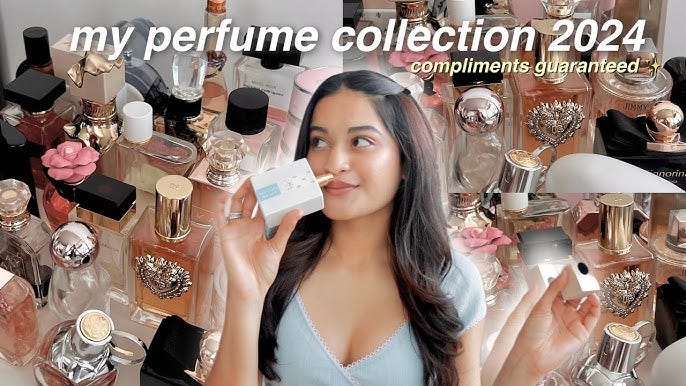
I would be remiss to not reference Benjamin as well. I really enjoyed this video by fashion/culture theorist Ash Callaghan, in which she references Walter Benjamin’s concept of aura in relation to the unique effect luxury fragrance has on prospective customers in a specific cultural moment. For those not initiated, The Work of Art in the Age of Mechanical Reproduction was itself a piece of cultural criticism that straddled the intrinsic value and affect of a physical work of art with the 20th Century’s development of intricate modern technology that could now for the first time serve to proliferate and reproduce works of art which for most of human history imparted a certain mysticism simply by our base assumption of them being uniquely made, once and for all, by human hands. To be honest, I don’t think there is a one-to-one translation of Benjamin’s conception of aura into the inherently and transparently manufactured product of fragrance, but the framework is undoubtedly useful in understanding why people come to value bottles of fragrance. In art criticism, a specific work’s aura was the sum total of the place, interpersonal context, and prestige in which a work was displayed and consumed. It’s something we now intuitively understand has diminished the intrinsic authority of the image. Most every person in the entire world has now seen an image of the Sistine Chapel on a computer or their phone before they have seen it in real life, if they are even so lucky to be able to visit Vatican City. The aura of this masterpiece would have been indescribably palpable to a 16th Century pilgrim who had never encountered this image before entering the gates of The Apostolic Palace for the first time, in a way now definitively and inescapably eliminated from modern life. Perfume is different, because from the beginning it was always made en masse. In the 20th and 21st Centuries the assumption is that the bottle of perfume you are buying is simply one of many – and yet, it too exists at a precise moment in time and in a specific setting. It’s strange to admit, but the value of perfume is not derived simply from the scarcity of its ingredients, but from the stylized setting and excitement within which it is presented. It’s contradictory, but perfectly Marxian. Expensive perfume costs so much because well, it is expensive. Its value is an Emperor’s New Clothes scenario in which funds from its sale are reciprocally used to gild its environment and accelerate its perceived desirability. I’m often stumped by random clients who wander into my impeccably decorated workplace and upon learning we charge $250+ for a bottle of perfume, ask what makes it so expensive. As a sales associate doing my job, I can’t tell them the truth, which is that luxury houses are only able to charge this much for fragrance because the public has inadvertently proven that to acquire a piece of this prestige aura and outwardly signal their own taste, they will pay this much for fragrance.
There’s another factor at play here, that Callaghan also cursorily touches on, which is uniqueness. Such a tricky and duplicitous word. Everyone wants to smell unique, but in reality, very few people actually have unique taste in fragrance. Whether the public likes it or not, fresh woods, vanilla, and clean florals will win over people’s serotonin receptors in nine out of ten cases. The real campaign to national fragrance businesses then becomes not making altogether strange and inventive fragrances, but pushing the boundaries as infinitesimally little as possible to create the perception of experimentation, while still firmly residing in the wheelhouse of that which is empirically proven to sell. Enter supposedly ‘irreverent’ houses with minimal white labels and amorphous bottles like Margiela, Le Labo, and Byredo – and on an even smaller scale, a number of independent niche perfumers who I decline to name here out of politeness. I worry that the internet has accelerated hyper-consumption of weird perfume into a tightly bounded aesthetic in and of itself, and that true olfactory experimentation has become a marketing Trojan Horse by which larger beauty companies can wrangle younger consumers into accessorizing their identity by buying the same set of novel fragrance types. I’m sorry if this seems curmudgeonly to say, but I fear that owning a giant collection of perfume from niche brands (often themselves owned by larger beauty conglomerates) has become the very hollow-chic trend cycle symptom it once sought to destroy. There are of course exceptions to the rule, but from my own position as someone who, not to lean to heavily on my own laurels, was one small part of the reason why alternative fragrance took off online, I sometimes feel as if the past free promotion I’ve done for Estée Lauder et al. is an albatross hung from my neck. If I could do it all again, I would focus exclusively on building community around the work of small businesses and independent fragrance auteurs. I’m not even sure if that would have itself staved off the rise of individuality and eccentricism as its own secret profit-generating and conformist trend cycle. It’s just so strange to see so many sweet and well-meaning people ‘getting into perfume’ via pouring thousands (and I do mean thousands upon thousands) of dollars into collecting the same ten overpriced releases from the same ten brands. When I see perfume influencers online with shelves of every single Louis Vuitton Les Parfums $350 USD 100ml bottle lined up in a color-coordinated row, I genuinely get a little scared. Even at my most financially irresponsible, I bought bottles of fragrance for over $100 probably two times a year. The fact that my perfume collection is itself something that takes up multiple shelves in my own room is mostly because of generous press gifts, perfume swaps between friends, and resale markets. Perfume itself only lasts for five or so years when bottles are stored in room-temp conditions. I know I’m not the only person who owns too much perfume to feasibly use every last drop of it before it expires. It’s really easy to do, but something that itself feels kind of shameful. I don’t want to finger wag at people spending their money on things that make them happy, and honestly if I made more money I probably would be spending more of it on collecting fragrances, but I think its important to be conscious consumers, and to guard ourselves from falling into fantasies of hype or exclusivity. Some of the most impactful experiences I’ve had with perfume were from smelling things I didn’t own. Some of my favorite fragrances are scents I’ve smelled once as a sample, and didn’t buy. I have a couple signatures as full bottles, and when they run out I’ll likely buy them again. If the niche perfume market is going to matriculate in a way that actually keeps the wellbeing of its constituents in mind, it will be through use of heavy sampling. In lieu of the actual technology to replicate fleeting scent through a computer or phone, the sample size decant seems to be the great equalizer between classes. Yet embarrassedly what often gets me to upgrade from sample to full bottle is not necessarily the immediate want of more juice, but the aura of having the complete bottle itself. Even now, I’m not immune to this effect, and I hardly mean to position myself as somehow more enlightened than other collectors or critics. What I am, however, is also someone who sells thousands of dollars worth of niche perfume a week for a living, so I feel extremely qualified to comment not just on my own purchasing habits, but those of the general public. I promise, your relationship to fragrance collecting will change drastically when you think about buying full bottles of luxury perfume the same way you think about curating a versatile capsule wardrobe. It’s not about the thrill of the chase, it’s about the fun of exploration.
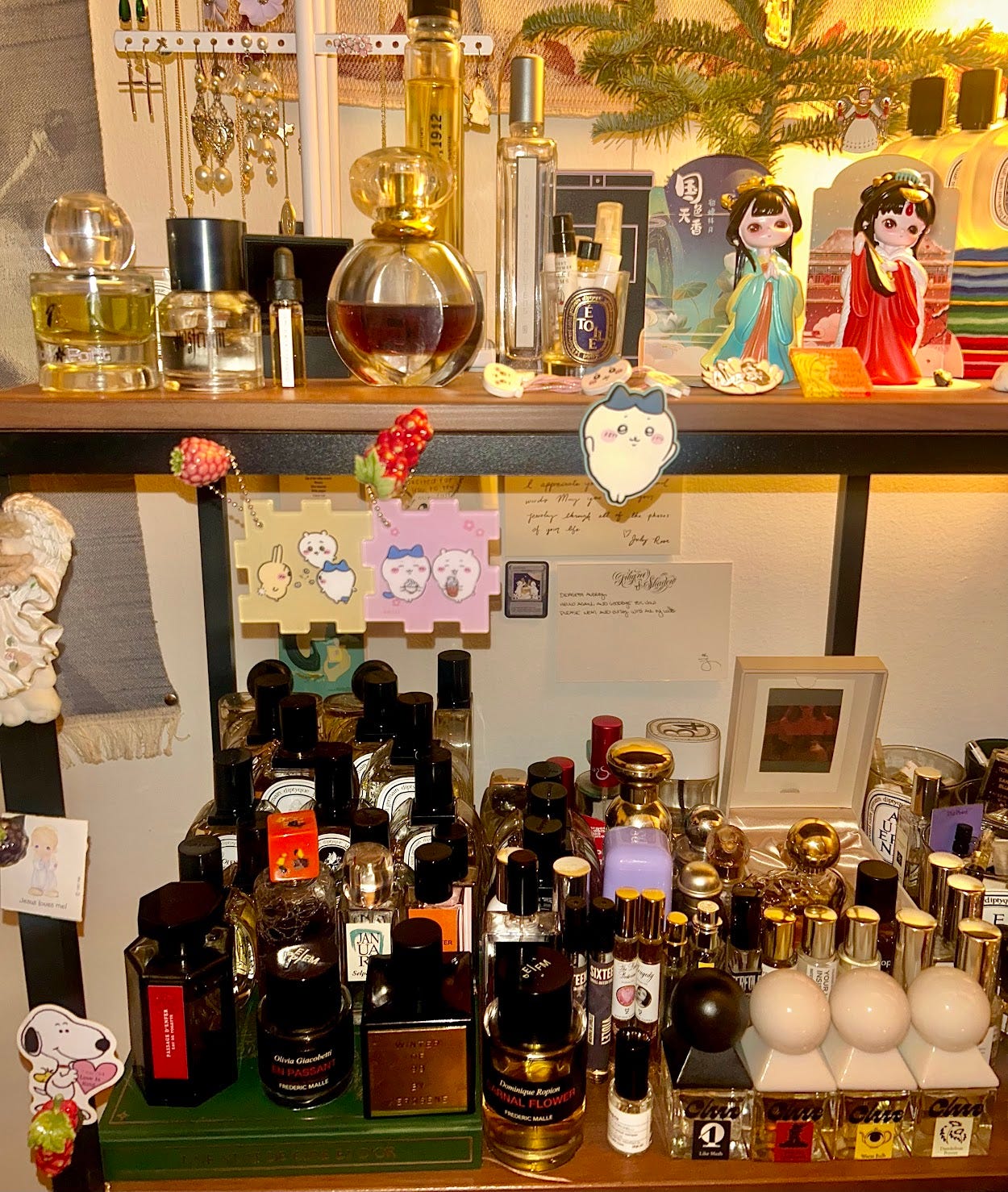
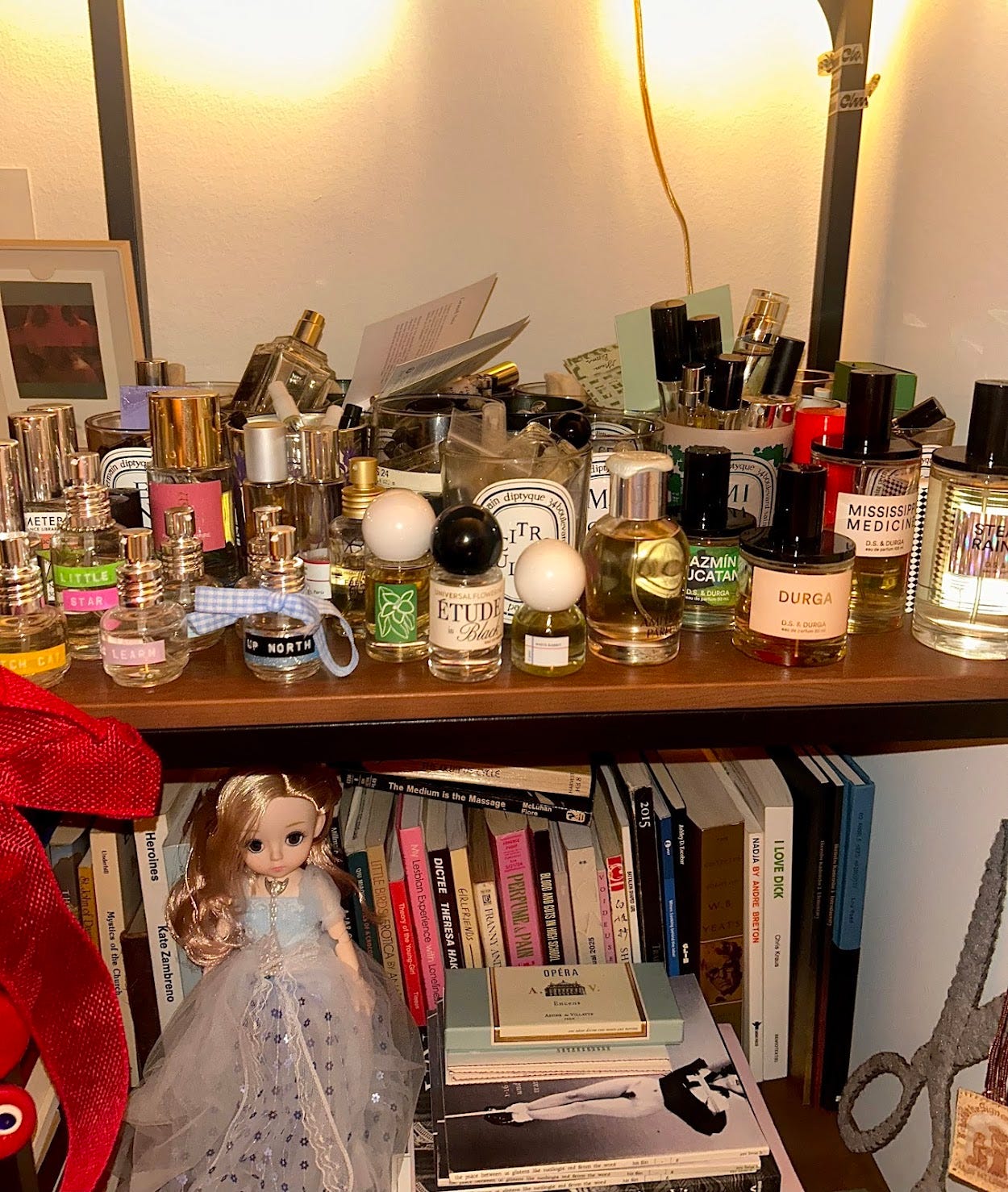
‘Eat your Lipstick’ is a perfume blog by Audrey Robinovitz, @foldyrhands
Audrey Robinovitz is a multidisciplinary artist, altar girl, and self-professed perfume critic. Her work intersects with the continued traditions of fiber and olfactory arts, post-structural feminism, and radical orthodox theology. At this very moment, she is most likely either smelling perfume or taking pictures of flowers.
No posts
Comments
Nothing yet. Say the first thing.
Sign in to join the conversation.