
A few months ago, I grew deeply resentful of myself for how much operational effort it took for me to get through a regular day.

Maintaining the basic structure of my life was consuming so much of my energy that I had nothing left for the extra fun stuff like the ideas, outfits, plans, conversations, and spontaneous moments that usually make me feel like myself. I was doing the bare minimum, not because I had suddenly become a bare-minimum girl, but because my day-to-day maintenance had quietly taken up all of my capacity.
That was when I realized lowering my cortisol could not just mean adding more “calming” things to my routine. I needed to understand why getting through an ordinary day required so much effort, and then redesign my life around that, so taking care of it would fuel me instead of draining me.
The first thing I did was cut the head off the snake, which was to fix my skin and hormonal acne. My skin was about 75% of the reason why I was not happy with my life, so I booked an appointment with a dermatologist, thinking I just needed a prescription, a stronger active ingredient, or a new topical routine to switch off the problem.
She told me that skin is healed from the inside out and recommended a list of supplements, lifestyle changes, and nonprescription topical products to see how my skin would react during the first 30 days. She told me that she could give me a prescription that would clear my acne, but it would not treat what was causing it.
That dermatologist appointment completely cracked open the door because it showed me how much more I actually had to work on. Sitting in that chair made me realize that my skin was not failing me; my life was over capacity. My body was reacting to a level of stress that required a completely different depth of internal work. And the hardest part to swallow was realizing that most of the work was not something I could simply add to my cart.
The wellness market runs on the exact same playbook as the medical and beauty industries: monetize the deficit. They have to convince you that you are fundamentally broken because a broken person buys things.
But that entire business model falls apart the second you realize your nervous system is unique to you. It assumes you have time to meal prep, money for supplements, and a nervous system built like everyone else’s. Some people feel calmer when everyone around them is happy, even if it means sacrificing their own comfort. Some people can let a small inconvenience roll off their backs. I am not one of those people, lol.
My brain likes clarity. It likes completed thoughts, clear expectations, and knowing exactly what is happening. When I do not have enough information, I fill in the blanks. When I do not speak up, I replay the situation. When something is slightly off, I can feel myself supervising it in the back of my mind all day.
Meanwhile, the people who need support the most are usually looking at a sink full of dishes, an inbox full of requests, and a nervous system that cannot take on one more thing.
That is what I had to understand. My nervous system did not need the internet’s version of peace. It needed me to up my self-awareness game a little bit more and pay attention to what was specifically making my own life harder to live inside and go from there.

Before my breakdown this year, I thought wellness meant exiting my life to recharge. Booking the trip. Taking the bath. Going offline. Getting the massage. Leaving town for the weekend and pretending my reality did not know where I was. And look, I’m not a hater. I love an iced matcha with oat milk. I love matching pajamas. I am extremely vulnerable to anything that makes my life look like it was art-directed by a creative woman with beautiful skin, pristine boundaries, and great taste. I am not against luxury wellness. I just do not think luxury can repair a foundation it did not build.
You can go to Pilates 3x times a week and still be agreeing to things you resent. You can buy every supplement on the shelf and still spend your entire day reacting to other people’s emergencies. You can book a retreat and come home to the same clutter, the same unclear relationships, and the same habit of saying “it’s fine” when it is very much not fine.
That is not wellness babe. It’s avoidance cosplaying an exit strategy. And exits are helpful sometimes. We all need breaks. But I wanted to build a life I can return to, not leave.
So I started at the bottom. I got honest about the unglamorous things that were raising my cortisol. Like waiting until 4 PM to eat. Or expecting people to magically understand my needs without communicating them in detail. It looked like unsubscribing from people-pleasing to stand ten 10’s on the uncomfortable boundaries I need to set in order to keep myself safe and sane. None of this looked like wellness content, but it worked for me. That is how I knew it was real.
This morphed into a framework that I’m calling Taylor’s Hierarchy of Wellness. It’s structured like a pyramid (like Maslow’s hierarchy of needs), but its main purpose is to look at wellness as a lifestyle you curate based on reducing friction in your life, instead of a product that you add to your cart.
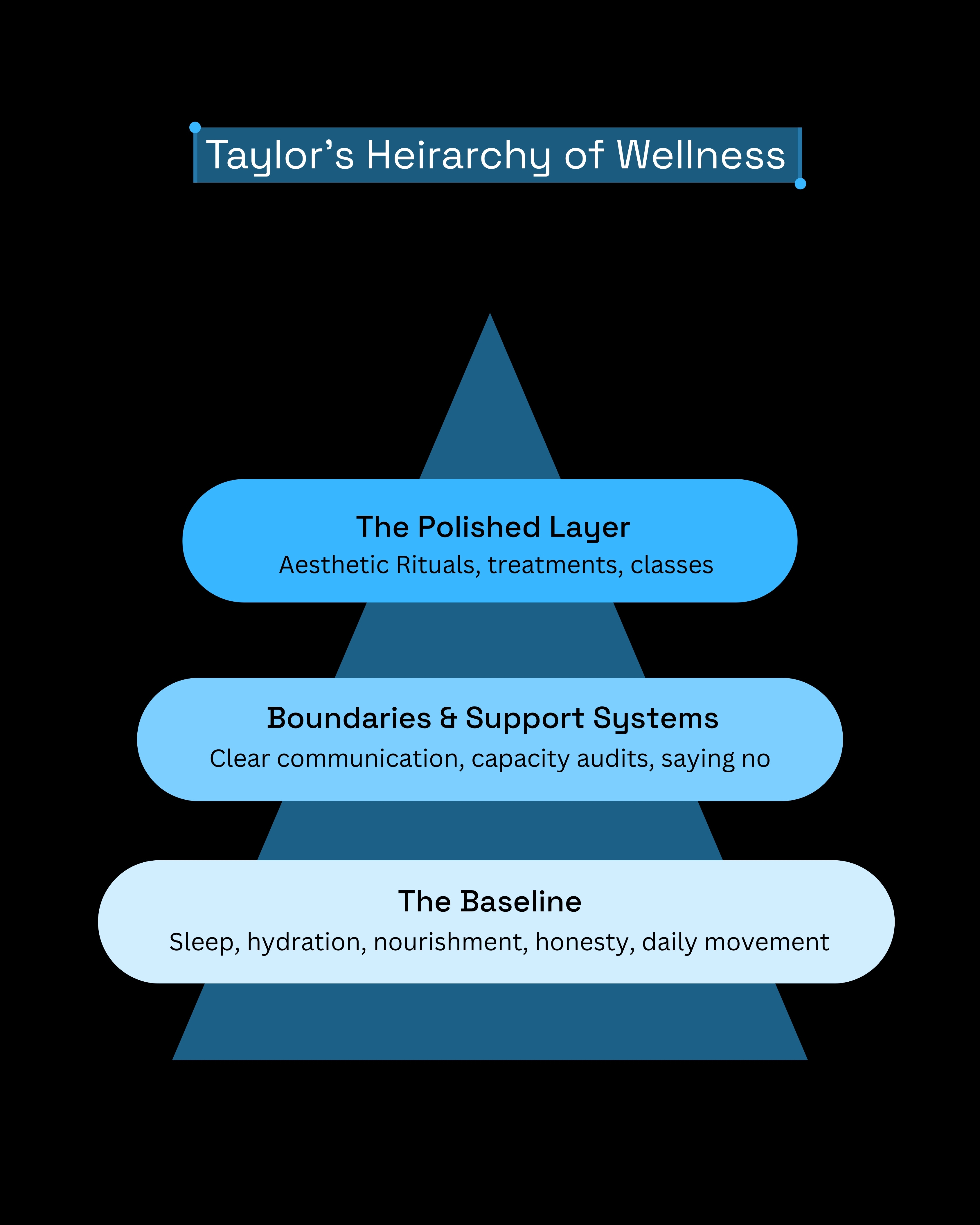
Capitalism wants you to start at the top with the luxury products, the aesthetics, and the expensive escapes (because that’s the part they can easily monetize) My pyramid completely reverses that logic. It forces you to realize that you can’t buy your way out of a weak baseline, and that true regulation starts at the bottom with the unsexy things capitalism can’t package and sell to you. Lowering your cortisol isn’t about escaping your life. It’s about being fully here for it and building a reality so safe and settled that your nervous system stop stops searching for the exit sign every chance it gets.
A beautiful Pilates studio cannot compensate for a life where you are constantly ignoring your own needs. An expensive supplement cannot outwork a schedule that leaves you depleted every day. A retreat cannot create a boundary you refuse to communicate when you get home.
Stage 3 is not useless. I love Stage 3. But it should support the foundation, not distract you from the fact that the foundation is cracked. That is the difference between a stay strategy and an exit strategy.
Before adding anything new to your wellness routine, I want you to study the life you already have. Ask yourself:
Where are you saying “it’s fine” while privately collecting resentment? Think about the work dynamic, friendship, family favor, or recurring situation that leaves you feeling heavy after you agree to it.
What specific task, conversation, or notification makes you immediately want to hide, procrastinate, or shut down? Name the exact thing(s).
You do not have to quit your job, end every friendship, or move to another country. Maybe you turn on Do Not Disturb until 9:00 a.m. so you do not consume everyone else’s emergencies before you have had water. Maybe you mute the group chat. Maybe you stop checking your email from bed. Maybe you give someone clearer instructions so you can stop supervising the outcome in your head.
Write the exact sentence. Not the softened version. Not the five-paragraph explanation designed to make sure nobody is ever disappointed in you.
The clean sentence:
“I do not have the capacity to take this on.”
“I need more information before I can agree to this.”
“That does not work for me.”
“I need this completed by Friday to feel comfortable moving forward.”
Your nervous system does not need you to be perfect. It needs you to stop making it carry truths your mouth refuses to say.
Over the next few weeks, I am going to share exactly how I rebuilt my foundation, got my creative energy back, calmed my skin, and started feeling like myself again. I want you to look at the architecture of my life so you can become more curious about your own. Because the goal is not to build a wellness routine that only works when your calendar is empty, your house is clean, and nobody needs anything from you. The goal is to build one that still works when you have back to back meetings, the house is messy, and you only have 50% capacity.
Let this marinate over the weekend. On Monday, I am going to tell you how my obsession with finding the perfect french pedicure in LA exposed one of my biggest boundary leaks—and why keeping quiet can be one of the most physically stressful things we do.
Take a deep breath today. Respect your capacity. And pay attention to what your body has been trying to tell you.
With love <3
DonYe Taylor
No posts
Comments
Nothing yet. Say the first thing.
Sign in to join the conversation.