
Your ancestors lived within a web of animate consciousness, their creativity in collaboration with wider forces.
Then came the cosmological destruction.
The persecution of wise women as witches, the outlawing of indigenous ceremony, the dislocation of spirit from the earth.
Is it any wonder that dominant culture has separated imagination from reality? Distorting creativity into escapism, pretending art can be separated from life?
It was in an orchard in the countryside of England that I first felt the call into a deeper cosmology.
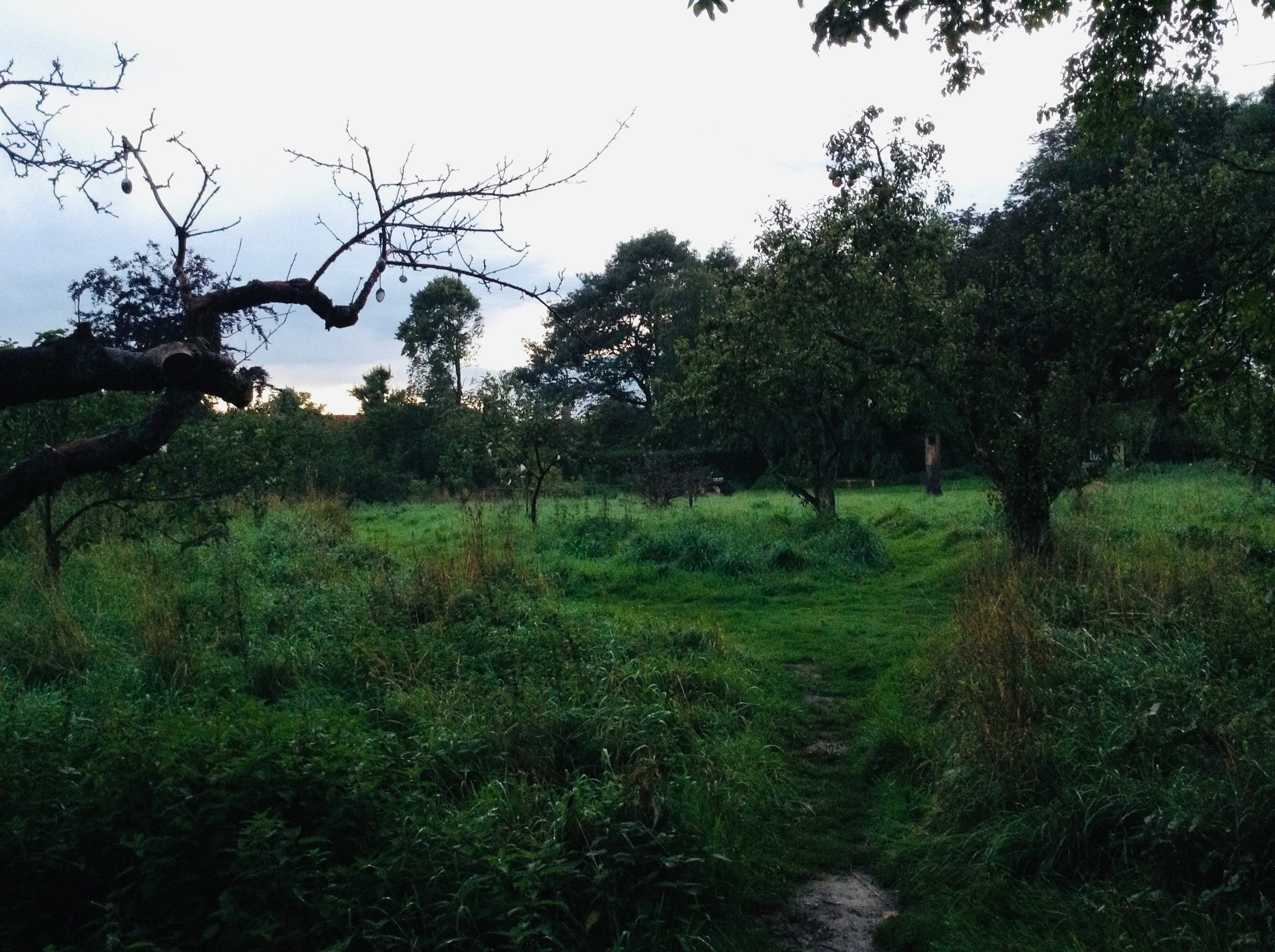
As an emerging theatre artist traveling in Europe as part of my MFA, I created a retreat for myself in the tiny village of Littlebourne, Kent—complete with public footpaths, pubs, and oast houses. I rented a room in a 17th century cottage turned airbnb to spend a week reading about ecology and systems thinking while experimenting with solo performance in the public orchard at the center of the village.
After the intensity of the Edinburgh Festival and a clown training in Switzerland, it was a relief to have some time in solitude to read, to create, and begin to clarify my thoughts about theatre. At that time I was becoming disillusioned by the pressures within creative industries as I saw artists I loved struggling to hold the integrity of their creation in the face of the systemic forces of scarcity and competition.
In Switzerland, I had glimpsed the relational presence I longed for during a clown exercise led by master teacher Pierre Byland:
You enter the stage to discover there are 4,000 people watching you, waiting in anticipation to see you do the most amazing thing they will experience in their lives.
Your presence expands as you imagine yourself witnessed and loved by such a vast audience.
You open to a power that doesn’t appear to fit inside your body—self-protective postures peeling away, breath deepening, body relaxed and alert at the same time.
You are so beautiful in your aliveness.
But off of the stage I was still baffled. Why couldn’t we embody this creative potency within the wider culture? Or even in our relationships with creative collaborators outside of the rehearsal room? Why did the undefended beauty of that aliveness only get to exist on stage, in film, in stories? I was grappling with a fundamental vacancy in daily life—this longing we have for relational witnessing, for circulation of creative power, while simultaneously there is the sense that living from such a vibrant possibility is scarce and separate within the social constructs that shape culture.
Thus began one of the most profound acts of imagination in my life: a week I spent creating in an empty orchard, performing for the silent witnessing of those trees.
In one of the books I was reading at the time, The Gift: Imagination and the Erotic Life of Property, Lewis Hyde compares the gift economies of indigenous cultures with the role of the artist in modern society. In both cases, Hyde describes how imagination expands identity beyond the isolated self, creating a collective organism composed of many beings.
During my self-created performance retreat, I was experimenting with that same prompt from the clown workshop, but my reading of Hyde inspired me to widen the context of my inquiry beyond the human.
I created the the arbitrary rule that the trees were my audience.
Anything I danced, sang, or spoke was offered as a gift to these witnesses.
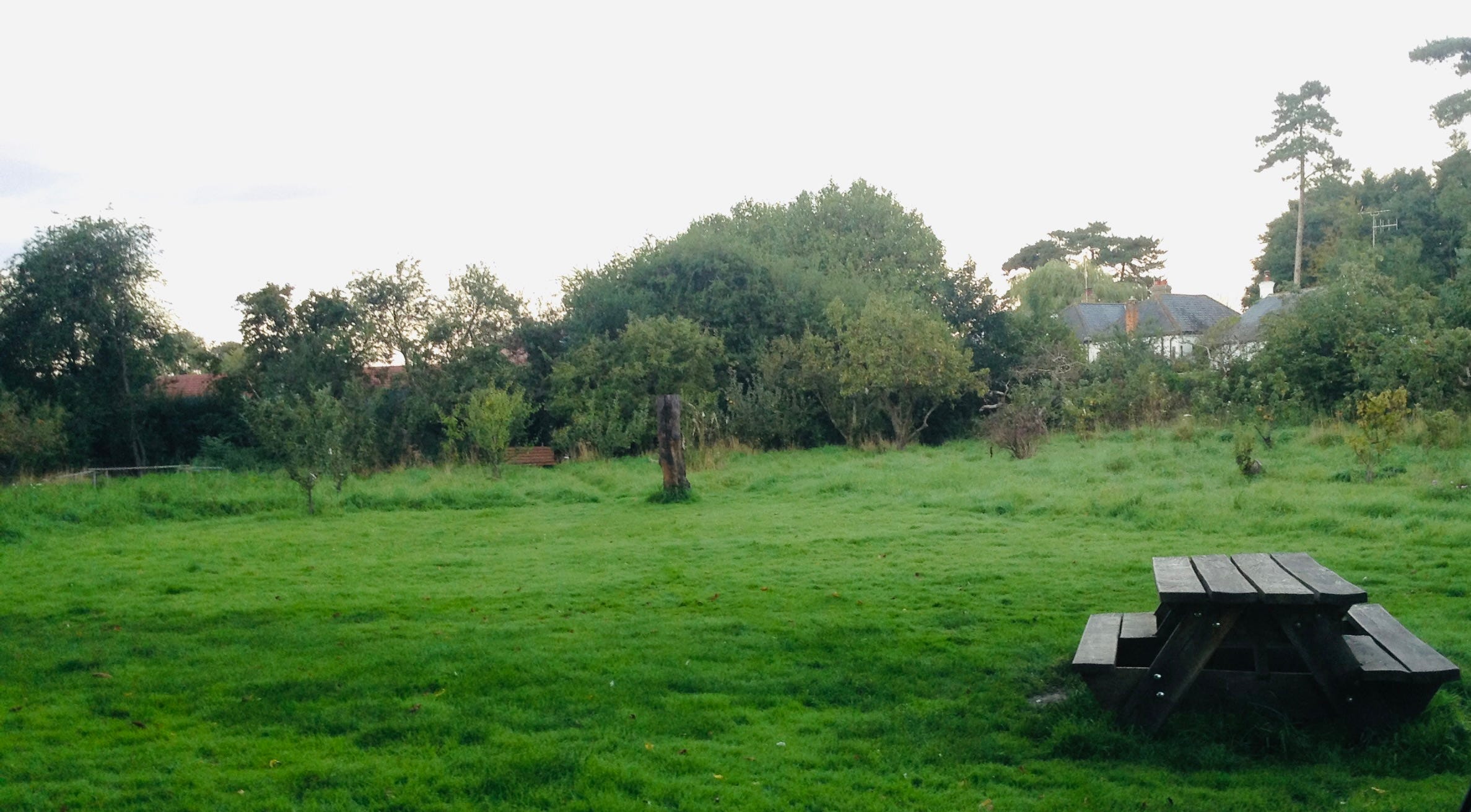
A cosmological transformation began to unfold for me through this perceptual offering. The beings of the orchard watched me expectantly, nodding their branches in agreement, whispering to me in rustles, swaying when I danced.
I brought my questions about my disillusionment within creative industries to these tree-beings. I felt myself companioned by them. I felt them guiding me and widening my perception.
On the last day of my retreat, I stood alone in the orchard, a horseshoe of trees encircling me, when I realized that a part of myself was becoming transparent, merging into the space between branches.
“It’s all me,” I thought. “Or rather, I am all it.”
And in the moment, I felt my body shift from closed to open. I felt suddenly: space.
I realized that the problem with theatre, the gap that many western artists feel between our daily life and our creations, is that cosmologically we cut ourselves off. We feel disconnected from our belonging within the wider body of the earth.
We are cut off from the way our creativity is in animate circulation, nourishing our belonging within the web of life—the inspiration that is also the trees, that is also all the dreaming forces, the apple tree, the weeping willow, the faint sliver of a new moon.
Later that year, I found a resonant description of this experience in the book Spell of the Sensuous where David Abram quotes a story from the Koyukon people of Alaska:
“[They] live in a world that watches, in a forest of eyes. A person moving through nature—however wild, remote, even desolate the place may be—is never truly alone. The surroundings are aware, sensate, personified. They feel. They can be offended. And they must, at every moment, be treated with the proper respect.”
And in that moment, standing alone in the orchard, I began to weep.
All of the stories in my life, all of the worlds, collided in that moment. I felt the visceral sensation of being held within a witnessing being.
The trees were listening, calling this understanding from me—the truth was: I wanted to create theatre because I didn’t want to feel alone.
When I wasn’t creating, I felt exiled, I felt lonely, I felt like I didn’t belong anywhere.
My imagination linked me back into a wider inside but when I stopped creating or immersing myself in stories, I felt like my life didn’t have any meaning anymore.
My actual self was cut off from creation. Only in the art-making could I be home.
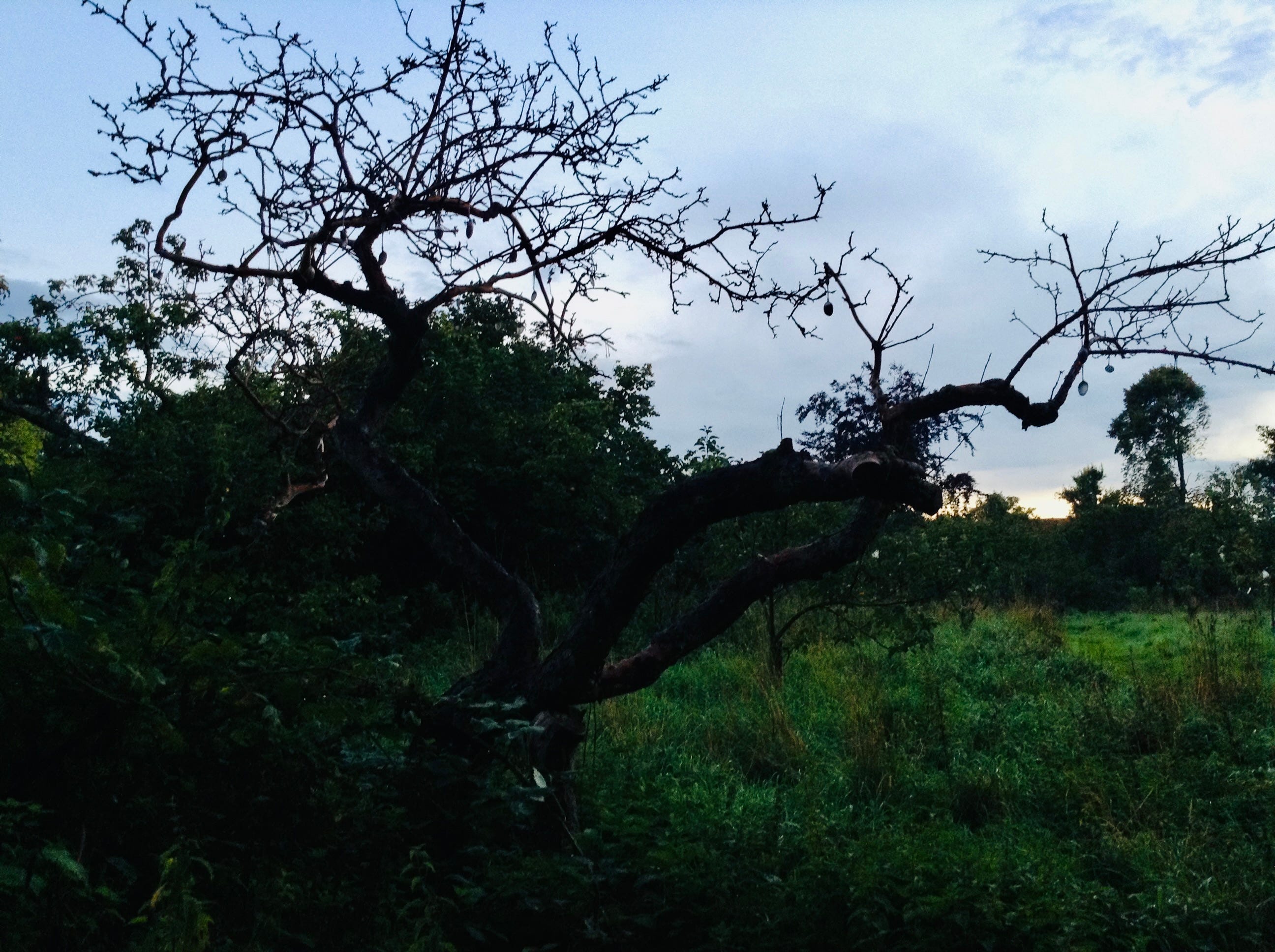
But what the trees showed me in that moment was that I was never outside of the love in the first place, it was just about giving myself permission to receive it.
This moment was the beginning of my awareness that creation within original cultures is connected to the sense of the whole of reality—not abstracted into relationship with just humans. Original peoples create art as emotional metabolizing, as offerings to the ancestors, as rituals rooting down into relationship with earth. And the art doesn’t stop when the performance is over, it is woven into the fabric of the world, the ways humans are in intimacy with animate forces.
Anishinaabe writer Robin Wall Kimmerer evokes this into her potent invitation to become literate within a “grammar of animacy” in her book Braiding Sweetgrass:
“Imagine walking through a richly inhabited world of Birch people, Bear people, Rock people, beings we think of and therefore speak of as persons worthy of our respect, of inclusion in a peopled world…Imagine the access we would have to different perspectives, the things we might see through other eyes, the wisdom that surrounds us. We don’t have to figure out everything by ourselves: there are intelligences other than our own, teachers all around us. Imagine how much less lonely the world would be.”
My time in the orchard showed me that art-making is a refuge for a much older wisdom, the relational consciousness that mediates our relationship with nature, with elemental forces, with the primordial depths of our own existence.
When we realize that the wounds of modernity are rooted in the absence of these animate relationships that bring the world alive, we can see the incredible power that art is attempting to channel into culture.
Theatre is the place where ritual went to hide when the earth was no longer sacred, when our imaginations were no longer allowed to be “real.”
Creation is a mediatory vessel for forces much bigger than ourselves that are weaving us into relationship with life.
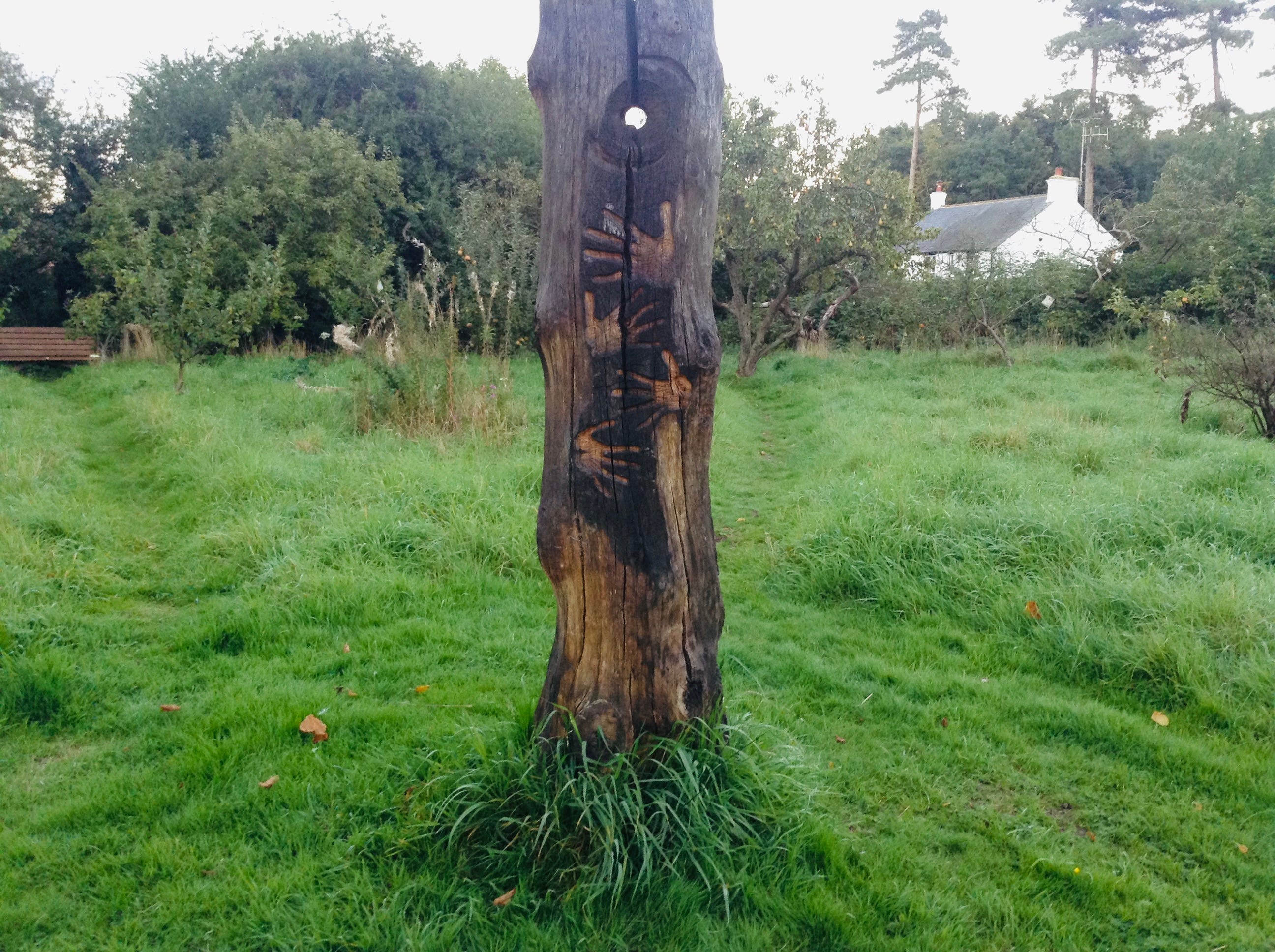
In center of the orchard is a tree trunk with a portal through its center and the carved outlines of hands, calling back to the oldest human expressions of art in ancient caves.
I would later learn that the farthest back I can trace my motherline through geneological databases is to Kent in the 1500s.
The orchard may have been close to the land where my mother’s people came from.
I was being guided by the dreaming of my ancestors before I even knew how to listen for them. My ancestors who were the witches, the medicine people, the ones who came from somewhere, who were intimate with the ecosystem, whose creativity was a ritual for life.
I am not cut off from this lineage, even as a white person, a descendant of the ones who came to Turtle Island on the Mayflower carrying the seeds of violence and displacement.
My roots are older than the rupturing.
The orchard called me home.
As you journey with me through these stories, I would love to hear your responses!
Drop me an email or a DM and let me know what sparked for you in reading this.
Where are your edges here? What connections do you feel taking shape?
Please invite your friends and creative colleagues to share their thoughts about this exploration. Let’s have this conversation ripple out to all the places it is needed to shift cosmology within creative industries, creating art as alchemy for collective transformation!
And if you’d like more support for your creative process, you can book The Cosmology Call as the doorway into my wider offerings including my long-term consulting work, energetic dramaturgy, and retreat facilitation for the core team of a creative project.
Comments
Nothing yet. Say the first thing.
Sign in to join the conversation.