
You can find all our hopeful headlines at Hope Scroll. Here are my favorites of the week:
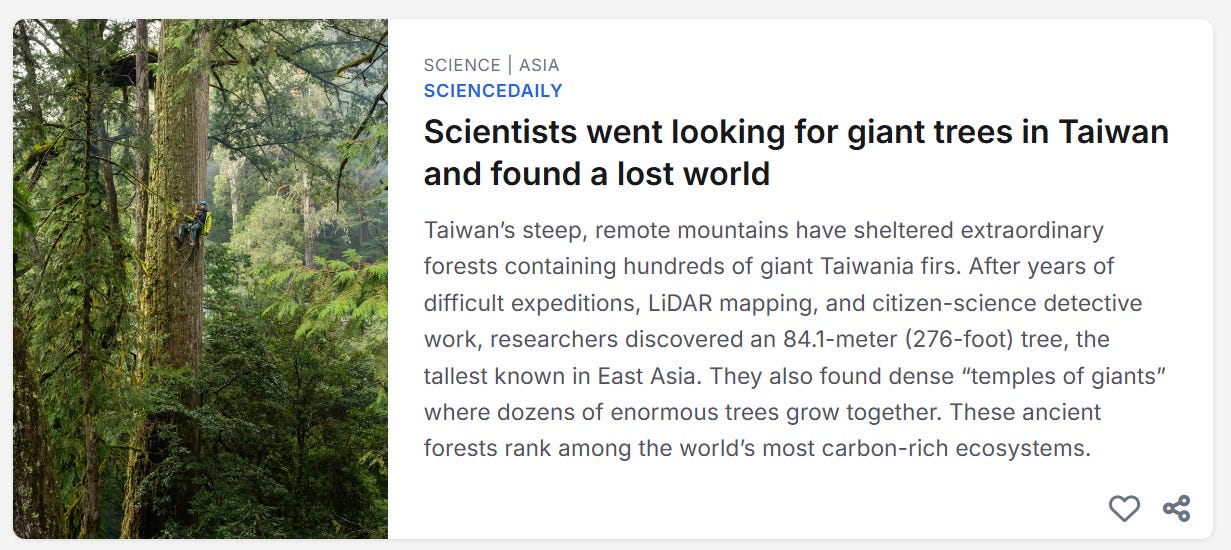
I’ve spent time in Taiwan and once visited a forest with trees as tall and wide as California’s redwoods, so I was not surprised to see this news. The “Taiwan tree seekers” are a group of professional tree climbers, ecologists, geologists, and remote sensing specialists who found not only East Asia’s tallest tree, but also clusters of huge Taiwania fir (Taiwania cryptomerioides), a species that the island’s indigenous Rukai people call “The tree that hits the moon.”
MassLive reports that horseshoe crabs are booming at Cape Cod, where decades of protections, especially during their spawning season, are bearing fruit:
Horseshoe crab eggs are also a vital food source for migratory shorebirds that stop along the Atlantic Flyway each spring. Cape Cod National Seashore also notes that species such as the red knot rely on the nutrient-rich eggs during their long-distance migrations, making healthy horseshoe crab populations important well beyond Massachusetts waters.
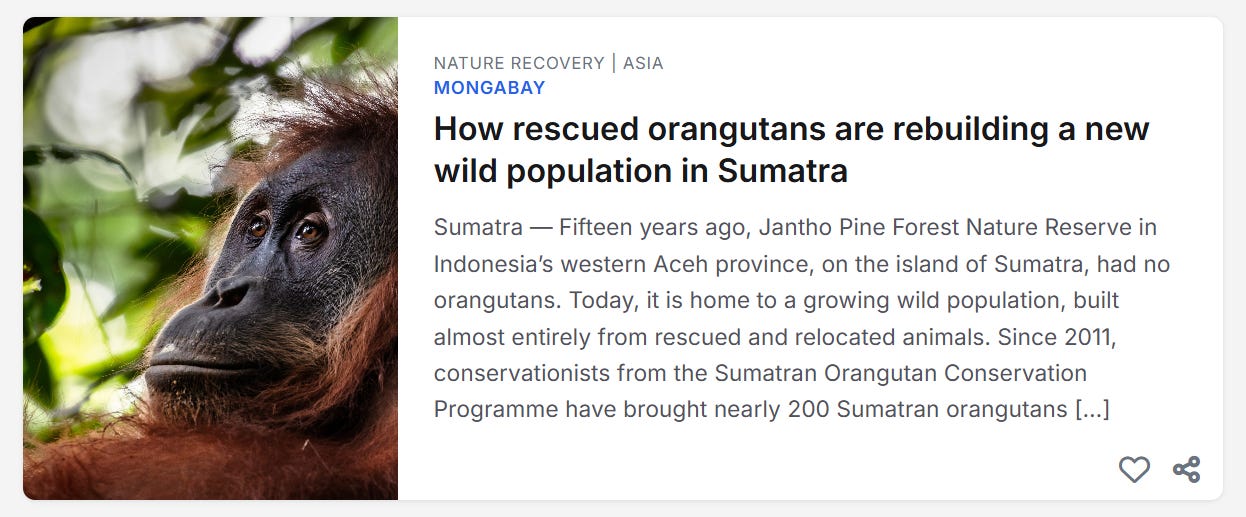
From Mongabay, the good news is that rescued orangutans are creating a wild population on Sumatra. Why are orangutans losing habitat elsewhere? Because of palm oil plantations. We must stop deforestation for the sake of palm oil food products and “biofuel.” Did you know that California’s gas prices are high partly because state law requires a special “recipe” that our gas must be composed of biodiesel? The law increases demand for biofuels that not only results in deforestation in Asia but also consumes cropland in the U.S., lands that require fertilizer and pesticide inputs, essentially using petroleum products to grow food like soy or corn that is turned into fuel for cars. Again, nonsensical environmental policy.
For a more in-depth explanation, read “California’s hidden gas tax is due for reform.” Where this says “forest loss internationally” here, read “Indonesian orangutan homes”:
[T]he small amount of biofuels that the LCFS may incentivize are likely to actually raise emissions. A recent UC Davis and Berkeley working paper found that diverting soybean oil and other vegetable oils to biofuel drove over 4 million acres of forest loss internationally, generating enough emissions to potentially make the biofuels more carbon-intensive than the fossil fuels they replace.
Grid-scale batteries made from salt have arrived, The Wall Street Journal is reporting. General Motors and startups are investing in scaling up the technology, which involves less pollution along its entire lifespan, including less mining and fewer spontaneous fires. Salt-based batteries don’t require rare earth minerals, which are mainly sourced from China. Improving the ability to store solar and wind power safely so that energy can be used at night is an important part of a clean energy transition.
While grid battery storage is already growing in the U.S. at a furious pace, new sodium-based batteries are potentially cheaper, longer-lasting, safer and more reliable than conventional, lithium-based ones. They could accelerate the rollout of renewables, and be part of less-polluting alternatives to natural-gas turbines and diesel generators. …
A recent report from Morgan Stanley projects that within a decade, more than a third of all batteries produced in the world will use sodium, not lithium.
The Inflation Reduction Act is alive and well, Leah Stokes writes:
Over the past few months, I’ve been working on an econometric study that looks at the manufacturing renaissance the Inflation Reduction Act kicked off. We found that the law helped drive $185 billion in private investment into building factories that make solar panels, batteries, and electric vehicles. And here’s the amazing thing most people don’t know: nine in ten of those facilities are still getting built …
Read the full article here:
And more good news, from Jonathan P. Thompson, reporting that “Solar is gaining ground on Western states’ grids.”
Related: Trump’s EPA was wrong to terminate billions in climate grants, US appeals court rules
PAID SUBSCRIBERS: A delicate wildlife rescue is posted at Eyes on Beauty for you.
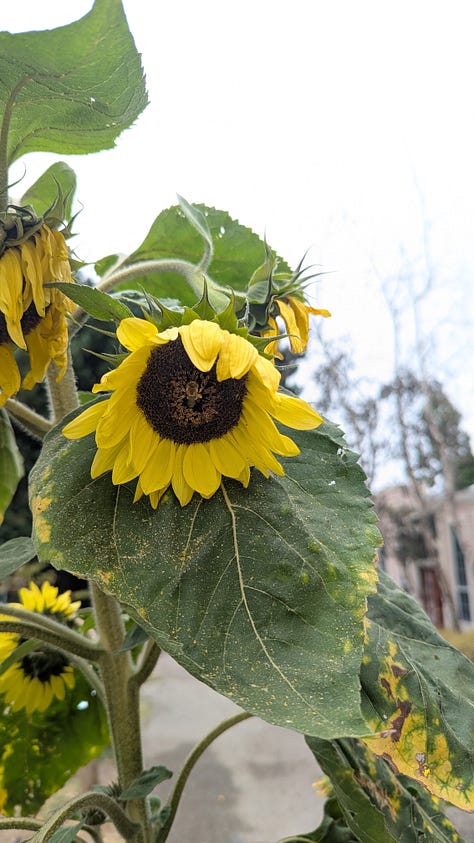
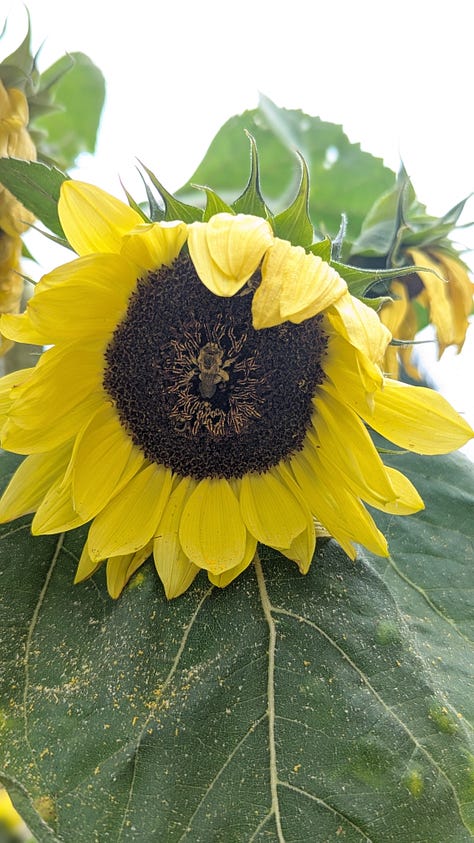
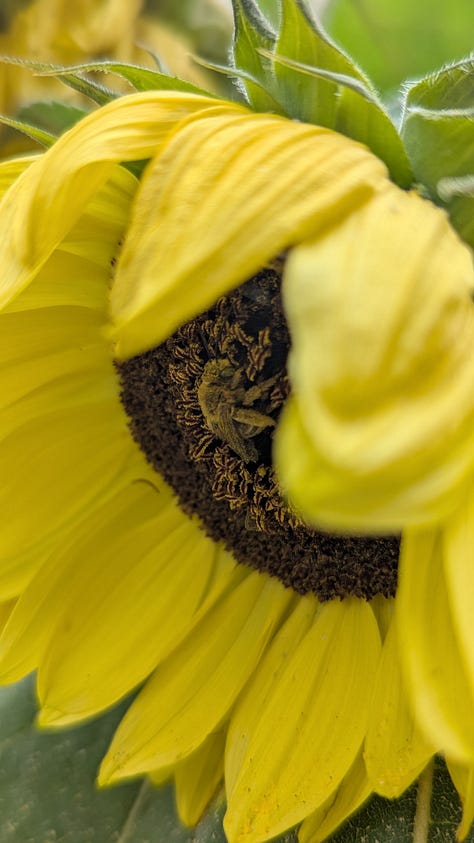
Our Hopeful Headlines are updated about three times a week at Hope Scroll. Even I feel better when I read my own collected headlines this way. Read them on a train, read them in the rain, read them whenever you need hope in your brain.🌻

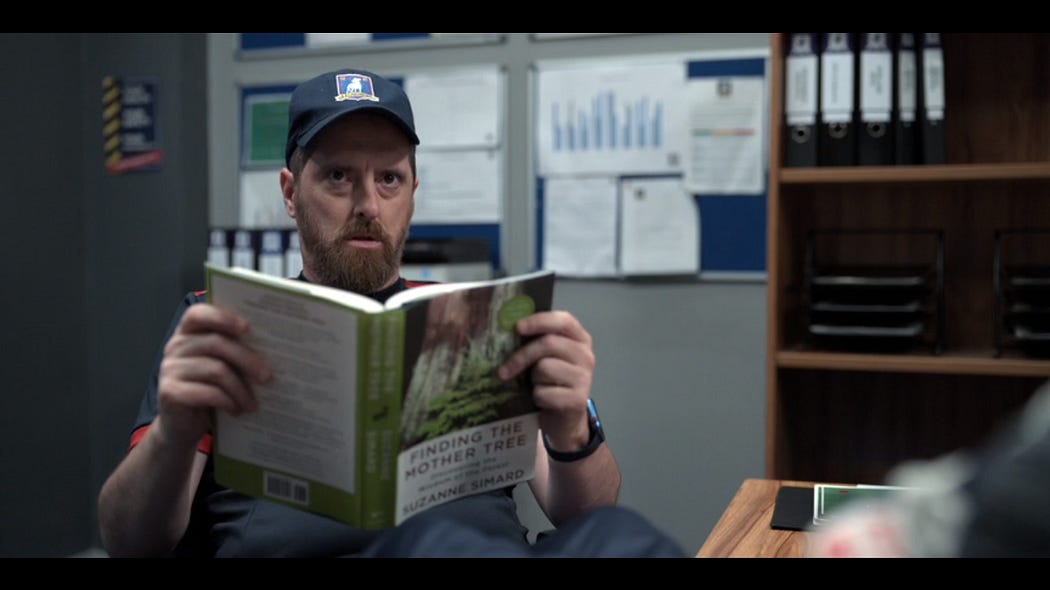
Ted Lasso contains some great jokes, nuanced characters, and heartwarming moments, but I give the first seasons a 3.5 out of 5 stars, simply because it continuously recycles the same storylines. The show promotes itself as family-friendly (one character is under 10 years old) but frequently gets pretty raunchy with its romance elements. However, this scene brought me pure joy, since Finding the Mother Tree is one of my favorite books of all time.
First, Distilled broke the news this week that Amazon is building a huge gas power plant in Texas solely for a new data center. Second, this comes on the heels of a heavily publicized announcement last week that Leonardo DiCaprio’s organization Re:wild and the Bezos Earth Fund are partnering to spend $200 million to save 100 endangered species. I saw the press release and just couldn’t bring myself to post it anywhere. Jeff Bezos, the owner of Amazon, has a net worth of around $294 billion. Bezos donated $100 million to the Phoenix Species Project. The fraction of his wealth that $100 million represents is so miniscule it can barely be captured in words, but it is 1/2940, or about one three thousandth of his wealth. Here is the decimal: 0.000340136.
I’m not sure what happened with the headline writers at The Guardian, but I think someone might have called in sick. I’m pretty sure this headline means “Arctic sea ice is melting faster”?? and it’s not good news. Beware, if you read this headline several times, you, too, may fall into a vortex where information is hard to grasp.🤔

We launched Hope Scroll at the end of July. I’m very pleased to see people are reading it from all over the world. 🙌🏼 Generous new paid subscribers did cover all the hosting fees. Thank you🙏🏼. I know this project will grow and inspire, and I’m excited about launching new capabilities soon. If you can pitch in to help cover my time to build and update the site, please consider upgrading to paid (only $40/year.)
Hope Scroll is a gripe-free, politics-free, doom-free space!
One woman can bring back sea otters. And sea otters can bring back whales. This is the story that inspired Earth Hope:
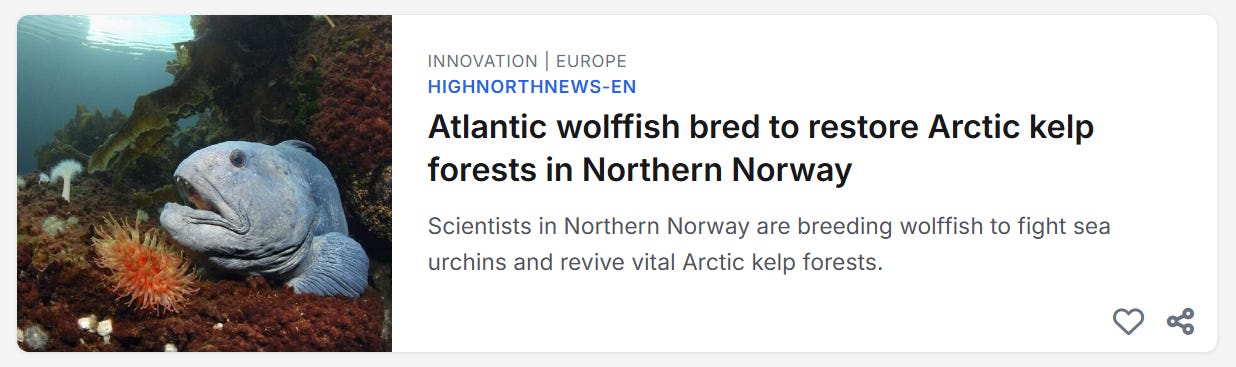
Related to kelp forests, a reader pointed out that an artificial reef in Southern California is now home to kelp and sea otters🙌🏼: “Giant Kelp Reef Achieves Success.” And don’t miss this news from across the pond:
Earth Hope is a solutions-based journalism project that highlights environmental success stories to inspire action. I’m Amanda Royal, a former newspaper reporter and current eco-news junkie. Read more about this project and what inspired it. I aggregate news under my “hopeful headlines,” conduct original reporting and interviews, and share occasional personal narratives. Visit earthhope.substack.com for more stories. To understand why I write about hope, please read “As I went down in the river to pray …”
Comments
Nothing yet. Say the first thing.
Sign in to join the conversation.