
195 nations are presently gathered in Bonn for the midyear UN Climate Change negotiations. They are facing more serious ongoing climate disruption than any negotiators before them, while geopolitical trends urge them to focus mostly on technical and procedural issues. The need for climate-related investment is greater than ever, so strategies for mainstreaming of climate resilience and related innovation activities priorities are coming into focus. Mainstreaming means, essentially, building climate priorities into everyday activities, for people, households, communities, and for industry and enterprise. Our message, at this crucial time, when we are setting climate conditions for countless future generations, is that climate-resilient local economies are full of opportunities for everyone. Climate action is not a technology story, but a human story. All of us have a role to play, and our everyday economies can be organized to reward constructive problem-solving, and to help us make the world more livable for everyone.
Our policy and strategy brief to the SB64 round of UN Climate Change negotiations
Earth is a living world. When we talk about “the planet”, we are not talking about some marginal part of human existence that interests scientists and climate advocates. We are talking about everything human beings depend on and aspire to. Nothing is possible without the living systems that make Earth hospitable to human existence.
The costs of climate disruption and Nature loss are human costs. Even when we look beyond the balance sheet, to consider non-financial ‘hidden costs‘, the very idea of cost tends to come back to what it means for the prospects of human security and thriving. Many costs are not built into the prices we see on products we purchase; instead, they filter through the economy, compounding each other’s effects and undermining security and wellbeing.

While negotiations focus on how insights, technologies, and evidence can best be shared, and how to finance best-case development, the following priorities can deliver real-world benefits that make future choices more attractive:
Focus on food – Climate-resilient development requires regenerative, agroecological food systems that restore and protect Nature and improve lives and livelihoods. Treat human and ecosystem health as a continuum.
Diversify decision-making – Too much needs to be done too quickly to leave decisions of multigenerational consequence to just a few high-ranking officials; invite stakeholders to co-design policies and investment arrangements.
Localize financial innovation – Evolving financial institutions and arrangements to support successful climate-resilient development naturally suggests a wider base of financial actors and activities. Support local MSMEs to expand opportunity.
Build better infrastructure – Climate-resilient infrastructure can include roads and bridges, trains and ports, but also coastal flood management systems, science observation capacity, and telecommunications. Invest for the best outcomes.
Incentivize zero pollution – Most industries can now operate without polluting; the obstacles tend to be access to capital, transition risk, and habit. Public incentives can help eliminate pollution and spur innovation.
As we consider ways to support biodiversity and ecological health and resilience, it makes sense to treat biodiversity as a measure of human health and security—both in our personal understanding and as a matter of public policy. It is also useful to leverage the protection of biodiversity to support an integrated approach to planetary health and sustainable development.
Richer soils more effectively filter water, protecting watersheds, clean water, and the health of people and of ecosystems. They also more effectively sink carbon and so provide better climate-stabilization services, which have measurable benefits across the economy and for human health and security.
Intact ecosystems that have a sufficient buffer against human intrusion are also far less likely to result in zoonotic disease transfer from wildlife to humans. This means the risk of pandemic-related shocks and their ripple effects is reduced. As Nature is cut back and ecosystems are depleted, zoonotic spillovers are more likely and pandemics and related catastrophic impacts are also more likely.
To mark the International Day for Biological Diversity in May, we called for nations to recognize and uphold the Rights of Nature, in order to “fully and consistently defend the rights of all human beings and establish conditions for a fair, equitable, and peaceful world.” We also recognized important policy breakthroughs in the European Union and the United Kingdom.
The reluctance of some governments and leading financial institutions to prioritize climate-resilient practices will not shield them from risk or cost. We live in an age of risk; understanding the balance of hidden costs and co-benefits is essential to making informed decisions about the future.
Earth’s climate is changing.
Major climate patterns are being disrupted; rainfall patterns are being dislocated; snowpack is being depleted; wildfires are spreading. The Atlantic Meridional Overturning Circulation (AMOC)—an essential climate-stabilizing network of ocean currents—is at risk of collapse.
Vital ecosystems and farming are strained, and food scarcity is expected to become more prominent in all regions, undermining the stability of household budgets, local economies, and some nations.
In 2026, we see a surge in public understanding of the need for turning good ideas and bold visions into meaningful action that serves human needs, builds resilience, and spreads opportunity sustainably. Public officials at all levels should recognize the need to work with communities, stakeholders, and coalitions, to advance the best ideas, in the most relevant, rooted, and value-building ways.
SB64 Virtual Forum
Tuesday, June 16, 2026
8:00 am EDT / 13:00 GMT / 14:00 CEST
The most significant factor in determining whether climate policies turn into real-world benefits is their ability to support everyday economic activities. “Mainstreaming” is the process of connecting climate policy to local needs and priorities and the activities of small and medium-sized enterprises, which comprise the majority of economic activity. In remote areas, where most incomes are dependent on some form of agriculture, micro-scale enterprises are of vital concern.
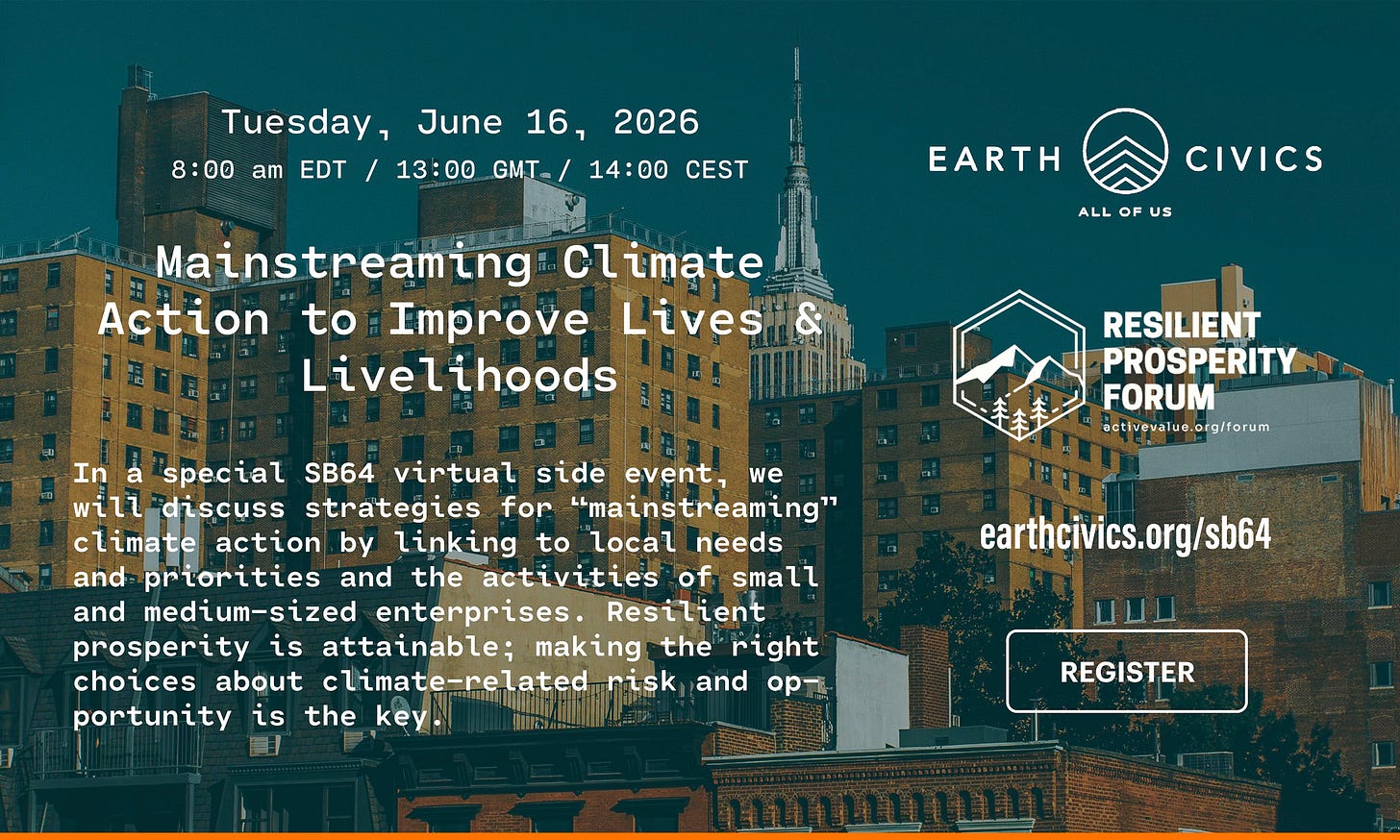
This session will explore ways in which climate policy at different scales (local, national, and international) can support:
Diversifying local economies, including in remote and vulnerable communities;
Climate-resilient agriculture, conservation, and sustainable development;
Leveraging data systems to support enhanced investability and right-scaling;
Climate-smart trade, banking, and climate resilience services.
Comments
Nothing yet. Say the first thing.
Sign in to join the conversation.