
A few weeks back, I argued the advice to build a professional personal brand around one big idea, one word, one thing you own, often gets the order wrong. Underneath every big idea built to last sits something deeper: a signature conviction, the argued, hard-won belief a person keeps defending. A hill they'd die on, so to speak.
The response to the article raised an obvious follow-up question. Fine, say you’ve found your conviction. What happens next? How does an internal belief become the kind of public idea you can build a business or career around? One that people quote and share with their peers?
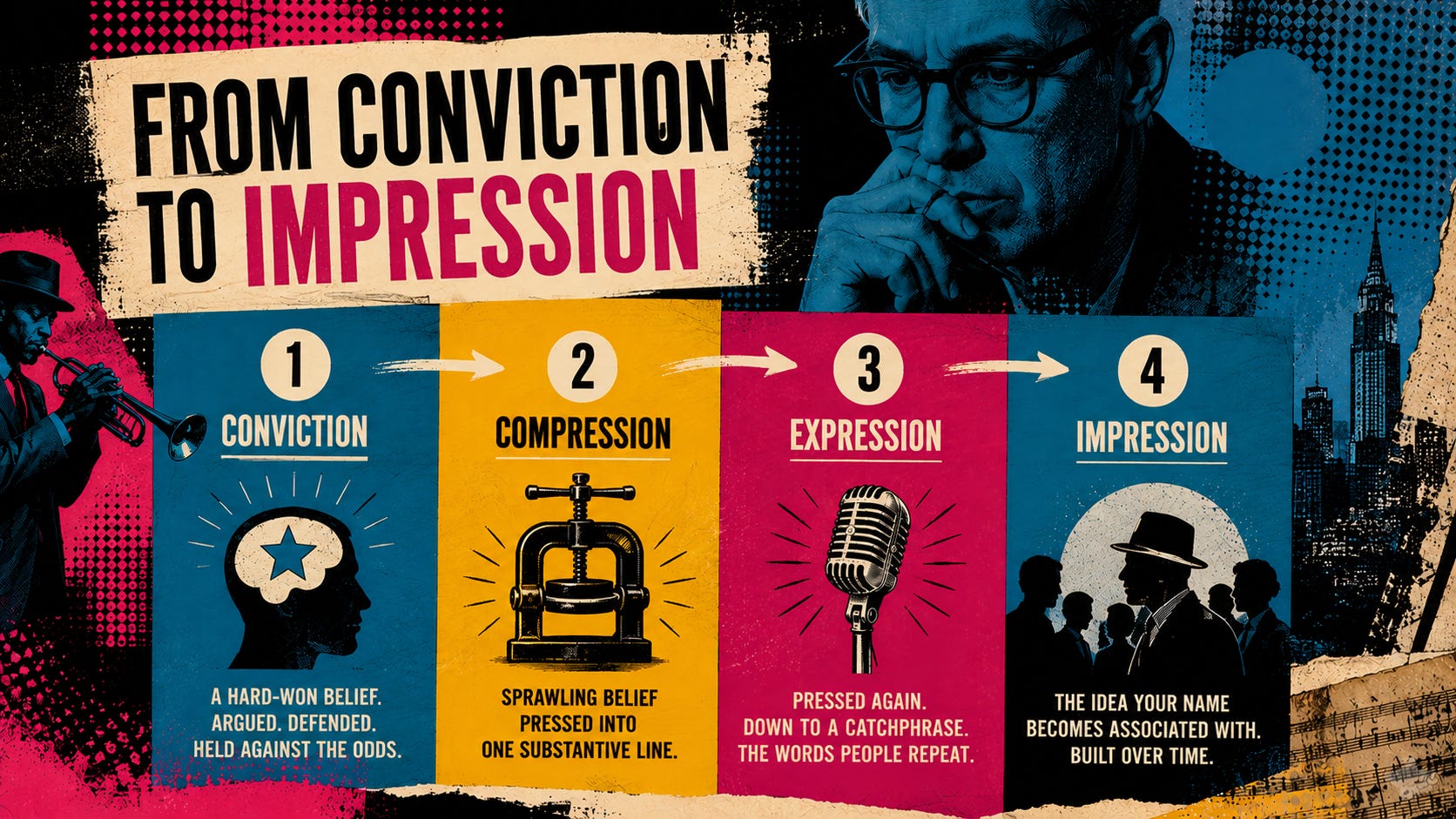
Let me answer this in four stages, and the sequence matters as much as the stages themselves.
This is a belief you go into bat for over and over, arrived at privately over years of work and pressure-testing, then argued in public. This is the foundation covered in the last piece, so I won’t re-argue it here. Worth restating only the core test: a signature conviction contradicts something: the status quo, a dominant assumption, a received wisdom, an industry default most people absorb without questioning. Without an adversary, a conviction is an observation. With one, a conviction becomes something worth building a body of work around.
Cal Newport’s is a working example. His conviction, formed across years of writing about how knowledge workers operate, and held against the entire culture of connectivity: the modern workplace is destroying the very capacity it rewards most, and the tools everyone treats as essential - email, social media, the always-on office - are the instruments of the destruction. The adversary is built in. He has never held a social media account, and he argues the position to audiences whose livelihoods run on the platforms he refuses.
Meet Lana, a hypothetical employment lawyer, 18 years in, several hundred workplace investigations behind her. Her conviction formed slowly and against her own billable model: investigations don’t fix workplaces. By the time one starts, the damage is done, and the real failure happened months earlier, when a manager saw the first signs and had nowhere to go except formal escalation. Her adversary is the complaint-centred system her own industry is built on. She has argued this in partner meetings where investigation revenue pays the salaries, and continues to hold this line outside of the boardroom.
The pressing happens here, often in private - boiling down a sprawling belief into a single substantive line, sharp enough to repeat, small enough to fit in a sentence. This line is what others might call “one big idea,” a “premise,” or an “ownable concept.” For some, the line is the finished article. Others keep pressing - as we’re about to see.
The compression work stays largely invisible to an audience, and for good reason. A conviction rarely arrives fully formed on the first attempt. Getting a true belief down to something sharp takes drafts, false starts and phrases discarded before the right one holds. Doing this work in public tends to look unfinished rather than earned, so most of the work happens off stage, but not always.
Newport’s pressing happened in plain sight, if you knew where to look. Years of Study Hacks blog posts circling focus, attention and the habits of impressive people, phrase after phrase tested and left behind, until a key one settled: focused work is becoming rarer at exactly the moment it's becoming more valuable.
Lana took the best part of two years boiling hers down. “Investigations come too late” - true, but limp, a complaint rather than an idea. “Prevention beats process” - alliterative and empty enough to hang in any HR department in the country. “The complaint is a lagging indicator” - closer, but the phrase made managers’ eyes glaze over. Then, drafting a client memo one Tuesday, she wrote it plainly: “by the time it’s a complaint, it’s too late”. An adversary, a warning, one sentence. The conviction never wavered. Only the phrasing changed.
Public again, smaller and sharper. Expression is the line pressed once more, down to a catch phrase, or handle - one word, two, three. The thing people repeat to their friends and peers. The phrase that gets shared because it’s catchy and carries a whole idea inside it.
Cal Newport went down this path when he created the handle: “Deep Work” - coined on his blog in 2012, on the front of a bestselling book four years later, and everything he has built since. A core belief, then a sentence, then a catchphrase with a decade of work underneath it.
Blair Enns pressed his catchphrase down to three words: “Win Without Pitching.”
Susan Cain nailed hers in one. “Quiet”, carried across a book, a TED talk and an entire platform, all packaging the same conviction: the modern workplace was built for extroverts, at the cost of everyone who isn’t one.
The single owned word is the rarest form, and nearly every example gets its heft from a book title - Angela Duckworth’s Grit, Greg McKeown’s Essentialism, Nassim Taleb’s Antifragile. A word carries no argument of its own, so the further you go past the sentence, the more work has to stand behind it.
Worth noting: Claiming a common word and redefining it is tough because it demands enormous repetition. Coining a new word altogether, as Taleb did with Antifragile, and Kevin Roberts with Lovemarks, is one way, but requires depth underneath otherwise it might look gimmicky.
Lana’s line went public: “By the time it’s a complaint, it’s too late”. It opened a conference talk, then another, then threaded through her LinkedIn posts and titled the cornerstone piece of her newsletter. Then she pressed once more, getting the idea down to three words: “Before the Complaint”. One conviction, one line - now one catchphrase - applied without deviation for three years.
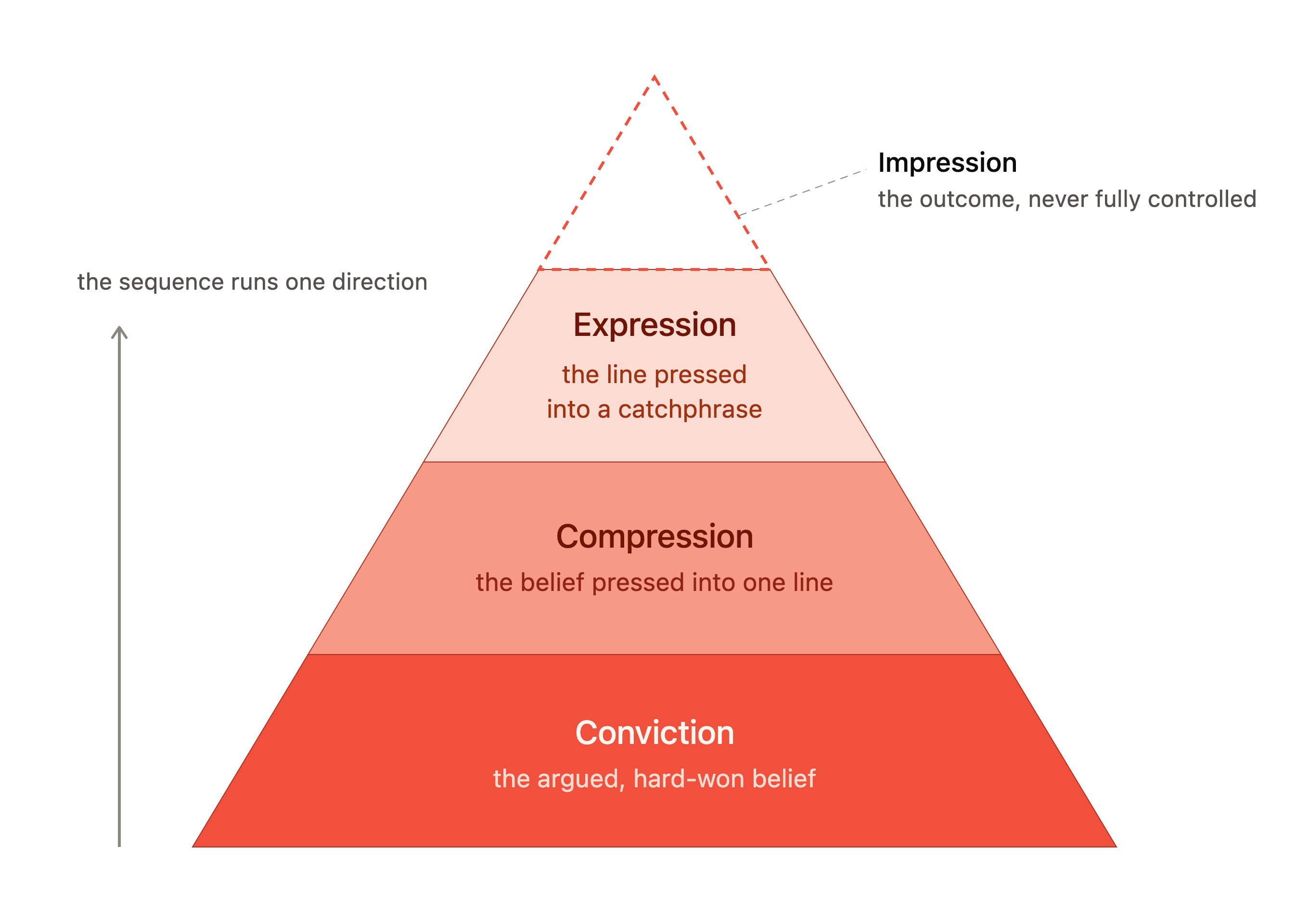
The outcome, not a stage anyone controls directly. An impression forms in an audience’s mind over time, built from every conviction stated, every line repeated, every expression put into the world.
This closes the loop back to a distinction I’ve drawn before. Reputation is the story others tell based on accumulated actions, the outcome a person influences but never fully controls. Impression is narrower: the specific idea your name becomes associated with, taking shape one repetition at a time.
After three years, Lana’s phrase had started gaining traction within business and legal circles. A general counsel, recommending her to a peer: get her in, before the complaint. Her words, published solidly across her own work, now repeated in rooms she isn’t in. Her reputation is 18 years of sound work. Her impression is three words, attached to her name.
Ignore the need for a well-held conviction and the pressing work underpinning it - in other words, skip straight to the expression side of the equation i.e. the sharp phrase, the ownable word, the named framework - and you risk going to market with a clever line but little meat underneath to carry your argument.
This shows up in one of two ways.
The first is the hollow idea or phrase. You land on a sharp line, an ownable phrase, a named framework, but without the support of an accompanying conviction. The word or catchphrase travels for a while, because sharp phrasing always does. But then an inquiring audience probes deeper, and it quickly becomes obvious there’s not much sitting behind the phrase.
The second way is worse. This is when you conjure up a cool two or three word catchphrase - again with little intellectual oomph behind it - but this time you’ve manufactured a conviction and retrofitted it to strengthen your case. Unfortunately, readers (and viewers and listeners) today cross-reference a public presence in seconds, leaving the author of the phrase on shaky reputational ground.
The sequence only holds one direction. Conviction, compressed, becomes expression. Expression, repeated and defended over time, becomes impression - the outcome you influence but never fully control.
Newport, one more time: a belief, then a sentence, then a handle (“Deep Work”).
None of this means retiring words like big idea, premise or ownable concept. Many credible thinkers have built genuine, well-constructed methodologies around versions of this language, and the words themselves aren’t the problem.
But cracks appear when the intellectual work isn’t sufficiently carried out beforehand.
Find the conviction. Press until the line holds. Press again until the catchphrase sticks. Let the impression build from there, one repetition at a time.
Onwards!
~ Trevor
Here’s a free diagnostic to find out. The Authority Gap Diagnostic will show you exactly where you stand and what to prioritise first.

The Authority Gap Diagnostic is a 13-question self-assessment tool. It takes about five minutes. Your results tell you where the gap sits, which of five common authority patterns fits your situation, and what to prioritise first.
The Authority Gap Diagnostic is free to download - here’s the link.
Comments
Nothing yet. Say the first thing.
Sign in to join the conversation.