

Three issues back, I made the argument that content marketing has reached the point of exhaustion, thanks largely to years of saturation, consumer fatigue, and a more recent flood of AI-generated content across all channels.
I made the point that editorial thinking - the discipline of applying a publishing standard and asking whether a piece of content is worth a reader's time before anything goes out - is the more defensible model for building professional reputation and genuine authority today.
I followed up that article with a second piece in which I provided additional shape to this content-marketing-is-exhausted argument.
I urged people to activate what I call ‘Editorial Creator Mode’. That is, running a micro publication, podcast, or video channel along editorial lines versus mindlessly feeding a content calendar, regardless of platform, format, or audience size.
To explain, I outlined a set of Editorial Creator archetypes - the Curator, the Beat Reporter, the Analyst, the Documentarian, the Synthesist, the Interviewer - each one capable of building authority through a different kind of editorial labour.
What neither article answered is the obvious next question.
“If editorial thinking is the standard, what does it actually require?”
I wanted to come back to you with a practical checklist you could run your own work against, or someone else’s, and get a good feel how you’re going on this front.
That’s what this article is all about.
Editorial integrity is not a stance. Nor is it a worldview, a niche, or a tone.
Rather, editorial integrity is a standard represented by consistent judgement, shown through quality, originality, independence, genuine fairness, transparent sourcing, and visible correction if and as required.
Its roots are in time-honoured journalistic practice. Having trained as a journalist and worked with hundreds of reporters, editors, sub-editors and broadcast producers over three decades as a PR consultant, the whole notion of editorial integrity is naturally ingrained in me.

But that doesn’t mean you can’t be aware of, or adopt, these standards either. You don’t need to be a trained journalist to adhere to editorial practices.
Yes, journalistic standards are at the heart of it, but what follows has been adapted for a different context - everyday writing and content creation by people like you: credible business people - versus working journalists guided by newsroom principles.
It’s a working judgement framework, built for independent creators, newsletter writers, analysts, podcasters, and practitioners who publish under their own name and want a principled way to think about what they put out in the world.
Let me put it this way: a weekly newsletter writer is not being measured against the work of an experienced beat reporter, but they can aspire to it.
Why? Because by raising the editorial bar, you will produce work that accumulates weight over time in a way that lightweight volume alone does not. It will differentiate you in the marketplace, and position you above those who are simply churning out stuff because they feel they need to.
Also worth noting: this is not a pass or fail test. It is a set of signals to weigh, the same way you would weigh evidence rather than tally a score. You will not show all of them, all the time. A clear majority, shown consistently, is a win and will put you ahead of the content-creating pack.
Without further ado, here is the list:
Is the work genuinely well made, researched, written, produced, edited, regardless of the topic? This is a value judgement, not a universal definition, but it is a necessary one. Work that is sloppy on execution asks readers to do extra work to trust it. Most will not bother.
Does the piece add something a reader could not get from a press release or a competitor’s coverage: original reporting, a worked argument, a synthesis of insights that required real thought? Or is it repackaging what is already out there. Worth being specific here: Does the piece reflect a judgment call, a primary source, or a synthesis a reader could not have generated themselves in thirty seconds? The litmus test is simple: look at the origin of the insight. A press release or someone else’s reporting processed through AI and presented as analysis is repackaging, even when nothing has been technically copied.
When there is a financial, commercial, or structural interest in what you are covering, is it explicitly disclosed? This means managing the bias that comes from sponsors, your client base, or products you sell yourself. True discipline here means writing about the uncomfortable or critical realities of your industry, not just the parts that flatter your business model or protect your revenue streams.
A recognisable point of view is a strength when the record shows it being argued and re-argued as circumstances change, including those where the popular answer would have been different. The observable test: does the position move with the evidence over time, or does it only ever land wherever the audience already is?
This is worth naming directly because it is rarely a single decision. Audience capture is the slow, psychological pull where a creator who started out independent gradually narrows their views to whatever their echo chamber wants to hear, one small concession at a time, until the position is no longer being argued at all, just performed back to the people who reward it. It shows up in a pattern over time, not in any one piece: do your takes get safer and more aligned with the loudest segment of the audience over time, or do they keep moving where the evidence or the work leads?
What gets covered and what gets left out is itself a position. Does the selection follow a standard you could explain, or does it follow whatever performs? This is also where restraint shows up. Being willing to kill a piece you have already invested time in, because it does not meet your own standard, is one of the clearest signals of editorial judgement there is. Most people will run it anyway because they have a gap in their content calendar that needs to be filled.
The instinct to notice something before it is being discussed everywhere is not a separate skill from the rest of this list. It is judgement and selection, applied earlier than most people are willing to commit to a position. A creator who only ever covers what has already been validated by everyone else’s coverage is not exercising judgement, they are merely following one.
Are claims sourced in a way a reader could check? Is opinion clearly distinguished from reporting or analysis? When something is wrong, is it corrected visibly, or quietly fixed and left unacknowledged? Do you give sufficient attribution when quoting someone else’s work or ideas?
For research-led or analytical work especially, are the methods or standards behind a claim visible, not just the conclusion? A reader or viewer does not need a style guide, but they should be able to see roughly how a figure was reached or a position was formed, not just told to trust it. This signal matters more at some formats than others. Apply it proportionally.
A strong point of view does not excuse misrepresenting the people, businesses, or institutions you write about. The observable test is simple: if the subject of your piece read it, would they feel their position was represented accurately and in good faith, even if they ultimately disagree with your conclusion? True fairness means engaging with the strongest, most intelligent version of an opposing perspective, rather than just knocking down a cheap oversimplification of it.

Do not aim for a perfect score. Aim to be genuinely good at most of the above, most of the time, and honest about where you fall short. Quality and a real point of view will carry you a long way on their own. Disclose when there is something to disclose, show your method when it matters, and correct visibly when you are wrong, and attribute liberally because it’s the right thing to do.
The one combination that should fail outright is high-production competence with zero editorial soul. That is frequent, confident content driven entirely by what performs, with no real point of view, no original substance, and no willingness to ever say something unpopular. That is competence without editorial judgement. It is also exactly what most content marketing looks like.
Onwards!
~ Trevor
Here’s a free diagnostic to find out. The Authority Gap Diagnostic will show you exactly where you stand and what to prioritise first.
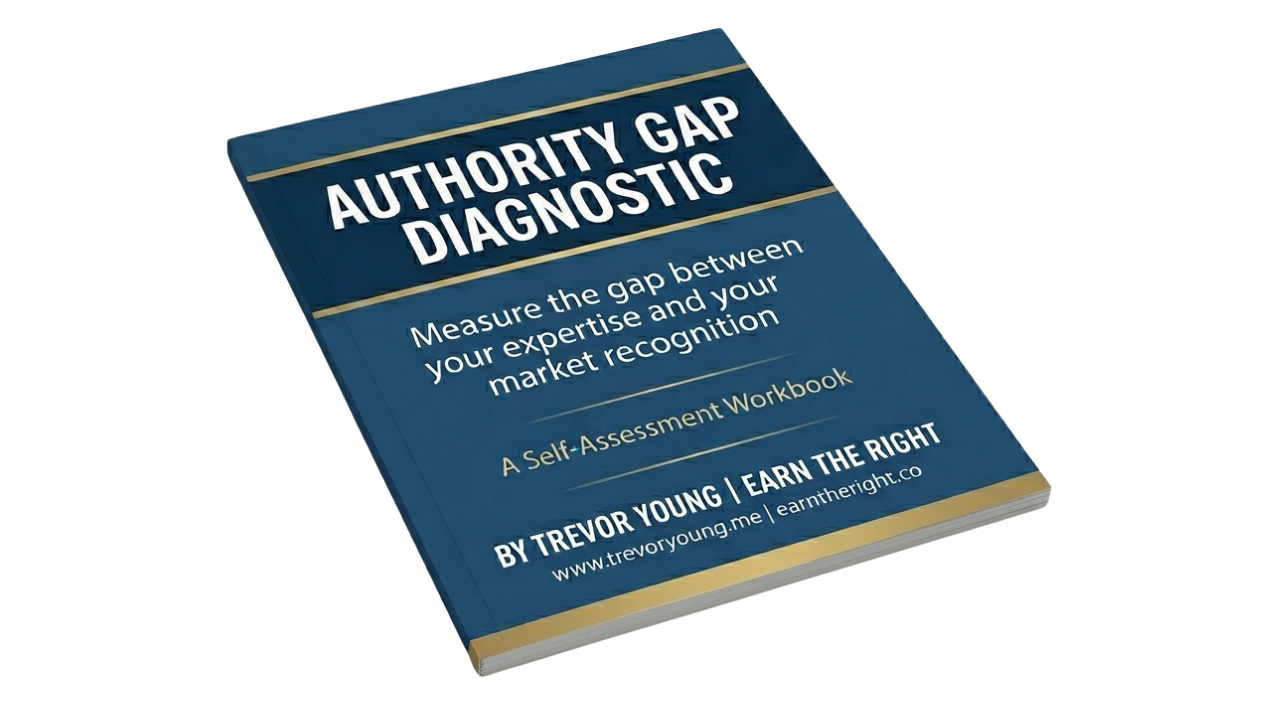
The Authority Gap Diagnostic is a 13-question self-assessment tool. It takes about five minutes. Your results tell you where the gap sits, which of five common authority patterns fits your situation, and what to prioritise first.
The Authority Gap Diagnostic is free to download - here’s the link.
Comments
Nothing yet. Say the first thing.
Sign in to join the conversation.