

There is a particular kind of professional who gets overlooked.
They have deep experience and a genuine track record in getting results. Clients rave about them privately and refer them constantly.
But they have almost no recognition beyond their immediate network and the people who have already worked with them.
The default ‘guru’ diagnosis is visibility. Post more. Show up everywhere. Feed the algorithm.
I think that diagnosis is wrong, or at best half right. Yes, plenty of these people might lack broader visibility and thus need to put themselves in front of new audiences.
But really what they lack is a key differentiator, something tangible for other people to acknowledge and hold onto.
Now think about how you land on someone who doesn’t know you, or who has had only glancing contact with your story. You arrive with expertise to burn, plenty of experience, anecdotes and hard-won judgement, all of it valuable. None of it repeatable by the person listening. What they walk away remembering might not be the thing you want to be recognised for.
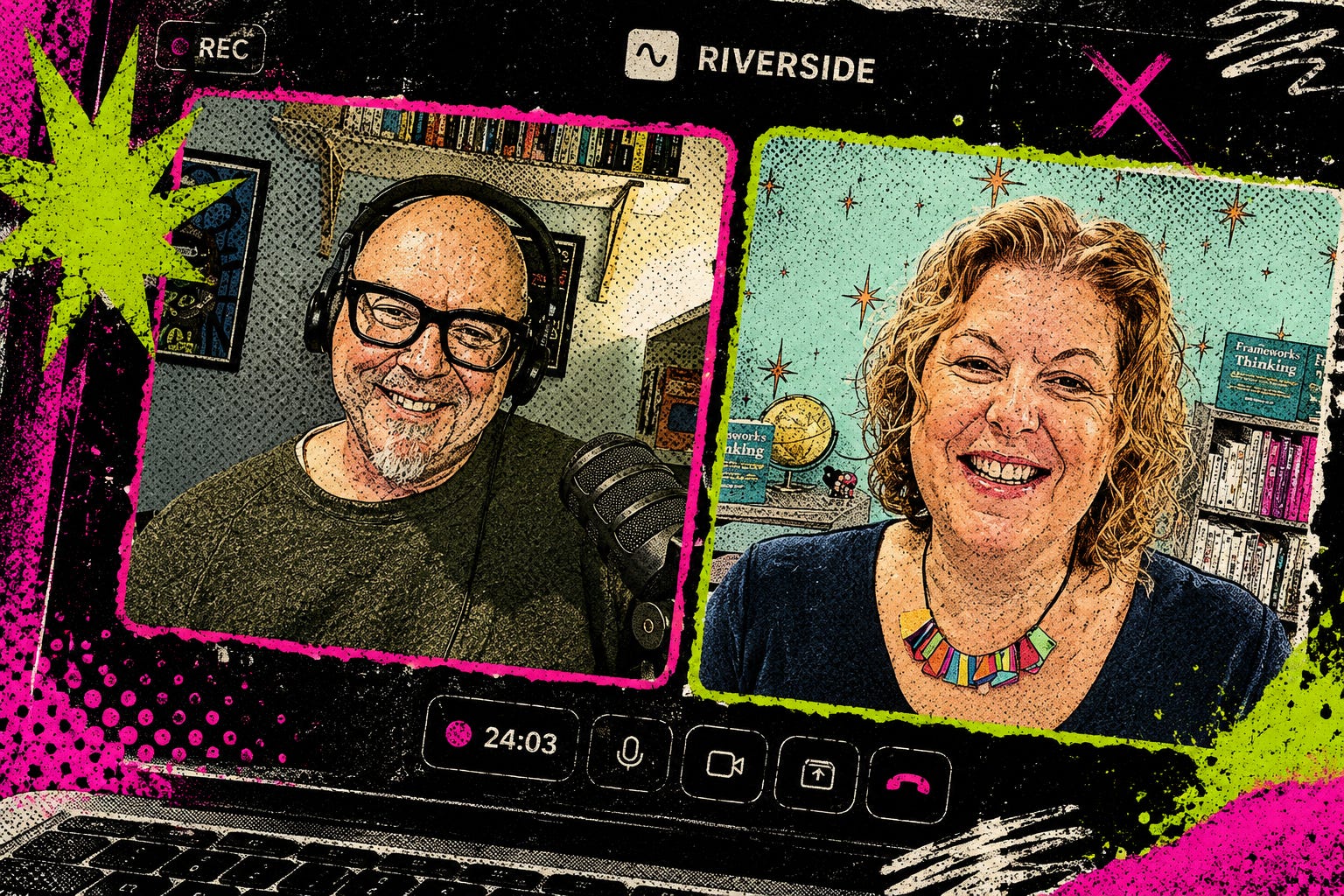
This was a key thread running through a recent conversation on my Earn the Right podcast with Susanna Reay, a UK-based business coach who has spent more than two decades helping consultants, coaches and practitioners turn scattered expertise into structured intellectual property.
Susanna’s new book, Framework Thinking: Sketch. Scale. Be Sought., went straight to number one across three Amazon categories on release, and is worth checking out if you’re keen to build your authority by structuring your thinking and expertise.
Susanna’s own turning point came in 2022, inside a mastermind she was running.
A client told her she was doing everything asked of her and getting nowhere, as though she were speaking a foreign language to her market. Susanna realised she had a client archetype tool she used constantly for her own work but had never once shown anyone. As it turned out, those in the group felt the tool would be useful in their own businesses.
“At the end of that session, there was like grins all around the room. The energy was off the charts, and people were like, Susanna, why have you not told us this before? There was literally, I was being berated by my own clients for not sharing that.”

Susanna calls it “hiding the Mona Lisa in the basement”. The frameworks existed, the transformation was real, but nobody could see any of it.
The curse of knowledge does most of the damage here.
What feels obvious to you, because you have run it a thousand times, lands as revelation on someone encountering it for the first time. Tom Schwab from Interview Valet, a past guest on this podcast, says it well: “What is ordinary to you is amazing to others.”
Which brings us to frameworks, and the role they play in building an authority brand in the marketplace.
Susanna defines it this way: "A framework for me is a method of connecting ideas together to make them easy to understand."
She uses the analogy of an umbrella to describe what a framework is: like an umbrella, a framework has essential components - a central spine, spokes, and fabric - holding everything together, offering structure without rigidity.
Just as an umbrella’s purpose shifts depending on whether it's shielding you from rain or providing shade from the sun, a framework is adaptable, supporting and connecting ideas in various contexts rather than prescribing a single, inflexible way to use it.
Susanna is also clear you’re not building something new.
“We’re not inventing them, we’re uncovering the work you’re already doing,” she says, describing the framework development process as archaeology, digging for the patterns already running underneath your client work.
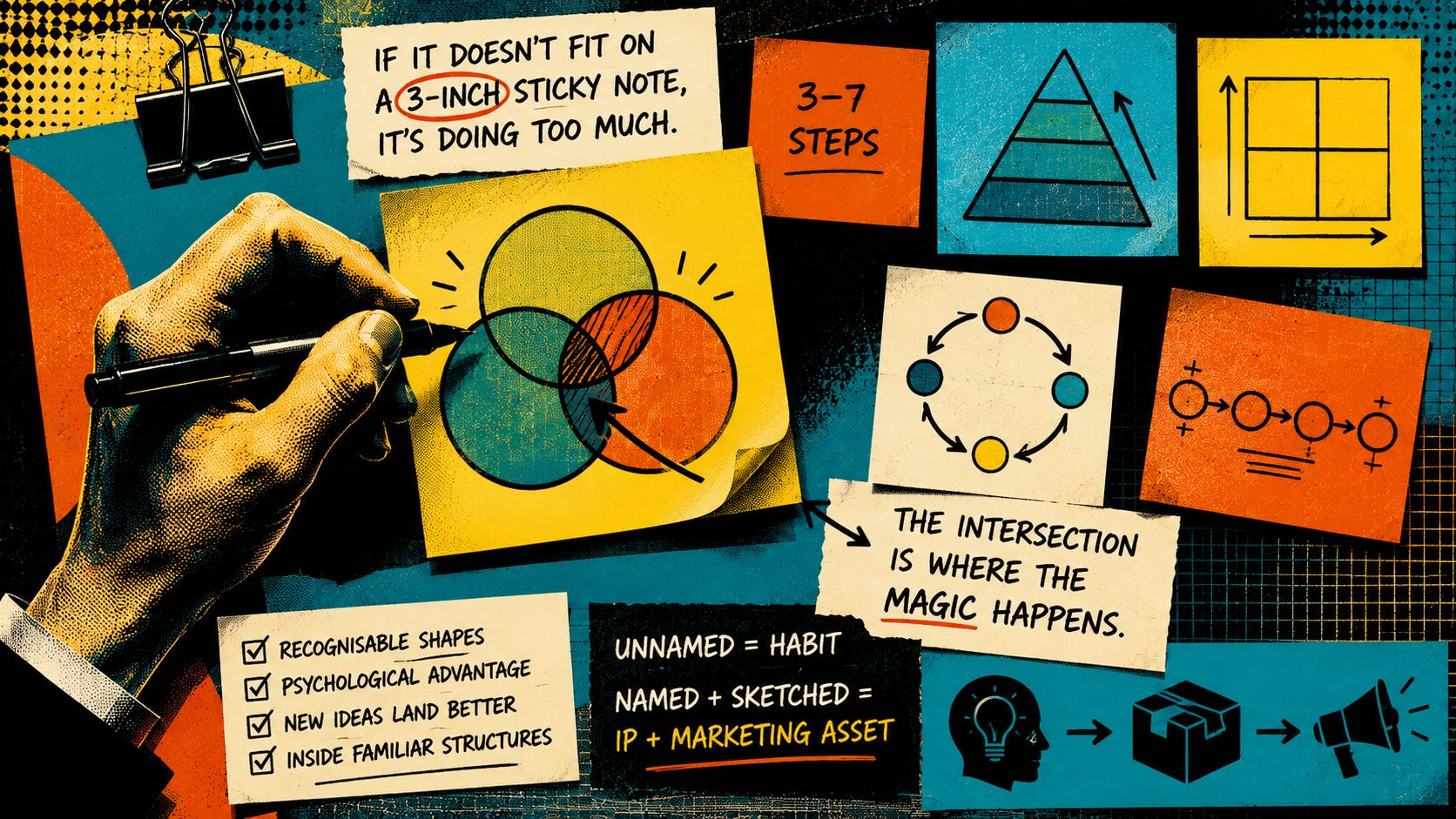
Susanna’s practical test is to sketch out your framework on a sticky note. If it does not fit on a three-inch square bit of paper, then it is doing too much.
Three to seven steps. Recognisable shapes, which she argues carry a psychological advantage, because new ideas land better inside familiar structures. For example, a Venn diagram, a pyramid, a matrix, a loop.
Regarding Venn diagrams, Susanna made the point many people in business treat the circles as the content, but “it’s where it all comes together that the magic happens.”
In other words, the intersection is where the idea sits - the circles are only the ingredients.
This is what I mean when I talk about articulating, packaging and communicating your value.
An unnamed process is a habit. A named one you’re able to sketch on a sticky note becomes both intellectual property (IP) and a marketing asset.
Here’s the part most people get wrong when they first try this.
They list what they do. Step one, step two, step three, a tidy sequence of actions. Susanna argues the actions aren’t the framework. What matters is what changes in the client as a result.
“It’s not as simple as: I tell you to do one, two, three. It’s more: if you do action one, two, three, what’s the impact that is now happening?”
She points to a client who coaches widows, someone who came to the work through her own experience and found the standard grief model wanting. What surfaced in their sessions was a shift in language, the words people reach for changing as they move through grieving, and this became the spine of what became her “Sunflower Method”. The framework wasn’t designed as much as uncovered through reflection.
Ask yourself where the real shifts happen in your work, and the framework tends to reveal itself.
Susanna wants your framework settled before you hit the visibility accelerator. Her sequence runs grounded one-to-one work first, then the framework, then everything else: courses, memberships, keynotes, books.
She knows it cuts against the prevailing advice, and says so.
“I’m slightly contrarian in this because yes, a lot of people go, yeah, you’ve got to get out there, you’ve got to get visible, but I have come across far too many business owners than I can count who’ve been burnt out and overwhelmed by thinking they’ve got to do all the things, and then when you talk to them, they’re not really sure what their thing actually is,” Susanna says.
“So this is why I say framework first, visibility second. You’ve got to know what your IP is, what is special about you, and a framework helps you define that.”
Personally, I have a slightly different view.
I don’t believe you have to wait for the finished framework before you open your mouth. The one-to-one years are incredibly useful - working shoulder-to-shoulder with clients, or even doing something with the work you’re researching in your own time. Publishing during this phase is often how the pattern surfaces in the first place.
I’ve found the process of ‘building in public’ to be a fruitful exercise - publish as you go, share your thinking with the world, seed your ideas in the public realm and see what comes back in the form of reader (or viewer) feedback.
In a way, you’re building a ready-made audience for when your framework is fully formed.
Nonetheless, whichever way you come at this, Susanna and I are in staunch agreement: creating your own framework-based IP is a strong play for expert founders and solo practice owners looking to build authority and differentiate themselves in the marketplace.
The old instinct is to guard the method. Susanna argues the opposite, and I agree.
You hear it all the time. People say: Hey, if I share my frameworks publicly, people might go away and do it themselves, or worse, they might steal my IP and use it in their own business.
In terms of the former, my theory around this is, if people want to take your IP and implement the ideas themselves, in all likelihood they were never going to become a client anyway.
Regarding people stealing your IP, Susanna sums this up perfectly:
"The ultimate protection for your IP is actually then getting visible, owning it, sharing it, talking about it lots, because that is what protects it."
Ownership is established by association, not secrecy. Donald Miller talked about StoryBrand relentlessly until the two became inseparable.
There is a deeper protection at work too. Someone can copy your diagram, but they cannot copy the two decades of client work the diagram came out of, or the failures that shaped it. This is where provenance plays a key part.
Clients are not paying for your method anyway. They are paying for the result, and the framework is simply how they see the pathway to it.
Susanna’s analogy: an ordnance survey map is what you know behind the scenes, but what your clients need is a tourist map.

Susanna’s client list runs broad. Accountants, financial advisers, interior designers, a trainer working exclusively inside the travel industry, a voice healer, an animal communication expert.
Her test is simple. If you’re in the business of moving someone from one state to another - in other words, you support a transformation for your client - there’s a framework in there.
The obvious objection comes from the tightly regulated professions. If your process is already fixed by law or by industry standard, what is there to develop into a framework?
Susanna’s answer is the family lawyer she worked with. The legal process itself never changes, but the client going through a divorce has no idea what happens next, or when. What the framework maps is the journey, not the procedure. The milestone moments a client passes through, so they know where they are and what’s coming.
That still separates you from the practice down the road running the identical process.
Accountant ‘A’ and Accountant ‘B’ do much the same work, but only one of them has made the experience of working with them visible before the contract is signed. This, of course, builds trust, and enduring trust is critical to the success of any service-based business today.
The strongest idea in the conversation was one Susanna places at the centre of her framework thinking model: transfer integrity.
She describes running training inside a corporate internal comms team, where a message travels from strategic communications to global manager to regional manager to shop floor.
“Without having a visual, that message changes at every single step on the way,” she says.
With the support of a visual framework, however, the message survives the journey.
You see the same effect at an event. Susanna describes the moment near the end of a conference talk when the speaker puts up a single slide, a framework holding the whole argument together, and the cameras come out.
“What you’ve done there as a speaker is just popped your business card into their back pocket, because they’re now remembering your key IP.”
For Susanna, the dividing line sits right here. “This is where it steps beyond the personal brand into the authority brand, because then you can license your IP, you can franchise it, it can travel beyond you.”
That distinction deserves more attention than it gets. A personal brand depends on your presence. An authority brand keeps working when you’re not in the room.
Susanna is blunt about the cost of the former: build your standing purely on personality and visibility, and the whole thing runs on your energy.
Develop a framework, and it continues to work for you day in, day out. It becomes a marketing asset that helps to grow your business over the long term.
One key point to make here: frameworks are not a way to manufacture authority.
What structure does is make earned authority clear, memorable and repeatable to people who have not yet worked with you, but portable enough to work on your behalf when you’re not around to explain it.
To take Susanna’s wonderful analogy from earlier, your ‘Mona Lisa’ is probably already down there in the basement. The job ahead of you now is to bring it up the stairs.
Onwards!
~ Trevor
[ LISTEN TO THE FULL INTERVIEW WITH SUSANNA REAY ]
Susanna Reay is a bestselling author, award-winning strategist, and speaker for strategic service entrepreneurs & CEOs to land their expertise with impact.
Connect with her on LinkedIn here
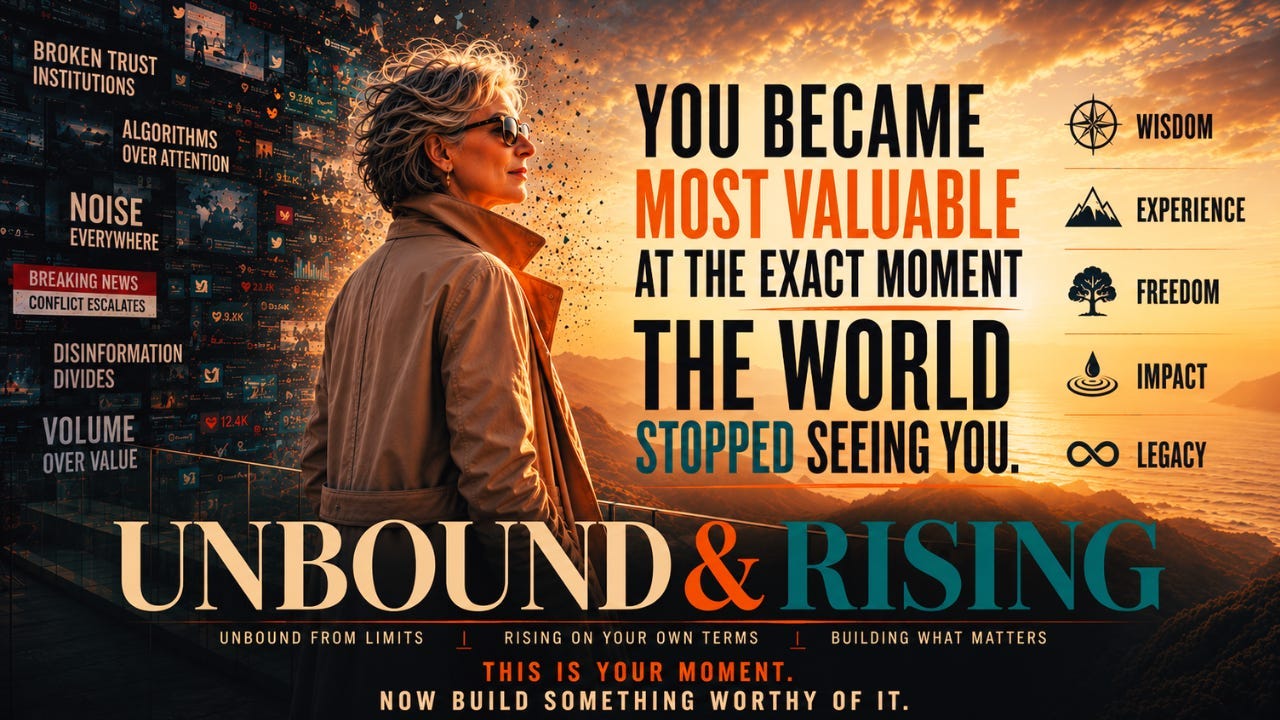
It’s called Unbound & Rising - here’s the blurb:
You became most valuable at the exact moment the world stopped seeing you. For those in midlife not done yet, turning hard-won wisdom into influence, income, and a life by design. Unbound from limits. Rising on your own terms. Building what matters.
CHECK OUT THE UNBOUND & RISING MANIFESTO.
Comments
Nothing yet. Say the first thing.
Sign in to join the conversation.