
THING ONE: THE MOMENT ON JOHNNY CASH’S AT FOLSOM PRISON RECORD THAT HAS NOTHING TO DO WITH THE MUSIC
Every canonical live album eventually gets reduced to a handful of agreed-upon facts, the same three or four anecdotes recycled by every journalist who needs eight hundred words on why the record still matters, and At Folsom Prison is no exception. The Jim Marshall photography gets discussed. The mythology of Johnny Cash performing for the incarcerated gets discussed, usually with the same faux-revolutionary framing, as though singing about killing a man in Reno to the actual men Reno-adjacent crimes put behind bars is inherently an act of solidarity rather than, more plausibly, a killer career move by a guy who needed one. What almost nobody discusses is a fifteen-second stretch of dead air at the end of Cocaine Blues, the fourth track, when the song fades and the prison’s PA system cuts in over the sound of the Man in Black catching his breath: “These men have receptions: Matlock, 856032, and Batchelder, 839879. They have receptions.” Then Cash slides into 25 Minutes to Go like nothing happened, because from his vantage point, nothing did.
This is the detail that actually explains the record, more than the photography or the mythology ever will. Consider the position of Matlock and Batchelder. You are locked inside one of the more unpleasant facilities in the California penal system, and Johnny Cash, an actual mythic figure, is engineering the second act of his career from inside your address, and you are in the audience for it. You have just watched him perform Folsom Prison Blues inside Folsom Prison, which is the kind of experience that should, by any reasonable metric, be the emotional high point of your month, possibly your year. He works through Dark as the Dungeon, then I Still Miss Someone, then the genuinely tremendous Cocaine Blues, and at the precise moment you are fully inside the show, someone comes to visit you, because visitation does not care what else is happening, and you are extracted from the one transcendent afternoon available to you in a maximum-security prison. I choose to believe that both Matlock and Batchelder, walking off to see whoever showed up, were thinking some version of “I may have to kill someone. Again.”
THING TWO: MICKEY D’S PERPETUALLY BROKEN ICE CREAM MACHINEThe premise that McDonald’s ice cream machines break constantly by pure mechanical bad luck is one of those cultural assumptions that collapses the moment anyone actually investigates it, which is a category that includes basically every persistent urban myth about capitalism, except in this case the myth turns out to be correct. Every franchisee is required to run the Taylor C602, an $18,000 machine that performs a mandatory overnight self-cleaning cycle, and if that cycle fails, the machine locks itself and can only be reopened by a Taylor-certified technician, an arrangement that generates a service fee every single time. Franchise owners lose sales, burn hours, and pay out repeatedly, while customers absorb the same explanation on a loop: the ice cream machine is broken. It never occurs to most people to ask why a fast food company would tolerate a machine that fails this reliably, which is itself the answer.
In 2019, a startup called Kytch built a small device that decoded the machine’s error codes, which let owners diagnose and fix the problems themselves instead of paying for a technician every time. McDonald’s banned the device almost immediately, citing safety concerns that nobody found especially convincing. Leaked emails later suggested that Taylor’s own engineers had gotten their hands on Kytch’s technology and tried to build something similar. What looked, from the outside, like a hardware problem was actually a closed system engineered to produce recurring repair revenue, which means the machine was never actually failing. The business model was working exactly as designed.
Cory Doctorow, the brilliant and reliably furious Canadian, covers this case and dozens of others in Enshittification: Why Everything Suddenly Got Worse and What to Do About It, which is either a business book or a horror novel depending on how closely you’ve been paying attention.

“We are all living through the Enshittocene ― the Great Enshittening ― a time in which the services that matter to us, that we rely on, are being turned into giant piles of shit. It’s frustrating. Demoralizing. Even terrifying.”
THING THREE: THE GREEN HORNET, BATMAN, AND HOW I’M SLOWLY BECOMING MY GRANDFATHER
My maternal grandfather was a welder by profession and a polymath by temperament, equally happy discussing architectural drafting, oil painting, or the construction of ambient soundscapes, and he died before I finished middle school, which means my entire understanding of him is built from a child’s incomplete inventory of a genuinely interesting man. One of the things on that inventory is model building, the plastic-and-decals-and-paint hobby that requires more patience than I generally associate with anyone in my direct genetic lineage, including myself.
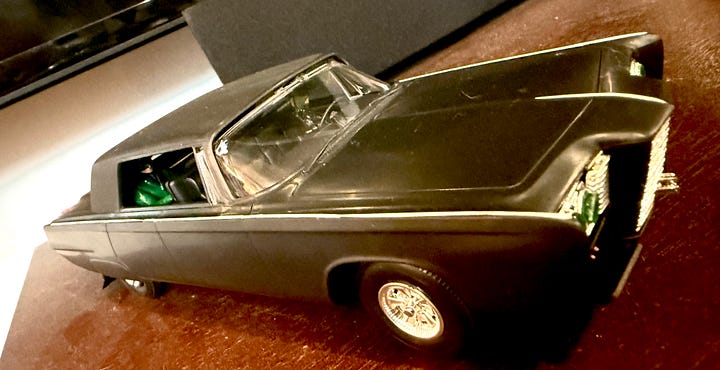
A few weeks ago I found a model kit for the Green Hornet’s Black Beauty, the modified 1966 Chrysler Imperial Crown loaded with rockets and gadgetry, at a moment when I happened to already be several episodes deep into a Green Hornet rabbit hole, because the original 1966 series is absent from every major streaming platform and exists only because some anonymous archivist uploaded the whole run to YouTube, which remains, against all odds, occasionally a force for good in the world. I assembled the model while the show played in the background, which meant I spent several evenings building a scale-model car while watching a self-serious 1966 crime caper, wearing reading glasses to get the panel lines right, with a beard that has gone salt-and-pepper and a hairline that has functionally retired. There is no version of this scenario in which I am not becoming my grandfather, and I have made a kind of peace with that.
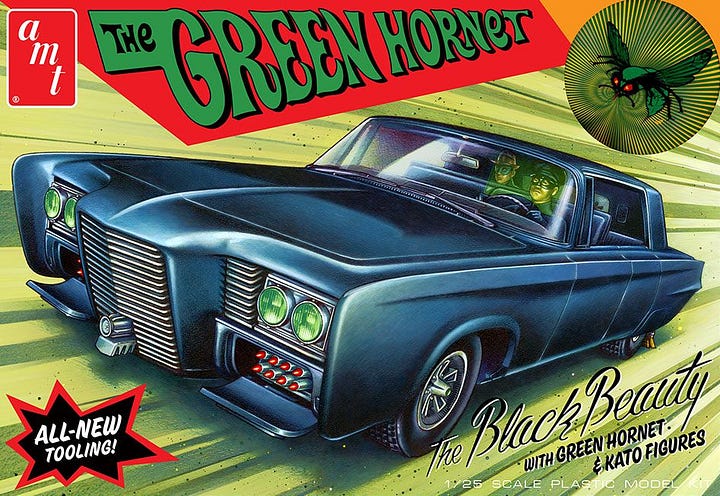
The show gets stranger from there. ABC aired both Green Hornet and Batman, and when the Hornet’s ratings collapsed after a single season, the studio arranged a two-episode crossover on the campier, more successful Batman, and the crossover somehow works. The Green Hornet and Kato, played by an actually electric Bruce Lee, masquerade as criminals in order to infiltrate the criminal underworld, and on March 1 and March 2 of 1967, playboy Britt Reid and his valet Kato travel to Gotham to visit an old college friend named Bruce Wayne, at which point the hijinks proceed exactly as you’d expect.
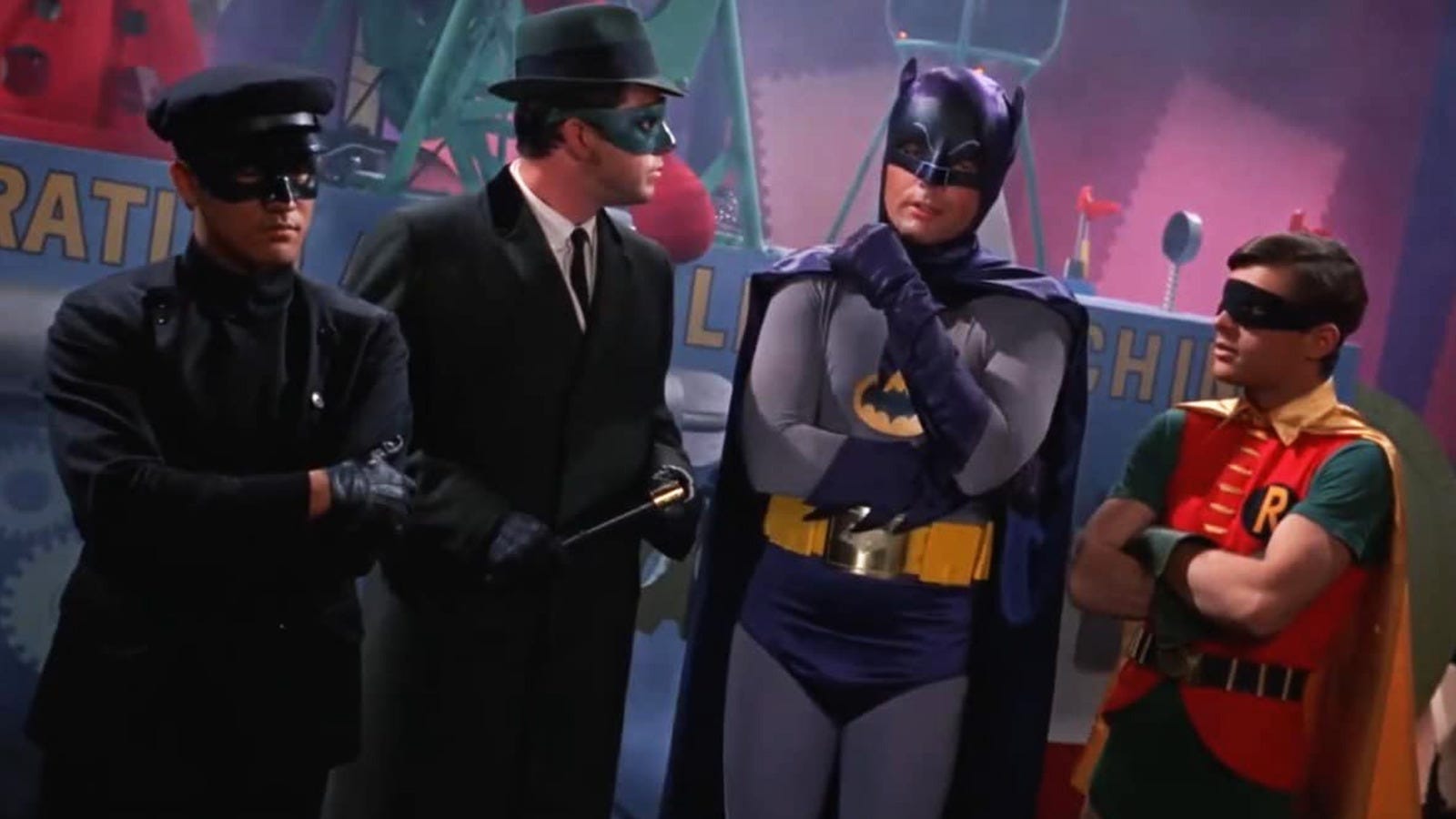
Here is the detail I find genuinely delightful: Britt Reid is the grandnephew of Ranger John Reid, better known as the Lone Ranger, and both radio programs debuted on WXYZ, right here in Detroit.THING FOUR: THE GREAT CARTOON TOY CAPER OF THE 1980S
I have recently fallen into the specific internet ecosystem of 1980s toy content creators, a habit I cannot fully justify and have made no serious effort to stop. This is how nostalgia functions as an economic system: studios keep exhuming old properties for the big screen, people my age start treating their childhoods as sacred texts, and eventually we are handing over real money to revisit the Cobra Terrordome, or Castle Greyskull, or the Thundercats’ Lair, as though owning the object again restores something that was never actually located in the object.
The scale of this economy is worth pausing on. A 1983 Snake Eyes figure is currently listed near $25,000 on eBay, which tells you everything about how thoroughly film, television, comic books, and toy manufacturing fused into a single coordinated machine, and how well that machine still runs decades later. I’d been considering a rewatch of the source cartoons, especially in the wake of the spectacularly ill-conceived recent Masters of the Universe film, which lasted about 38 minutes in theaters and cratered with roughly the grace of Trump at a White House Correspondents’ Dinner.
The cartoons, it turns out, do not hold up. G.I. Joe and Thundercats are legitimately bad. Transformers is marginally better without being good, and the films built from it have only gotten longer while getting worse. Voltron holds up slightly better, in a disjointed, patched-together way, though I will admit I still feel a small charge when the lions assemble, because I am not, in fact, dead inside. Across the board, the toys have aged better than the cartoons that sold them, and the comics, strangely, have improved the most of all.

Nostalgia is difficult to argue with, which is precisely why it works. Don Draper articulated the mechanism better than anyone else ever has. But the older truth still holds, the one Thomas Wolfe got to first: you cannot, in fact, go home again.
THING FIFTH: MANY HAPPY RETURNS

Happy 86th to the legend of legends, a bon vivant par excellence, and an honorary Marine Master Sergeant. He is a noted space traveler, a celebrated time traveler, and a peerless gunslinger. King of the cross-dressers, carrot connoisseur nonpareil. Opera impresario, master of disguise, award-winning thespian, and undefeated duck-rabbit season arbitrator. Unflappable in the face of anvils, dynamite, and mobsters, an international super-spy, scientist, magician, medieval jester, and mad barber. King of England, Emperor of Rome, and Sultan of the Desert, political campaign manager, intergalactic basketball player, and world-class stinker.
No posts
Comments
Nothing yet. Say the first thing.
Sign in to join the conversation.