
On the Dark Side on Apple Music
I love a good mystery. I love music more. So when I tell you that Eddie and the Cruisers is officially classified, genre-wise, as a musical mystery, you should understand that somewhere a version of me exists who was built in a lab specifically to be delighted by this fact. Two great tastes, one deeply unnecessary sequel, and a soundtrack that outlived the movie by forty years and counting.
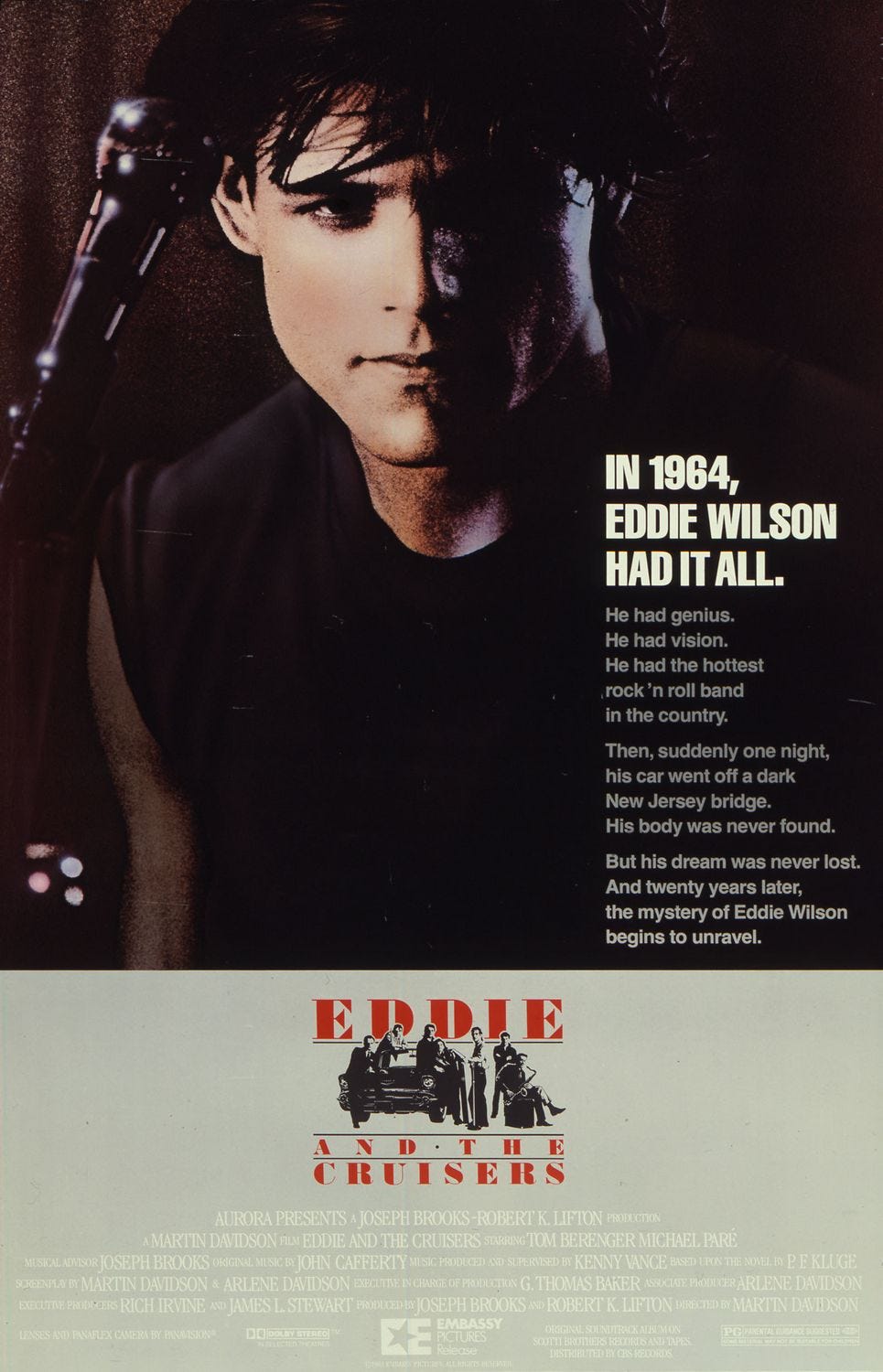
Quick refresher for anybody who’s been living a full and productive life without this particular knowledge lodged in their skull: the film is based on a P.F. Kluge novel about a fictional Jersey Shore bar band, Eddie and the Cruisers, fronted by the enigmatic Eddie Wilson, who supposedly drives his car into a river and dies right as the band’s dark, weird, label-rejected second album gets shelved. Twenty years later a reporter, Ellen Barkin, starts digging around trying to find the lost master tapes, because of course there are lost master tapes, because nothing in this movie is allowed to be simple, and the hunt eventually leads to a real-life pile of junk in Vineland, New Jersey called the Palace of Depression, built by a guy who lost his fortune in the stock market and decided the appropriate response was to construct a tourist attraction entirely out of garbage. I cannot stress enough how much I respect that guy’s whole vibe. And in the last shot of the film, Eddie is alive, older, bearded, unrecognizable, watching a documentary about his own mythology through the window of an appliance store, which is one of the most quietly devastating endings I can think of for a movie that also features 19th-century French poetry.
None of that is why we’re here today, though. We’re here because somewhere in the middle of that plot, a song gets born on a rooftop, and it might be my favorite five minutes of movie-watching involving a musical instrument that isn’t actually a documentary about musicians.
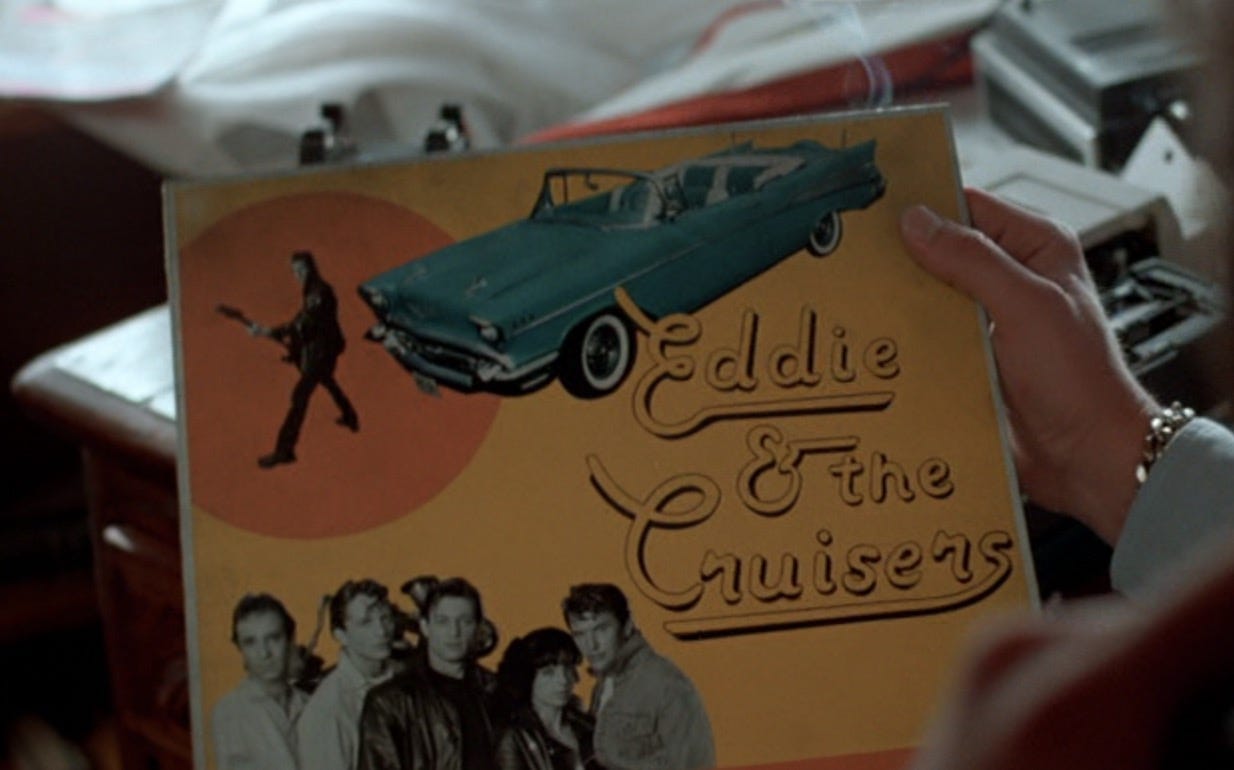
Here’s the scene. The band is up on a roof, doing what bands do when nobody’s watching, and Frank Ridgeway, aka Word Man, played by a baby-faced Tom Berenger who I keep forgetting was ever this young, is noodling around on a little melodic idea. It’s nothing yet. Eddie, played by Michael Paré, who should have been much bigger, is listening with dramatic intent. The bass player, Sal, and the band’s manager, played by Joey Pants, Joe Pantoliano, in the grand and eternal tradition of bass players and managers everywhere, start ribbing him for it, because that’s what you do to a guy who hasn’t proven his idea is good yet, and sometimes even after he has.
But Eddie hears it. And so does the sax player, Wendell (more on him in a moment). I dig that part tremendously, because it’s not the frontman alone recognizing genius in isolation - cinema loves that lonely-genius shorthand, and it’s usually lying to you. It’s two guys hearing the same ghost in the same three or four notes at the same time, which is a much more honest depiction of how songs actually get born. Somebody starts humming. Somebody else finds a rhythm to hang under it. Three minutes of tinkering later, in movie time, which I assume compresses actual band time by a factor of about fifty, they’ve got a fully formed song. A fucking banger, actually. And Eddie has to remind Frank that playing rock and roll is like riding a bike or getting laid, because that’s straight from the Keith Richard chapter of the Rock and Roll Bible - it’s music for the neck down. It’s the kind of scene that only works if you already believe, somewhere in your gut, that songs are conjured alchemically out of the ether or are less written than excavated, that they’re sitting there under the surface waiting for the right gang idiots with instruments to stumble onto them at three in the afternoon on a roof in New Jersey.
What makes the scene work, though, isn’t just the writing of it. It’s that the song they’re building toward is real. It exists. You can listen to it right now. And that’s where the actual story gets so much better than the fictional one.
The music in Eddie and the Cruisers isn’t a Hollywood invention dressed up to sound period-appropriate. It’s a real bar band, John Cafferty & the Beaver Brown Band, who’d been grinding it out around Narragansett, Rhode Island since the early ‘70s, six guys including a Black sax player fronting a white band, getting compared to Bruce Springsteen and the E Street Band so relentlessly and for so long that it apparently torpedoed their major label chances entirely. Labels didn’t want a Springsteen who wasn’t Springsteen. They wanted the real one, and Cafferty’s crime was sounding like he might be able to do the job almost as well, which in the record industry is somehow worse than not being able to do it at all.
Enter Kenny Vance, who is one of those guys who shows up in rock history again and again under different job titles, a founding member of Jay and the Americans, a guy who did session work with the pre-Steely Dan nucleus of Walter Becker and Donald Fagen, eventually the music director of Saturday Night Live in the early eighties.
Vance gets hired to find music for this passion-project indie film, listens to the demo the director already has, and by his own account thinks it sounds like a jingle, like a Broadway guy’s idea of what bar-band rock is supposed to sound like. Which, if you’ve ever heard a movie try to fake authenticity and land somewhere closer to a commercial for a regional car dealership, you know exactly the sound he means.
And then Vance remembers something. About a year earlier, he’d caught a band at the Bitter End in NYC that absolutely tore the place down, and he didn’t know their name, didn’t know anything about them beyond the fact that they rocked, but he made some calls, and the trail led to Rhode Island, and there they were. Cafferty gets handed the script. He writes On the Dark Side fast, they head into RCA’s studios in New York with Vance producing, and just like that, a bar band that couldn’t get a record deal because they sounded too much like Springsteen finally gets signed, because a movie needed a fictional band that sounded exactly like Springsteen. Cafferty himself has said as much, that the comparisons that kept doors shut for a decade turned out to be the exact hoop he had to jump through to get one open.
I find something almost unbearably satisfying about that. The universe doesn’t usually close loops this neatly.
What kills me about On the Dark Side as a piece of music, setting aside its entirely absurd backstory for a second, is how many decades it’s simultaneously in conversation with. The film needed a song that could plausibly be the work of a fictional ‘60s Jersey Shore band, something that could sit next to the British Invasion and the earliest Springsteen-adjacent bar-band sound without anachronism. But it also had to work as an actual 1983 single that people would buy. Cafferty threaded that needle by writing something that sounds less like a museum reconstruction and more like the missing evolutionary link, the record that could have come out in 1966 as easily as it came out blasting from a car stereo in 1984. And forty-some years later it still doesn’t sound dated so much as it sounds like a genre unto itself, a little pocket of rock and roll that exists slightly outside of time, which might be the highest compliment you can pay a song written on deadline for a movie about a guy who’s supposedly dead.
Two minutes and forty-two seconds. That’s all it takes. No song needs to overstay its welcome, and this one understood the assignment completely.
I want to talk about the sax solo for a second because we don’t talk about saxophones in rock music with nearly the reverence they deserve anymore, and it drives me a little batty. There was an era, and it wasn’t even that long ago in the grand scheme of things, when the saxophone was a lead instrument in rock and roll, not a novelty, not a wedding-band signifier, not something you roll your eyes at when it shows up in a Careless Whisper joke. It was Junior Walker and his horn representing the entire Motor City. It was King Curtis. It was the instrument that could do what an electric guitar couldn’t, which is sound simultaneously mournful and triumphant in the same eight bars.
On the Dark Side gets this completely right, and it gets extra credit because the solo isn’t some studio ringer brought in to sweeten the track. It’s Michael “Tunes” Antunes, the actual sax player from the actual Beaver Brown Band, the only real member of the group to appear on screen as part of the fictional Cruisers. So when you watch that rooftop scene and the sax player is one of the two guys who hears the magic in Word Man’s little riff, there’s a layer of truth sitting underneath the fiction, because in real life the sax player absolutely was one of the guys who helped turn a scrap of melody into a record. The solo rips, there’s no more elegant way to put it, and it rips specifically because it’s not decoration. It’s the second voice in the song, the one that says everything the lyrics are too cool to say directly.
And then there are the hand claps, which I will die on a small but sturdy hill defending as one of the most underrated production choices in all of rock and roll. Hand claps are cheap. They’re not virtuosic. Any idiot with two hands and a sense of rhythm can contribute a hand clap. But that’s exactly why they work, because a hand clap is the sound of a room full of people who are actually there, actually invested, actually leaning into the beat instead of just playing it. You hear it in Motown, you hear it in early rock and roll, you hear it anywhere a producer wanted a track to feel less like a recording and more like a document of an event that really happened.
For On the Dark Side specifically, the hand claps aren’t just a texture choice, they’re doing narrative work. This is a song that has to convince you it’s the product of a real, sweaty, loud bar band playing to a room of people who came out on a Friday night because they heard something was happening. It has to sound live even though it’s a studio recording, because the entire premise of the film hinges on the idea that this band earned its following the hard way, one packed club at a time. A hand clap is the fastest possible shorthand for that kind of communal energy. It’s a crowd invited directly into the mix. And a real bar band, playing the role of a fictional bar band, using the exact production trick that real bar bands have always used to bottle their own live electricity, is the kind of accidental honesty that elevates the whole project past gimmick territory.
It’s worth turning over in my mind how unfair the whole Springsteen comparison was to and for John Cafferty, and also how it stopped mattering the moment On the Dark Side actually existed. Cafferty never became the Boss. He didn’t need to. What he became instead was the guy who wrote the single best distillation of a very specific sound, the horn-driven, blue-collar, boardwalk-adjacent rock and roll that an entire region of the country had been perfecting in bar after bar for a decade, and he got there in the space of a couple of minutes on a rooftop and then a few sessions at RCA. That’s not a consolation prize. That’s just a different kind of bullseye. Springsteen was writing sprawling, novelistic epics about American disappointment. Cafferty wrote a two-minute-forty-second gut-punch about obsession and shadow-selves and getting pulled somewhere you know you shouldn’t go, and he did it with the economy of a guy who’d spent a decade learning exactly how long a bar crowd’s attention span actually is. Different job. Different tools. Nailed it either way.
Here’s my favorite part of the whole saga, and it’s the part that says as much about the television business in 1983 as it does about music. Eddie and the Cruisers opened in September of that year and flopped almost immediately, pulled from theaters after about three weeks, mostly because releasing a movie aimed at teenagers right as they’re heading back to school is not what anyone would call a savvy release strategy. Embassy Pictures had the money to distribute it and apparently not much of a plan beyond that.
But then something strange happened, the kind of thing that could really only happen in that exact narrow window of media history. HBO picked it up and started running it constantly, over and over, in heavy rotation, in the spring of 1984. And you have to remember what HBO actually was at that point. This is years before prestige television existed as a concept, decades before anyone was pitching gangsters in therapy or sprawling epics about crumbling eastern seaboard cities. HBO in the early eighties was a channel desperate for programming, filling hours with whatever movies it could license, and a modest theatrical flop with a killer soundtrack turned out to be exactly the kind of low-cost, high-rewatch-value content that HBO needed. People weren’t seeking the movie out. It was just on, constantly, the way certain movies were simply always on cable in that era, absorbed by osmosis rather than intention. And through sheer repetition, Eddie and the Cruisers found the audience the theatrical release never gave it a chance to find.
The soundtrack followed the movie’s second life almost exactly. On the Dark Side climbed all the way to number seven on the charts, the soundtrack itself hit number nine, and the album eventually went triple platinum, numbers that would have seemed like science fiction back when the movie was quietly dying in theaters six months earlier. It’s a genuinely strange, almost accidental origin story for a hit song, a movie that failed doing exactly what it was supposed to do, and a cable channel’s programming desperation doing what marketing couldn’t.
Cafferty & the Beaver Brown Band kept going after this, because that’s what real bands do - they don’t get a Hollywood ending. They just keep playing, and that means every roadhouse, county fair, and cheap casino one can find. There was a second soundtrack for the genuinely unnecessary sequel, one that the original director wanted nothing to do with, and Cafferty later landed Hearts on Fire on the Rocky IV soundtrack and racked up more than thirty film placements over the years, which tells you the ear that found On the Dark Side wasn’t a fluke, it was a whole career’s worth of instinct.
But none of that later work quite matches the strange lightning of the original song, born on a fictional rooftop, written for real in a matter of days, recorded by an actual bar band standing in for a fictional one, saved from box office obscurity by a cable channel that just needed something to fill the schedule. It’s a ‘60s song and an ‘80s song and somehow also a song that doesn’t sound like it belongs to any decade in particular when it comes on today. The hand claps still sound like a room full of people who showed up. The sax solo still sounds like the second lead singer nobody bothered to put on the marquee. And Word Man’s little rooftop melody, the one the bass player laughed at before Eddie and Wendell heard what it could become, turned out to be worth every bit of the three minutes it took to become something real.
No posts
Comments
Nothing yet. Say the first thing.
Sign in to join the conversation.