
I turned 46 this year, which is a number that sounds fraudulent even as I type it, and I just earned my degree from the University of Michigan. I earned this silly piece of paper mostly out of spite and stubbornness after twenty-four years of active duty in the United States Navy. I retired a Chief, which for you civilians means I spent the back half of my career getting paid to make other people’s problems disappear before they became my problems, and then I spent my forties in classrooms full of kids who think Blockbuster is a myth, like Bigfoot or a balanced federal budget. I’ve buried friends. I’ve been in rooms I can’t talk about and probably shouldn’t have survived, and I came out the other side with most of my marbles and a genuine, uncynical love of the Grateful Dead, which is either the healthiest or the most suspicious thing about me, depending on who you ask.
So I’m going to talk about Truckin’.
Every generation thinks it invented weary wisdom, but rock and roll has been quietly smuggling philosophy into three-minute songs since the day somebody plugged a guitar into an amplifier and discovered feedback. Nobody wants to admit that some of the most durable insight into the human condition arrived via men and women who were, chemically speaking, no longer fully participating in consensus reality. And yet here we are. Steven Tyler, somewhere between a bump and a bender, tells you that you’ve got to lose to know how to win, and it lands like scripture because it is scripture, just filtered through a scarf collection and a wall of Marshall stacks. Paul Simon, cold sober and Ivy League to his bones, writes about people bowing to a neon god of their own making, and forty years later you watch the country doomscroll itself into a stupor and think, well, goddamn, Paul called it from a Manhattan apartment in 1964. Joe Strummer tells us “he who fucks nuns will later join the church”, which is simultaneously the filthiest joke in the Clash catalog and the tidiest summary of every conversion story ever told.
This is the part nobody wants to cop to. The drugs weren’t incidental to the wisdom. Sometimes they were the delivery mechanism. I’m not here to write a public service announcement, and whatever gods exist know I’ve watched what excess actually does to people up close, on ships and off them, but there’s something almost holy about the way a compromised brain sometimes strips away the scaffolding of a thought and hands you the load-bearing wall. Coleridge didn’t finish Kubla Khan because he was well-rested. The Dead didn’t write Truckin’ sober, either, and it shows, in the best possible way. It’s a song about being road-worn and half-lucid and somehow more honest for it, which is a pretty good description of how I felt around year eighteen of my Navy career, standing on the deck at 0300 trying to remember what timezone my body thought it was in.
Truckin’ gets dismissed sometimes as a novelty, the Dead’s one or two genuine radio hits, the song your uncle plays before he tells you about the parking lot in ‘77. But strip away the shuffle and the good-time delivery, and you’ve got a document written by men who were, by any reasonable measure, extremely tired. Busted in New Orleans. Living out of vans. Watching the sixties curdle into something meaner and more commercial in real time (have you been to Haight Ashbury lately?). And out of that exhaustion comes a line that I think about more than almost any other lyric in the American songbook: hang it up and see what tomorrow brings.
That’s it. That’s the whole doctrine. Hang it up. Stop turning the thing over in your hands at two in the morning. You don’t get to know how tomorrow shakes out by interrogating today past the point of usefulness. I spent two and a half decades under five presidents in an institution that trains you to plan for every contingency, to war-game the worst version of every scenario until you’ve mentally lived through it a dozen times before it happens, and there is real value in that, don’t get me wrong; a rehearsed mind survives things an unrehearsed one doesn’t. But there’s a companion skill the Navy doesn’t teach you nearly as well, which is knowing when the war-gaming is finished, and it’s time to hang it up. The Dead, of all people, understood the difference between preparation and rumination better than most Chiefs’ Messes I sat in.
Then there’s the card game. Sometimes the cards ain’t worth a dime if you don’t lay ‘em down. I’ve heard this line reduced to a poker platitude a thousand times, fold when you’re beat, don’t chase a busted flush, and sure, fine, it works on that level. But that’s the shallow end of the pool. What that line is actually describing is the terror of commitment, the way a handful of potential is worthless the second you’re too scared to show it. I watched Sailors twenty-two years old freeze at decision points because the theoretical version of the choice felt safer than the real one. I did it myself, more than once, holding onto some plan or some relationship or some version of my own future because as long as I hadn’t laid it down, it still had the shape of every possible outcome instead of just one. Going to university at 42 and sitting in a lecture hall next to kids who weren’t alive during my first deployment was its own version of laying the cards down. Worth a dime or not, you have to show them eventually, or the hand doesn’t count.
Sometimes the light’s all shinin’ on me, other times I can barely see. This is the line that gets the least credit, because it doesn’t sound like wisdom so much as a weather report, but it’s doing quiet, serious work. It refuses the narrative arc that every self-help book and every commencement speech insists on, the one where the struggle is temporary and the light is destiny and the darkness was just a chapter title. The Dead don’t promise you that the light stays on. They tell you it comes and goes, unpredictably, sometimes for reasons you’ll never identify, and the job isn’t to chase permanent illumination; the job is to keep walking through both conditions without confusing either one for the whole truth about your life. I’ve had years that were all floodlight, medals and promotions and a relationship that worked, and I’ve had stretches so dark dying would have been sweet relief. Both were true. Neither one was the final word. That’s not a bumper sticker, that’s just an accurate description of how time actually treats a person, and it took a jam band from Palo Alto to say it in nine words.
And then, of course, the line that ate the whole fucking song and became a phrase people use who’ve never heard the song at all. Lately it occurs to me what a long, strange trip it’s been. Everybody quotes it. Fewer people sit with what it’s actually claiming, which is that the strangeness only becomes visible in retrospect. You don’t clock the trip as strange while you’re inside it. You’re just doing the next damn thing, and the next, and the next, showing up for the next watch, taking the next exam, burying the next friend, and it isn’t until you turn around, the way I turned around at my CPO pinning all those years ago today, that the whole shape of it announces itself as something genuinely bizarre.
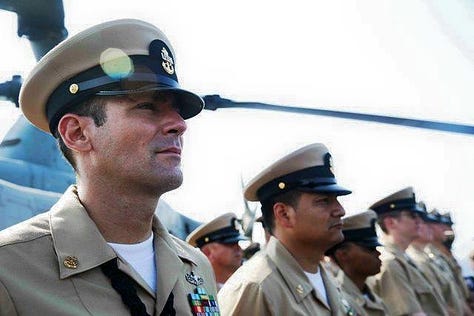

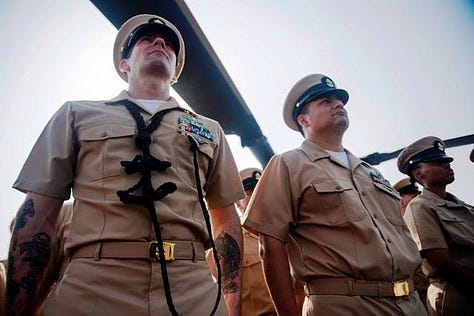
Twenty-four years in the Navy and then a bachelor’s degree at forty-six is not a normal sentence to say out loud. It’s a long, strange trip, and I didn’t know it was strange while I was living it, because you never do. Strangeness is a retrospective judgment. That’s the wizardry of the line, and it’s the same wizardry every good rock lyric pulls off, dressing a piece of hard-won philosophy up in language plain enough that you don’t notice you’ve been handed scripture until years later, humming it in your car, suddenly undone by four words you’ve heard a thousand times.
There’s also something to be said for the verb itself. Truckin’ isn’t marching, and it isn’t sprinting, and it sure isn’t retreating. It’s a specific gait, unhurried but relentless, the pace of a man who has accepted that the destination is a long way off and decided to stop pretending otherwise. The Navy has its own version of that gait, though nobody calls it truckin’. We called it turning to, which meant getting your head down and doing the unglamorous work in front of you regardless of how you felt about the weather, the watch bill, or your own mortality. You didn’t sprint through a deployment. You don’t survive twenty-four years by treating every day like a crisis that demanded maximum output. You found the pace that let you keep moving without breaking, and you held it, day after day, until one day you looked up and the thing was finished, and you had somehow become a different person in the process without ever noticing the transition happen. That’s truckin’. It’s not a burst of inspired motion. It’s a discipline dressed up as a shuffle beat, and the Dead understood that discipline better than half the leadership manuals I was handed over two and a half decades, because most of those manuals were trying to sell you urgency, and Truckin’ is selling you the opposite. It’s selling you the long game, the unglamorous middle, the part of the story nobody puts in the recruiting commercial.
I don’t think there’s anything embarrassing about finding your ethics in a Dead song, or in Aerosmith, or in a British punk band that named an album after the sound of a machine gun. The academy wants its wisdom footnoted and peer-reviewed, and there’s a place for that - I sat through enough of it this past year to respect it. But some truths only survive the trip through a drug-frayed nervous system and a cheap PA system in a smoky room, and they come out the other side scuffed up and slightly ridiculous and somehow more durable for it. The Dead weren’t trying to write scripture when they wrote Truckin’. They were trying to describe being exhausted and busted and still, somehow, moving forward, which turns out to be the most reliable definition of wisdom I’ve ever come across, whether it’s delivered by a stoned guitarist in 1970 or a tired Chief who just found out the hard way that graduation gowns do not, in fact, come in a size that fits a grown man’s shoulders.

Truck on, in other words. See what tomorrow brings. Lay the cards down. That’s the whole sermon, and it fits on a t-shirt, and it’s still true.
No posts
Comments
Nothing yet. Say the first thing.
Sign in to join the conversation.