
Author’s note: I’ve been writing about dysregulation for a while now without stopping to clearly define it or explain how it is directly linked to our current political crisis. This is the post I should have written first. I’m pinning it so new readers have a place to start, and so I can stop redefining the term in every piece. Regular readers may recognize parts of this opening from an early piece I wrote called Stroller Spaghetti. I’m re-visiting it here because that moment does a great job capturing what I mean by dysregulation.
A few months ago, I loaded my girls into our jogging stroller for our usual morning run. The stroller we have is a cool multi-purpose one that can convert to a bike trailer or even a cross-country ski sled. It’s very neat in theory, but very narrow in practice. While the cramped quarters are less of a problem now that my youngest daughter is a bit older, it was a serious struggle back when she was still in her “grab your sister’s hair and pull without warning” phase.
At the time, my main strategy for maintaining the stroller peace was a steady stream of snacks.
My best invention at the time (and still now) was stroller spaghetti: cold handfuls of plain pasta to keep little sister’s hands busy and away from big sister’s hair long enough to buy me a few extra minutes of endorphin-soaked quiet.
The girls love it… until they don’t.
Because little sister also loves throwing food (even now) and big sister does not love being pelted in the face with cold noodles. So inevitably, stroller spaghetti turns into flinging spaghetti and complete mayhem breaks out. And, predictably, my nervous system responds with a similar intensity. My heart rate rises, stress hormones flood my body, and every muscle tenses as if flying spaghetti is an immediate threat to my children.
Rationally, of course, I know cold noodles are harmless (though admittedly unpleasant when thrown in your face), but human nervous systems didn’t evolve to carefully distinguish between true danger and shrieking toddlers pelting one another with pasta. They evolved to respond to environmental cues signaling conflict, distress, and alarm, and when those cues are strong enough or enough of them pile up, the body shifts into a state where the more emotional parts of the brain begin driving behavior.
And that is how I ended up in the middle of the street yanking pasta away from my children and screaming “THAT’S IT! NO MORE STROLLER SPAGHETTI! NOT TODAY, NOT TOMORROW, MAYBE NOT EVER AGAIN!”
That moment is what I mean when I use the word dysregulation. And it happens to everyone.
Dysregulation is a nervous system state in which the brain’s ability to regulate emotions, behavior, and the body’s response to stress is exceeded or impaired.
Neuropsychiatrist and author Dan Siegel has a particularly helpful way to understand what happens in your body when you become dysregulated using your hand and fingers as a model.
To do it, hold up your hand flat in front of you and place your thumb across your palm. Now close your fingers over your thumb.
In this model, your thumb represents the brain’s limbic system, while your fingers represent the cortex and your fingertips represent the prefrontal cortex. The limbic system is a group of structures involved in emotion, memory, and basic survival behaviors, and includes the amygdala, which scans the environment for threats and triggers the body’s alarm system when it detects them. The prefrontal cortex is the slower, more deliberative region behind your forehead that handles things like self-control, perspective-taking, complex decision-making, and emotional regulation.
When your hand is closed in a fist, it represents a regulated state in which the prefrontal cortex helps regulate the body’s alarm system by evaluating signals coming from the regions underneath, mediating the response, and helping the body return to baseline once the threat has passed. When something overwhelms the system, however, the threat-detection regions begin driving behavior with less prefrontal regulation. Siegel calls this “flipping your lid,” which is represented by the fingers flipping up.
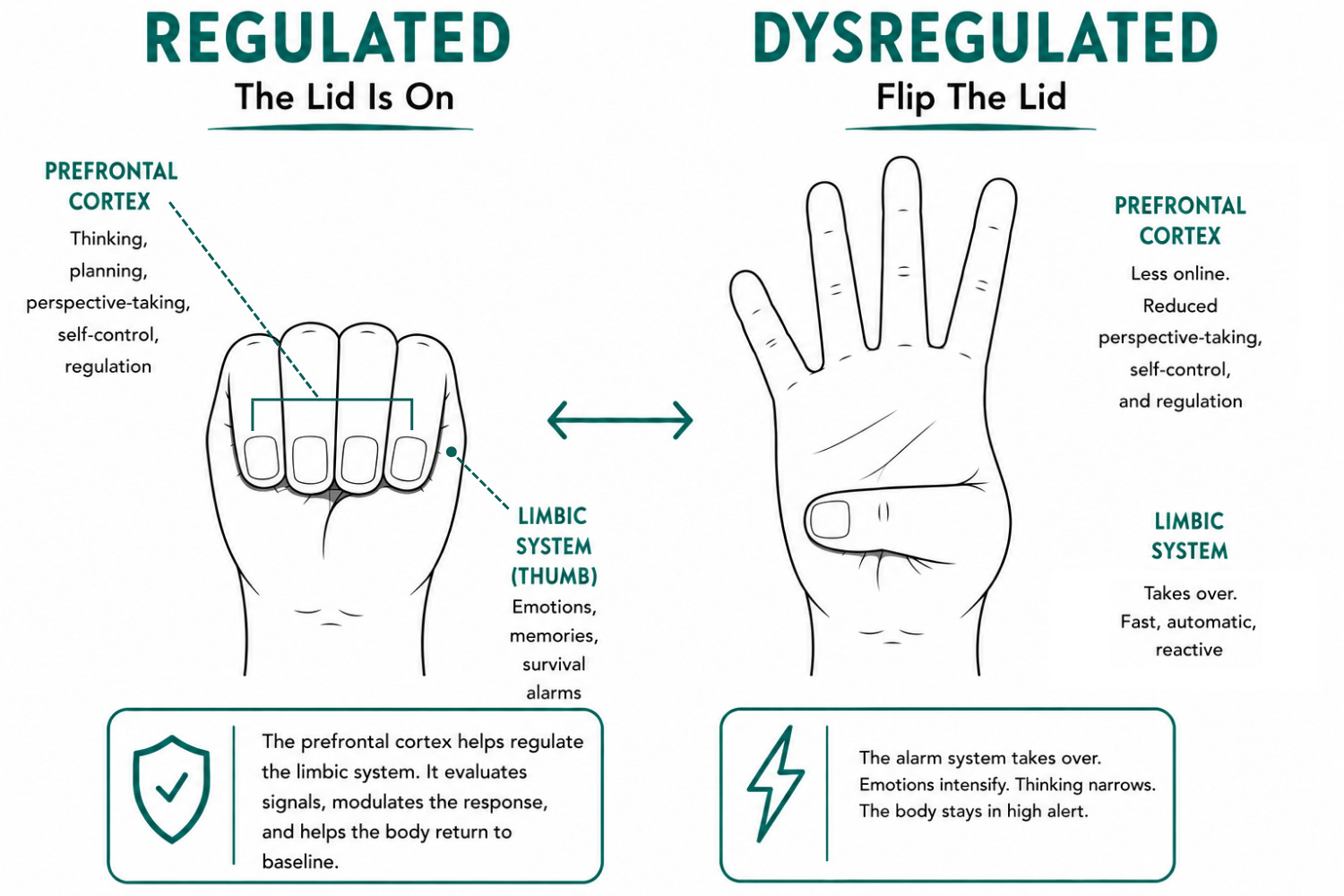
This “lid flip” is what happened to me at the moment of the spaghetti meltdown. The slower, reasoning part of my brain (the part that knows spaghetti is harmless and that I had countless better options available to me than screaming at my kids) was no longer in charge.
In short bursts, this kind of response is adaptive and helps us respond to danger. When our lids are flipping constantly and we begin to live in a perpetual state of dysregulation, however, it becomes a problem.
The morning of the stroller spaghetti meltdown is a small example of what happens when you live in that perpetual state of dysregulation. By the time my kids started screaming and throwing noodles at each other, my nervous system was already under strain, because for the entire run, I had been listening to the news. And if there’s one thing that dysregulates me more than shrieking toddlers, it’s the constant chaos of this political moment.
By the time the spaghetti started flying, the pasta wasn’t really the problem. It was simply the final straw for my nervous system, which had already been absorbing stress for the entire run, and for months and years before that.
And I think that’s true for a lot of us right now.
Most of us are moving through daily life with nervous systems that are already overloaded by the time any acute stressor arrives, because modern life exposes us to constant threats. For some people, those threats include direct exposure to violence, discrimination, economic insecurity, or instability within their own lives and communities. For others, it is more indirect but still persistent, experienced through a constant stream of information about war, suffering, political instability, environmental damage, and social conflict. At the same time, many of the conditions humans have historically depended on to regulate and recover (including stable communities, consistent social connection, economic security, trust in institutions, and a shared sense of reality) have weakened or disappeared altogether. Essentially, we are living in a society that constantly pushes us into alarm mode while also stripping away the tools we’ve evolved to shut the alarm off.
And this has direct implications for our politics and democracy.
Democracy depends on people having enough emotional and cognitive capacity to tolerate complexity, disagreement, uncertainty, and nuance. But humans become much worse at all of those things when their nervous systems are dysregulated.
The pieces I write here cover a range of topics, including politics, parenting, community, and our modern outrage-driven media environment. The book I’m writing, Dysregulation Nation, makes the larger argument, and this newsletter is where I work through pieces of it.
What ties it all together is my conviction (supported by the evidence) that our individual experiences of overwhelm and susceptibility to “flipping our lids” are not separate from what’s happening in the country. They are the same phenomenon playing out at different scales. Modern human nervous systems are being asked to handle more instability and threat than they were ever built for, with fewer of the social and structural systems that once helped them recover. The result is a population that becomes more reactive, more divided, and more vulnerable to authoritarian movements and strongman politics.
While this newsletter does offer some individual coping strategies along the way (because we still have to live inside the conditions we’re also trying to change), I increasingly think the deeper challenge is not simply helping individuals regulate within overwhelming conditions, but asking why so many aspects of modern life have become so dysregulating in the first place, and imagining better alternatives.
That’s what this newsletter is for.
For more content like this (but in bite-sized video format), head over to my TikTok (@Dysregulation.Nation), YouTube, Facebook, or Instagram (@DysregulationNation).
And, as always — stay calm, stay connected, and stay regulated.
—Brianna
No posts
Comments
Nothing yet. Say the first thing.
Sign in to join the conversation.