
Today let’s decode a study that takes something patients have suspected for years and puts real numbers behind it. That the data your wearable is collecting, heart rate, heart rate variability, breathing rate, is not just interesting background information. In people with Long COVID and ME/CFS, it may actually predict how you are going to feel later that day, and potentially how bad a crash is going to be before it arrives.
What the study did
The research team, led by Dr David Putrino at Mount Sinai School of Medicine and including Dr Akiko Iwasaki at Yale and Dr Amy Proal at PolyBio Research Foundation, analysed data from 4,244 participants with Long COVID, ME/CFS and other complex chronic conditions who had used the Visible app. This is the largest dataset of its kind by a significant margin.
Each morning, participants recorded three biometric measures using the Visible wristband: heart rate, heart rate variability (HRV), and breathing rate. Each evening they reported the severity of three core symptoms: brain fog, crashes, and fatigue.
The researchers then asked a specific question: can morning biometric data predict how someone feels that evening, beyond what their previous day’s symptoms would already tell you?
What they found
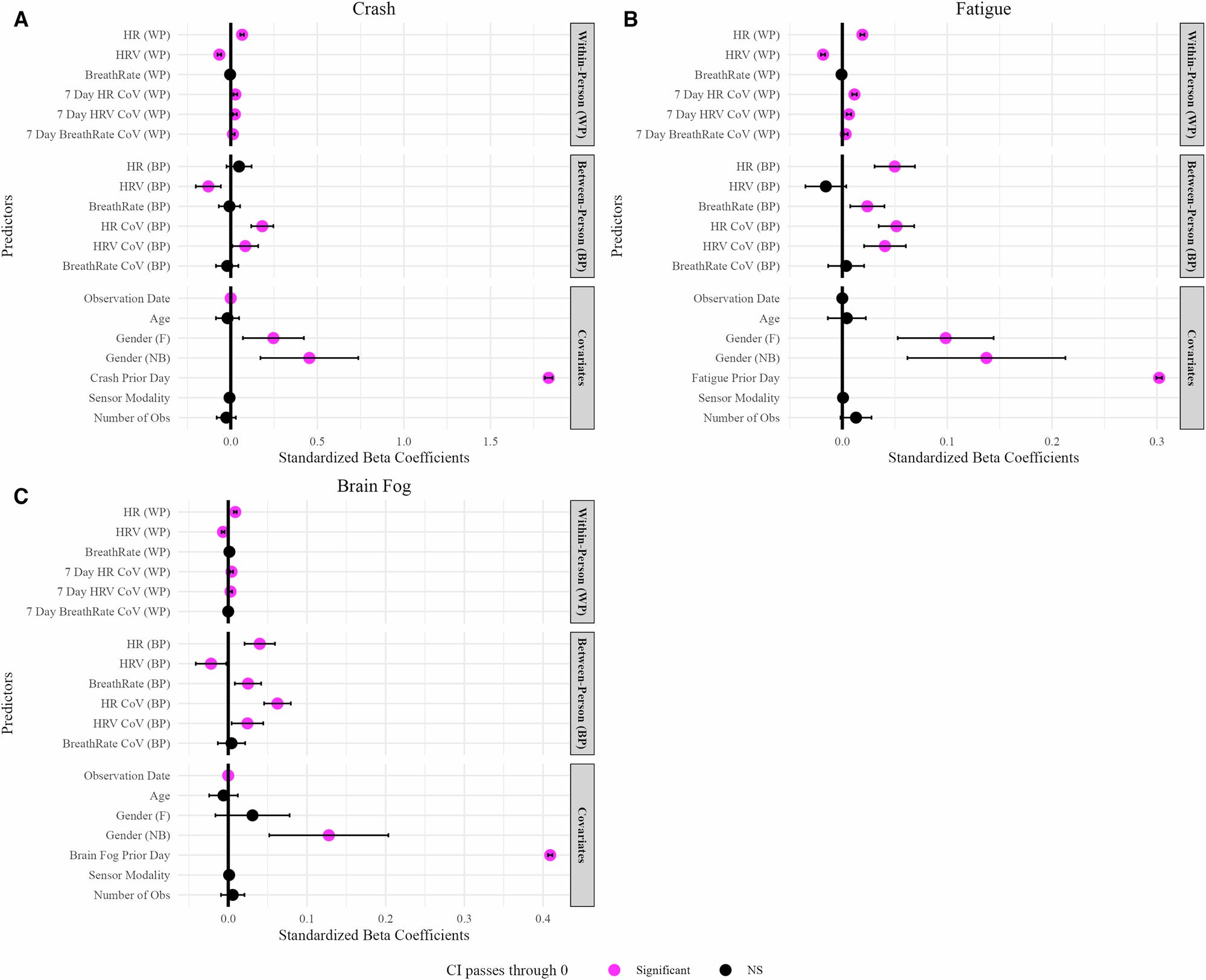
HRV data could predict crashes in individuals with quite good accuracy, though your data was good at predicting your own patterns of crashing rather than other people’s crash patterns. This distinction matters enormously. The model is personalised, not population-level.
Within-person increases in heart rate and decreases in HRV in the morning were associated with worsening symptom reports in the evening. In plain terms: if your HRV drops and your resting heart rate rises in the morning, that morning signal predicts a harder evening, before the evening has happened.
The models that combined morning biometrics with the previous evening’s symptom reports performed significantly better than models using either type of data alone. The most predictive window was morning biometrics, which outperformed biometrics measured throughout the day. There appears to be something specifically meaningful about the morning physiological state as a predictor of how the day will unfold.
Why HRV specifically
Heart rate variability is the variation in time between consecutive heartbeats. It is not the same as heart rate. High HRV generally indicates a well-regulated nervous system with good parasympathetic activity. Low HRV suggests sympathetic dominance, reduced autonomic flexibility, and often correlates with poor recovery, stress, or illness.
In ME/CFS and Long COVID, HRV is consistently reduced compared to healthy controls. The autonomic nervous system in these conditions is operating with less flexibility and less capacity to adapt to demands. What this study shows is that on days when HRV drops further than a person’s own baseline, something measurable is happening that predicts worsening symptoms later that day. The body is giving a signal before the crash arrives.
Why the personalised aspect matters so much
One of the most important findings is that the predictions were individualised. Your HRV pattern predicting your crashes is not the same as a population-level average predicting everyone’s crashes. This fits with everything we know about ME/CFS and Long COVID: the conditions are heterogeneous, individual thresholds vary enormously, and what constitutes a warning signal for one person may be meaningless for another.
This has direct implications for how wearable data should be used in clinical and self-management contexts. A blanket threshold, “HRV below 50 means you’ll crash,” is not what this study supports. What it supports is that your own morning data, tracked consistently over time, can become a meaningful personalised predictor of your own symptom trajectory. That is a meaningful step forward from the current situation where most people are flying blind.
The connection to pacing
This study connects directly to the pacing principle we have discussed in previous pieces. Pacing in ME/CFS and Long COVID means staying within your individual energy envelope to avoid triggering post-exertional malaise. The problem has always been that identifying the envelope is difficult, subjective, and usually only apparent in retrospect, after the crash has already happened.
If morning biometric data can reliably predict worsening symptoms before they occur, even with modest accuracy, that has real potential as a pacing tool. Not perfect, not universal, but a data-driven signal that could help people make more informed decisions about activity before they have already overcommitted.
What this study cannot yet tell us
The study is observational. It can identify correlations between morning HRV and evening symptoms but cannot tell us why the relationship exists or whether intervening on the signal would change the outcome. Knowing a crash is likely and being able to prevent it are different things, and this study addresses the first but not the second.
The data comes from Visible app users, a self-selected population who have already sought out wearable technology for their condition management. This group may differ from people with ME/CFS and Long COVID who are not using wearables, potentially being more engaged with self-monitoring or having different symptom profiles.
The findings also vary in how well they predict across individuals. For some participants the morning signal was highly predictive. For others the relationship was weaker. The study cannot yet tell us which characteristics predict who will benefit most from this kind of monitoring.
What it means practically
If you are using a wearable and tracking symptoms, the morning HRV reading may be more informative than you realise. A lower-than-usual HRV in the morning, particularly combined with a higher-than-usual resting heart rate, appears to be a signal worth paying attention to before planning activity for the day.
This does not mean you need the Visible app specifically. Any wearable that measures HRV, and most modern smartwatches do, combined with consistent daily symptom tracking, gives you the raw data to start noticing your own patterns. The key word throughout this research is within-person. The comparison point is your own baseline, not a population average.
The views and opinions expressed in Dysautonomia Decoded are my own and do not represent those of my employer or any affiliated organisation.
References
Aitken A, Sawyer A, Iwasaki A, et al. Digital physiological biomarkers predict within-person symptom changes in complex chronic illness. npj Digital Medicine. 2026;9:257. https://doi.org/10.1038/s41746-026-02543-3
Sawyer A, Preston R, Leeming H, et al. Wearable technology in the management of complex chronic illness: preliminary survey results on self-reported outcomes. Frontiers in Digital Health. 2025;7:1662255. https://doi.org/10.3389/fdgth.2025.1662255
Appelman B, et al. Muscle abnormalities worsen after post-exertional malaise in long COVID. Nature Communications. 2024;15:17. https://doi.org/10.1038/s41467-023-44432-3
No posts
Comments
Nothing yet. Say the first thing.
Sign in to join the conversation.