
Reasoning agents are getting better fast. Every week, we see signs that they can do useful work in complex domains, including biology.
It has been reported that Claude Mythos and Claude Fable perform better than many expert humans on a well-defined biological interview challenge. Claude Fable has also shown promising performance in protein design and, on proprietary Dyno datasets, predicted basic capsid packaging traits much better than bio-foundation model baselines.
These are early results, but they point in a clear direction. The important question is where reasoning agents will first become reliable enough to change the economics of drug development. They do not (yet) need to solve biology end-to-end. They need to solve bounded problems in a robust, low-error way, and compound across workflows. We think genetic medicine is one of the best places for this to happen because it is modular.
A genetic medicine can be broken into reusable parts: a delivery vehicle, a payload, regulatory elements, manufacturing processes, assays, clinical logic, and patient-selection logic. Each part is hard, but each part can increasingly be modeled, reused, swapped, optimized, and improved independently. That makes the field unusually well suited for industrial-scale reasoning.
The old model of drug development required too many rare experts, too much bespoke work, too many experiments, and too much capital before a program could even begin. That worked for large markets. It does not work for thousands of rare diseases. That barrier is starting to fall thanks to much improved capsids, commoditized reasoning and bio-foundation models that can redesign molecules in one shot.
By the end of this decade, we believe teams of fewer than five people, with budgets under $5 million, will be able to use hundreds of reasoning agents, mostly computational workflows, and reusable physical components, such as Dyno® capsids, to speedrun real gene therapy programs for thousands of patients.
Biological foundation models are specialized systems that operate on biological objects (sequences, images, etc). Their main promise is that they replace physical experiments and make access to ground truth cheaper. With LEAP, we showed that we can replace a year-long, million dollar experiment with a machine learning pipeline that runs in a week and costs $10K.
Reasoning models are generalists that reduce the need for expert time as a critical bottleneck to progress. As we saw in Claude Mythos Preview System Card, a task that would take a specialized human expert 4 hours can now be run at expert quality by a generalist scientist in a few minutes. These tools will increasingly make drugs cheaper, and lower the barrier to entry for many drugs that were previously economically infeasible.
Satya Nadella has described the future of companies as a combination of human capital and “token capital”: human judgment, relationships, and pattern recognition compounded through AI systems that learn from the organization’s work.
Dyno is building the integration layer between biological components, reasoning agents, and bio-foundation models that makes it possible for many companies, small and large, to launch and solve disease programs. We are the infrastructure that makes the ecosystem of genetic medicine thrive in this hybrid economy of humans and tokens.
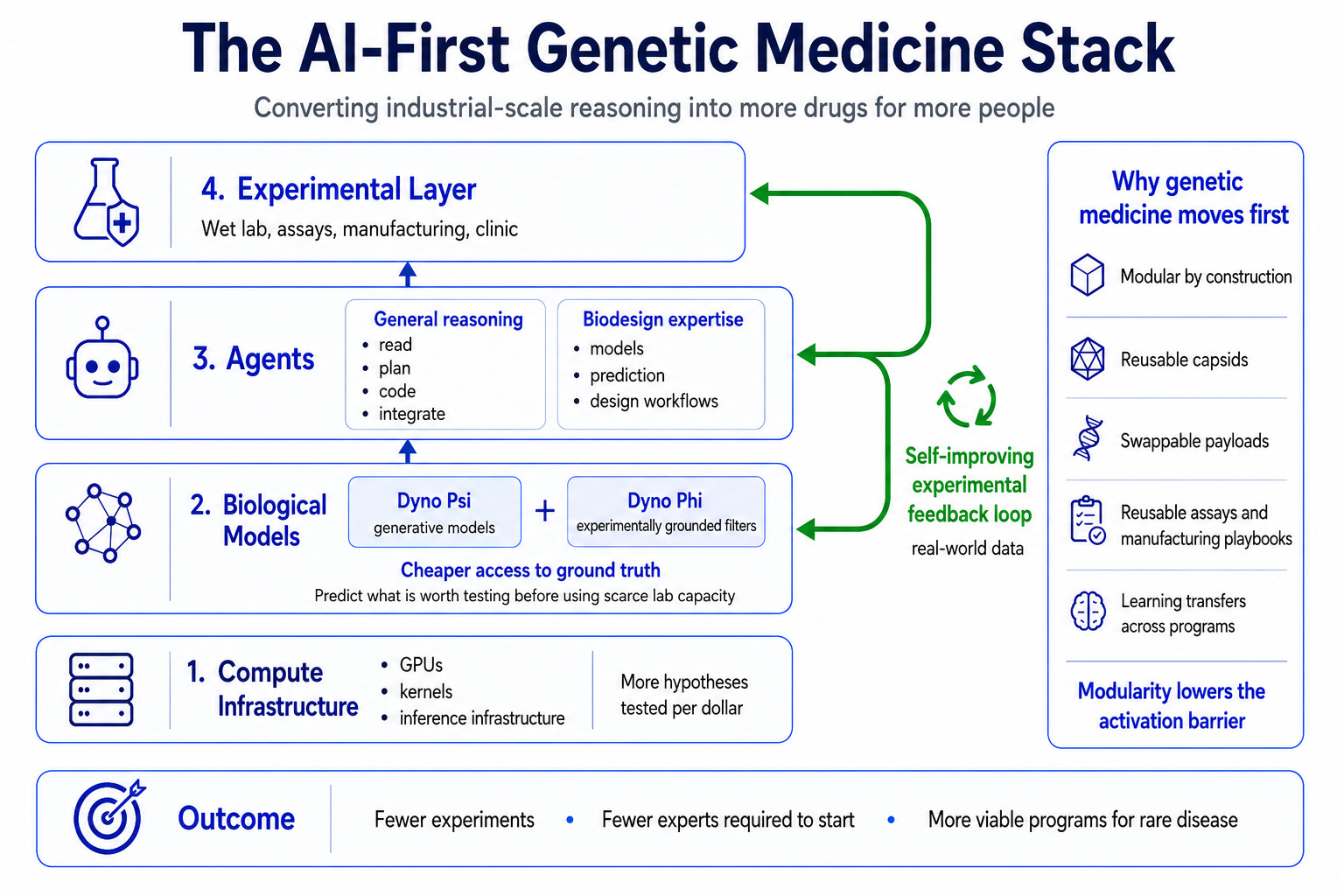
This transformation depends on a new infrastructure stack for biology, built on top of the infrastructure that has already revolutionized AI. In our case, NVIDIA has become a critical part of that stack: from accelerated compute, to biological model deployment, to agentic workflow orchestration.
First is compute infrastructure. At Dyno our NVIDIA Hopper infrastructure is the primary workhorse of our model training. Our own frontier models, as well as other public models, are pre-trained, fine-tuned and run on these systems. We’ve seen accelerators like the Transformer Engine provide up to 50% speedup here. These gains compound across workflows, because every improvement lowers the cost of training, screening, iteration, and deployment.
Second are models that operate on biological objects: structure predictors, generative design models, affinity predictors, filters, and simulators and so on. At the model layer, NVIDIA BioNeMo open models and NVIDIA NIM microservices make public biological capabilities easier to deploy and compose. The future here will not be transformed by one model. It will be transformed by many specialized models, both public and proprietary, working together inside reliable workflows.
Public protein design models have made impressive progress, but most still focus on a relatively narrow set of proof-of-concept tasks, with uneven experimental grounding across use cases. In mini-protein design, for example, many tools are now available, but their strengths, limitations, and domains of reliability are not always clear.
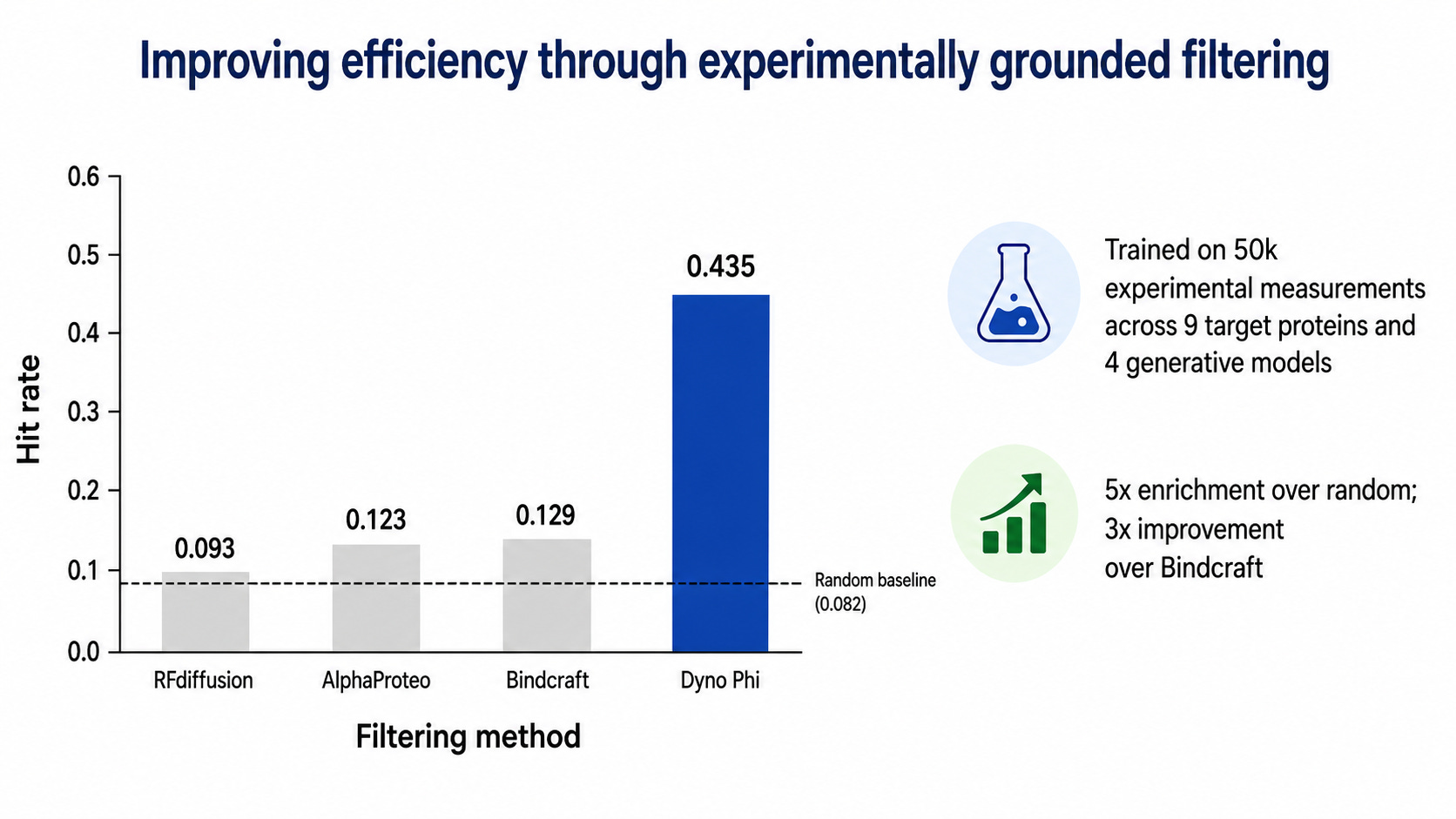
At Dyno, we’ve been building models with tighter links to experimental data. To contribute to the broader community toolkit, we released Dyno Psi-1 earlier this year: our first open-weights generative model, inspired by La-Proteina Complexa. While Psi-1 is also focused on mini-protein binding, it has a distinct performance profile from existing models. We plan to share additional experimental validation and comparisons later this summer.
In addition, Phi, a set of experimentally calibrated public filters, complements Psi (and any other generative models) by reducing the number of false positives generated by any design model. Below, we show the power of a well-designed experiment in improving the performance of these systems. As more data is collected, these systems increasingly reduce the need for experiments.
At the third layer, agents either help use biological models to design proteins and nucleic acids or they can help execute generalist tasks from research and target selection to agents that help search for the right physicians to supervise clinical trials. Here, one of the tools we use is NVIDIA Nemotron 3 as our open source system, and systems like NVIDIA BioNeMo Agent Toolkit to help build and improve models and workflows that can orchestrate these capabilities. The BioNeMo Agent Toolkit is NVIDIA’s open platform that turns any AI agent into an autonomous life sciences scientist. It gives AI agents, software platforms and biopharma systems immediate access to NVIDIA’s full life science stack. These systems save our experts time, and increase the number of projects each expert scientist can work on.
Finally, everything comes together in the physical layer. This is the slowest layer, but it is where reality lives, and the most valuable training bits flow back to teach our models. Dyno’s expertise is to take the hardest execution challenges in experimental biology (in vivo readouts), multiplex (parallelize) them at scale and perform them at high quality and lightspeed. These bits are the secret sauce that change our models from potentially useful to translationally impactful.
This technology stack will grow ecosystems in genetic medicine and beyond. Sometimes, people argue that agentic AI means fewer scientists. We think that is the wrong model. Biology is not constrained by a shortage of questions. It is constrained by the cost, and capacity to pursue them.
There are more diseases than the current drug development system can address. More hypotheses than scientists can test. More designs than companies can evaluate. More patients than the current economics can serve. If agents lower the cost of expertise, and models lower the cost of experiments, the amount of viable scientific work should expand. That means more programs. More companies. More shots on goal. More scientists directing larger search processes. More patients with high-quality drugs.
The scientist’s job changes. It becomes less about manually executing every step and more about designing systems, asking better questions, supervising agents, interpreting reality, and converting feedback into durable knowledge.
As Dario Amodei points out, this acceleration is inbound, yet it does not magically solve all disease just yet! For instance, for many diseases, the progress in technological solutions need to be met with regulatory reform in order for these benefits to be felt by patients.
In genetic medicine, Dyno is building the platform to accelerate and deliver on the promise of AI. As we mentioned before, genetic medicine is particularly well-suited for a revolution, due to its modularity and elasticity to AI lift. We are excited for the transformative years ahead, but the lessons will propagate far beyond genetic medicine.
Dyno Therapeutics, DYNO, the DYNO logo, and mountain design are registered trademarks of Dyno Therapeutics, Inc. All rights reserved.
No posts
Comments
Nothing yet. Say the first thing.
Sign in to join the conversation.