

After the annihilation of Zevka, a strange equilibrium settled over the Second Cipher War. The machines raided small outposts and colonies, destroyed infrastructure, abducted crews and colonists, and then departed. The Allies drew in vulnerable outposts where possible, fought off raids where they could, and built up strength for a future all-out confrontation—all while searching in vain for a Cipher center of strategic gravity.
This stalemate went on for weeks, then months, until over a year had passed with no great battles occurring. Most Allied citizens did not suffer during this low-intensity conflict, save for the minor deprivation caused by the wartime economy. Even the bulk of military personnel saw little combat, unless they happened to be assigned to a raided system.
But while the frontline, such as it was, remained largely still, great changes stirred behind this false curtain.
During the first year of the war, an anomalous datapoint had been noted by Allied strategists. After both Signet Arrow and Anson Point, the Ciphers launched attacks which appeared to be responses to these operations. The problem with that conclusion was that these attacks had been launched long before news of the operations should have been able to reach the forces employed, unless Cipher Stardrive velocities were orders of magnitude greater than had been observed.
Still, these cases remained mere anomalies—until a pattern emerged during the long latter months of 2375. Cipher raiders consistently seemed to possess information they should not have been able to have. Raiding parties separated by tens or hundreds of light years acted almost in concert; in at least one case, a Cipher force canceled its attack in the Hampton system within minutes of a raid in Lodestone being defeated—twenty light years away.
As isolated incidents, any of these could be coincidence. But combined, they led to a surprising conclusion: the Ciphers possessed some form of instantaneous, or near-instantaneous, FTL communication technology.
Several theoretical methods were advanced: micro-wormholes, metaframe signal propagation, and quantum entanglement-based communication. But all of these presented significant problems.
Virgonid scientists had been creating micro-wormholes in laboratory conditions for almost two centuries; but these were unstable, surviving just fractions of a second. While this could theoretically permit a burst of information to be sent through, the other problem was range: the amount of energy required to link two points via wormhole scaled logarithmically with distance. The best the virgonids had managed was points a few meters apart. Once that was scaled up to dozens or hundreds of light years, the energy costs became nearly galactic. While it was theoretically possible the Ciphers had found a more efficient way around this problem, there would undoubtedly be massive releases of energy and radiation whenever a wormhole connecting two such distant points was created, and nothing like that had been observed from the machines.
Similarly, the phenomenon of quantum entanglement had been well known and largely understood for centuries—and it does involve the effective communication of information across any distance without lag. When one particle’s spin is resolved via observation, its entangled pair is instantaneously resolved in the opposite direction. However, for all those centuries humans and virgonids had been trying to construct a theoretical model that would permit exploiting the phenomenon for communication, without success. The problem was as simple as it was bedeviling; in theory, the resolution of a particle’s quantum state could serve as a signal that would convey information to a detector—but how could that particle be observed without being observed, thus resolving the state prematurely?
The theory of metaframe signal propagation initially seemed the most promising. If the metaframe is a preferred spacetime foliation where Lorentz symmetry doesn’t apply and c isn’t a speed limit, then a signal propagating natively through it wouldn’t be subject to the same distance constraints and dissipation effects as baseframe-bound signals. If ships imperfectly decoupled from the baseframe can travel thousands of times faster than light, then perhaps perfectly decoupled electromagnetic signals could travel an infinite distance virtually instantaneously.
Allied scientists had not yet found any means by which a signal could be coupled to, or encoded on, the metaframe. And decades of examination of Cipher technology recovered after the first war had revealed no evidence of such technology. But Cipher tech captured during the present war, mostly from destroyed ships, contained a number of systems which could not be identified. One of these might be an FTL communicator.
As Allied engineers tried to reverse engineer these systems throughout 2375 and 2376, they were also working furiously to devise a defense against Cipher UREBs. Initial efforts focused on stealth, in which a number of significant advances were made. Free Worlds scientists pioneered a new form of adaptive visual camouflage, while Terran engineers developed more efficient heat recycling systems and radiation disruption techniques.
These were rapidly rolled out through shipbuilding and refitting programs; war production was also simplified, focusing on a small number of ship classes with easily replaceable parts and components, so they could be quickly upgraded with just such innovations as these. Stealth upgrades would significantly increase the survivability of Allied ships in combat, and potentially allow the Allies to set up ambushes against Cipher forces similar to the ones they had suffered earlier in the war.
But stealth systems could not protect planets. To that end, Allied engineers were at work on a method of hard defense. Deflecting or absorbing even a single particle beam shot in battle could save a ship, or millions of lives on the surface of a planet. But that was far easier said than done. The problem was not just the enormous energy of the shot, which could in theory be turned aside by a sufficiently powerful magnetic field; the fact that the beam is neutralized means that it cannot be affected by magnetic forces. To deflect it, then, a charge would first need to be imparted to it
To solve this problem, the virgonids developed an innovative two-stage shield system. In the first stage, the beam strikes an envelope of high-energy plasma, which imparts a charge. Then, the shield generates an enormously powerful magnetic field, which surges directly against the vector of the shot. If the plasma field is too weak, a charge will not be imparted; if the magnetic field is too weak, or misaligned, the beam may not be sufficiently deflected. But in most cases, this is enough to deflect the beam such that it misses the target.
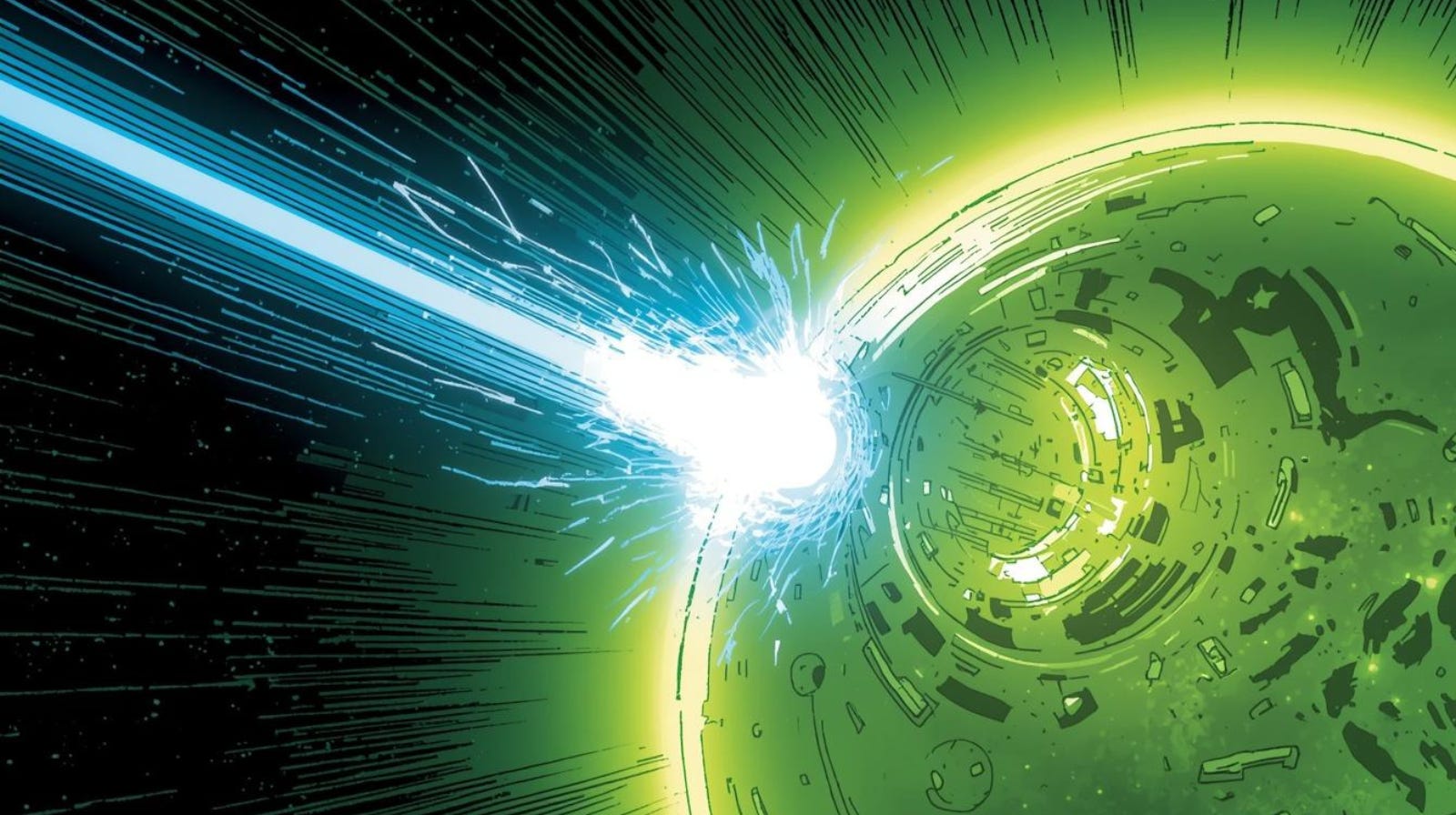
The magnetoplasma field the virgonids designed was generated by several large reactors with a huge power draw, which would launch a network of micro-nodal dust between them to act as a medium for the plasma. Obviously, this was not feasible for defending a ship or a planet’s surface; but the virgonids were working on a system that would allow the field to be generated by a large network of drones. These would operate in concert with one another, each generating only a small part of the energy required, as well as drawing power wirelessly from a host ship’s main reactor. In theory, such a system could also be deployed to protect a planet, or at least parts of its surface.
The first drone-network shields were field tested in late 2376. The field could only be generated once—the energy used would inevitably burn out the drones and power transmitters—but that was often enough to save a ship from destruction at a pivotal moment. Such a system could equally help save cities from UREB strikes fired by Cipher raiders. Satellites equipped with antimatter reactors and magnetic field generators would be spaced at regular intervals around a planet’s orbit. During a raid, these would deploy drone swarms which would generate and anchor the magnetoplasma field just like a ship’s defensive screen. Once one portion of this orbital network was burned out, satellites could be rerouted to cover gaps over critical areas. While it would take many months to roll these systems out, they provided hope that some kind of planetary defense was at least feasible.
In early 2377, UCC scientists made a breakthrough on communications when they discovered cores containing condensed hydrogen gas in a number of Cipher wrecks. The gas was segmented into thousands of tiny compartments, whose purpose could not be determined. These discoveries put the project’s lead engineer, Darien Wu, on the path of entanglement as the mechanism of communication. His theory was that each compartment might correspond to a qubit; a state-resolution in a particle in that compartment would thus correspond to that qubit being activated in a quantum computer system. Another related device was theorized to be an observation system which could monitor for state-resolutions in these chambers.
The breakthrough came when a seemingly useless piece of tech was identified as a device which somehow interposed between the monitoring device and the hydrogen core. This device, which Wu dubbed the “discrete eigenstate filter”, somehow preserved the unresolved state of each particle. Only the information that the particle’s state had been resolved by observation on the other end could pass through the filter to the detector, effectively allowing each particle to be “observed” indirectly.
The mechanism by which this was achieved took months to uncover—namely, that the DEF operates based on the weak measurement principle, simply at an unfathomably higher resolution than human systems were then capable of. The DEF performs an extremely rapid cascade of weak measurements on each particle, each one extracting only an infinitesimal amount of information—below the threshold that would constitute a full observation and trigger collapse. But aggregating those measurements across millions of cascade iterations can detect whether a resolution event has already occurred in the paired particle, without itself constituting an observation of the local particle’s state.
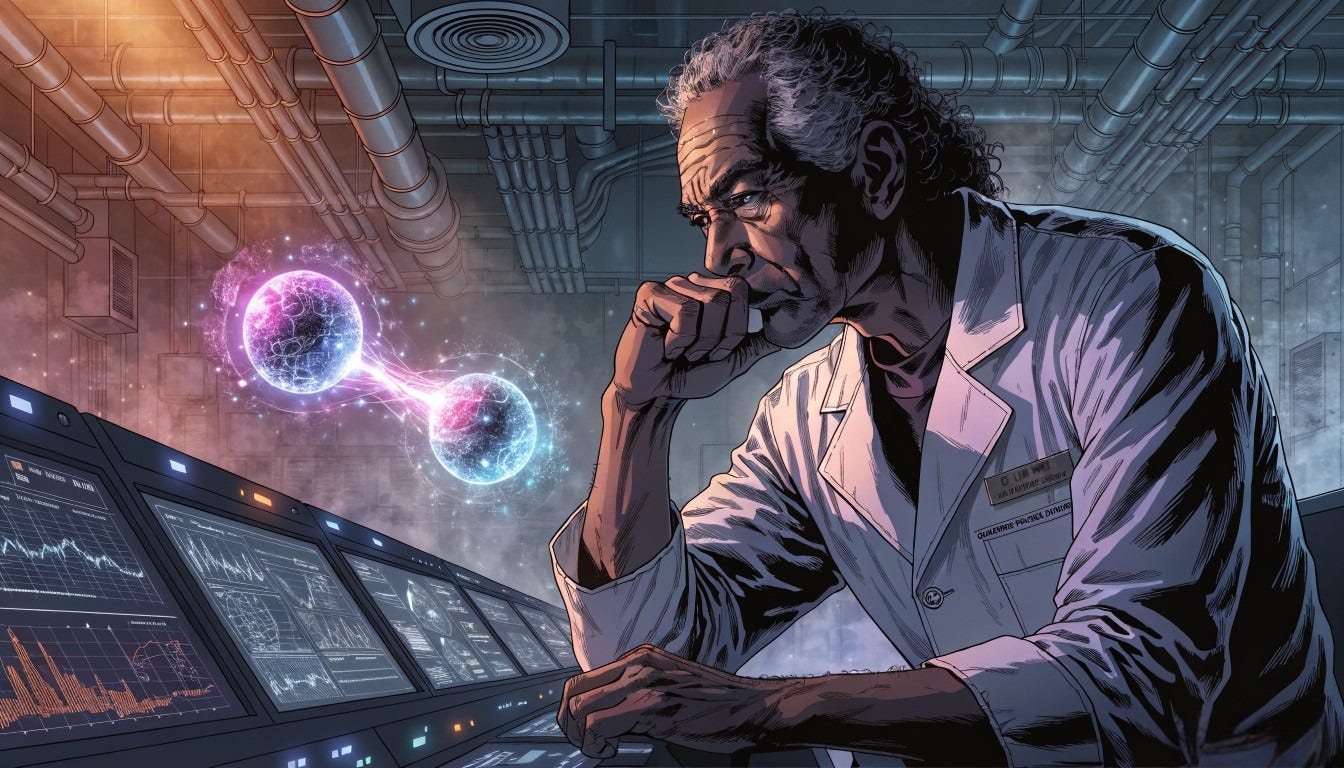
Even after determining the nature of the device, Dr. Wu’s team could not replicate its effects at the same level. While the Cipher DEF could resolve individual subatomic particles, the prototype DEF the team constructed could only filter hundreds of such particles at a time. To send a signal, hundreds or even thousands of particles would have to be observed and resolved to equal one qubit of information. That, in turn, meant that entangled cores had to be extremely large, and were exhausted rapidly by high-information transmissions.
The first public test of the prototype featured a real-time visual and voice communication between Unity Prime in the Progress system and Ngayo in the Justice system, over a hundred light years apart—a literal quantum leap that captured the attention of the galaxy. But due to the first-wave DEF’s limited resolution, production models of the Quantum Entanglement Communicator (QEC) were limited to sending simple text messages. Operators were advised to be as parsimonious as possible.
Even so, the QEC promised to change interstellar civilization, perhaps forever. For the past three centuries, messages could only be transmitted across interstellar distances via courier ships and drones. While Stardrive velocities were incredible for moving people and things from star to star, moving information that way had begun to feel interminably slow. As during the Age of Sail on Earth, news of a battle or an enemy movement in one corner of explored space might take weeks or months to reach the other. Coordinating action between fleets and governments across these distances was extremely difficult, requiring time, preparation, and calculation.
Now, if the QEC could be widely disseminated, that problem would be solved. The powers of the Alliance could—in theory—work together more closely than ever before, respond to threats with unprecedented speed, and take more decisive action to win the war.
But there was an obstacle standing in the way of that future. The pacifist movement in the UCC had only grown with the months of low-intensity conflict. Activists and leaders vehemently opposed sharing the QEC with the FWR and the TIU, lest it be used for military purposes. This stood in stark contrast to the virgonids, who immediately disseminated their shield technology the moment it cleared their testing standards.
As impatient Allies demanded the technology be shared, a consensus started to build in the Councils that it should be—but with a price. That price was an immediate halt to military operations against the Ciphers, and the opening of peace negotiations. They used the TIU’s deal to share the Mk IV Stardrive in 2321 as a justification for this demand, but this did little more than enrage the already indignant Republic, and frustrate the usually more forgiving Terrans. A UCC-wide referendum on the issue was scheduled for late November, 2377. Polls suggested the resolution would pass, even though the FWR threatened to cease all cooperation with the UCC should the measure be adopted.
But the referendum, and the crisis likely to result, were overtaken by three events. First, the Ciphers launched their first large-scale offensive in almost two years, targeting six more populous systems with larger colonies: Rostam in the TIU; Kyōyū in the UCC; the virgonid colonies in Wolf 1061—the first virgonid worlds ever to be attacked—and three worlds belonging to the melakeen, the xirān, and the uthal. The associate allies had up until that point been providing only economic and intelligence support, and had been spared direct attack.
Speculation was that the machines had discovered the Allies’ recent technological advances, and wanted to gain a decisive upper hand before they could be disseminated. The defenses in all six systems were quickly overwhelmed, placing the Allies in another strategic bind. A counteroffensive might result in another calamity like Zevka; the planetary defense version of the virgonids’ magnetoplasma shield was only just entering the field testing phase, with limited units deployed to Eos, Frontier, and Earth. The Ciphers were effectively holding these worlds hostage—though mercifully, they were not yet engaged in a large-scale program of abduction.
Second, a number of Kyran clans—Harag, Rhyllok, and Atkar—sought to take advantage of the distraction caused by the Ciphers to invade their former systems still occupied by the FWR. The invasions did not appear to be closely coordinated, and varied considerably in effectiveness, but they still required the FWN to commit significant assets to repulse them.
Third, just two weeks before the UCC referendum was to be held, Dr. Wu smuggled the designs and schematics for his QEC prototypes to the virgonids, the Terrans, and the Free Worlders.
Citizen outrage over this betrayal was intense; hardliners proposed that the planned referendum go ahead, but recast now as a question of whether to leave the Alliance and make a separate peace. To quiet the furor, the High Council was forced to accept the proposal, as well as voting to strip Dr. Wu of his citizenship, effectively exiling him. Wu expressed regret, but not remorse for his actions. He released a statement that he had invented the QEC to benefit all of humanity and its allies, not one government or one people, and that would do the exact same thing again if he knew it would result in his death, let alone his banishment. Wu spent the remainder of his years on Earth, a hero in the TIU and the FWR, and a villain to most in his home country.
For now, though, the Allies scrambled to produce as many QEC units as possible, and solve the methodological problems involved in using them. They hoped that the QECs and the planetary shields would give them some kind of advantage they could use to break the deadlock, before the Ciphers seized more systems. In the UCC, the newly formulated referendum went ahead in early December. The resolution to leave the Alliance failed by the narrowest of margins, 50.5/49.5; apparently, enough Citizens remained fearful of the Ciphers to want the protection of the Allied fleets. With regards to the QEC, Schrodinger’s cat was already out of the bag, as the saying went.
For hardline pacifists, the vote only deepened their resentment and anger. Calls to secede from the UCC rose on planets where the vote had favored leaving the Alliance. But most of the population was placated, at least for now. The Alliance could get back to the work of winning the war, or at least surviving it.
The problem that needed solving was how to eject the Ciphers from the systems they occupied without the machines destroying the planets as they retreated. Fantastical solutions were proposed, such as finding a way to wholesale neutralize the Ciphers via cyberwarfare or EM weaponry, or by sneaking in largely untested planetary shield nets to protect the worlds in question before an attack.
Ultimately, the only viable solution was both simple and extremely difficult: coordination. The best way to minimize damage to the besieged planets was to attack each of the systems simultaneously. Given the Ciphers’ sophisticated QEC, an attack on one system could trigger a massacre in another, however far away. Further, each attack would have to be coordinated precisely at the tactical level; every Cipher ship in position to fire on the planet’s surface would have to be struck, and ideally destroyed, in the first volley.
That level of precision would require long term reconnaissance of Cipher deployments in each system, both long range and close-in. For the latter purpose, stealth drones equipped with next generation detection tech would be infiltrated into the systems to watch for stealthed Cipher ships. These would all have to be tracked for long enough that an attacking force would have a reasonable chance of striking them all in a single volley immediately after decelerating from Stardrive. Then the attacking force would have to fight off the remaining Ciphers in the system to prevent them from gaining a firing position against populated areas of the surface.
That meant months of preparation: planning, study, training, simulation, and shipbuilding. Present fleet strength would have to be increased significantly, to provide enough forces to carry out the six simultaneous attacks in sufficient strength, and leave enough behind to defend vital systems from possible Cipher counterattack. To that same end, orbital magnetoplasma shield nets would have to be deployed to as many vital systems as possible before any attack went ahead.
The six assault fleets were put together over the first few months of 2378, incorporating most of the best ships and commanders from each of the combatant fleets to form a core of veteran leadership. How to disperse this core was a logistical challenge of its own, given how widely spaced were the target systems and the multiple states to which they belonged. Given lingering resentment over Zevka, the TDF was assigned to carry the bulk of the weight at Kyōyū, supported by what remained of the UCC fleet. The FWN, still considered the best space combatants in the galaxy, was split into five battle groups, each of them providing support in one of the target systems rather than taking the leading role anywhere. The remainder of the TDF would go to Rostam, the virgonids would liberate Wolf 1061, and the melakeen, uthal, and xirān would each handle their own colonies, with the FWN providing fire support and crucial QEC coordination.
Once assigned, these fleets simulated and rehearsed their assigned attacks relentlessly, ironing out potential issues. Over the course of these months, Cipher raids against Allied systems increased, as did the pace of abductions from the surfaces of the six besieged planets. But this time, the political pressure to act was manageable. No-one wanted a repeat of Zevka.
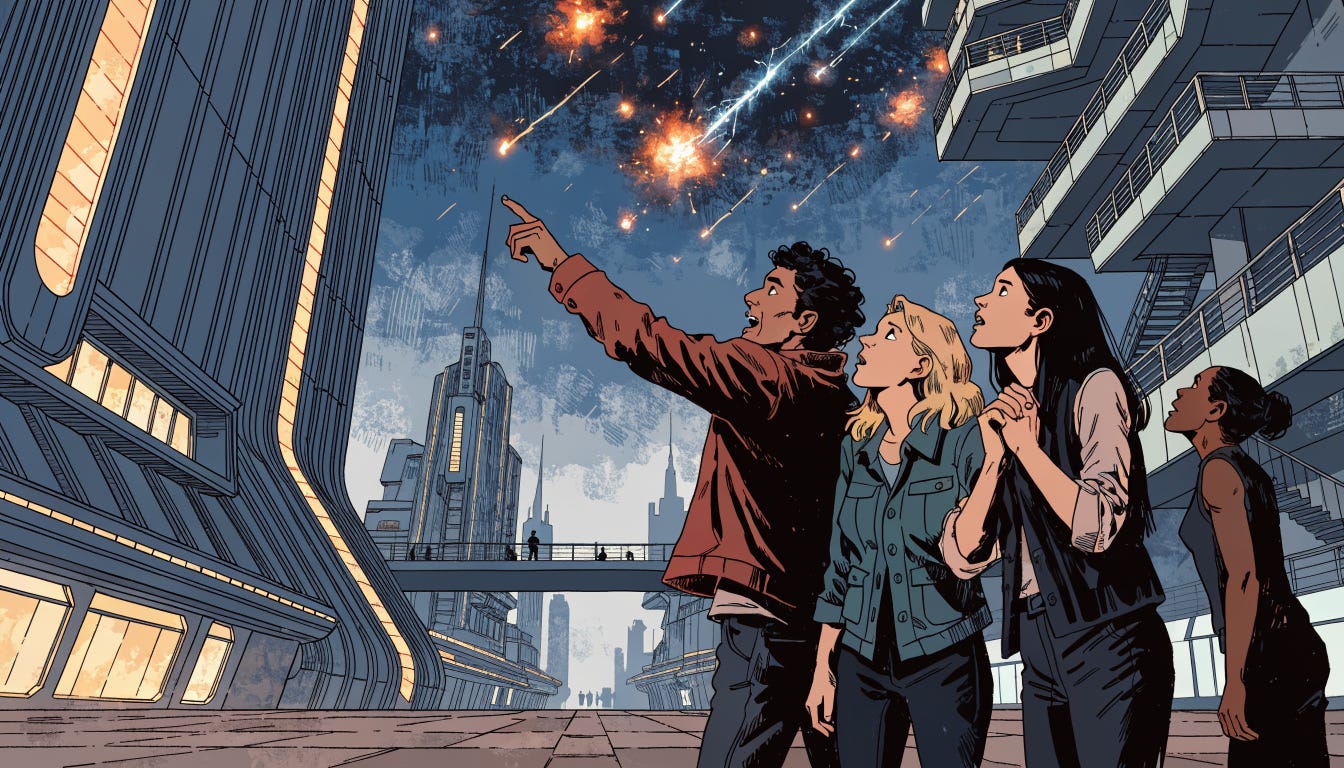
After nearly six months of preparation, the attacks went ahead on June 2nd, 2378. Dubbed Operation Swift Blade, this was the first-ever military operation to be coordinated across multiple star systems simultaneously. Despite the novelty, the execution was near-perfect. All six fleets decelerated within seconds of one another, across over a thousand light years of space. At the tactical level, the attacks were executed with remarkable precision, fruits of the meticulous preparation and rehearsal. All Cipher ships in position over population centers were destroyed before they could fire.
After the opening volleys, the six engagements became desperate battles to keep the Ciphers away from the deadliest firing arcs. Each one ended with the destruction of all Cipher ships—and across all six systems, only a handful were able to fire on a planet’s surface. Two of these shots struck major population centers, while the rest primarily inflicted environmental damage. Combined, these strikes still killed hundreds of thousands—but the destruction could easily have been exponentially worse.
Swift Blade was a remarkable success—the first unambiguous, large-scale victory for the Allies in four years of war. Billions had been liberated from Cipher occupation, and thousands of the machines had been destroyed. Celebrations erupted across the Alliance; but AJC was less ebullient, waiting as they were for the expected Cipher counterattack.
The hammer fell two months later. Cipher fleets struck at Hyperion, Frontier, Ouroboros, and several other antimatter mines between August and December, 2378. All these attacks were repulsed, though with significant losses to the Allied fleets. When the Ciphers had the tactical initiative, they could still do serious damage; but mercifully, their attempts to fire at cities on Eos and Freedom failed, deflected by the newly installed orbital shield nets.
Similar shields defended the Ouroboros mines, preventing their destruction when they were attacked in October. While the Ciphers did succeed in damaging or destroying the mines in WZ Sagittae and EX Hydrae in November and December, antimatter supplies had been sufficiently diversified that these losses did not significantly hamper the war effort. Cipher attacks dropped off following the last of these failed raids in December. The FWN was able to refocus on the Kyran threat, raiding the attacking clans’ home systems and inflicting serious damage before withdrawing.
In March, 2379, the Ciphers finally reopened communications with the Allies. Now that they no longer had to hide their QEC capability, this was substantially easier; a single Cipher ship entered the Hyperion system well beyond UREB range of Eos and its defenders, and opened a channel with AJC.
It appeared to be a live communication from Dr. Toll, still serving as an intermediary. Toll reiterated now years-old justifications that the entire war had been a terrible misunderstanding; that the abductions were a clumsy attempt to learn more about humans and the Alliance; that the destruction of Zevka was a tragic mistake. Toll insisted that the Ciphers would prefer cooperation, coexistence, and symbiosis—but the war had proven that humanity was not ready for this. Nor were the virgonids, melakeen, xirān, or uthal if they continued to associate with us.
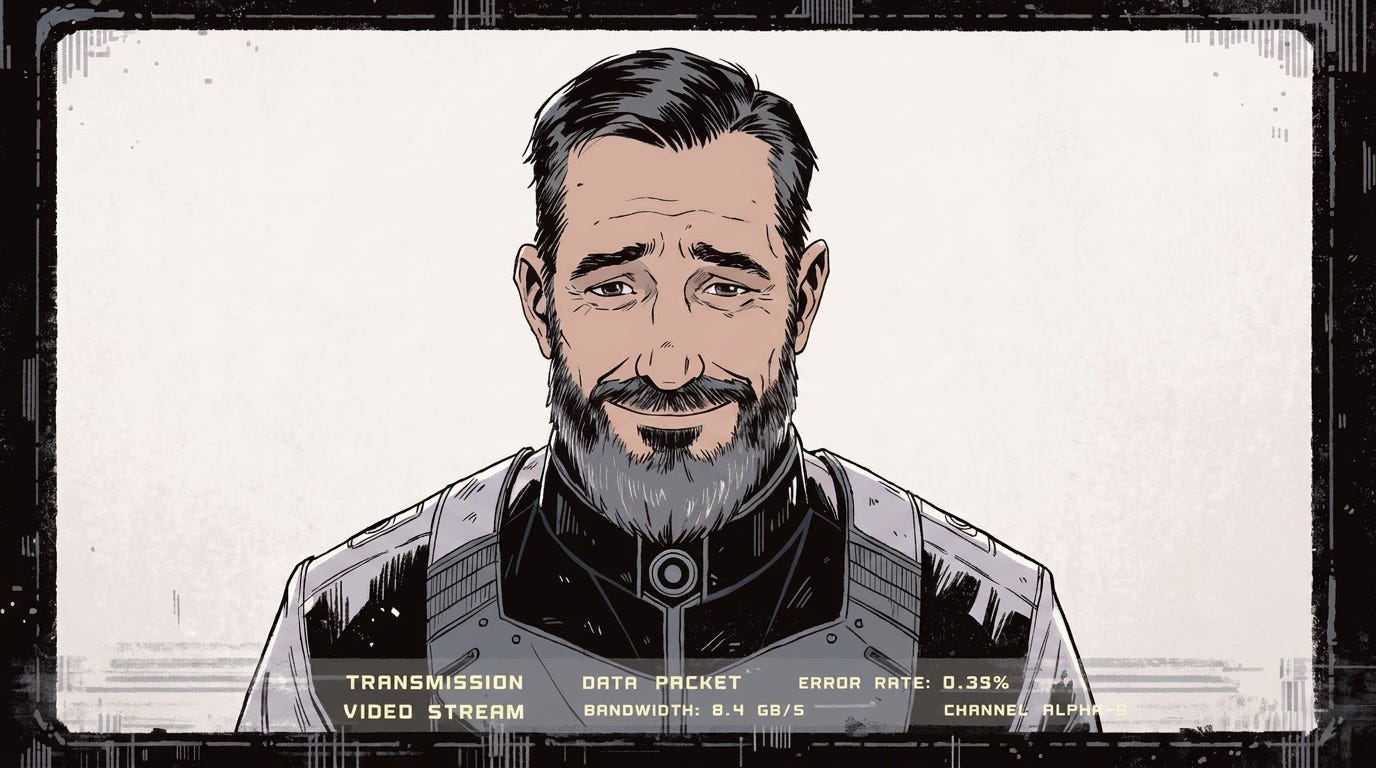
But rather than continue to engage in conflict, the best course would be for the two sides to simply leave each other alone. To that end, Toll offered to end hostilities with an effective status quo ante bellum agreement. The Ciphers would stay out of Allied systems, the Allies would stay out of known Cipher systems. Should they meet unexpectedly in unclaimed space, these encounters could be deconflicted as they came up. Toll gave the AJC a week to consider the proposal, while the intermediary platform waited in the outer system.
AJC debated for several days before recommending accepting the proposal. The proffered agreement would not resolve any underlying issues between the two sides, provided no reparations for the tens of millions of civilian dead, and did not secure the release of any abductees. But AJC argued that despite their major leaps in defensive ability, the problems of offense from the beginning of the war remained. Despite years of searching, the Allies had confirmed no Cipher-controlled systems beyond the four under observation already.
That meant that the Allies had no meaningful way to strike back against the Ciphers, and that any search for the abductees would be groping in the dark. Continuing the war would thus mean continuing the strategic defensive. In a war of attrition, the Allies would run out of material and will long before the machines.
Facing these facts, the Allied governments reluctantly signaled their assent to accepting the agreement via QEC—but on a provisional basis. The response stated that the Allies saw the agreement as a ceasefire or armistice, not a permanent peace treaty. That would require further negotiations, and would not be signed until the issue of the abductees—well over a hundred thousand by the end of the war—could be resolved.
But after receiving the preliminary acceptance, Dr. Toll merely expressed gratitude for the resolution of the conflict, and that further loss of life would be avoided. Then, the Cipher ship departed. No further contact could be made with them. The Allies were reluctant to send even unmanned platforms into Cipher systems, as this might be considered a violation of the ceasefire.
The war, it seemed, was over. The Allied people were relieved to have survived, relieved the pressures of a wartime economy could be lifted. Many grieved their losses. The governments and societies of the Alliance had been permanently changed. Some had been militarized to an unprecedented extent, while another—the UCC—seemed on course to completely demilitarize in the months and years to come.
But this was a strange sort of peace. One which might be broken again at any moment. If war with the Ciphers resumed—or if, God forbid, a similarly deadly adversary should emerge from the depths of space—even greater cooperation would be required to survive.
Whether that was something of which modern humanity was capable remained to be seen…
No posts
Comments
Nothing yet. Say the first thing.
Sign in to join the conversation.