
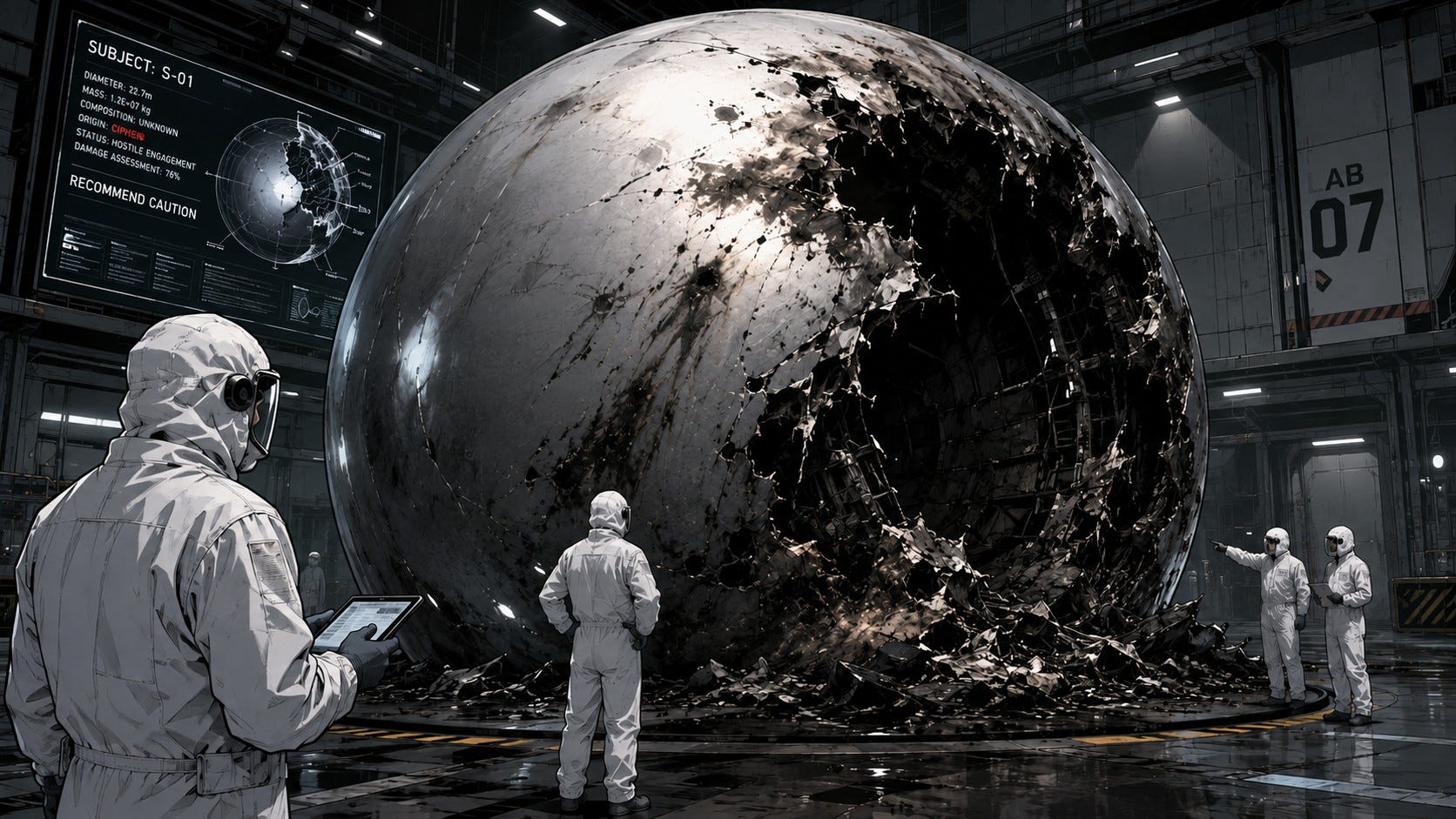
By 2380, humanity and its allies had survived two wars against the Ciphers—a ruthless, highly advanced, and ancient machine civilization, which had been observing and learning from each of our races for thousands of years. The questions no-one could answer were why, and how.
Why did the Ciphers attack?
How had we survived?
The two problems were closely linked and multi-factorial. The future of humanity, and every other Allied species, would depend on whether they could be solved.
After the Corporate Worlds War / First Cipher War (2311 - 2314), human and virgonid scientists sought answers in the ruins of the Machine World. All they found was conclusive proof that the machines had lied to the OIGC about their origins. The rest was mere speculation. Dominant opinion was that after millennia of observation and experimentation, the machines had determined that humanity either was, or would become, become a threat. They then sought to destroy us, first by turning us against one another, then by taking direct action once internecine conflict weakened us.
In that formulation, the conflict had been a total war for survival between organic and machine, with the human-virgonid alliance barely coming out on top. The discovery of the Cipher occupied worlds in the 2350’s put this theory into question, proving as it did that their “empire,” such as it was, must have a considerable extent. Thus, the machines had patently not directed all their resources into the supposedly “existential” conflict.
This theory was modified by the new story of the machines’ origins and motivations provided by human interlocutor Dr. Toll during the Sukat Incident. Toll suggested that a splinter faction of machines had determined humans were a threat, but the rest of the civilization had disagreed. These only wanted coexistence, or what they called “symbiosis.”
The Second Cipher War (2374 - 2379) had then thrown this version of the theory into question. Some Cipher theorists saw the war as a definitive repudiation of the Toll Thesis, as it became known. These saw Toll’s story as just that—a lie told to lull the Allies into a false sense of security, or a test to gauge our response. In this formulation, the war had shown the machines’ true colors, proving that they were a threat to humanity.
The problem with this theory was that the machines had not fought the war as if their survival was at stake—or at least, not as a biological civilization would have fought with its survival at stake. They had used an incremental, probing strategy for most of the war, failing to take advantage of clear Allied weaknesses, to strike at centers of gravity when they were at their most vulnerable.
Only in the last six months of the war had they adopted something like a truly aggressive strategy, attacking Allied capital worlds, industrial centers, and antimatter infrastructure. But by then, the Allies were well prepared to defend these vital targets. The resources of the machines were clearly greater than those of the Allies; even after the defeats they suffered in 2378, they could probably have continued the war.
If the conflict had been existential for the machines, why would they not have done this? Proponents of the theory suggested that the Ciphers might have other enemies elsewhere in the galaxy about which we knew nothing, which required them to split their resources. But with no evidence to support this supposition, this constituted a major flaw in the theory.
This is what opposing Cipher experts and peace activists pointed to. They suggested that Dr. Toll’s story had been true; the Ciphers really did want coexistence and symbiosis. It was we who had fired the first shots of the Second War, after all, launching Operation Signet Arrow to rescue “hostages” who in this formulation did not really need rescuing. Everything the Ciphers had done after that was an effort at self defense, or an attempt to save us from ourselves, so that they would not be forced to destroy us.
This theory sought to explain away seemingly inconsistent Cipher actions by various means: the frightened hostages had simply misinterpreted the behavior of the Ciphers and Dr. Toll, and panicked; the much publicized abductions from Allied planets had been overblown; the abductees had probably been no more mistreated than the Sukat hostages had; Toll’s explanation that this was an attempt to learn about us was also true.
But the hardest thing to explain away was the destruction of Zevka and its 100 million inhabitants. For this there was no orthodox explanation among the peace party. It was a tragic mistake; it was a misguided attempt to end the war quickly and avert worse suffering in the future—heartless, but understandable from a machine’s perspective. The most ardent even suggested that it was the UREB-armed FWN that had actually destroyed the planet, then blamed it on the machines, a false flag attack to drum up support for expanding the war.
This remained a fringe theory, but even so the gulf between the two sides was vast, and seemed unbridgeable—except by an emerging theory that rejected both arguments entirely.
In the closing phase of the war, Paul Niven, a well-known philosopher and noologist on Astraeus, wrote and published an essay called “We Cannot Know the Ciphers.” Essentially, Niven’s argument is that Cipher behavior over the past four centuries has been so inconsistent that it is not possible to formulate a rational, internally consistent explanation for it. At least, not from a human or biological point of view.
That being the case, there are only two possible explanations: these wildly inconsistent behaviors are in service of a logical end, but one based on fundamental facts of which we are not aware, and may be incapable of knowing; or Cipher thought at its core is so different from ours that it does not employ logic or consistency at all, not as humans understand these things.
Within these two buckets, there are a number of possible explanations. Despite outward appearances, and occasional actions that conform to human expectations, the Ciphers’ primary existence and consciousness may be in higher dimensions, where thought, or even causality itself, might work differently. They may be performing some unfathomably elaborate series of experiments on us, and other biological species. We may all be pieces in some game the machines have been playing for millions of years, simply for their amusement.
According to Niven, though, none of that matters. The important takeaway is that Cipher behavior cannot be predicted in any meaningful way. “For the machines,” as he writes, “the past is not prologue.
Beyond the philosophical and scientific ramifications of this, certain political conclusions must also be drawn. Niven argues that “a permanent state of peace between humanity and the Ciphers is just as unlikely as a permanent state of war; but the consequences of war are so apocalyptic that this prospect must be treated with the more seriousness.”
The essay made few waves when it was first published in early 2378. But following the end of the war, it grew in notoriety, giving voice to a rising conviction among military, political, and scientific leaders that the Ciphers were a fundamentally different force than humanity had ever faced. Niven was invited to speak at the annual Inter-Allied Conference on Virgon in November, 2380, where his stark take on the situation made an even greater impression on Allied leaders.
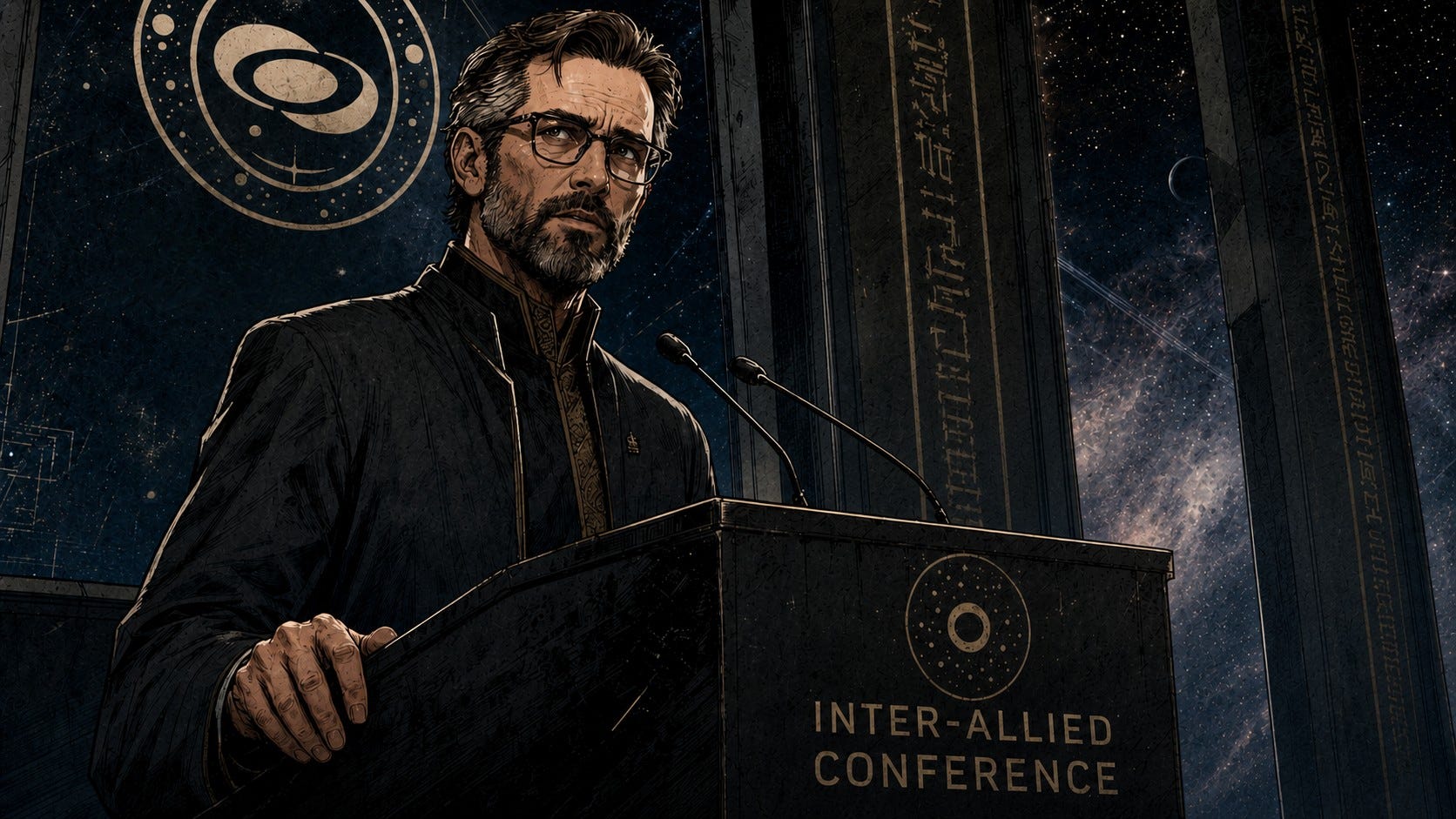
“The Ciphers are chaos,” he said in one notable passage, “an underlying principle of the universe that we cannot understand, but which it would be fatal to underestimate. When we see them clearly—as clearly as they allow us to see them—we cannot but regard them with awe, in its most traditional sense: reverence, and existential dread. To contend with them is to contend with gods; to survive, it may be necessary for us to become godlike ourselves.”
Perhaps this framing played a part in prompting the first tentative discussions of an unprecedented step in human-virgonid history. In the backrooms of the conference, the Terran Prime Minister, the Free Worlds’ President, the speaker of the Greater Hive, and the chair of the Citizens’ High Council—along with several high-level cabinet and staff members from each government—met to discuss the possibility of a federal union between the Allied powers.
The logic of such a decision was clearer than ever in the aftermath of the war. As Niven was just then pointing out in the bluntest of terms, the “why” of the Ciphers did not matter. It was useless to wonder why they had attacked, why they had not fought to the death; there was no way to guarantee that in the next war, they would not give their all. And if they did, as things now stood, the Allies would not stand a chance.
That was to say nothing of the possibility of other as-yet undiscovered alien threats lurking in deep space, if the theory about the Ciphers being distracted elsewhere had any merit. The best chance for humanity and the virgonids to survive was to unite: to pool all their considerable resources to an unprecedented degree; to structure this union so that those resources could be fully mobilized as rapidly as possible in the event of war; and to ensure that all would operate with one purpose.
Such a path was not without its own perils, not least of which would be popular resistance from both ends of the political spectrum. While all the leaders were agreed on the intent, the details would have to be worked out—and might prove insurmountable, given the variance between the parties. In the meantime, recovery from the war remained the priority for the Allies, and for some, following through on promises made in the desperation of the moment.
In 2381, the UCC held its promised constitutional convention, accepting input from all across the Council worlds. Tara Okuda, then rotating chair of the High Council, was hoping to avoid holding a referendum on the question of a pacifist amendment; she knew how devastating such an amendment would be to the prospects of the federal union so recently discussed at Virgon. Wheeling and dealing as best she could, she tried to get the convention to adopt a watered-down version of the amendment, something that would allow rearmament in the most exigent of circumstances.
But the political pressure proved too great. Faced with either adopting the amendment or resigning, she chose to hold the referendum, wording the question in such a way that, she hoped against hope, it might fail to garner the necessary support. Thanks perhaps to this wheedling, the vote was much closer than many had originally anticipated. Indeed, had Zevka been able to participate, the measure might well have failed.
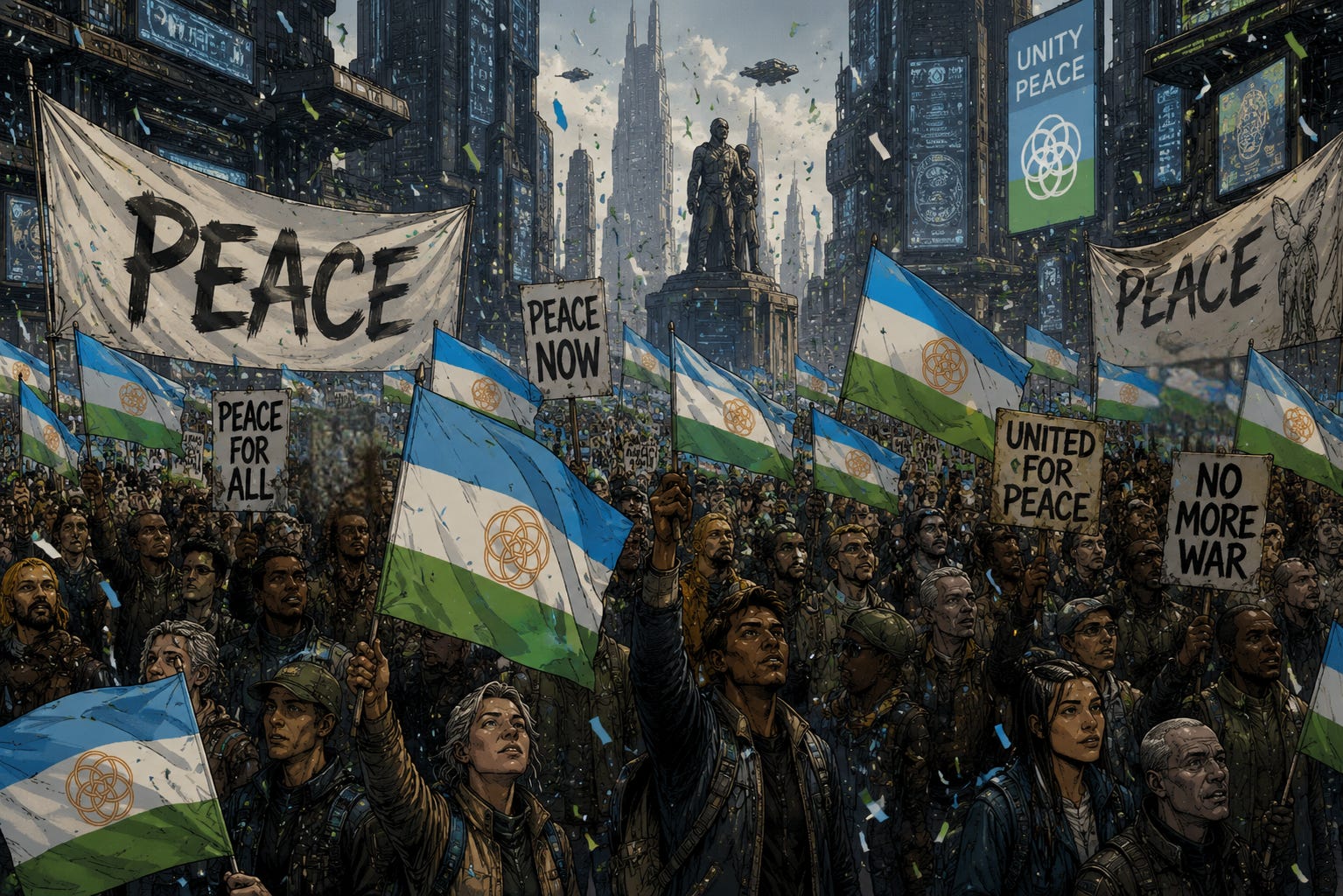
As it was, the “yes” votes had it, 55 to 45. The convention was left with little choice but to do what the rest of them had wanted to do from the start. Okuda was forced to assent. The adopted amendment stated unequivocally that all military action, even defensive in nature, was thenceforth illegal; that all armed forces were to be disbanded and abolished within one year of the passing of the amendment; and even that law enforcement was prohibited from using lethal weapons under any circumstances, though this last in large part merely codified what was already standard practice throughout the UCC.
But that was what observers had expected. The amendment as written went even further. Citizens were barred from joining the militaries of any foreign powers, even those within the Alliance, under harsh legal penalties including revocation of Citizenship. The manufacture of lethal weapons of any kind was totally prohibited, whether for domestic use or for export, with carveouts only for specific lists of tools that might also have a dual use, such as various blades, and surgical and mining lasers.
The leadership of the TIU and the VGH were concerned by the amendment, since it went beyond what Okuda had warned them to prepare for at the secret summit. But the FWR was livid. Congress immediately passed a non-binding resolution stating that Allied federalism was a dead letter if it included the UCC in even an associate capacity. President Wright gave his assent to this resolution—though he withheld it from a further measure demanding the UCC voluntarily withdraw from the Alliance.
Binding or not, the effect of these twin acts of the Free Worlder and Citizen legislatures was the same: all talk of federalizing was derailed, perhaps permanently.
The severity of the Republic’s reaction may have been due in part to their own separate concerns. The worlds in the Interim Kyran Occupation Zone, designated IKO-Alpha through Delta, had grown from a thorn to an ulcer in the Republic’s side. When the Kyrans had been driven out in 2360, military planners had hoped that within five to ten years, it would have become possible for the FWR to set up stable, democratic local governments on each world, constituent of former slaves now schooled in modern governance and assisted by Republic AIs. Then the FWN could simply leave token forces in each system to deter or defeat Kyran invasions, an inexpensive buffer zone between the Republic and the clans.
But twenty years on, stability remained elusive, even though there was not a single living Kyran left on any of the planets. All the warriors had long since been killed, while the worker species’ had stopped breeding—in some cases, stopped eating and drinking—once the occupation began. Speculation was that the worker castes were either selectively bred or genetically engineered to passively extinguish themselves in the event of capture or conquest. In any case, all of these had either died of starvation or natural causes, with their short lifespans and failure to procreate reducing the population to zero within a decade.
In theory, this should have solved the problem. Only former slaves now remained, and these should have been grateful for liberation and eager to start their own communities. And many had been, at least at first. But some had always resisted Republic occupation, even violently. Some of these remained loyal to their former overlords, for whatever reason; others simply distrusted the Free Worlders, seeing them as yet more alien masters to be fought.
Ironically, the problem had only deepened with the death of the last Kyran. The FWGF were now fighting full-blown insurgencies on IKO-Alpha and Gamma, while slightly less violent political and social chaos reigned on the other two worlds. At least three different species were represented on each planet, each of them with radically different cultures, religions, and languages. All attempts to force these species to work together had failed, as had all attempts to sort them into more homogeneous communities. Constant intervention was required to keep civil war from erupting, to say nothing of fighting off frequent Kyran raids.
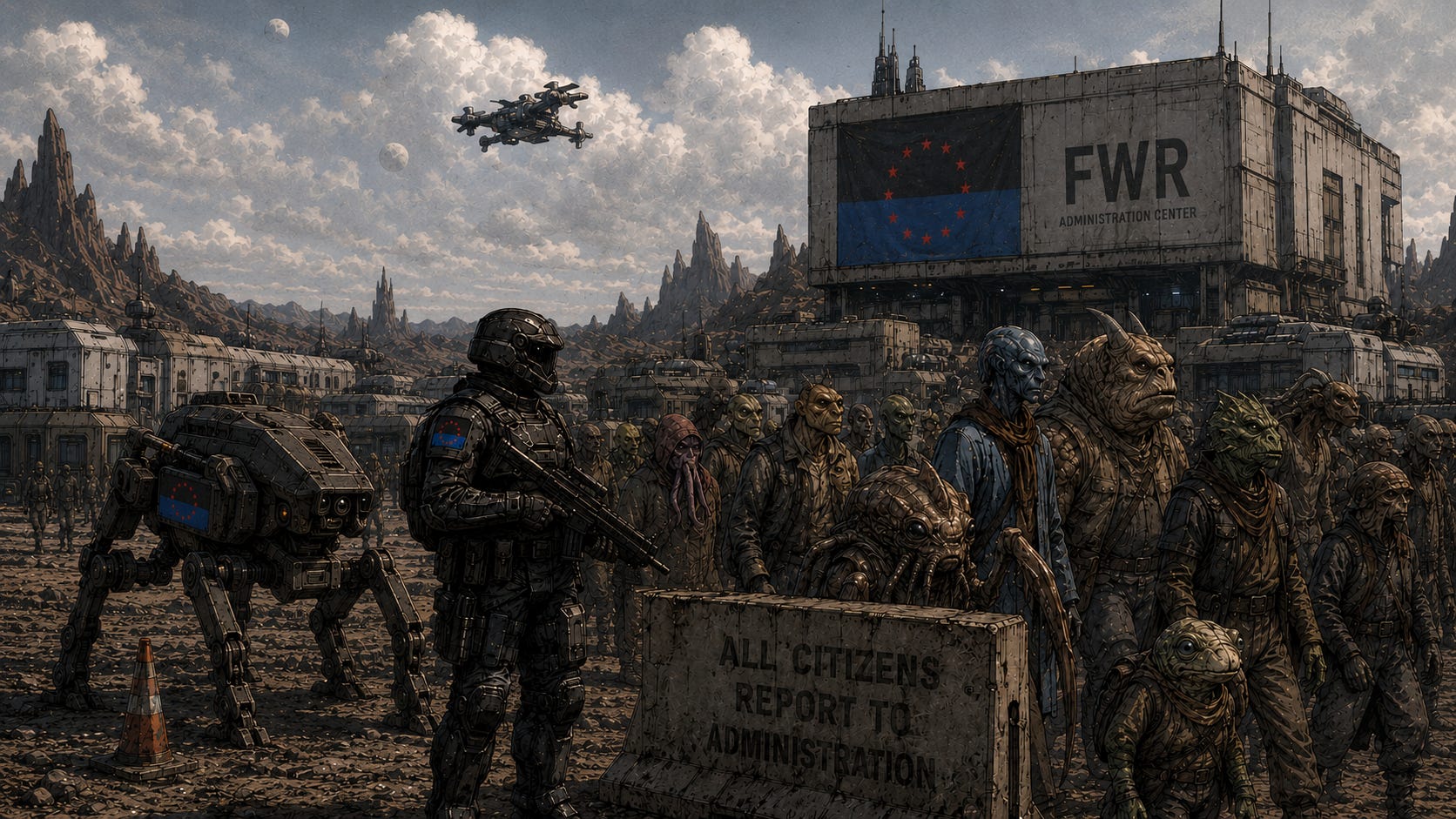
By the early 2380’s, a cross-partisan faction in Congress was demanding that the Republic cut its losses and withdraw from the IKO immediately. The left cited “humanitarian” concerns, given the suffering of the downtrodden, and the constant violence inflicted by the FWGF in their COIN campaigns; the right cited practical concerns, the drain of resources that could be spent combatting the Kyrans directly, or confronting the Ciphers to deter or win the next war.
But President Wright, elected in 2380 for a five year term, had no intention of bowing to the pressure. This intransigence was based in part on advice from his military chiefs on the potential consequences of withdrawal; and in part, because it might be seen as caving to UCC pressure, given the constant calls from that quarter to end the occupation. Instead, Wright vowed to continue the campaigns until stability could be achieved, by whatever means necessary.
Outside the FWR, and despite the end of the war—or because of how it ended—the renewal of the Cipher threat remained front of mind throughout the 2380’s. Long range observation of known Cipher worlds continued, while the search for another Machine World was expanded. As Allied recon pushed further out, more and more potential technosignatures were detected around distant stars. But these had to be approached cautiously, lest the Sukat Incident should be repeated. If even outer system reconnaissance were detected in a Cipher held system, it might be seen as a breach of the armistice.
Further, the possibility could not be discounted that many more civilizations like Byas and Embra—which would produce few if any technosignatures detectable from more than a light years’ distance—might be out there under Cipher dominion. The Allies might stumble upon these, or another Sukat, at any time. This had a chilling effect on even authorized civilian exploration and colonization beyond already mapped systems. Human expansion once again slowed to a crawl, resulting in the period between 2321 and 2374 being referred to as the “Second Scramble.”
Moving drones to within a few light months of the closer technosignature systems (those within one to two thousand light years of existing Allied borders) showed many of these to be false positives. Others hosted technological civilizations, which might or might not be under Cipher control. Closer observation would be required to confirm the findings, but this was not authorized.
Finding a Machine World was much harder. Several candidates were ID’d within the assigned range; all were put under long distance observation. This task was now simplified considerably by the advent of QEC. Past missions surveilling Byas, Ranak, and Embra had required regular check-ins to relay their findings, with drone couriers being launched or arriving at regular intervals. But now, the recon sats simply sat in space, dark, watching. Only if they detected irrefutable Cipher activity would they send the data back to base in a QEC burst.
This new protocol radically decreased the likelihood of discovery, thanks to far lower power usage, and no comings and goings at Stardrive to release radiation bursts. Given that the signals could now travel infinitely faster than even a Cipher ship, that should give the Allies plenty of warning if any of these candidates proved to be a Machine World, or if activity increased in the known Cipher systems. Conversely, if an attack began elsewhere, these same drones could be instantly ordered to jump into the candidate systems and send back data in real time. If any should prove to be a Machine World, this would immediately become a target for any Allied counteroffensive.
Nor did QEC only find a use in this narrow, but crucial case. Over the course of the 2380’s, the technology disseminated throughout the Alliance, first in military circles, where it became standard in HQs and command ships, creating links between field forces and home bases. Given the limitations of the early technology, those HQs and fleet flagships were refitted to include comms rooms, with multiple paired QEC units collating data from across the AO in question.
But QEC also found increasing civilian usage, beyond the direct links between the Allied governments and the AJC. Colonial governments now had direct lines to the metropole; interstellar corporations and organizations had connections with satellite operations in distant start systems. Even this relatively low-information communication across hundreds of light years proved revolutionary; direct comms between governments helped prevent another Tannhauser or WZ Sagittae from spiralling out of control. Inter-Allied military and economic cooperation increased dramatically.
Theorists compared the nascent QEC to the early telegraph on Earth in the 19th century. They postulated that if QEC matured along similar lines, the equivalent of interstellar radio, television, and even the Internet would one day become possible. Just as those technologies had advanced cultural and economic interchange on Earth—leading eventually to a federal union that survives to the present day—so might similar advances enable interstellar humanity to unite in the same way.
Armed with this new technology and its prospects, the Terran and virgonid governments launched a long-term plan to drum up support for federalization in both the FWR and the UCC. The virgonids led the charge, owing both to their fervent commitment to the idea, and their enduring popularity among nearly all segments of fractious humanity.
Over the mid-2380’s, this virgonid campaign saw significant success in the UCC, working with a homegrown federalist movement on Unity Prime, Ngayo, and Revolution. Citizen federalists supported a union without rejecting pacifism; indeed, they supported it because of their pacifist ideals. They recognized that efforts to influence the Terrans and Free Worlders toward peace from outside, even from within the Alliance, had singularly failed. That being the case, the best chance of promoting peace in the galaxy would be a union with these powers, from which more concrete internal pressure could be exerted, along with more subtle cultural influence.
The Republic, however, proved harder to shift. Congressional and public opinion remained strongly against any union with the UCC. But over time, even this staunch opposition began to erode, in light of a number of facts. The ulcer of the IKO and the vast populations of the Kyran dominions—estimated to be between one and two hundred billion—showed that this problem was likely to be an intractable one. If left to their own devices, it would be vastly harder for the Republic to deal with the Kyrans and the Ciphers. Increased cooperation with the Allies would be required to meet these threats, and the FWR had been pushing for a fully integrated military since late in the war, which could only come with some sort of federal union.
The final push was provided by the Terrans. During private conversations with the newly elected President Park in 2390, Prime Minister Roth effectively threatened that if the Republic was not on board, a union would go ahead without them. At the same time, he promised that he would sign no federal constitution that prevented the Republic from defending itself against the Kyrans as they saw fit, leaving the UCC with no prospect of inserting such an amendment. That meant that if the negotiations failed, it would be the fault of the UCC, not the FWR; in that case, the Citizens could be the ones to withdraw and leave themselves in the cold if they so chose.
Promise and threat in hand, the new Park administration agreed to begin negotiations in December, 2390, at the secret, joint Allied antimatter mine being constructed at V616 Monocerotis. The system was the most distant Allied outpost by a fair margin, being around 4500 light years from Earth. The facilities there, including both a mine and a small, largely automated shipyard, were being constructed in secret, to serve as a source of reinforcement and fuel secure from enemy attack.
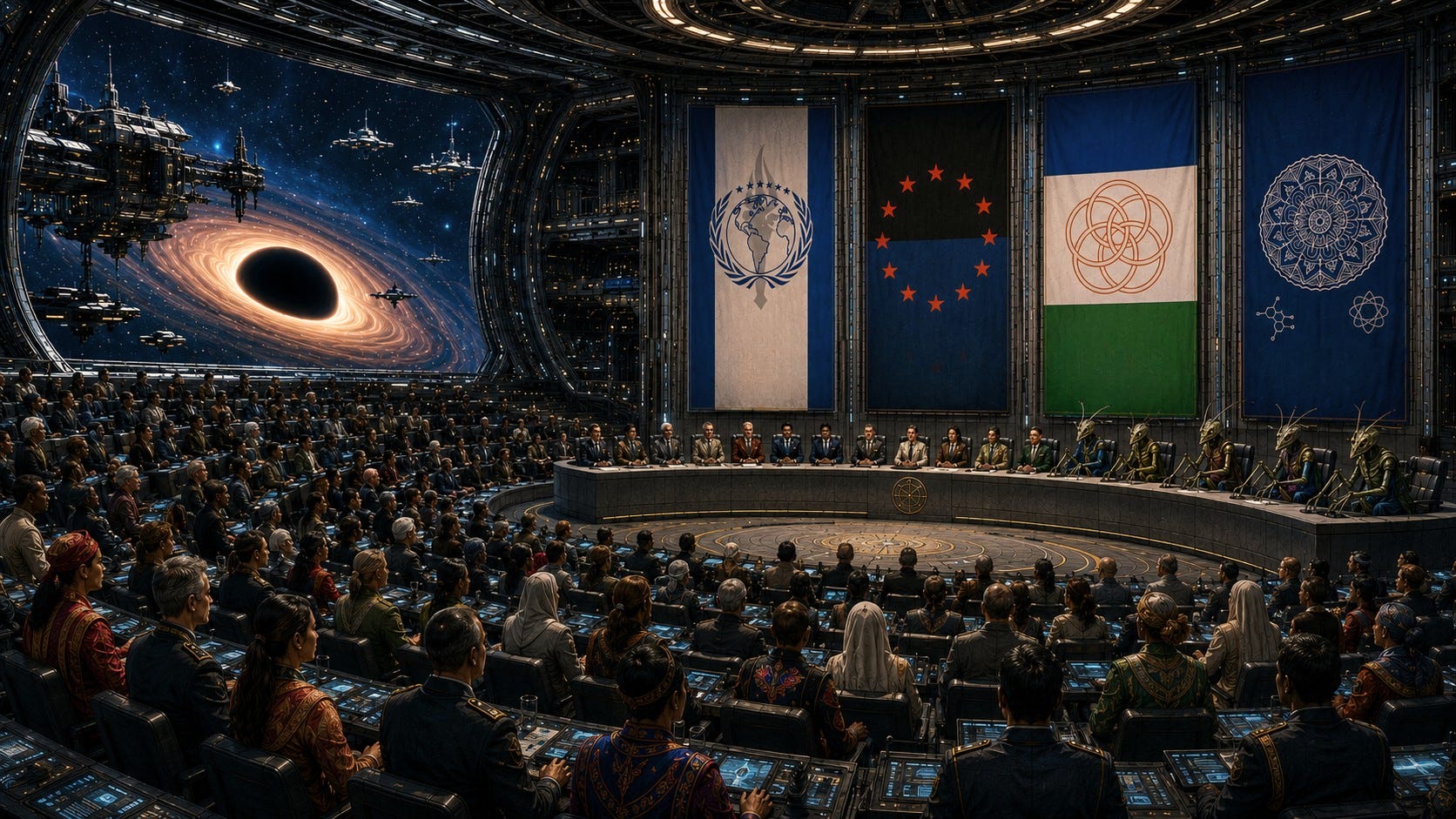
Prime Minister Roth, the virgonid speaker, the new rotating UCC chair, and President Park were all in attendance for the start of the negotiations. Hopes were high as the delegates arrived, with smiles all around in publicity holos. Yet within days, most of the smiles had disappeared. No-one had harbored any illusions that a final agreement would be easy to come by; but it had been hoped that a preliminary memorandum of understanding could be agreed upon by all parties within a few days. This would serve as an announcement to the galaxy of the powers’ intentions to work toward federalization.
A week after the first meeting, this still had not been achieved. The heads of state went home, and left their negotiating teams to continue wrangling. In the end, it took months just to agree on the MOU, with wording that pleased both the FWR and the UCC, and without committing either to cross any of their red lines. If the final document was underwhelming and uninspiring, it at least served to avoid getting the hopes or hackles of the Allied populations up. That was important, given the long road that clearly lay ahead.
In addition to constant, low level QEC-enabled talks to discuss details and areas of contention, the participants agreed to hold annual summits at Monocerotis until a deal was reached, or until enough of them walked away to make a union untenable. The next summit began in December, 2391. It lasted another four months, and achieved even less than the first. Every bit of ground gained pushed back one or the other parties from the finish line. Promises made in bilateral talks proved impossible to enforce once all parties were in the room together.
The melakeen, xiran, and uthal were invited to attend in 2392/3, in the vain hope that including more alien participants would bring the human parties closer together. Instead, this only further complicated issues, and the third summit also ended with little success. At the end of the fourth summit, both the melakeen and xiran agreed in principle to become associate members of any future union, participating in military and economic cooperation and sending delegates to any political body. Essentially, they would be permanent military allies with favored economic and trade status. But the uthal declined to participate any further, citing cultural and personality clashes with the human powers.
And still, the humans could not come to an agreement. Leaving aside myriad minor points of contention and diplomacy, the major issues preventing the formation of a union were, predictably, between the Republic and the Councils. The UCC refused to consider revoking or altering its pacifist constitutional amendment, rejecting a Terran proposal that would see them alter the amendment to allow for re-armament “in the event of a genocidal or extinction-level threat.”
Further, the UCC delegation continually pushed for a greater degree of union state control over the domestic affairs of member states, particularly in regards to social justice and welfare programs, and law enforcement. Finally, they demanded that, if a union state were to be formed, it would be forbidden by law from participating in the occupation of Kyran worlds, or in any future wars against the Kyrans.
Conversely, the FWR wanted union state assistance in ending the Kyran threat permanently, so that the Ciphers could be focused upon. They charged that UCC non-participation in the military meant they would enjoy the protection of the union without bearing any of the cost. Further, they wholly rejected any potential union state interference in domestic affairs, even for seemingly compassionate purposes.
It took until the 2397/8 summit before a compromise could be formulated which was, at least in principle, acceptable to both parties. The UCC would keep the deal it had with the Alliance; not participating in military affairs or industry, but picking up more of the non-lethal/non-military slack. While its members could of course vote their consciences in a federal parliament, the UCC would not have veto power over the use of force by the federal military.
The union state would also have only a limited influence in members’ domestic affairs. These would include areas such as defense, foreign affairs, and interstate trade & monetary policy, as well as jointly-agreed guarantees of basic rights such as freedom of speech and conscience, and the right to trial. An impartial Interstellar Compact High Court (ICHC) would be set up to adjudicate constitutional issues related to these questions.
In return for these concessions, the FWR would agree to end the occupations in the IKO within one year of union accession, and to forswear any unilateral military action against the Kyrans or any other threat, without the sanction of the federal government. With assent to these terms in hand, a deal seemed likely to be signed at the following year’s summit.
However, a seemingly minor issue prevented that diplomatic triumph from manifesting. The FWR, along with the TDF, insisted that any citizen of the future federal state should be permitted to join the federal military if they passed the entrance requirements. The UCC insisted that none of their citizens were legally capable of joining any military force, federal or otherwise. The 2398/9 summit ended without a deal over this sticking point, with such bitter recriminations that there were fears the entire deal had been scuttled, wasting almost a decade of negotiations.
But talks went on through unofficial channels in the months leading up to the tenth Monocerotis Summit. The result was that the parties came to an unexpected but welcome compromise early in the negotiations: United Citizens would be permitted to join the federal military—but in so doing, they would be stripped of their citizenship and unable to return to the UCC for the duration of their military service. Even afterward, they could only go home if they renounced the use of violence and pledged loyalty to the ideals of the UCC constitution, and served a term in a correctional education institution.
Few were happy with the arrangement, but it saved enough face that the final constitution could at long last be drafted, with a signing ceremony scheduled for the end of the calendar year. Thus in December, 2400, the first Interstellar Constitution was signed, with the union slated to come into effect one Terran Standard year later. Illustrative of at least three of the member states’ priorities, the Interstellar Compact Navy was chartered that same month, so that the process of military integration could begin immediately.
Elections were held for the new Interstellar Parliament and Interstellar Executive throughout 2401. These lasted months, while the work of completing the setup of the new interstellar bureaucracy continued. The Interstellar Compact finally came into being on December 10, 2401, on the date the Interstellar Parliament sat for the first time and heard an inaugural speech from the first Executor, Indira Magnúsdóttir of the TIU. Thus, at a stroke (and after a decade of wrangling), humanity was united under a single banner once again—indeed, as never before.
Now spread across thousands of light years, with a population nearing one hundred billion, humanity had become a truly interstellar species. One could have looked back 400 years from the Compact’s inaugural address to the early 21st century, the era that birthed our interstellar age, and marvel at how far we had come—and what we had surmounted to get there. Not only our internal divisions, which had reached their apocalyptic climax during the horrors of the Third World War, but first contact with alien species, both peaceful and violent; wars with savage aliens and ruthless, inscrutable machines; technological leaps of which our ancestors could only dream.
Looking forward to the next century, our future would have seemed bright, despite the challenges and divisions that yet remained. After all, it is in facing challenges that the human spirit thrives. Indeed, a new era of peace was about to dawn, a welcome change from the years of war and fear that preceded the foundation of the Compact.
Only a few observers, those with more jaundiced eyes, might have feared what would come next. Despite the devastations of Rāma and Zevka, and the horrors of those who experienced Kyran raids and occupations, from a purely rational perspective the wars of the 23rd and 24th centuries had been relatively bloodless by the standards of human history. Excepting the two planetary massacres, most casualties had been military—and even including those two holocausts, and estimated Kyran losses, the death toll of every war, major or minor, fought by humans between 2062 and 2401 amounted to less than half the death toll of the Third World War alone.
From that perspective, if from none other, humanity had spent the last four centuries getting off easily. After the coming age of peace, that was to change. Before the 25th century was out, the greatest and bloodiest conflict in history would be fought, proving once and for all the dark wisdom in Rance Wolfe’s famous phrase: if you want the stars, prepare for war…
No posts
Comments
Nothing yet. Say the first thing.
Sign in to join the conversation.