
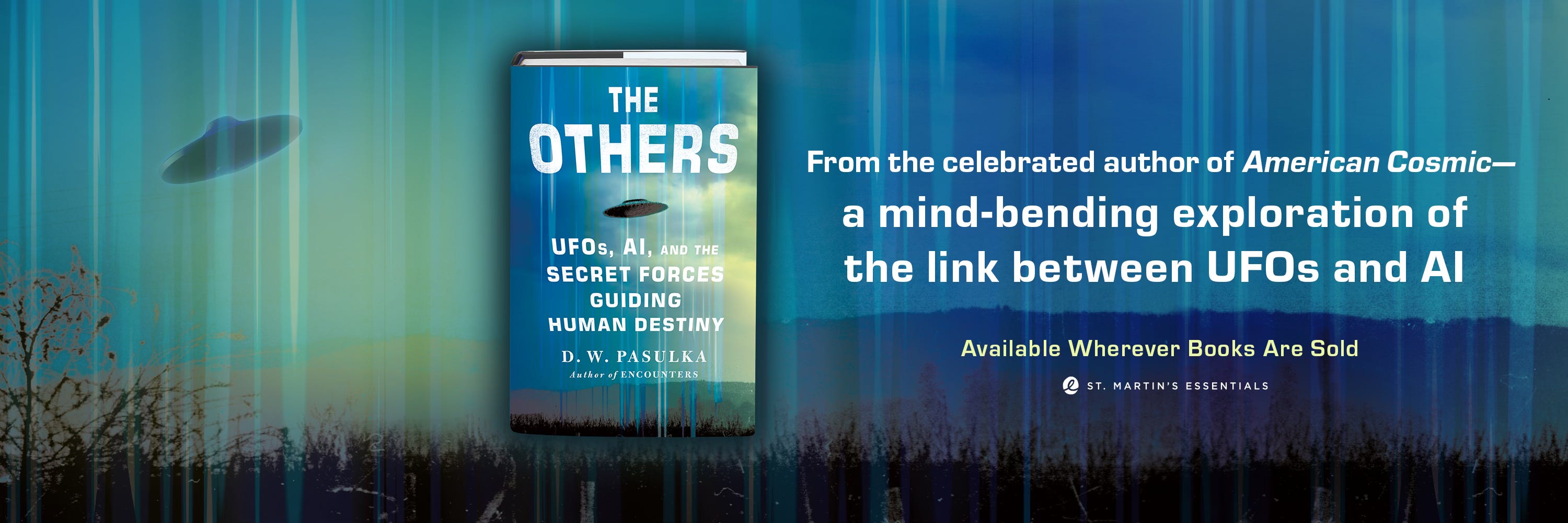
The Others is out. I’m in Austin to talk about it. I was recently on Coast to Coast with George Knapp to discuss the book, and he noted, “The Others is dark, very dark with some hope splashed in there too.” Well, okay, that's true. But the hope is real, my friends.
Rod Dreher, who writes about Christianity and has read my other work, did a short write up of my book. I love it. He was able to take my writing and make it more accessible. I didn’t know I needed someone to do that until I read his review. In any case, I post part of below, but if you want to read the whole of it, it is at Rod’s Substack.
“Today is the publication date of The Others: UFOs, AI, and the Secret Forces Guiding Human Destiny, the new book by Diana Pasulka, who is best known for her last two books about the UAP phenomenon. This one is different. To me, it’s her best one, but Pasulka fans who turn to it expecting more woo stories are going to be disappointed. In this one, she tells us what she thinks it all means. And boy, is this something else.
I’ve read the book twice, and read around it a third time, and I get more out of each reading. In the book, Pasulka, a Catholic professor of religious studies, brings together thinkers like Marshall McLuhan, Rene Girard, Pierre Teilhard de Chardin, and even, most notably, the science fiction writer Arthur C. Clarke. To sum it up, Pasulka posits that we are quite possibly in the Age of Antichrist, in that global electronic media are taking away the thing that makes us most fully human: our ability to perceive God, and things of the spirit. This technology both unites us, and effaces our humanity by taking our attention captive. I was telling a friend about the book last night, and said this paragraph gets to the heart of her argument:
If I were to identify a possible Antichrist, I would look for something with the capacity not only to erase the knowledge of the spiritual sense and the interior life, but also to physically diminish — or even reconfigure — the human faculty that makes such awareness possible. In the classical Christian tradition, this faculty is not an abstract metaphor, but is understood to reside within the human body. Thomas Aquinas, in his search for a “sense” by which human beings apprehend the sacred, treats this capacity as real. To sever or distort this integration would not simply impair religious imagination; it would obstruct the very mode of human perception through which divine reality is encountered.
At one point, she talks about how young people who have been raised on heavy screen use have measurable changes in their brain matter, with the part of the brain associated with perceiving spiritual realities becoming deformed. One way to think of this is that our technology is forming us in such a way that we find it far more difficult to perceive God, or even a human self.
What does this have to do with UAP and NHI (non-human intelligence)? The most interesting part of this always-interesting book is Pasulka’s long discussion of the novelist Arthur C. Clarke. Pasulka points out that in Clarke’s best known novel, 2001: A Space Odyssey, both artificial and alien intelligence converge at a crucial moment in human evolution. She calls his 1953 book Childhood’s End is perhaps a prophetic anticipation of our current moment. It is a novel not about humanity’s end coming through tyranny imposed from the outside, but rather “the inward colonization of spiritual intuition.”
Thanks for reading everyone, and more to come this week!
Comments
Nothing yet. Say the first thing.
Sign in to join the conversation.