
The title of this essay is provocative, not because I know better than anyone else about what is going on in the Persian Gulf, but because I wanted to provoke! It amounts to counterpoint to the chorus of doom in the online commentariat.
That is as political I am going to get in this essay. I am going to focus more on the seamlessness of the operation. Didja notice, for example, that the Arab Gulf States have not complained? They have not complained despite the fact that Iran has lobbed missiles at their cities and oil infrastructure, all in an effort (surely) to compel them to complain.
That suggests that the Gulf States have understood what they were getting into. They had some understanding of what might yet unfold, and they did not make a public effort to block the air campaign over Iran. They may even approve of it. They may even be privately cheering it on giddily. And no one leaked the plan.
That’s amazing. The Gulf States have taken blows but have yet fallen into line. They’re with the program. And no one has noticed?
What else have we not noticed? Over the course of a few days, the Israeli and American forces have first eluded and then neutralized Iran’s vaunted air defenses. Those would be air defenses of Russian and Chinese design and manufacture. So much for Russian and Chinese engineering prowess.
In following days, the Iranians launched their Chinese-made “carrier killer” missiles at the USS Abraham Lincoln. No hits. Just noise. In fact, there was even some question of whether the Iranians had launched any of their carrier-killer missiles at all. So much for making a statement.
It is true that the American carriers operate some distance from Iranian shores, and this gets to long-running debate about the future of naval forces. Does the future make room for aircraft carriers, or will anti-ship technologies render them obsolete in peer-to-peer engagements? I don’t know, but not yet, it seems.
Operations in the Persian Gulf reveal much about the capacity of the United States to project hard power. It remains something that cannot be dialed up at scale on short notice. Iranian protesters flooded the streets by the hundreds-of-thousands (millions?) in January. Over the course of two days, the Iranian authorities gunned down 32-to-50 thousand of them. (The Gaza “genocide” brigades have issued nary a sound. They don’t care.) No surprise, the mass killings put an end to the protests. The USS Abraham Lincoln was already under sail, venturing from Southeast Asia, through the Straits of Malacca, enroute to the Arabian Sea. “Help is on the way,” Trump declared.
But, was it all bluff? Was the blood in the streets of Iranian cities all for nothing?
The most senior Iranian leadership seemed to take it all as bluster, for why else would it concentrate at a single site in Tehran on a Saturday morning? But, the Abraham Lincoln was in place, and Israeli units took to the air. The Spiritual Leader, the Ayatollah Khamenei, and about 40 other senior personnel were pulverized in a single strike.
We are about two weeks into this business, and critics from many quarters glibly complain that the Trump administration has no plan. The administration has articulated no clear objectives! The war will escalate into another Forever War! Oh, and gasoline prices will go up!
War does make for an uncertain business. Unintended consequences, the stuff of Rumsfeld’s “unknown unknowns,” can upset best-laid plans. But, best-laid plans can work. One can anticipate that demands to adapt will emerge as the inconvenient realities of the thing unfold, but a glib response to glib complaints about the lack of objectives would include a Reaganesque declaration that the plan is: “We Win; They Lose!”
The war planners have surely ranked potential outcomes and objectives. Their preferred outcome would surely include (A) the substitution of the theocratic regime in Iran with a polity uninterested in exporting Islamic revolution or in the prospect of nuking the Great Satan (the United States) and the Little Satan (Israel). Short of that, objectives would include (B) taking away Iran’s capacity to fund global and regional jihad by taking away its capacity to commercialize its oil. Then there is the matter of (C) destroying remaining nuclear infrastructure and (D) destroying home-grown nuclear know-how. The latter affair could involve some very rough dealings with nuclear personnel. Finally, there is (E) the matter of rendering Iran’s existing stock of refined uranium unavailable… I would not want to be one of the people who might end up assigned to the job of physically relocating radioactive materials. How does one pull off such an engineering feat in a potentially hostile environment?
The war planners have also had to factor in likely Iranian responses. You know, like, “Closing the Strait of Hormuz!” Many observers complain that the administration had no plan for the prospect of the Iranians “closing” the Strait … notwithstanding the fact that people have puzzled over such a gambit since at least 1948: What would we do were some party to endeavor to close the Strait? One can imagine a James Bond Goldfinger gambit: a cabal of Texas oilmen organize the sinking of some number of tankers in the Strait or the mining of the Strait. Global prices shoot up!
I confess that, at this stage, I have no idea what securing the Strait would entail. Would naval escorts merely make themselves vulnerable to attack by aerial drones, seaborne drones, or missiles? At the same time, however, I puzzle over how disruptive an effort to close the Strait would be. The Saudis have operationalized a pipeline that runs from the Gulf to the Red Sea, and Oman has operationalized a pipeline that runs from the Gulf to the Arabian Sea (just beyond the Strait). Ramping up volume through these channels must surely amount to resorting to next-best least-cost transportation options, but a bigger question in my mind revolves around whether these channels are constrained to the point that they really can’t make up for the entire volume of oil that would otherwise flow through the Strait. These channels might make up for much of the volume, but would closing the Strait still yet constrain global supply of oil?
Then there is the non-trivial question of maritime insurance. Even if naval vessels could be made available for escort service, would insurers still yet decline to insure commercial vessels going through the Strait?
Last, and most importantly, there is the question of Iran’s incentive to “close” the Strait. One can imagine that the regime right now maintains much interest in seeing its own oil go through the Strait. But, were the Americans to disable Iran’s capacity to deliver oil by, say, seizing Iran’s principal export terminal on Kharg Island on the north side of the Persian Gulf, then Iran may be disposed to make it best effort to shut down all traffic through the Strait.
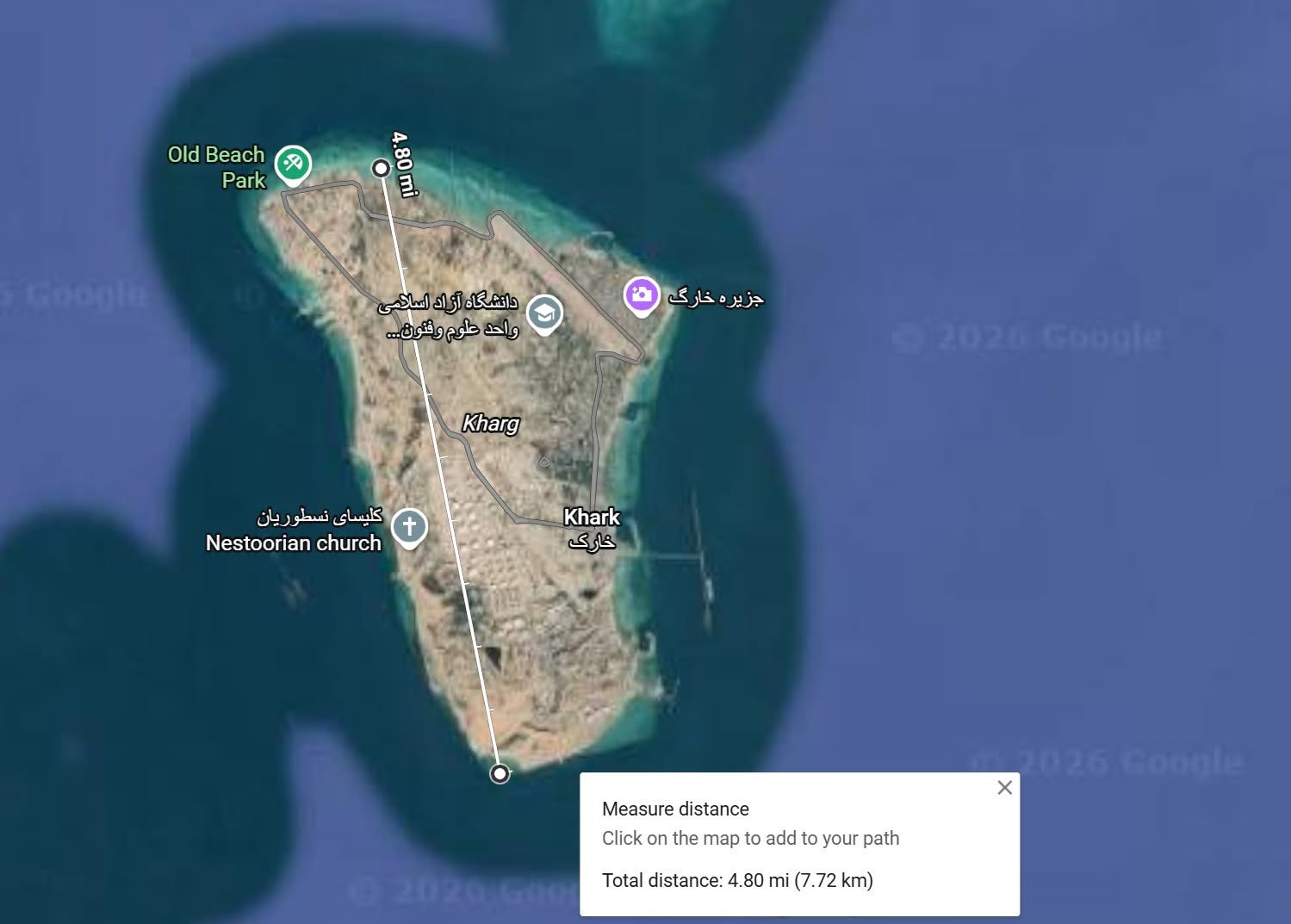
The Administration knows this. Hence its talk about seizing Kharg Island. Which amounts to talk about not seizing it. Which is all part of a larger campaign to “flip” regime insiders and to thereby get them to commit to a Venezuelization of Iran: Go along with a robust de-Islamization and de-nuclearization of the regime, and you get to keep your heads, your jobs, and your villas.
This is all very Trumpy, and I heartily approve. His public pronouncements are always about cutting deals. Trump declares this or that, but this or that are really bargaining points framed as either offers or threats. But, he never definitively commits to a given offer or threat. Everything is conditional on how the other side responds.
Observers opportunistically misinterpret this. “Trump Always Chickens Out!” (“TACO!”) But, really, it is Trump bargaining with the other side. It works.
* * *
The campaign in the Gulf has been going on for about two weeks. It turned out that help really was on the way, but even the United States requires massive capacity and a lot of time to assemble that capacity to launch an effective campaign.
The campaign has been spectacular much as the operation last June during which the Israelis and Americans incapacitated the Iranian nuclear program. It is spectacular much like the four-hour Forever War in Venezuela to nab Venezuelan dictator Nicolas Maduro and to incapacitate the Venezuelan regime. It is also spectacular much as the 1991 campaign over Kuwait.
Do you remember that campaign? The Iraqi army had dug-in and robustly fortified itself in Kuwait. The United States assembled an army of a quarter-million soldiers in the desert of Saudi Arabia. Other countries nominally contributed forces, although Britain sent over a potent force.
It took months to assemble all those people and hardware, but the campaign to run the Iraqis out of Kuwait started in earnest in January 1991 with a bombing campaign. It went on for about five weeks. It seemed to go on and on. The news was dominated with video of planes at high altitude releasing their bombs. But, were they hitting their targets? Was the bombing effective?
Then the First Infantry Division of the US Army, “Big Red One,” swept into the desert west of Kuwait and flanked the Iraqi positions. The ground war was on, an anxious business. We soon learned, however, that the rout was on!
It all looked so easy, but I remember being puzzled about the deployment of forces. It looked so static, stationary, anachronistic, and, every day CNN would bring on a “consultant” who would exclaim that fighting with Iraq would degenerate into a stalemate. “Quagmire” and “Like Vietnam” were operative phrases. But, how could desert fighting degenerate into a “quagmire” like that of “Vietnam,” I wondered.
Of course, it did not, and we learned a few things about the new battlefield. First, once the ground war started, the military treated us with video of its bomb strikes, not merely video of planes dropping bombs from high altitude. We were bedazzled with the “smart bombs.” Video of bombs dropping into the air vents of concrete bunkers made it all look like a harmless video game. All that technology we’d been overpaying for for decades actually worked. What a relief.
A less obvious, but no less important innovation, was GPS. Without GPS, the Big Red One would not have been able to navigate swiftly through the featureless desert and complete its missions. But, it did sweep through the desert and catch Iraqi armored units by surprise. Again and again. The rout was on.
Since then, technologies have improved, and we could then see the militaries of the world engaged in a new race to either outpace each others’ capabilities or to avoid being too sorely outpaced. The United States had raised the ante.
For its part, the United States subsequently put more energy into developing its military communications. (I have some insight into this by virtue of working on some antitrust investigations that looked into just such matters.) Different services and different units might have been operating off of different radio platforms. These platforms might operate on different frequencies and could not talk to each other. The capacity to talk to each other could facilitate coordination on the battlefield and could, in turn, help avoid “friendly fire” incidents such as an infamous encounter in Kuwait in which an American helicopter unit mistook a British armored personnel unit for an Iraqi unit. It made for a bad business.
The race was on to move from hardware-based communication platforms to software-based platforms that, being software-based, could be easily upgraded or tuned to different frequencies. These software-based platforms would also support hardware units that could talk to each other anywhere on the battlefield. Each unit would operate like a moving cell-phone tower, and you’d end up with a dynamic, moving network connecting units on the ground with units in the sky.
In the race the keep up with each other, all militaries endeavor to do this kind of thing. The networked battlefield may have been a big aspiration in, say, 1998. It is now closer to standard practice.
* * *
The campaign over Iran has been going on for two weeks. The crowd complaining about Forever Wars has re-engaged. For its part, the Washington Post virtually eulogized the Ayatollah Khamenei:
With his bushy white beard and easy smile, Ayatollah Khamenei cut a more avuncular figure in public than his perpetually scowling but much more revered mentor [the Ayatollah Khomeini], and he was known to be fond of Persian poetry and classic Western novels, especially Victor Hugo’s “Les Misérables.”
The piece in the Post spent more time passive-aggressively criticizing Trump than criticizing a murderous regime. Meanwhile, professional Israel critic John Mearsheimer dismisses the action as “wonderful news for Vladimir Putin.”
We’re not winning against Iran. We’re not winning.
What message are we sending? We’re sending a message that we’re a bunch of fools — that we started a war we can’t win.
The Financial Times had a big editorial today. The Financial Times is usually very sympathetic to the United States and the various cockamamie schemes that we come up with. The Financial Times usually supports us.
They’re saying we had no objective, no clear objective. We didn’t have the required military forces to achieve any of the objectives that we were floating, and we had no plan.
That’s what they say. And of course, they’re correct.
So the question you want to ask yourself is: What does this tell the Chinese, and what does it tell the Russians?
It tells them that we are incompetent.
I am not well situated to judge these things, but I’d be willing to bet that there are people situated to know better who would be inclined to understand that United States and Israel have demonstrated competence far beyond what critics could have imagined. Throw in some observations about the much-hyped but ultimately useless Russian and Chinese anti-aircraft and anti-ship hardware. That said, destroying the capacity of the Iranian regime to project power may be the easier project. Setting the stage for a popular uprising may make for a trickier affair, and actually expecting an uprising to succeed may make for an unlikely fairytale ending. Encouraging some regime elements to relent might be more realistic, in which case a Venezuela-like scenario may play out. Will the coming weeks or month or two prove pivotal?
These two young Persian ladies who are doing the Trump dance hope so:

No posts
Comments
Nothing yet. Say the first thing.
Sign in to join the conversation.