
Hey guys, Dvora here. As you can see from the byline, this newsletter is not my handiwork but that of Claire Billman, a good friend, stats coordinator for ESPN, and senior editor over at College Gym News. She consulted judges, gym nerds, and other members of the gymnastics media not named Dvora to put together an overview of the upcoming women’s gymnastics competition in Paris.
Over at Texas Monthly, I indulged my middle age need to wax nostalgic by writing this Olympic curtain raiser about covering Simone Biles’s career from her first senior meet at the 2013 American Cup. Eleven years ago, I wrote a piece for Deadspin about that competition though my byline has now been replaced with that of Emma Carmichael, a lovely journalist who is working on a book about the history of the WNBA that I’m very much looking forward to reading. (At least my bio is still at the bottom to prove that I wrote it.) Seems like Deadspin’s new overlords are doing a great job. No notes.
I also have a new longform piece up at the Verge about AI judging in gymnastics because this was inevitable. I spent way too much time reporting, researching, and writing it so maybe give it a read? Only if you want to though. I’m not forcing you or anything.
Anyway, here’s Claire’s rundown of the women’s competition thus far and what to expect in team finals. (Plus, a handy guide to select deductions!)
For the overwhelming majority of you who don’t know me, I typically stick to more data driven analysis over at College Gym News, so this type of narrative-based format is challenging for me, to say the least. To say more accurately, Dvora is dragging me, kicking and screaming, outside of my comfort zone here (and I’m damn grateful for the shove).
[Ed. note: Mentoring the next generation. That’s what it’s all about. Claire is a whole three years younger than I am, which makes me her elder.]
I’m writing this based on the assumption that any subscriber of Unorthodox Gymnastics has either a pre-existing love of the sport or a desire for meatier fare than what standard Olympic gym coverage offers. Please don’t disabuse me of that notion if I’m wrong—between the Sports Illustrated article that predicted Bulgaria would win the men’s team bronze despite the fact that it sent only one male competitor to Paris, and whatever this nonsense is from Axios, I need to believe there’s an audience for Olympic content that isn’t written and fact-checked by AI.
Most of you probably didn’t wake up at the crack of dawn on Sunday to watch the women’s qualification sessions livestreamed from Paris like I did, so here are some of the important stories you might’ve missed and that NBC might’ve neglected to tell you in their U.S.-centric primetime broadcast.
First—and most notably—the implosion of Team France. The French women, sporting Dior-designed leotards, entered their home Olympics as a favorite for a team medal based on their historic third place finish at last year’s worlds.
What started as a suboptimal, but not insurmountable, opening rotation on bars quickly deteriorated into a folie aux bleues, counting at least one fall on every apparatus save vault. The team ultimately finished a heartbreaking 11th place (out of 12 teams) with no individual event qualifiers to offer a chance at redemption.
Adding salt to the wound is the stunning performance of former French national team member Kaylia Nemour, now representing Algeria, who posted the second-highest score on any event—on her specialty, the uneven bars, where she is the favorite to win gold—and is in the top six heading into the all-around finals. The French Federation essentially drove away its most talented young gymnast since 2004 Olympic bars champion Emilie Le Pennec out of spite.
After the session, the French Federation’s technical director Kévinn Rabaud revealed the “nightmare situation” that occurred immediately prior to the competition when Marine Boyer entered concussion protocol following a terrifying fall while warming up on bars. Though Boyer was given the green light to compete, the incident clearly affected the team’s focus—particularly that of star Mélanie de Jesus dos Santos, who had been expected to factor into multiple event finals. One of the few bright moments for the French came as the crowd demonstrated its love and support for a visibly distraught de Jesus dos Santos.
On a happier note, Romania was able to sneak into the team final for the first time since the 2012 London Games. In fact, this is the first time since 2012 they even qualified a team to the Games. For those of us old enough to remember the Romanian legacy that gave us skills like the Silivas and Amanar (not to mention Nadia Comaneci and the OG perfect 10), it’s wonderful to see them back on the upswing even if they’re not expected to factor into the podium mix in the team final.
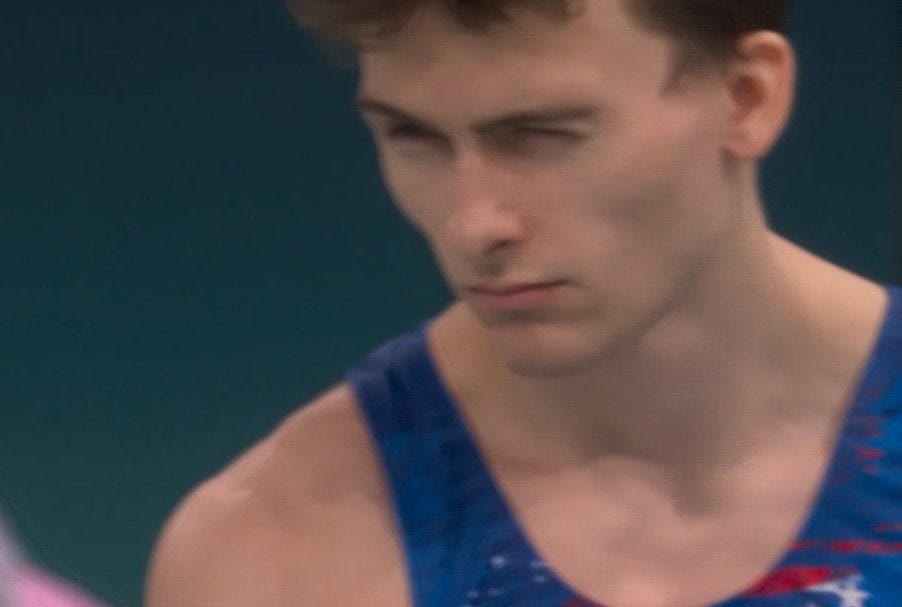
French drama aside, the preliminary rounds played out more or less as anticipated with the usual suspects—save for defending champion Russia which has been banned from most international athletic competition—advancing: Brazil, China, Italy, Great Britain, Japan, Canada, and, of course, the U.S. These eight teams will be competing simultaneously, though you may not know it from watching NBC. At best, you’ll see one routine from each of the medal-contending teams per rotation, and the rest of the broadcast will feature the Americans’ performances and a LOT of interstitial footage of Simone Biles getting her ankles wrapped, putting on grips, and yawning. If we’re lucky, they might accidentally air the odd glimpse of a gymnast competing in the background, though you’ll have to squint harder than Stephen Nedoroscik during a pommel horse routine to see. (In case you missed it, horse specialist Nedoroscik clinched a bronze medal for the U.S. men—their first Olympic team medal since 2008—despite competing without his signature glasses in yesterday’s thrilling team final.)
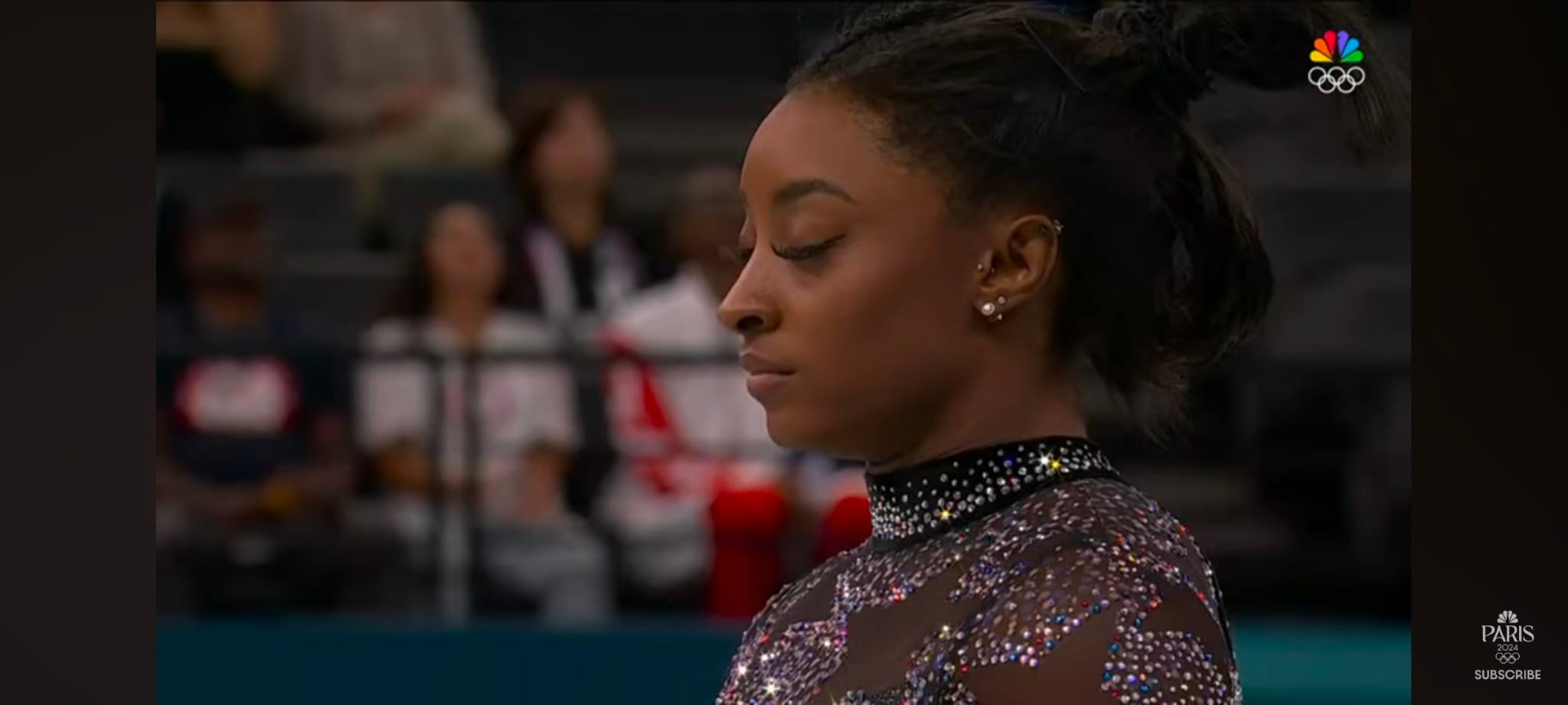
Back to the women. If you didn’t watch the qualification round, it will be hard to tell from the nearly five and half point gap between the U.S. and second-place Italy that the Americans weathered more than a few shaky moments—particularly when Biles looked to be dealing with calf pain during floor warm ups. She then briefly went backstage with USAG’s medical staff. For many, this brought to mind her exit from the arena in Tokyo in 2021, which led to her withdrawal from the team event due to the twisties. Thankfully, it didn’t come to that this time around. Ultimately, Biles was able to finish the competition with minimal fuss and some light trolling.
Jade Carey’s status is a bit murkier. Echoing her balk during the 2021 Olympic vault final, she bailed out of her last floor pass and nearly rolled off the podium in Paris. Though she bounced back with a gritty performance on vault that earned her a spot in the apparatus final, Carey later confirmed that she’s been feeling too unwell to eat over the past few days, which—aside from the obvious concerns about her health—threw a wrench in the team’s lineup strategy for the final where she had been expected to contribute on both vault and floor.
During a press conference last week, USAG technical coordinator Chellsie Memmel made a point of saying that Biles would not be made to compete in all four events during the team final, and that the decision would be “completely up to her.” However, Carey being limited to only vault places decidedly more pressure on Biles to pick up the slack, which is not ideal when nursing a painful calf. 2021 Olympic all-around champion Sunisa Lee will be competing on floor in the team final, which I doubt she expected.
Regardless, the situation is by no means dire: Even a repeat of Sunday’s nervy performance would likely be enough to take the gold. That said, fourth place Brazil left a lot of points on the table, and they’re poised to follow up last year’s historic team silver at Worlds with their first Olympic podium finish. Star Rebeca Andrade (who notably won individual vault gold and all-around silver in Tokyo) is the only gymnast in the competition with a snowball’s chance of challenging Biles in the all-around, though she’ll have to pull out all the stops to do it. (Sounds like that’s her plan).
A team medal would be a pleasant surprise for this relatively young Chinese team. It’s going to be an uphill battle given that they’re finishing on their weakest event, vault. Those piked-down Tsuk and Yurchenko fulls will not fare well next to the Brazilians’ booming Yurchenko double fulls, never mind Andrade’s immaculate Cheng, so China will need to press its full advantage on bars and beam to have enough momentum heading into the final rotation to pass either Brazil or Italy, assuming those two are on their game.
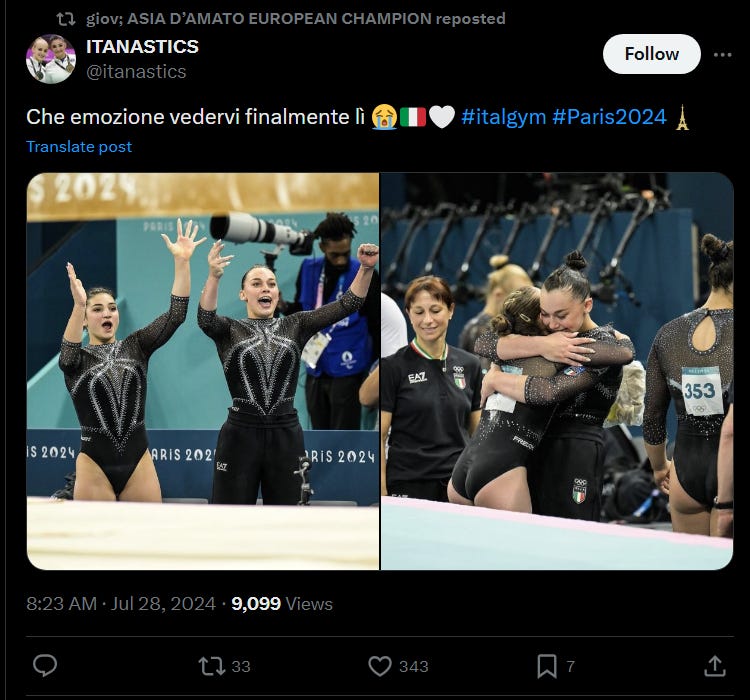
Preliminary standings saw less than four tenths separating Italy, China, and Brazil. After the top four, there was a four point drop off between Brazil and fifth place Japan. Assuming the final plays out more or less as expected with no major meltdowns, this will be a hotly-contested competition, at least for the silver and bronze medals. The final standings may again be decided by a matter of tenths, and—whatever the outcome—you can be sure the fan discourse over the results will be swift, fierce, and wholly subjective.
Now, I will freely admit that fruitless bitching about scores is half the fun of watching Olympic gymnastics, but bear in mind that scores don't materialize out of thin air based on vibes. There’s a panel of International Gymnastics Federation (FIG) certified Brevet judges evaluating every skill based on the requirements and deductions as laid out in the Code of Points.
We all know it’s possible for judges to get scores wrong, but it’s far more likely they clocked something most of us didn't. (It’s worth noting the majority of commentators, journalists, and even former gymnasts are not Brevet judges.) Here are some of those so-called “phantom deductions” on each event that will differentiate the good from the great from Simone Biles.
Vault:
Poor technique on the block
The gymnast must use both hands to push off of the table and into the air. Things like bent shoulders and/or elbows, staggered hand placement, and not passing through vertical will cost them at least a tenth.
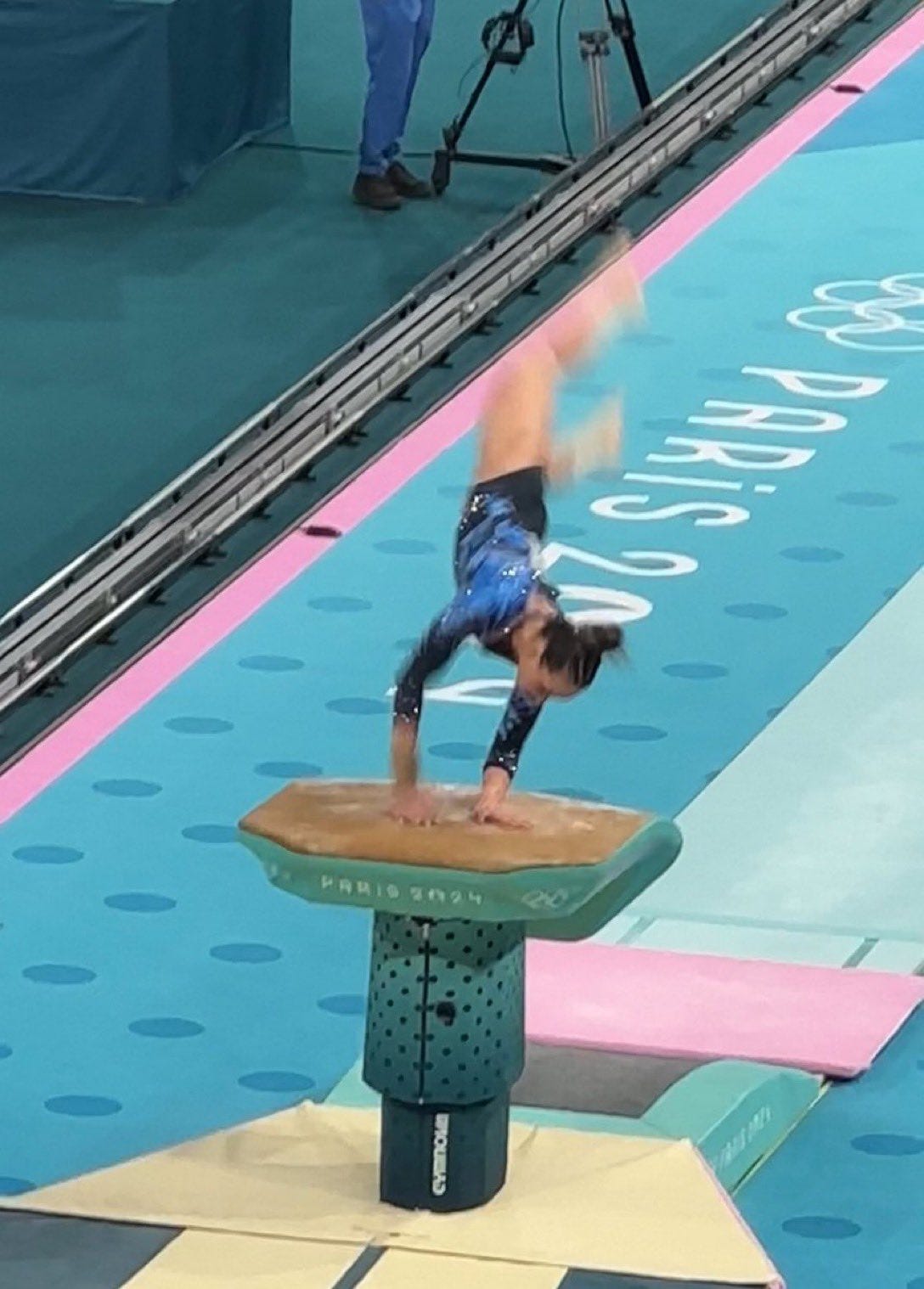
Possible Deductions: missing degrees of turn onto table ≤ 45° (0.10); bent arms, staggered hand placement, shoulder angle (0.10 ≤ 0.30), not vertical (0.10)
Body shape during the flight element
Once the gymnast is in the air, they’re expected to commit to a body shape (i.e., a tuck, pike, or layout) and maintain it until they’re ready to land. If you can’t tell whether the gymnast’s bent knees and hips are intentional, it’s almost certainly a deduction and could even result in the vault being downgraded altogether.
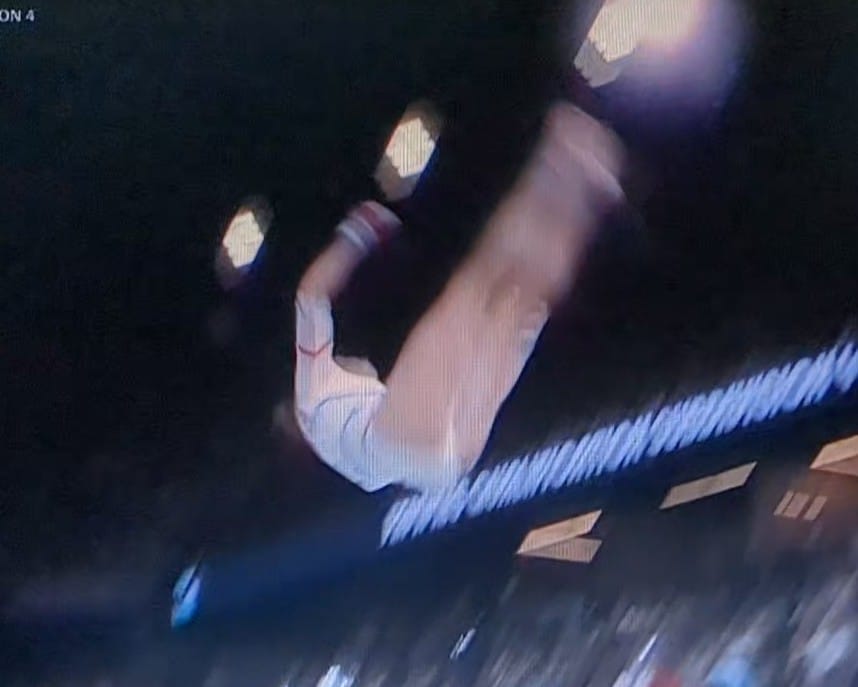
Possible Deductions: body alignment in stretched salto with twist, failure to maintain stretched body position (hip angle >90° will be credited as a piked salto)
Landing errors
Barring an actual fall, landing deductions are capped at 0.80 regardless of how squatty the landing or number of steps, hops, or jumps the gymnast takes.
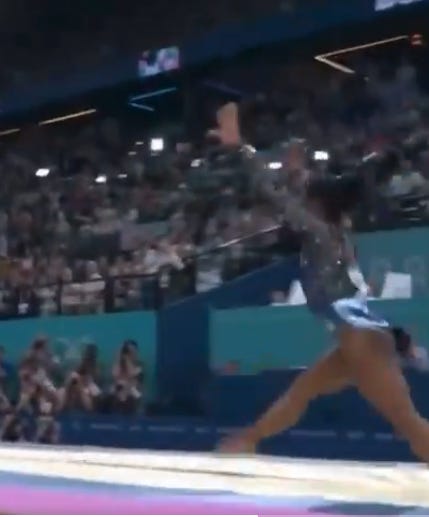
Possible Deductions: extra steps (0.10 each), very large jump more than shoulder width (≤ 0.30)
Bars:
Breaking connections
The concept here is pretty straightforward: connecting major skills gains bonus tenths; if the gymnast has to add an extra skill like a kip or empty swing in between those elements, they don’t get the bonus.
Hitting feet on mat or bar
You think it’d be fairly obvious when a gymnast smacks their feet on the bar, but it can be surprisingly tough (even for the judges). The giveaway is often a loud, metallic pinging sound. Hitting feet on the mat counts as a fall (1.00), even if it doesn’t seem to disrupt the overall flow of the routine.
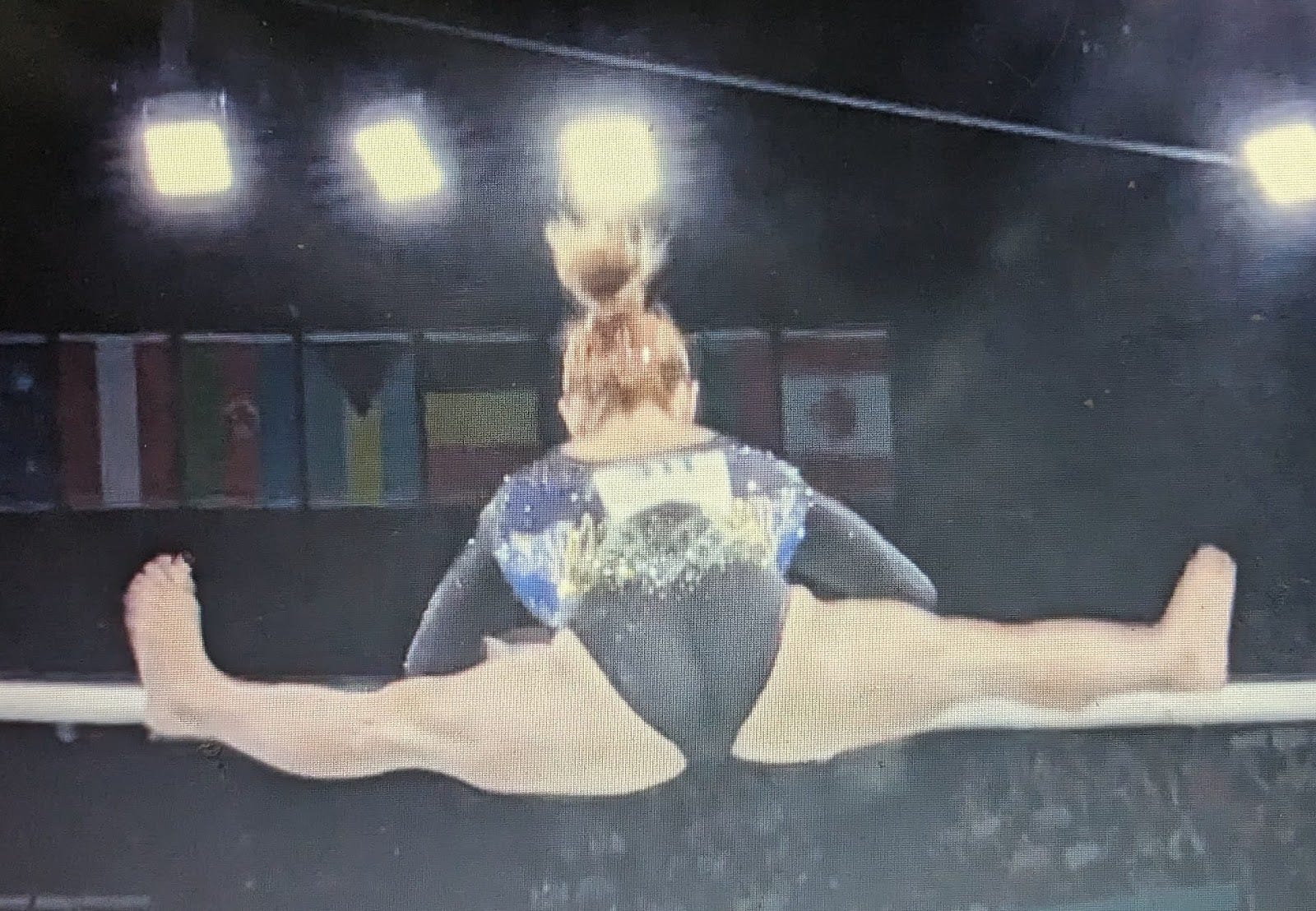
Possible Deductions: hit on apparatus with feet (0.50)
Beam
Downgraded or uncredited skills
Shapes and angles matter, particularly on dance elements. It’s conceivable, even probable, that certain skills will be credited as something less difficult because of a subtle imprecision in their leg position (I’m looking at you, basically anyone doing a switch half). Without falling too far down the D score rabbit hole, a downgraded skill can affect how other skills and bonus connections throughout the routine are credited.
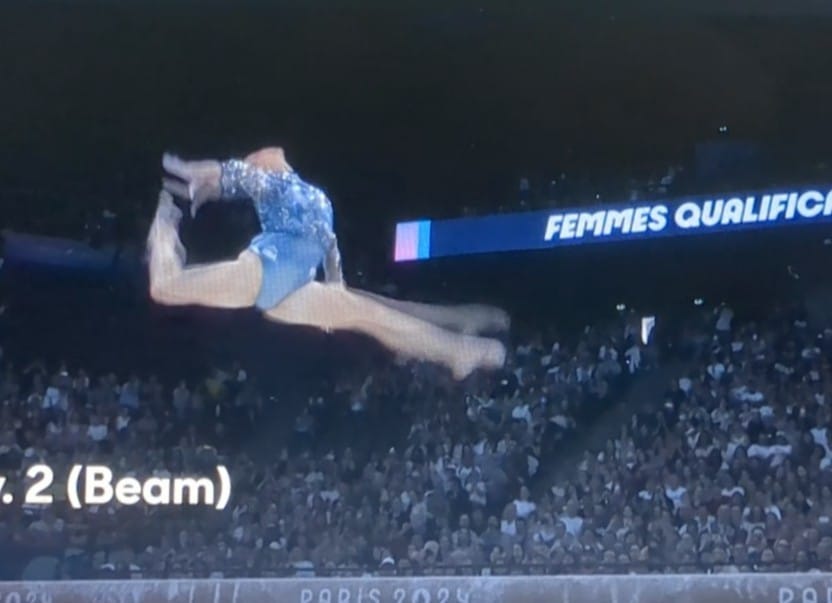
Possible Deductions: insufficient arch position (0.10), front leg below horizontal (≤ 0.30), rear foot at shoulder height (≤ 0.30)
Broken connections
As on bars, beam connections are a high risk/high reward way to rack up bonus points. Any pauses, adjustment, or general awkwardness will result in some sort of deduction or loss of bonus points.
Floor
Dance elements
It’s fairly obvious when a gymnast botches an acro skill, but errors on dance skills like leaps and turns are much more subtle: starting and ending positions of the feet, posture, leg angles, and a myriad of other details are subject to deduction.
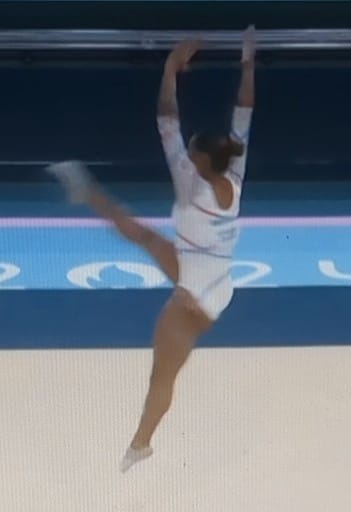
Possible Deductions: failure to hold free leg at horizontal throughout turn (0.10), lack of precision (0.10)
Artistry & composition deductions
Suffice it to say, an entertaining performance isn’t necessarily an error-free one according to the Code of Points. This is one of the more controversial categories of potential deductions because the judges can (and will) take tenths off for seemingly subjective offenses like “insufficient complexity or creativity through movements” or “poor expressive engagement according to the style of the music.”
Out of Bounds
Landing out of bounds is a neutral deduction of 0.10 for one foot, 0.30 for both feet. Though still best avoided, stepping out of bounds is not quite as devastating a penalty as it was under the 10.0 scoring system.
No posts
Comments
Nothing yet. Say the first thing.
Sign in to join the conversation.