
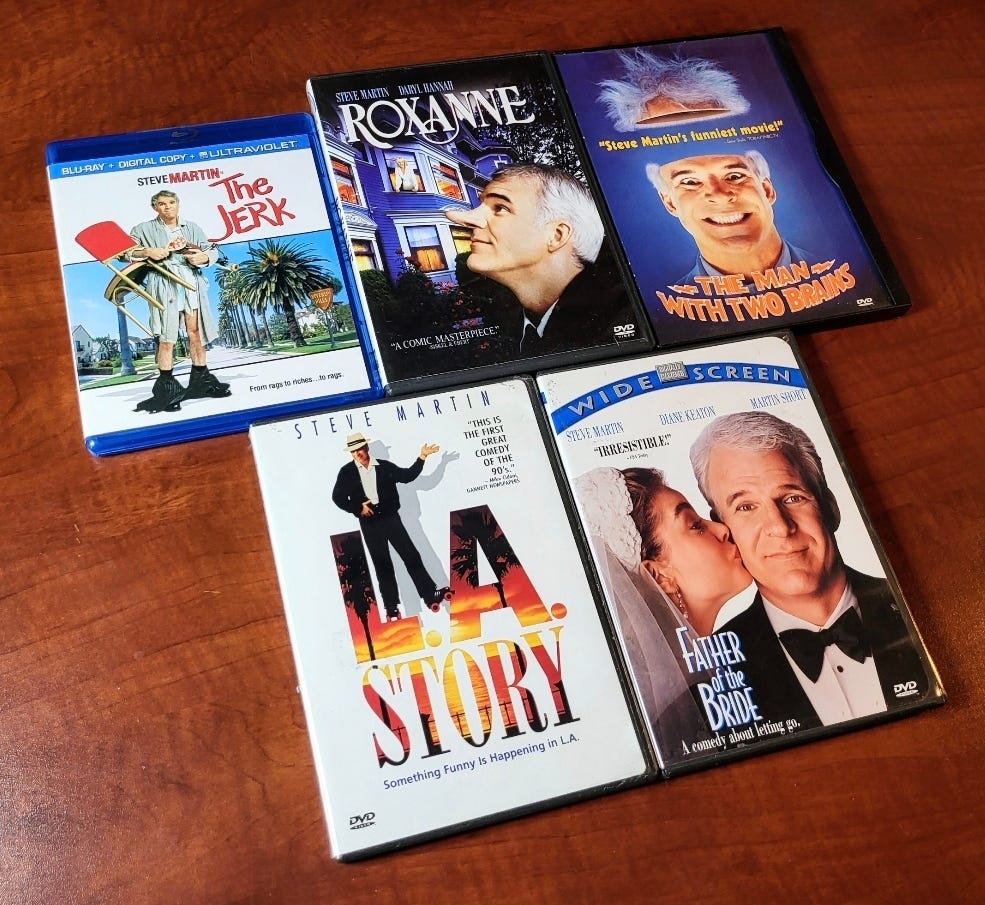
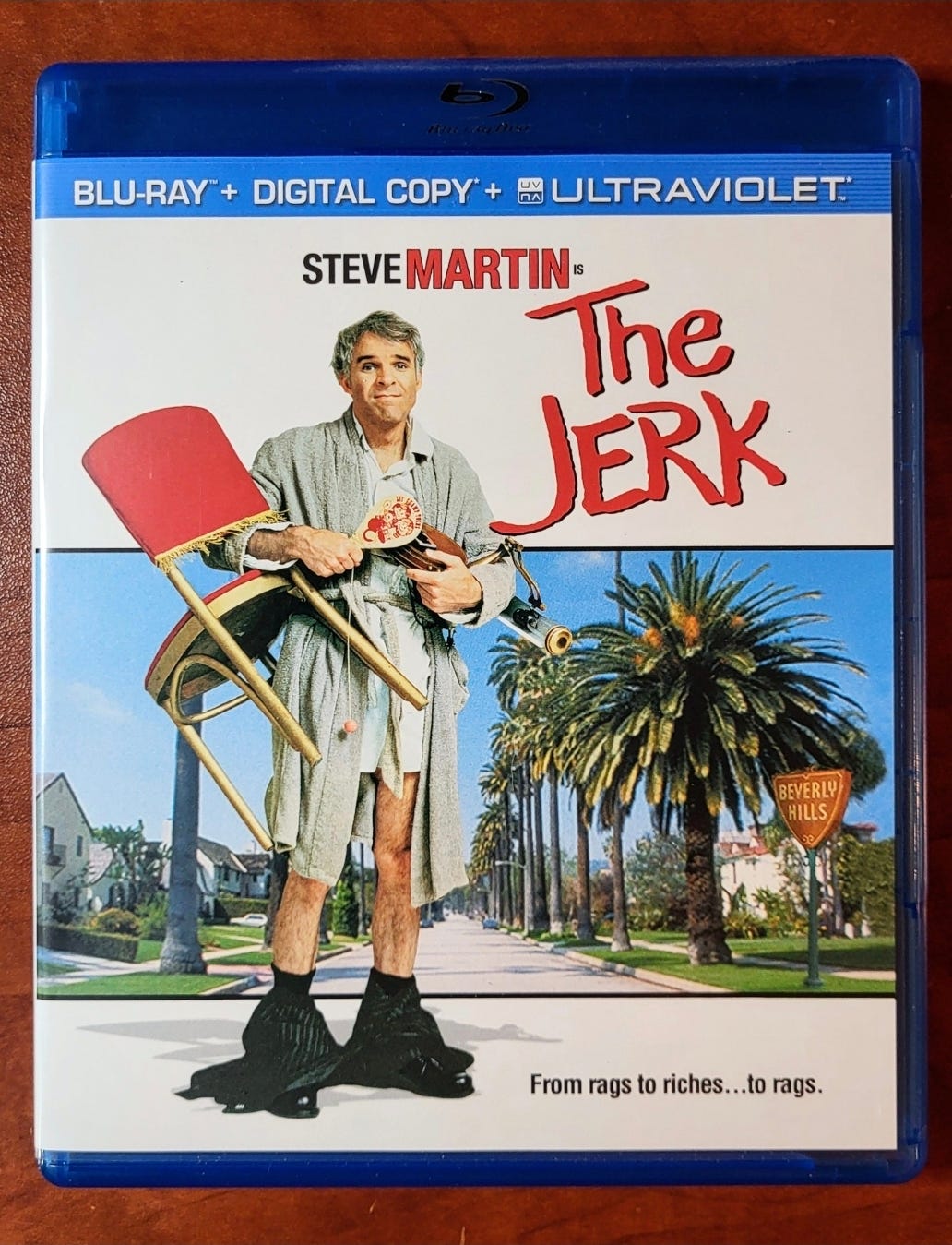
The absurdity of Carl Reiner’s The Jerk (1979) begins with Steve Martin’s line, “I was born a poor black child” and builds right up to the point of Reiner himself stepping into his own movie to sue his lead character. I didn’t think it could get any more absurd than cat juggling, but I was wrong.
Martin’s first starring performance as Navin Johnson is a blend of innocence, earnestness, directness, and idiocy that I thoroughly enjoyed. When Navin is hitchhiking, he’s offered a ride from the front of his house to the end of the fence post and he takes it. Navin takes in a stray dog that caused a false fire scare that evacuated an entire motel and when an elderly guest suggests he name the dog Shithead, that’s his name for the rest of the movie. It’s just one bizarre moment after another strung together in a rags-to-riches-to-rags story and mostly all of it works.
Navin writes home telling of his new job at a gas station and how his boss is “teaching me how to be impatient” and he postscripts one of the letters, “P.S. Is grandma still farting?” Honestly, the letters home are my favorite running gag of the movie, especially when he gets rich and writes his mother things like, “Remember how much I wanted an all-red billiard room with a giant stuffed camel?”
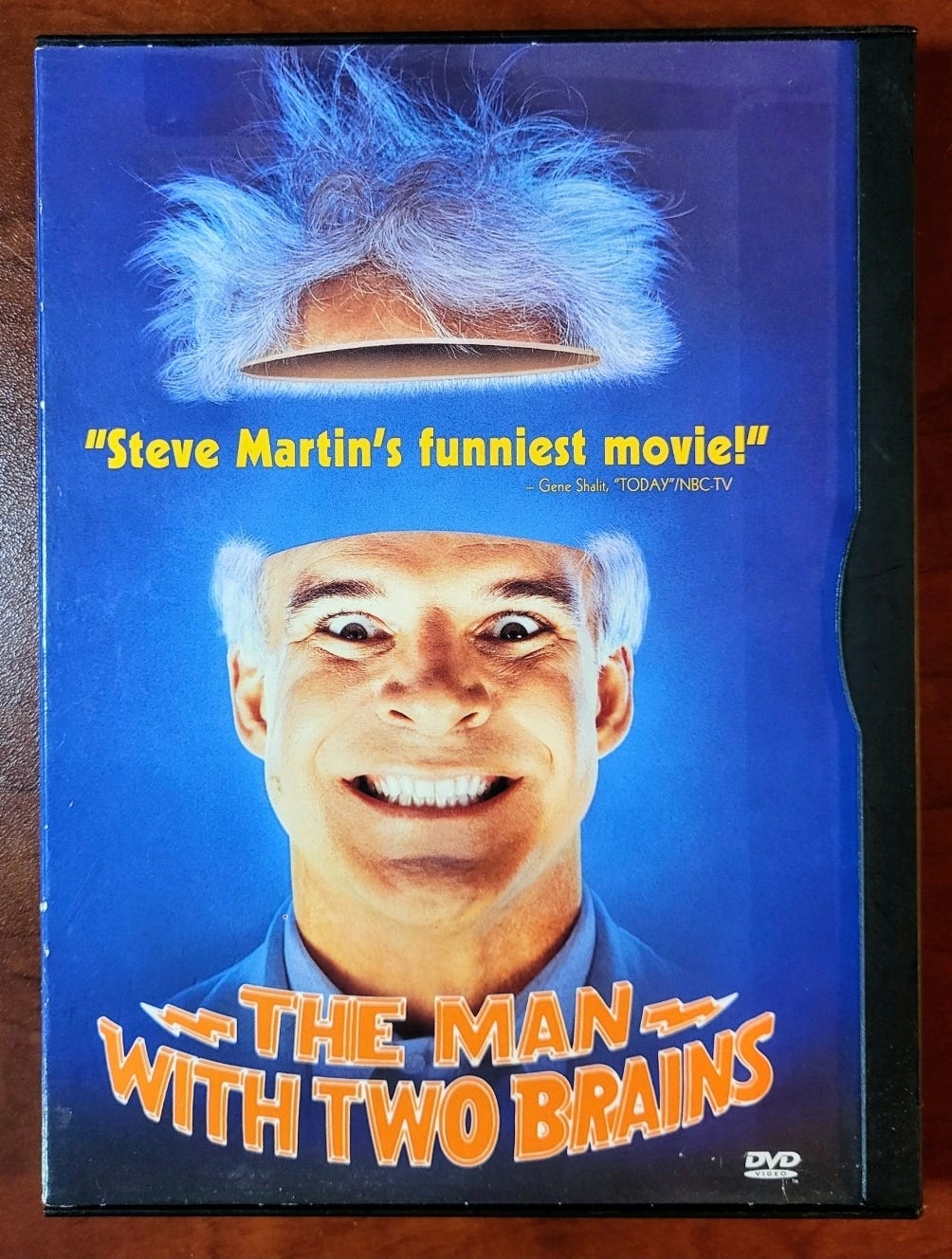
The third of four Steve Martin and Carl Reiner collaborations, The Man with Two Brains (1983) showcases the same level of absurdity as their previous film in this marathon, The Jerk (1979), but it’s delivered in a much more dry, deadpan way. I wasn’t expecting to enjoy this movie as much as I did, but it was so attuned to my comedic sensibilities that I couldn’t help but have a blast with it.
Part noir thriller, part B-sci-fi, the film follows an arrogant brain surgeon, Dr. Hfuhruhurr, who marries a patient that happens to be a gold-digging femme fatale played by none other than THE femme fatale of the 80’s: Kathleen Turner herself. Martin’s straight face as he yells “Get that cat out of here!” during brain surgery and uses a cranial screw top to finish the job begins a relationship with Turner just as doomed as her marriage in Body Heat (1981).
The B-sci-fi element kicks in when Hfuhruhurr meets another brain surgeon, played by the brilliantly hilarious David Warner, who’s been collecting brains for an experimental procedure to transfer the consciousness from one brain to another. His conversion of his condo into a Frankenstein-esque castle laboratory is one of the funniest visual gags I’ve ever seen and I especially love the “Leaping lizards!” “Yes, we have those” exchange.
When one of the jarred brains, named Anne, communicates with Martin in the voice of Sissy Spacek, a bizarre love triangle begins and the rest of the movie is a race against time to transfer Anne’s consciousness to a human body before it’s too late. Along the way there’s a hilarious fourth wall-breaking joke about subtitles and one of the best cameos ever.
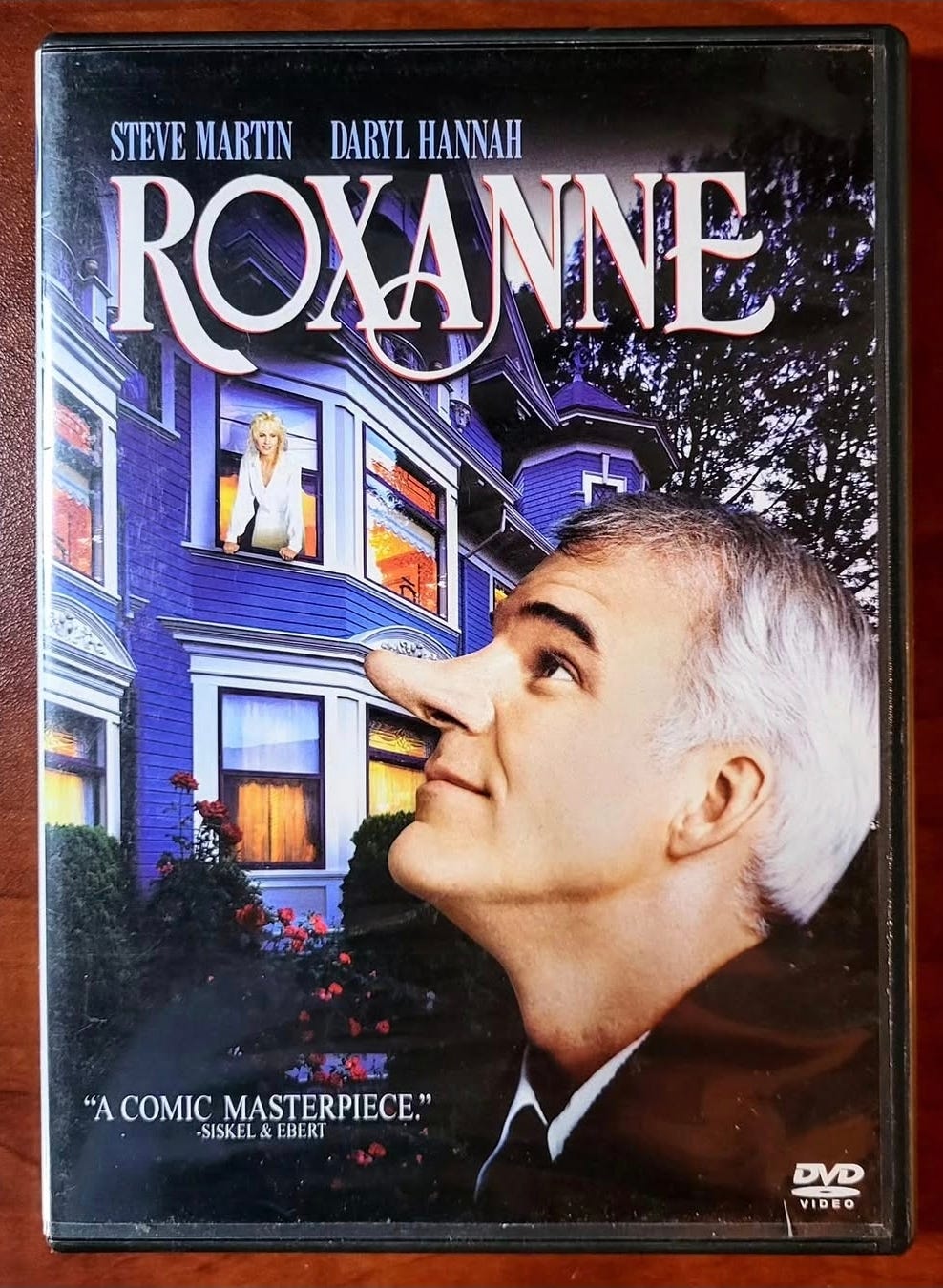
Roxanne (1987), the Steve Martin passion project in which he servers as executive producer, writer, and star, is a modern adaptation of the 1897 French play by Edmond Rostand, Cyrano de Bergerac. Martin plays the Cyrano stand-in, Charlie (C.D.), whose large nose leads him to fight anyone who says a word about it and creates a complex that makes him feel unworthy of love. Instead of pursuing his love, Roxanne, he uses his talent for words to help his more attractive friend win her over by feeding him lines and writing letters in his name.
I have to admit that I’m typically wary of contemporary takes on classic literature and I definitely wasn’t feeling the first act of Roxanne, which felt too much like Martin was carrying over the absurd humor of his Carl Reiner films with the opening tennis racket fight. However, once Rick Rossovich as the Christian character showed up and the play’s love triangle kicked in, I was quite charmed. As much as I enjoyed the last two-thirds, though, I still feel Shelley Duvall and Fred Willard were completely wasted, the parkour stuff was just odd, and the fact that these “ordinary people” all live in mansions in the mountains of the Pacific Northwest put a strain on my suspension of disbelief. It also didn’t help that my DVD was full screen and had some of the worst pan-and-scan I’ve ever seen.
As an adaptation, Roxanne stays fairly close to Rostand’s play, aside from a very different resolution. Martin’s C.D. is a fire chief of the worst fire department in the world instead of a French soldier, but his wit and charm are identical to Cyrano’s and it’s all on display in his “twenty jokes about my nose” bit. The ethereal beauty, Roxanne, is played by Daryl Hannah, the typecast ethereal beauty of the 80’s, so that works, too. My favorite scene of the film comes when C.D. is feeding lines to Chris through radio and the police channel interferes so that Chris romantically tells Roxanne, “There is a heart here that wants yours to know—that there’s a possible 502 on Main. Proceed to Main.”
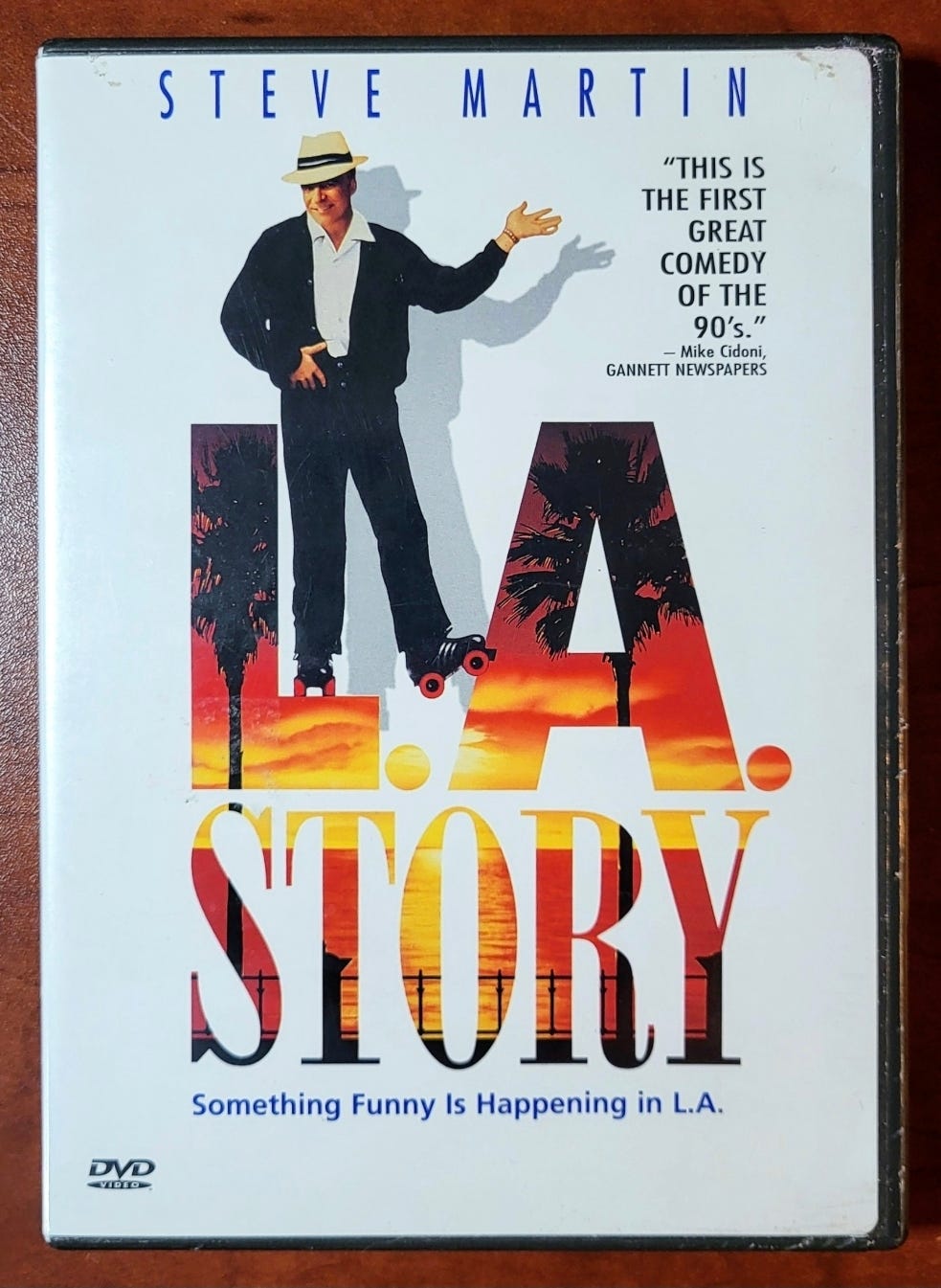
In L.A. Story (1991) and the previous movie in this marathon, Roxanne (1987), Steve Martin served as both writer and star and I’ve noticed a trend. Though each film deals in slapstick humor, there’s also a very sweet sincerity to their love stories, especially in L.A. Story. I spent nearly ninety minutes watching the film satirically roast every superficial, trendy, materialistic, decaff everything fad in early 90’s L.A. with some of that leftover Reiner absurdity (Martin even starts reciting the “Pointy Birds” poem from The Man with Two Brains (1983)), but the romance and Victoria Tennant’s smile charmed the hell out of me—despite her hilariously terrible driving. Is the tone inconsistent with frequent incongruous shifts? Definitely. But when that weather-centric climax started I almost teared up.
There’s an element of magical realism in L.A. Story that’s established in the opening scene of Martin’s Harris Telemacher commuting to work in a stunt driving sequence that felt like it was straight out of The Italian Job (1969) or Ronin (1998). The technique is utilized a number of times after that, most notably when God, Fate, a guardian angel—whatever it is—communicates with Harris in the form of a roadside traffic signpost and helps him to better his life through a number of “deus ex signpost” interventions.
There’s also an odd recurring gag involving Shakespeare in L.A Story. Martin repurposes the “This England” monologue from Richard II (1595) into a “This L.A.” speech, the “Tomorrow and Tomorrow and Tomorrow” soliloquy from Macbeth (1606) is spoken verbatim, and the gravedigger scene from Hamlet (1599) is reenacted with Martin as Hamlet, Tennant as Horatio, and Rick Moranis as the gravedigger. When the Bard’s tombstone is shown in the same cemetery, it goes from a meta joke about movies referencing Shakespeare to sound smart to a commentary on L.A. co-opting Shakespeare as its own.
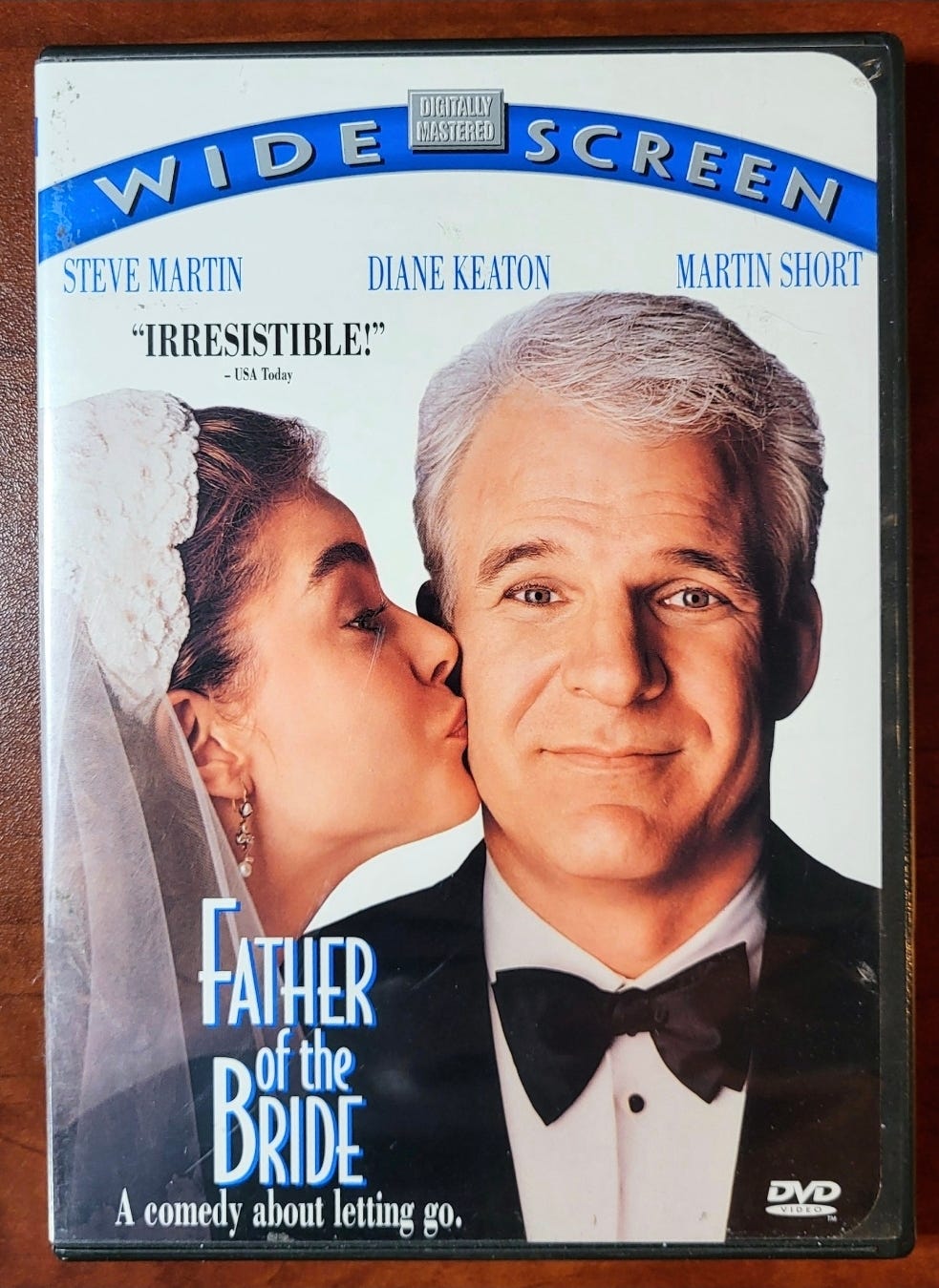
A prime example of why you don’t sink your entire identity into being a parent: Father of the Bride (1991). The movie opens with Steve Martin breaking the fourth wall to whine at the viewer in a soliloquy about losing his little girl and how he now feels obsolete, which he will later equate with a discontinued sneaker made by the small sneaker company he owns (a bizarre choice but at least he’s not an architect or an advertising executive like most white men in ‘80s and ‘90s movies). The existential crisis that comes with having nothing else in life but one’s kids is boggling in its inevitability. People like Martin’s George Banks are always blindsided by something they had decades to prepare for; these are also the same people who complain endlessly about their kids and profess how they can’t wait for their kids to leave the nest. Well, at least George got to fit in that one last completely random one-on-one basketball game set to “My Girl” with his daughter before she marries a guy she met while watching the Howard Hawks masterpiece Bringing Up Baby (1938).
Father of the Bride is an odd duck—or should I say an odd bathtub full of swans?—in that its only conflict aside from the bizarre internal Freudian stuff is the very VERY first-world problem of a fairly well-to-do couple paying for and organizing a dream wedding for their semi-spoiled daughter, a wedding set for January 6th nonetheless... All of the wedding staples are there, except the strange ommision of the rehearsal dinner. There’s the younger son (played by Keiran Culkin) pushed aside and forgotten about, the intrusive and expensive wedding planners played hilariously albeit stereotypically by Martin Short and B.D. Wong, and a comedy-free ceremony and reception.
There’s also the meeting of the in-laws, a scene in which Martin makes a complete ass of himself culminating with a fall into the pool to evade a pack of Dobermans delivering just desserts for him invading their owners’ privacy. Diane Keaton’s reaction to Martin falling in the pool with an “Oh man” and subdued laughter is one of my favorite moments in the movie and it sucks seeing her play second fiddle to Martin after watching her blow the doors off Looking for Mr. Goodbar (1977) and Reds (1981) with her incredible talent and presence. Also, I wish the budget allowed for more interesting casting for the in-laws.
L.A. Story (1991), the previous movie in this marathon, feels like it’s clinging to the 80’s in every way and yet Father of the Bride feels VERY early ‘90s. Maybe it’s the un-Silvestri elevator jazz score that’s common in so many early ‘90s comedies like Thelma & Lousie (1991) and A League of Their Own (1993). Whatever the reason and despite my gripes, though, I did enjoy the movie for the ‘90s of it all because it was cozy as fuck like a ‘90s comedy, legal drama, or political thriller should be.
Thanks for reading! This post is public so feel free to share it.
No posts
Comments
Nothing yet. Say the first thing.
Sign in to join the conversation.