
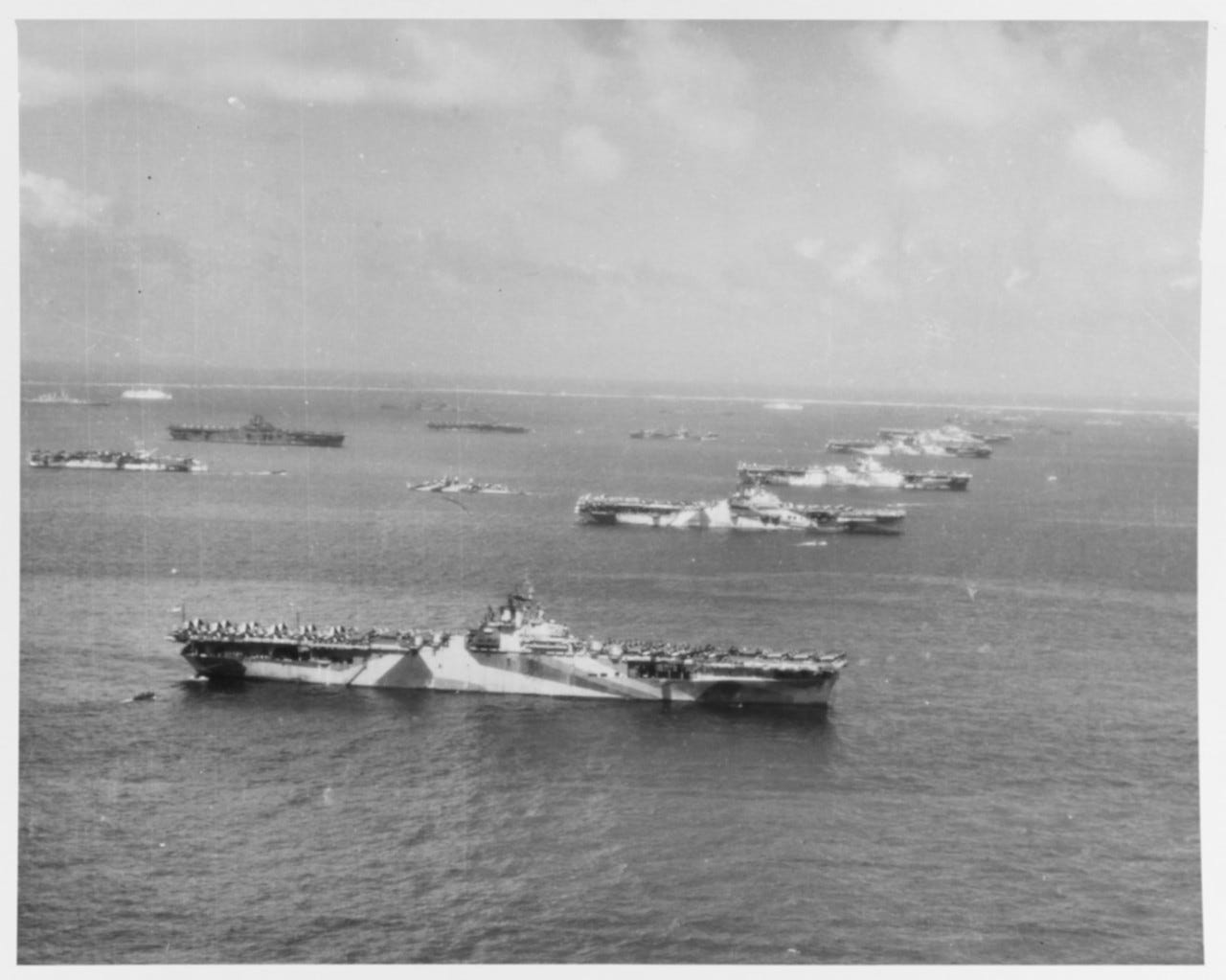
Essex Class Carriers in 1944
I find it amazing that the U.S. Navy continues to fail at designing and producing new surface warships. It wasn’t always this way as any Naval historian can testify.
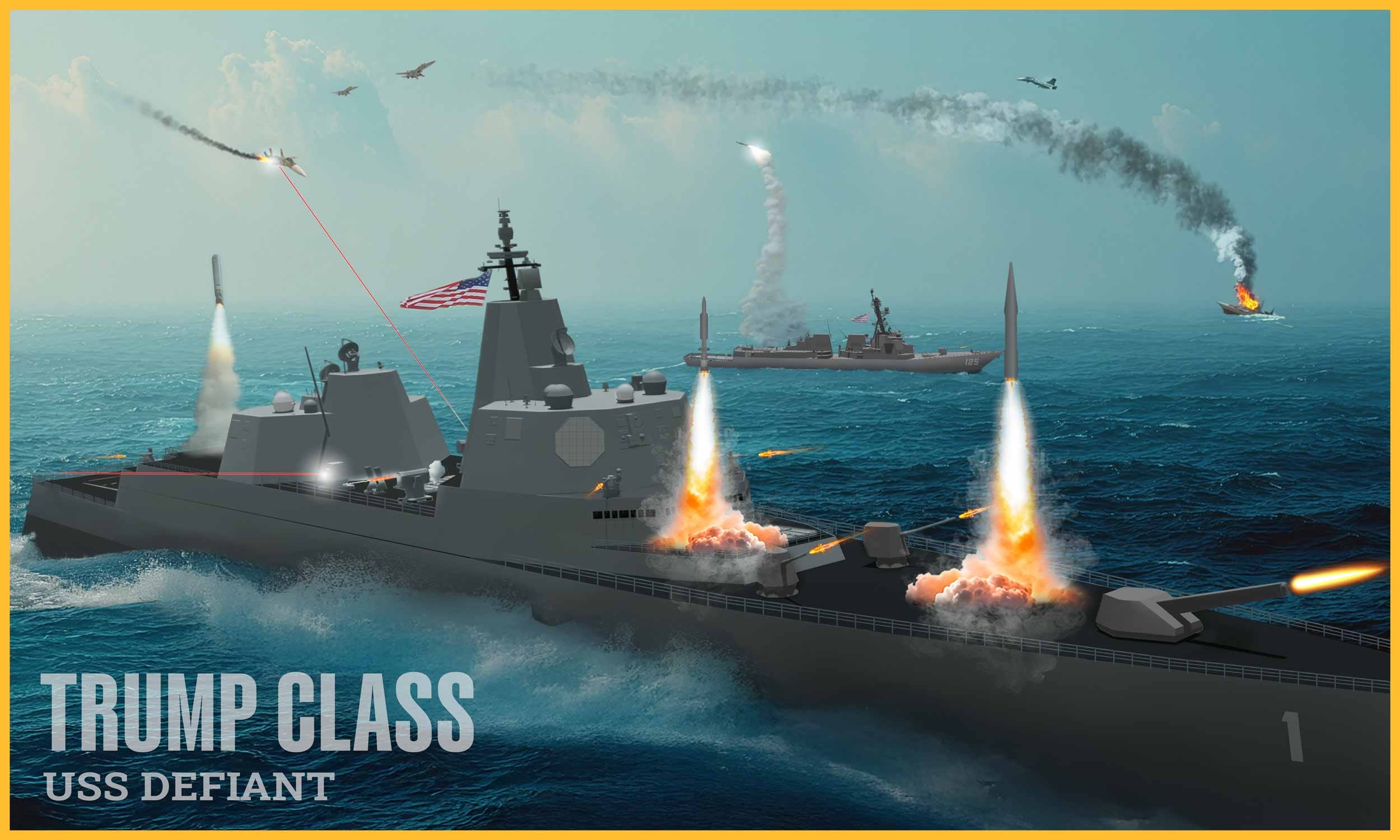
Donald Trump poses as the savior of the nation who will build a “Golden Fleet” which is in reality an impossible dream concerning our emaciated and overwhelmed shipbuilding industry, and a fleet built around the Trump Class Nuclear Battleship. Even before it was decided that they needed to be nuclear powered, the class was estimated to cost as much or more than the Ford class carriers per ship. They are to mount a weapons suite that is all untried and untested, and may have little strategic value. I have to hold my for that as yet unrealized fiasco until a following section of this already rather lengthy article. Let me not get into the weeds about our current shipbuilding and repair industry or the failed Navy ship designs since 2003.
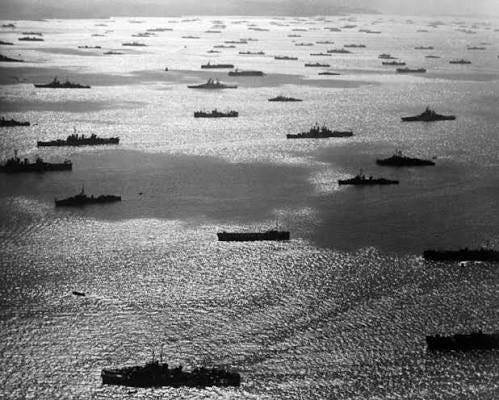
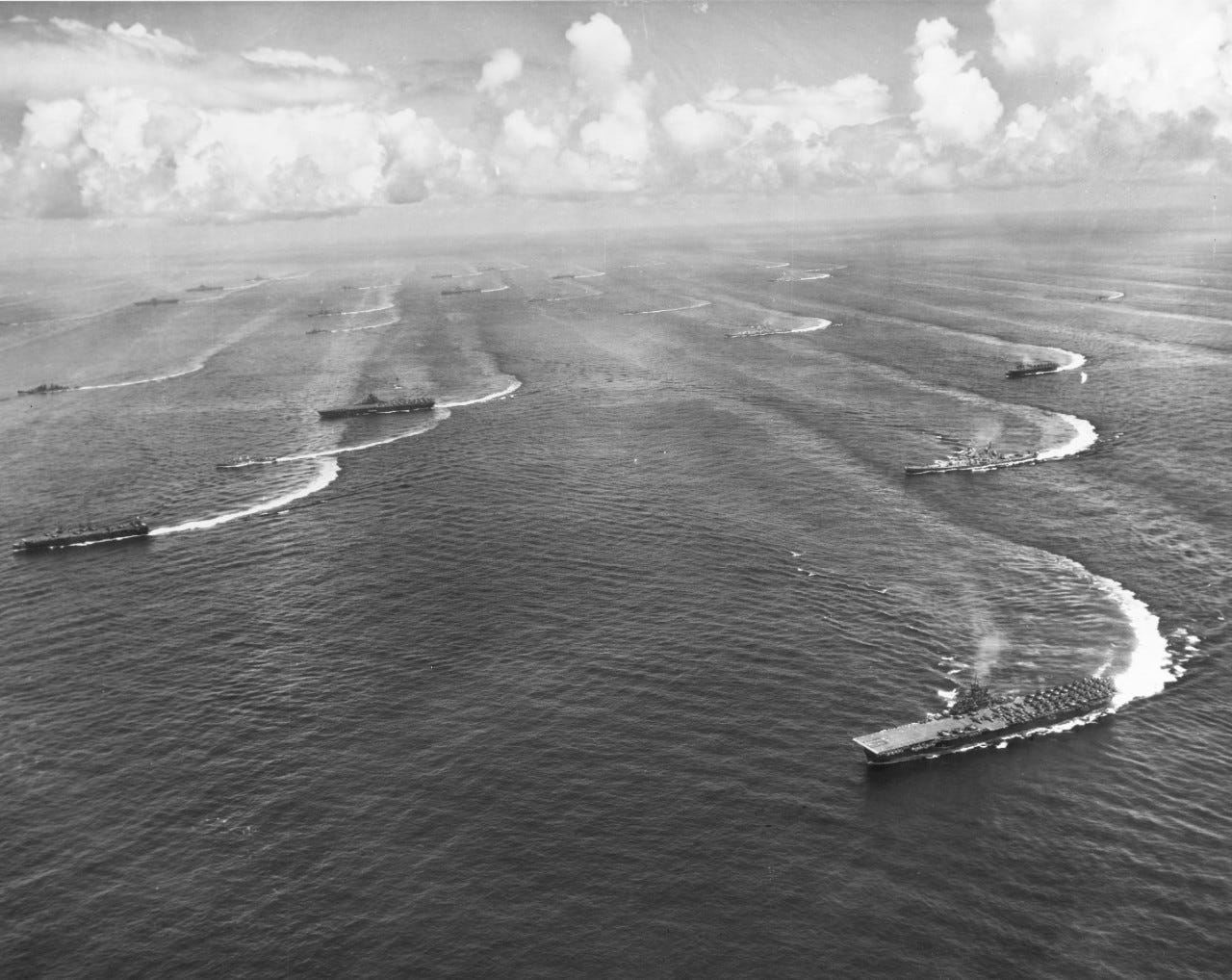
Back in the time before Donnie was even a sperm in his daddy’s reproductive magazine, the United States had a true Golden Fleet. In 1945 the United States Navy was the uncontested ruler of the seas. It included 23 Battleships, 28 Aircraft Carriers, 71 Escort Carriers, 72 Cruisers, 371 Destroyers, 361 Destroyer Escorts (Frigates), 232 Submarines, 586 Mine Warfare ships, 1204 patrol ships, 2547 Amphibious Ships and Craft, 1267 Auxiliaries, in total some 6768 ships of all types in commission. That did not count the ships of the Coast Guard or the Merchant Marine, which numbered thousands more ships. 84 shipyards were active in building this monumental number of ships in September 1945. They were located across the West Coast, Gulf Coast, the East Coast, and in inland shipyards on the Great Lakes and along major rivers. It was a truly national effort.
Thanks for reading Dedicated to the Proposition that All Men are Created Equal! This post is public so feel free to read and share it by liking or restacking on Substack, or sharing on the platform of your choice.
The United States used to be the leader in building effective, long lasting ships that could be continuously upgraded. I learned about this in Navy Junior ROTC, and then I watched as we designed and built the Oliver Hazard Perry Class Guilded Missile Frigates, the Spruance Class Destroyers and the Ticonderoga Class Guided Missile Cruisers, the Tarawa Class LHAs, new classes of mine warfare ships, and the Pegasus Class Hydrofoil Patrol Ships. Likewise reading about the Harpoon Anti-Ship Missile, the Tomahawk Cruise Missile, rapid firing automated 5 inch guns, and so much more was incredible for a teenager.
When I was a young Army officer I began to read about the Arleigh Burke DDG-51 class, which has endured to be one of the Navy’s most successful, effective, and prolific designs in recent history, and the current backbone of the U.S. Navy surface force. As of today 75 of these ships are in commission, with 25 more either building or ordered. Every new batch has been improved and updated with more capabilities than the preceding batch. Now those are being refitted and updated. With the DDG-51 class the Navy replicated its success of the WWII Fletcher, Allen M. Sumner, and Gearing classes, many which served until after Vietnam, and with foreign navies until the 1990s and 2000s.
Donald Trump likes to talk about a “Golden Fleet”, but his is looking for something as gaudy as his Oval Bordello.
Aircraft carriers designed and built in and shortly after WWII, like the Essex and Midway classes were modernized and updated, with the last Essex class ships being decommissioned in the late 1970s and early 1980s, with the last of them, the USS Lexington decommissioned in 1991 as a training ship for Naval Aviators. Four; Hornet, Yorktown, Intrepid, and Lexington are museum ships.
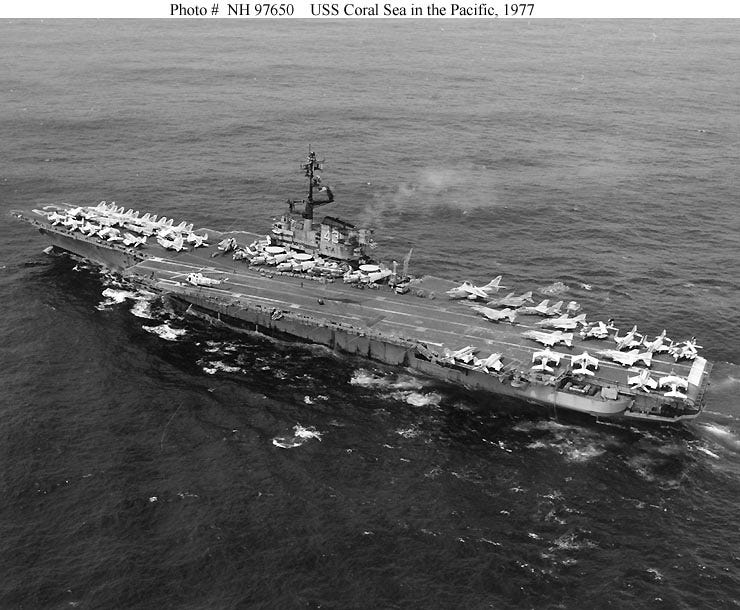
The next class, the Midway class just had three ships but they were larger and had armored flight decks. All three were modernized with angled flight decks like the Essex’s received when modernized, and served in Korea, Vietnam and the Cold War. One, the Franklin D. Roosevelt was decommissioned in 1977 having received fewer upgrades than her sisters during the post Vietnam drawdown. The Coral Sea decommissioned in 1990, and Midway in 1992 following service in Operation Desert Storm. She is now a museum ship in San Diego, California.
The Navy followed these ships with the Forrestal Class carriers, the first true Super-Carriers, that included Forrestal, Saratoga, Ranger, and Independence. These ship were a major improvement over the Midway class. These follow on ships of the Kitty Hawk class, the Kitty Hawk, Constellation, America, and John F. Kennedy. All eight of these ships were highly successful.
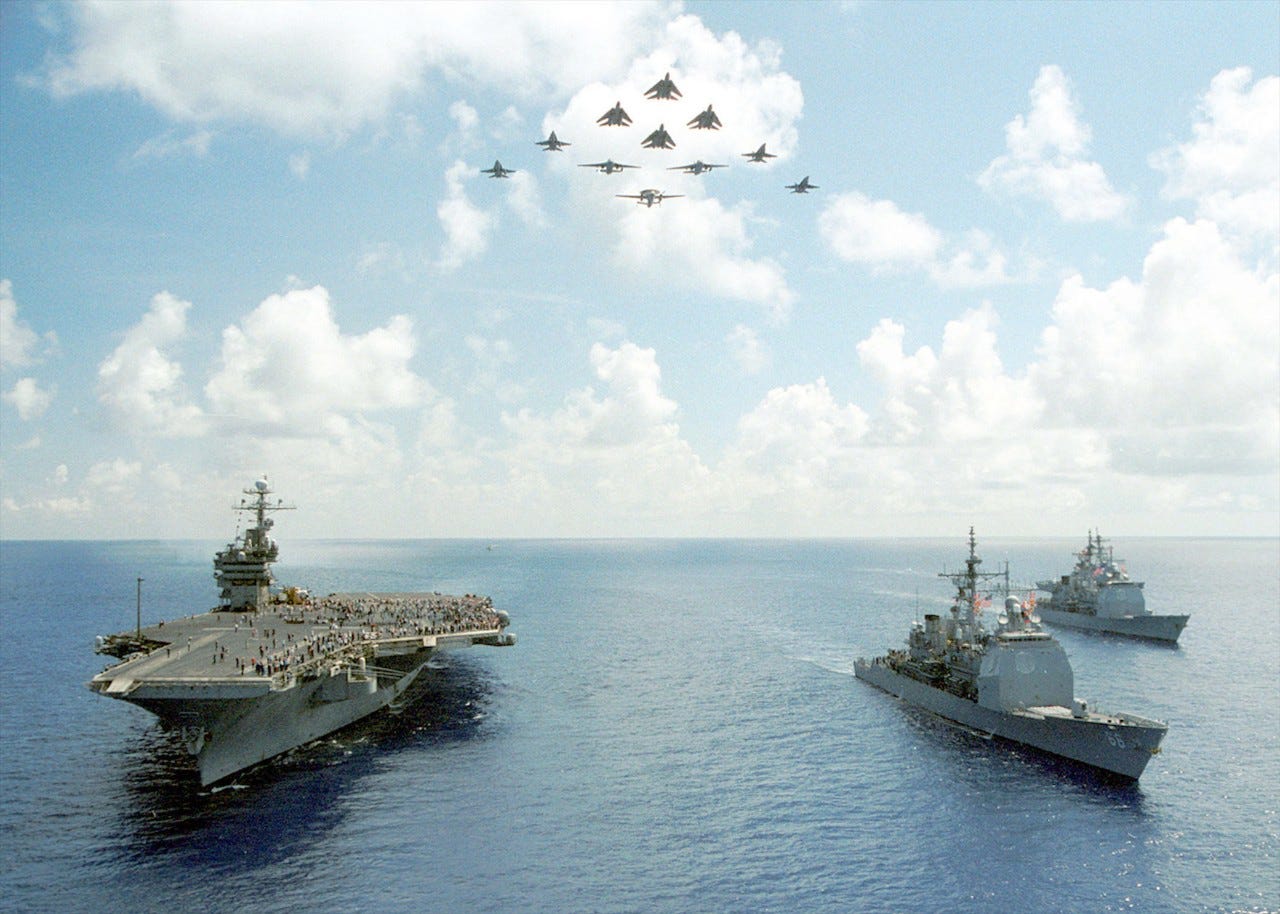
USS John F. Kennedy with USS Hue City and USS Vicksburg in July 2002
The Forrestal class were decommissioned following the end of the Cold War as part of the “peace dividend.” The Kitty Hawk class persevered longer, the America to 1996, Constellation to 2003 following Operation Desert Storm, John F. Kennedy until 2007, and Kitty Hawk, by then the oldest commissioned ship in the Navy, 2009. With the exception of America which was used as a target ship in a top secret test in 2005 to see the kind of damage a modern super carrier could take as part of the process to design the Gerald Ford class. No pictures of the tests were ever released except the final declassified pictures of her which showed none of the damage. She lies at the bottom of the Atlantic so 16,000 feet some 250 miles southeast of Cape Hatteras, North Carolina. The other seven have been or are being “recycled”, the kinder and gentler word for scrapping in Brownsville, Texas.
Of course the are the nuclear powered carriers, the Enterprise, and the 10 ships of the Nimitz class. All were remarkably successful. Enterprise decommissioned in 2012 after 51 years of service and probably won’t finish the “recycling” process until at least 2030. Unlike the conventional ships, the nuclear reactors, fuel, and innards that need to be disposed of as radioactive materials in Hanford, Washington, where we park all of our former nuclear reactors, even before the rest of the hull can be recycled. By law the nuclear ships have to be processed at a government, think Naval Shipyard. With submarines and cruisers it wasn’t that hard. They were smaller. They were taken to Puget Sound Naval Shipyard, where the reactors were removed, sent to Hanford, and the hulks were then recycled. The problem with aircraft carriers is that they take up dry dock space, which also is needed for carriers going through their periodic overhauls and their refueling cycles. By the way, Nimitz will be decommissioned in 2027 after 51 years of service and Eisenhower as early as 2030, unless the Navy does the smart thing and doesn’t decommission her until her replacement, the next USS Enterprise is ready. Even so, Nimitz, Eisenhower, and the other early Nimitz class ships will be tying up budgets, dry docks and shipyards for decades as they are decommissioned. Unfortunately, the Navy failed to ensure that we had the resources not just to build and operate them, but how to dispose of them when they reached the end of their service lives.
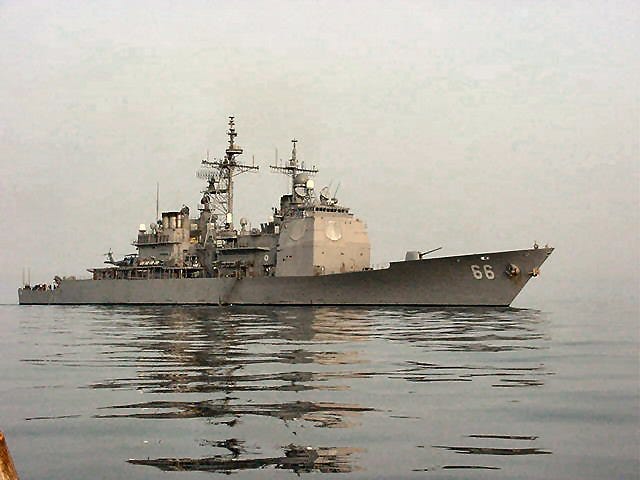
USS Hue City, May 2002 in the Persian Gulf. I was in a small boat departing for a day of boarding Iraqi smugglers.
Then there is the mismanagement of a class of ships that was our most powerful and versatile surface ship, the Ticonderoga class guided missile cruisers. I served on one, the USS Hue City, CG-66. She was a fine ship with a fine crew and exceptionally well maintained, except that she did not get her five year dry-docking and maintenance period until she was ten years old. She wasn’t alone. Based on the Spruance class destroyers, they were much more powerful than the destroyers. They had the SPY-1 Aegis radar and combat systems and carried 128 vertical launch (VLS) missile cells each, except the first four which had two twin rail missile launchers. There were 27 ships in all, and they were the backbone of carrier group air defense and offensive air operations. Additionally they had a large capacity for attacks on enemy ground targets and surface ships. They were highly effective ships that were in constant demand. Doctrine said that two cruisers would accompany each Carrier Strike group. In peacetime that was not demanding. Deployments were scheduled and maintenance periods predictable. After the attacks 9-11-2001 those days were over. Important maintenance periods were postponed, sometimes for years as the ships were continuously deployed without getting required maintenance. Likewise, the CGX follow on class was cancelled before a single keel could be laid.
As a result the ships were basically worked to death, and by the time the Navy began their modernization program the results of too many years of deferred maintenance had taken their toll. When the ships entered the shipyards many more important structural, engineering, and other issues were identified that costs and the time required to complete them rose exponentially. Only a few were completed, and the other ships scheduled for the updates and modernization were deleted from it and decommissioned, with most being classified as Logistics Support Assets, in other words, ships to be used for parts. The few modernized ships that remain in commission today are all scheduled for decommissioning by 2031, with no direct replacements.
The exercise shows that strategic requirements and planning are frequently dismissed to meet missions dictated by our political leadership. That is happening even now. Today many ships are being deployed for extended periods without even port calls for their crews, much less maintenance.
With most of the cruisers now gone their place is being held by the most modern DDG-51 ships, but those ships pack less firepower than the cruisers. By the way, the Trump Regime isn’t looking to replace the cruisers, it’s trying to figure out a massive building program of ships with problematic weapons technology, which isn’t proven, on a now nuclear powered surface warship. Since the U.S. Navy hasn’t designed and built nuclear powered surface combatants since the 1970s and 1980s when we produced the California and Virginia class guided missile cruisers. They were good ships, but in the political desire to save money through the so-called “peace dividend” meant that the cost of their modernization and refueling would not occur. They were all decommissioned and recycled despite being barely halfway through their expected lifetimes.
The Spruance class destroyers, and their four near sisters, the guided missile destroyer Kidd class, originally built for Iran, but given to the U.S. Navy after the Iranian revolution. The Kidd class ships are now part of the navy of the Republic of China (Taiwan) and received substantial upgrades. The Spruance class ships were all decommissioned well before their time and did not receive the upgrades that their large hulls could have received. The U.S. Navy was “penny wise and pound foolish” in how they failed to maintain and disposed of the CGNs of the California and Virginia classes, the Ticonderoga class CGNs, the Kidd class DDGs, and Spruance class DDs. The needless disposal of these ships took hulls and weapon systems out of the Navy that could have prevented needless wear and tear on the Ticonderoga, class and the first batches of the Arleigh Burke classes.
We also got rid of one of the best escorts we had, the Oliver Hazard Perry class guided missile frigates, with no replacements until the failed Littoral Warfare Class ships of the Freedom and Independence classes. More on the LCS abortions later. Many of the Oliver Hazard Perry class ships still serve in the Turkish, Polish, Taiwan, Bahrain, Chile, Egypt, Turkey, and Pakistan. Many of those vessels have been extensively modernized. Their LCS replacements are a complete failure. More about that later.
So until the next part. Have a good night and watch your six.
No posts
Comments
Nothing yet. Say the first thing.
Sign in to join the conversation.