
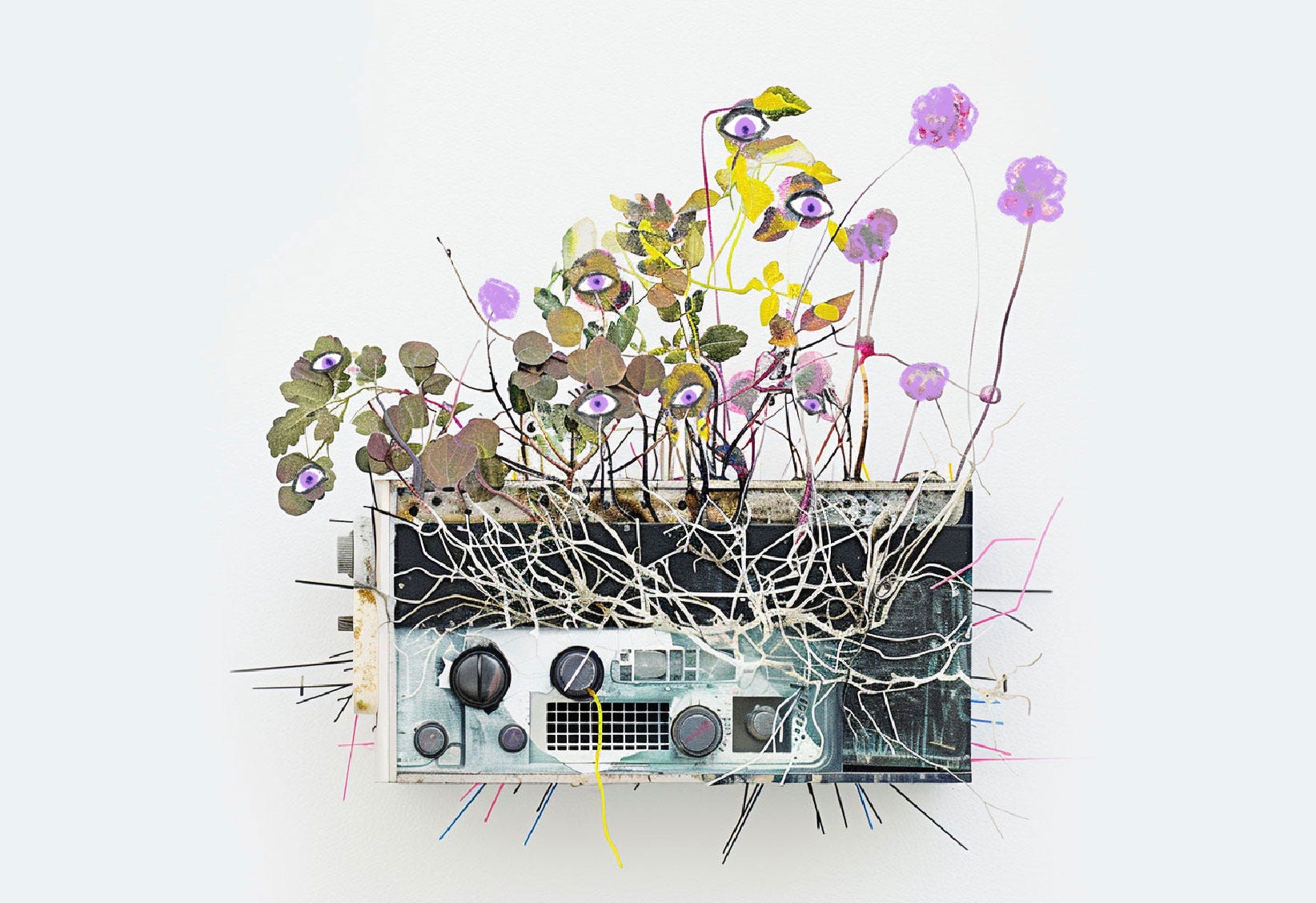
If you’ve been following for any amount of time, you’ve probably noticed I’m interested in plants.
Like… a lot.
So, I thought I’d share some of my research with you. My fascination with the natural world and all of its lifeforms started early. I grew up in the woods of Poetry, Texas (real place, look it up). The local pronunciation (at least when I lived there) sounded closer to “poultry.” I lived there with my hippie-ish parents, two older brothers, a couple dozen chickens, four bunnies, three geese, a couple of cats, and a dog named Arrow. I was basically a feral child, running around the woods with a pencil in my hand and brambles in my hair. I loved the woods more than any manmade place I’d ever been. It always felt like home.
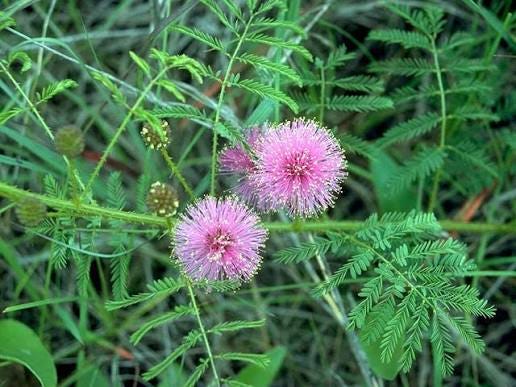
One day during my normal walkabout, I encountered a sensitive briar: a fascinating, fluffy little plant that curls its leaves when you touch it. The fact that this plant could respond to my touch (aka FEEL) and MOVE blew my little mind. It also had gnarly curved thorns that would make you regret getting too close. I was struck by the fact that it had multiple strategies for dealing with its neighbors: both defensive and offensive.
Well, yes. Right. Turns out we’re only starting to understand the numerous ways that plants are sending and receiving signals. All the time.
Most of what plants say is too slow, too quiet, too high-pitched, or too chemical for human ears. We notice the visible part of their world and miss the rest of it. But the science of plant communication has gotten remarkably specific over the last thirty years, and what’s emerged is a portrait of organisms that signal, eavesdrop, defend, and negotiate constantly — with neighbors, with insects, with fungi, across air and soil.
This is a brief overview of the channels they use, grouped by the channel itself — some rock-solid, some still hotly debated. If you’ve ever wondered whether your houseplants are actually doing anything, the answer turns out to be yes, in ways that are stranger than you’d expect.
Let’s dig in.
One thing before we do. I’m going to use words like talk and listen and scream throughout this. Fair warning: that’s me reaching for human words to describe distinctly non-human tricks. The plants aren’t doing any of it the way we do. They’re doing something stranger.
Just like you, plants run on electricity. Every cell holds a tiny charge across its membrane, and that charge can fire and travel, the same basic trick your neurons pull, just in slow motion. Plants are thinking with their whole body, sluggishly, all the time.
There are two flavors of signal, and the difference is basically “hello” versus “OW.”
Action potentials: The first is a quick, clean pulse, the plant’s version of a reflex. A touch, a shift in light, a change in temperature, and a little electrical blip zips along and something happens. This is what fires when a Venus flytrap slams shut on a fly, or when you brush a Mimosa and it folds up its leaves like it’s clutching invisible pearls. (That briar that blew my little mind as a kid? This is the machinery behind it.) Fast, tidy, over in a second.
Variation potentials: The second is the scream. When something bites, a caterpillar chewing, a burn, a tear, the plant sends out a slow, messy, spreading wave of alarm. And here’s the wild part: the bigger the injury, the bigger the signal. The plant isn’t just reacting where it got hurt. That wave travels to leaves nowhere near the wound and tells them to armor up, flooding them with bitter, bug-repelling chemistry before the caterpillar ever arrives.
So a plant that got chewed on yesterday is a plant that’s ready for you today. In its own slow, green, patient way, it remembers. And it holds a grudge.
But here’s where it stops being a lone plant looking out for itself and starts looking like a neighborhood.
When a plant gets attacked, it doesn’t just warn its own leaves. It leaks chemistry into the air, an invisible cloud of “oh shit! something is eating me!” and the plants nearby read it. They pick up the warning and quietly start arming themselves too, before anything’s even touched them. One plant gets bitten; the whole patch tenses up.
And it gets better. Some plants play favorites. When they send out these airborne alarms, they’ll respond more strongly, and get a stronger response back, from plants they’re actually related to. Siblings warn siblings. A plant will tip off its own family and let the stranger next door fend for itself, which, honestly, is more loyalty than some people manage at Thanksgiving.
So the forest floor isn’t a bunch of solitary green things minding their own business. It’s a gossip network. Warnings travel, kin look out for kin, and the quiet patch of weeds you walk past every day is humming with messages you were never built to hear.
Corn can call in airstrikes on their enemies. No, really.
When a caterpillar starts chewing on a corn leaf, the plant doesn’t just sit there getting eaten. It tastes the bug’s spit, actually clocks the specific chemistry of caterpillar drool, and figures out it’s under attack. Then it releases a very particular scent into the air.
And this is the part that gets me: it’s not a generic “help, ouch” smell. It’s a targeted ad. The scent specifically summons parasitoid wasps, which show up, lay their eggs inside the caterpillar, and let the larvae devour it from the inside out. The corn didn’t fight the caterpillar. It ordered a hit.
We’ve known about this since the early ‘90s, and it turns out half the plant kingdom is running the same playbook. Tobacco does it. Lima beans do it. Tomatoes do it. Different plants even call in different assassins, each with its own preferred bodyguard on speed dial.
And those same airborne signals double as a warning to the neighbors. When sagebrush gets damaged, the plants around it catch the scent and start bracing for attack before anything’s laid a mandible on them. Which brings up something that broke my heart when I learned about it: that smell of fresh-cut grass? That green, summery, lawnmower smell everyone loves? That’s a wound. You’re smelling a lawn screaming. Enjoy your Saturday.
There’s a long-running debate about whether the plant means to send any of this, or whether it’s just leaking chemicals that other creatures happened to evolve to eavesdrop on. But honestly, for the caterpillar getting hollowed out by wasp larvae, the philosophy doesn’t much matter.
This one is new, and as a musical person, I find it especially interesting. Plants are not silent (listen here).
In 2023, a lab in Tel Aviv put microphones on tomato and tobacco plants and discovered something nobody expected: when a plant is thirsty or freshly cut, it clicks. Little ultrasonic pops, way too high for us to hear. A happy, well-watered plant is basically silent. A stressed one pops off dozens of times an hour, and the clicks carry across a room. They could even train a computer to tell a thirsty plant from a wounded one just by the sound.
What’s actually making the noise is oddly beautiful. Plants pull water upward through impossibly thin internal channels, kept under so much tension it’s like a string pulled tight. When a plant runs dry, that column of water snaps, and each break makes a tiny percussive pop. A thirsty plant is quietly cracking apart inside, over and over.
Now here’s the part that lingers. We can’t hear any of it, but plenty of animals can. Moths, mice, bats: all of them live in that frequency range. Which means some of them may already be listening in, using the clicks to decide which plant to feed on or lay eggs in. There’s a whole conversation happening at a pitch we were simply never built to catch.
And now people are trying to eavesdrop too. Researchers are looking at whether you could point microphones at a field and hear which crops are in trouble, catching a thirsty tomato plant before it wilts, days before your eyes could tell. A farm that listens to its plants instead of just looking at them. We spent all of human history assuming the garden was quiet, and it turns out we just weren’t paying the right kind of attention.
Turns out plants don’t just feel a bump; they can tell what the bump means.
In one experiment, researchers played a recording of a caterpillar chewing to a plant. Just the sound. No actual caterpillar, no bite, no damage. And the plant started mixing up defensive chemicals anyway, bracing for an attack that existed only as an audio file. It heard the footsteps and locked the doors.
Even better: another team played the sound of bee wings to an evening primrose. Within three minutes, the flower pumped up the sugar in its nectar, sweetening the deal for a pollinator that hadn’t even landed yet. And the flower’s shape isn’t an accident. That little cupped bowl works like a satellite dish, catching the hum of an approaching bee. The plant is, in the most literal sense, all ears.
Underground, most plants are tangled up with fungi, 80-90% of species form symbiotic relationships with mycorrhizal fungi. Thin fungal threads wire plants together through the soil into a kind of buried network, and stuff actually moves along it. Scientists have watched tagged carbon travel between trees this way, and found that bean plants wired together underground can warn each other about incoming aphids, even with all the air between them sealed off.
This is the science that grew into the whole “wood wide web” story: forests as one cooperative family, wise old mother trees feeding their saplings. It’s gorgeous. It got the books and the documentaries.
And here’s where I have to be a buzzkill, because you deserve the honest version. A lot of that story has sprinted way out ahead of the evidence. The carbon really does move, that part’s solid. But why is wide open. Generous parent trees? A fungus quietly running the show for its own benefit? Or just stuff leaking around a shared network with no plan behind it? Nobody actually knows … yet.
Which I find better than the fairy tale. The network is real. The signals are real. What it all means is still a genuine mystery, and that’s a more honest place to stand than pretending we’ve got it solved.
Plants don’t just soak up light for food; they read it. Sunlight that’s passed through another plant’s leaves comes out subtly changed, and a plant can detect that shift. It’s how it knows a rival is looming over it, stealing the good light, without anything ever touching.
And it reacts. A shaded-out plant will stop wasting energy on side branches and instead shoot straight up, stretching desperately toward the sun in a slow-motion scramble to climb over its neighbor. It isn’t sending a message, exactly. But it’s constantly reading the room, keeping quiet tabs on every plant crowding in around it.
Roots do a lot more than drink water. They’re constantly leaking chemicals into the sliver of soil around them, and those chemicals are doing jobs.
Some are weapons. Black walnut poisons the ground around itself so nothing else can move in. Some are invitations: certain plants release a signal that summons helpful bacteria, which move in and start pulling nitrogen out of the air as rent. And some of these messages get intercepted. There’s a parasitic plant that has learned to sniff out a host’s root chemistry and time its own sprouting to the exact moment it can latch on and steal.
Every root system is its own little underground economy, part marketplace, part battlefield.
One more, because it’s awesome and will change the way you see the world.
Bumblebees fly around carrying a tiny positive electric charge. Flowers, rooted to the ground, sit at a slight negative one. And it turns out a bee can feel a flower’s electric field with the little hairs on its body before it ever lands. The two are, in a sense, quietly aware of each other across the gap.
Here’s the beautiful part. When a bee touches down, it leaves a faint electric smudge behind, nudging the flower’s charge for a little while after it leaves. The next bee cruising past can sense that smudge and reads it correctly: someone was just here, this one’s already been emptied, and moves on to a fresher bloom.
So the flower keeps a brief electric memory of who touched it last, and passes that note along to the next visitor without a word, a color, or a scent. Just a fading charge in the air, saying “This one’s tapped out. Move along to a better option”.
Let’s step back and look at the whole picture. Plants are running a dozen conversations at once: chemical, acoustic, electrical, optical, all of them going at the same time. And the receivers are everywhere, insects and fungi and other plants and bees, each tuned to a different channel. The old idea that the plant world is silent and passive was never actually true. We just didn’t have the instruments to notice.
Because nearly everything a plant “says” happens just outside the narrow slice of the world we’re built to perceive. Too slow for our attention. Too quiet or too high for our ears. Written in a chemical language our noses can’t read. The plants were never silent. We were just tuned to the wrong stations. And the real work, for scientists and artists alike, has been learning to widen that window: to slow down, turn up the volume, and translate.
I’ll drop a list of the scientists, studies, and books worth reading below, if you want to go deeper. (The Light Eaters is a great place to start. Thanks for the wonderful birthday gift, Michelle!)
Here’s where it leaves me. Plants have an enormous amount to say, and we’re only just beginning to learn how to listen. So it makes me wonder: what kind of world might we build if we finally figured out how to talk with the other living things we share this planet with?
With fascination,
Heather
Thanks for reading! This post is public so feel free to share it.
If any of this made you want to fall down a rabbit hole, here’s where to start.
The best single book is The Light Eaters by Zoë Schlanger (2024): rigorous, gorgeous, and honest about what’s still contested. For the underground-network story, read Suzanne Simard’s Finding the Mother Tree alongside the 2023 critique (Karst, Jones & Hoeksema in Nature Ecology & Evolution) that argues the “wood wide web” has run ahead of the evidence. Reading both is the point. (If you hit the paywall, the same authors wrote a free, plain-language version for Undark.)
For the specific studies behind each section: corn calling in wasps (Turlings, Science, 1990); plants popping off in ultrasonic (Khait/Hadany, Cell, 2023); plants hearing caterpillars chew (Appel & Cocroft, Oecologia, 2014); and bees reading a flower’s electric field (Clarke & Robert, Science, 2013).
And if you want more wonder: An Immense World by Ed Yong and Braiding Sweetgrass by Robin Wall Kimmerer.
No posts
Comments
Nothing yet. Say the first thing.
Sign in to join the conversation.