
I don’t have a word for what I do.
I’ve tried. Artist, technologist, experiential designer, experimental musician. None of them fit, or rather all of them fit, and stacking them together just makes a business card that needs a second page.
What I am, reliably, is excited by tools. “Oooo, shiny,” says my little magpie brain, and off I trot to learn a new skill. I have a lifetime collection of art supplies to show for it, down to and including the candle making equipment, which I am keeping, because one day.
There’s a reason underneath the magpie, though. Tools are keys, and each one opens a different portal. When I pick up a guitar I find a different song than when I sit at the piano. Not a better one. A different one, that was only ever reachable that way. So the question that keeps pulling me sideways is always the same: what can I make with that?
Which brings me to the messy middle I’m currently in. Not a butterfly yet. More of a primordial soup, sloshing around in a bowl of becoming. Sexy, right?
Here’s what I do know. I’ve spent the last few years building AR, and I’m going to keep building AR, including a creator course I’ll tell you about in a minute. But my curiosity has never respected the edges of XR. It keeps wandering off into plant bioelectricity, TouchDesigner, spatial audio, paint, woodworking. For a while I treated that as a discipline problem. I’ve come around to thinking it’s the actual work.
Because the through-line was always there, in all of it. Every tool I’ve picked up has been a way of feeling around for the edge of storytelling. Trying to build things that put people in the center of the story instead of in front of it. Trying to make something that leaves a person more connected to each other, and to this miraculous world we’re standing on.
That’s what this newsletter is becoming. Less “AR artist posts about AR,” more “maker of all sorts of stuff, making out loud.” Thanks for being here while I figure out what that means.
In June I made a new sculpture for the Strawberry Moon, the latest in my Full Moon series (where every full moon of the year gets its own artwork.) Six down, six to go. The long game is turning the whole thing into a watch you can wear and buy, with the moon face doubling as the anchor that summons each month's sculpture. More on that soon, hopefully. ;)
Later in June, I took Biophonic to Long Beach for AWE’s first Art Festival. Biophonic drops you a hundred years into the climate future of wherever you’re standing, where you meet a plant that responds to you, and together you build a song.
I’ve written before about where this fascination comes from: a sensitive briar in the north Texas woods, curling its leaves under a feral kid’s finger, and the dawning realization that this thing could feel me. I have been circling that moment ever since. Biophonic was one way of getting at it, an imagined conversation with a plant, built out of code and sound and a hundred years of climate projection data.
Now I want the real thing.
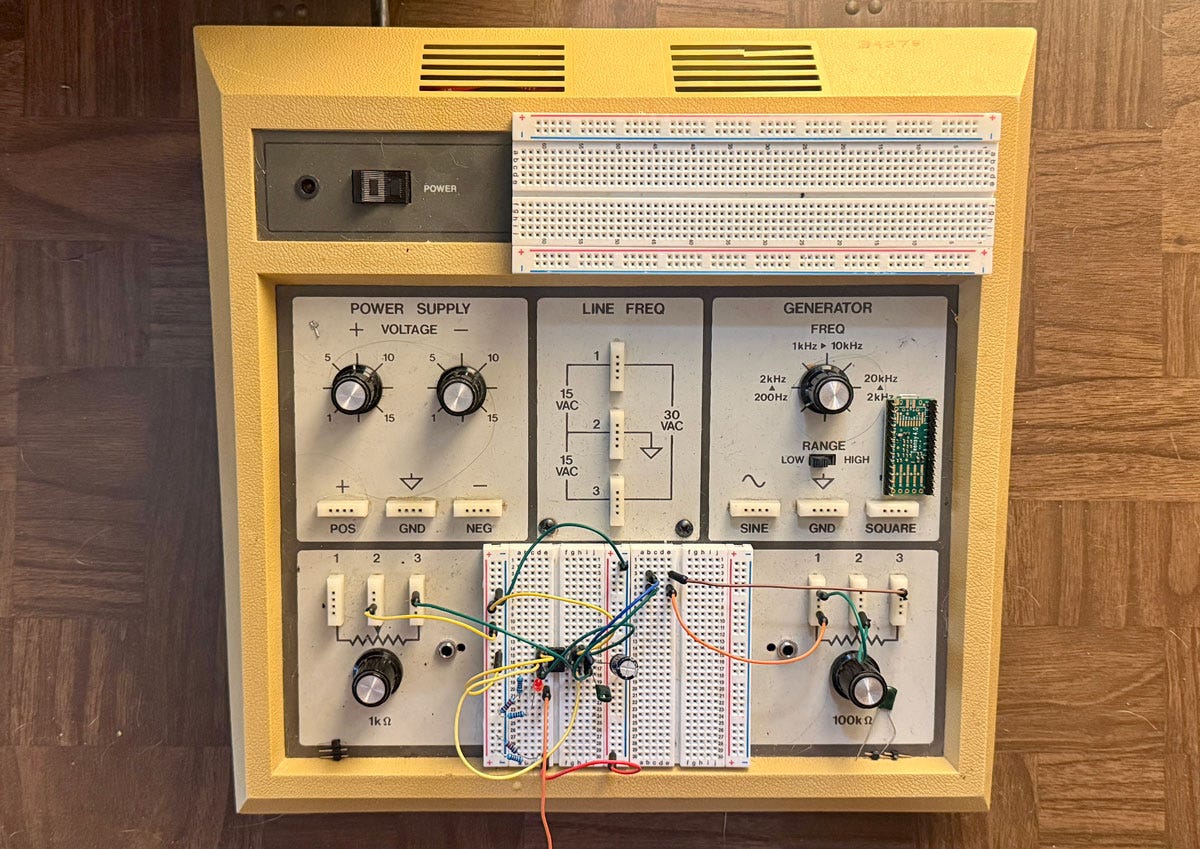
This was my very first sensor + Touch Designer test. I built the Touch Designer project to interpret the plant’s electrical signals into visuals and the hardware portion is a board called a Scion, which is a lovely little shortcut: it got me from nothing to a working prototype with the least possible friction. Now I'm learning to build the circuits from scratch.
So there’s a soldering iron on my desk, which I am still very much learning to use, and a growing pile of experiments.
The Elders Project takes that same idea and scales it to the size of a tree. It’s an idea I’ve been developing around Portland’s Heritage Trees, some of which have been standing here for well over a century: sensors reading what those trees are actually doing, translated into something a person can hear while standing at the trunk. Not a tree as subject matter. A tree as the other half of the conversation.
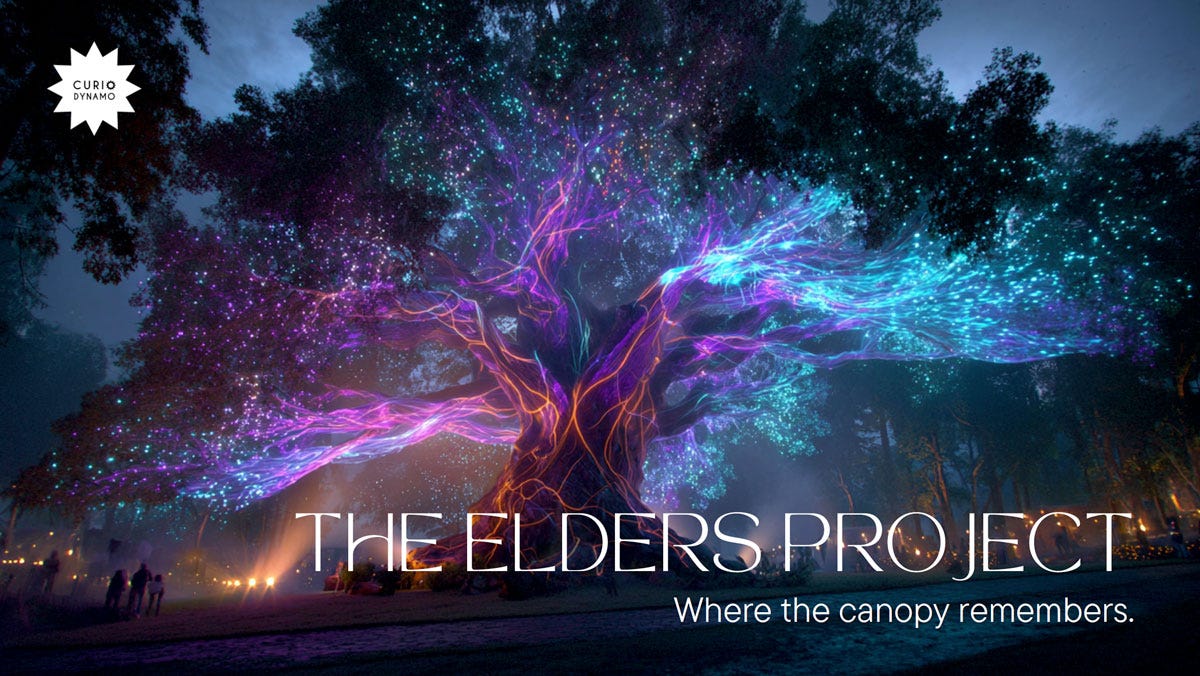
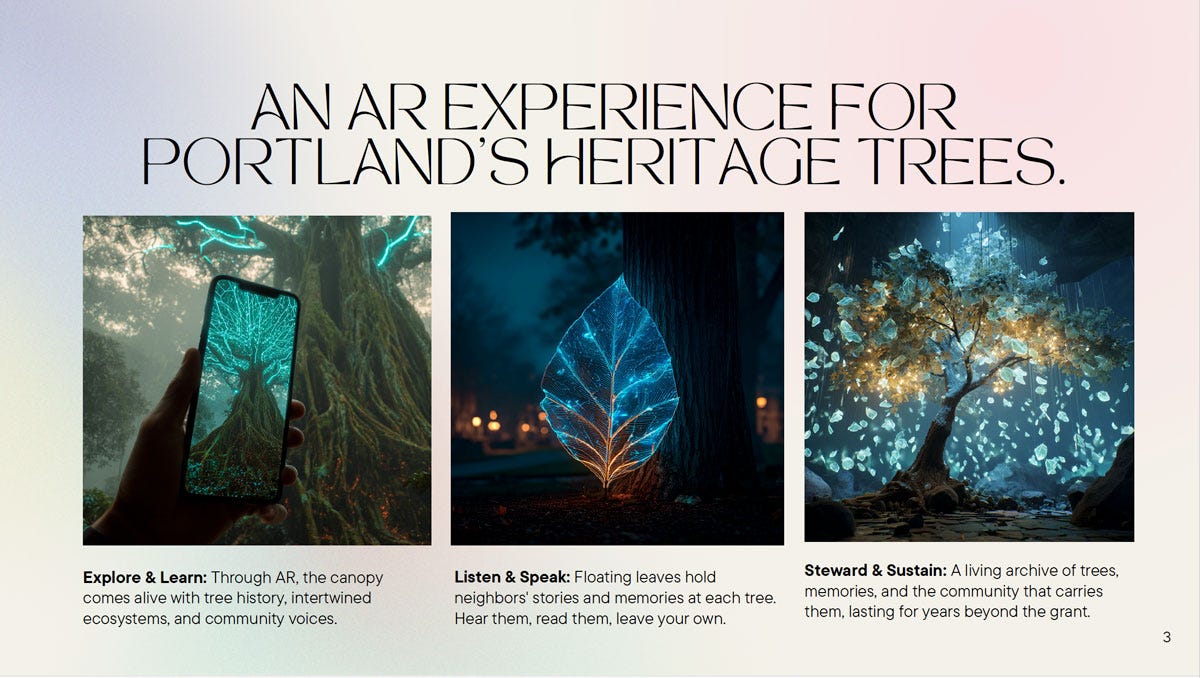
Same thing I’ve been chasing since the briar, really. Trying to build a door between people and the wonders of the world, and then holding it open.
Meanwhile, I’ve been building myself a maker’s studio.
I finally cleaned out the garage, which until recently was still packed with installation remnants from Lanterns of Light, the Portland Winter Light Festival project. From 2025. No need to clap.
What’s in there now is a huge roll of canvas and everything needed to stretch my own. I like to work big, and stretching your own is the affordable way to do that. It is also, and I want to be transparent here, an excuse to use more tools. Tee hee.
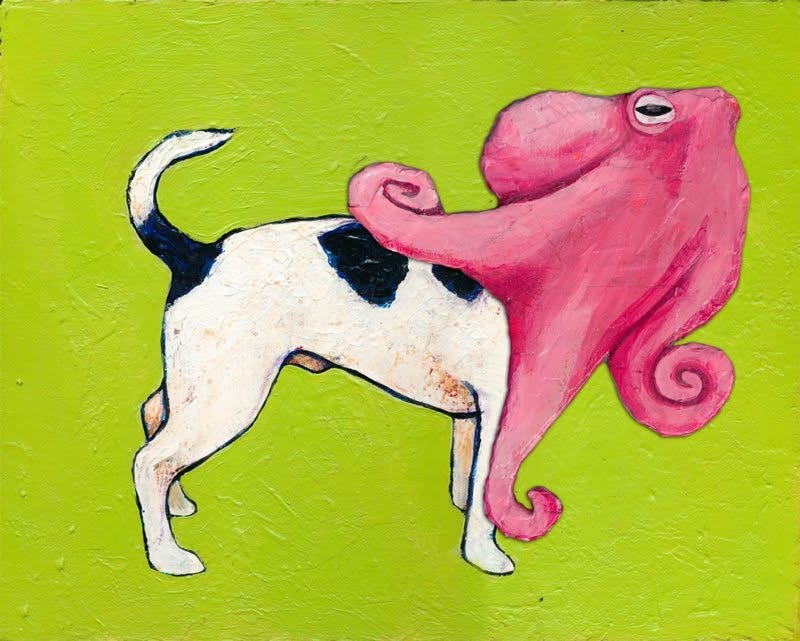
While I was digging through all of it I found a photo of a painting I made for a friend 20 years ago. It’s a portrait of their dog, Mr. Pickles, and it came with a set of magnetically attachable heads. An octopus head, a Cleopatra wig, etc.
It hit me that: I have always made interactive art. I just kept finding new tools to make it with. The magnets were an early version of the thing I’m still doing.
Now you know what I’ve been doing. Here’s a sneak peek at what’s next.
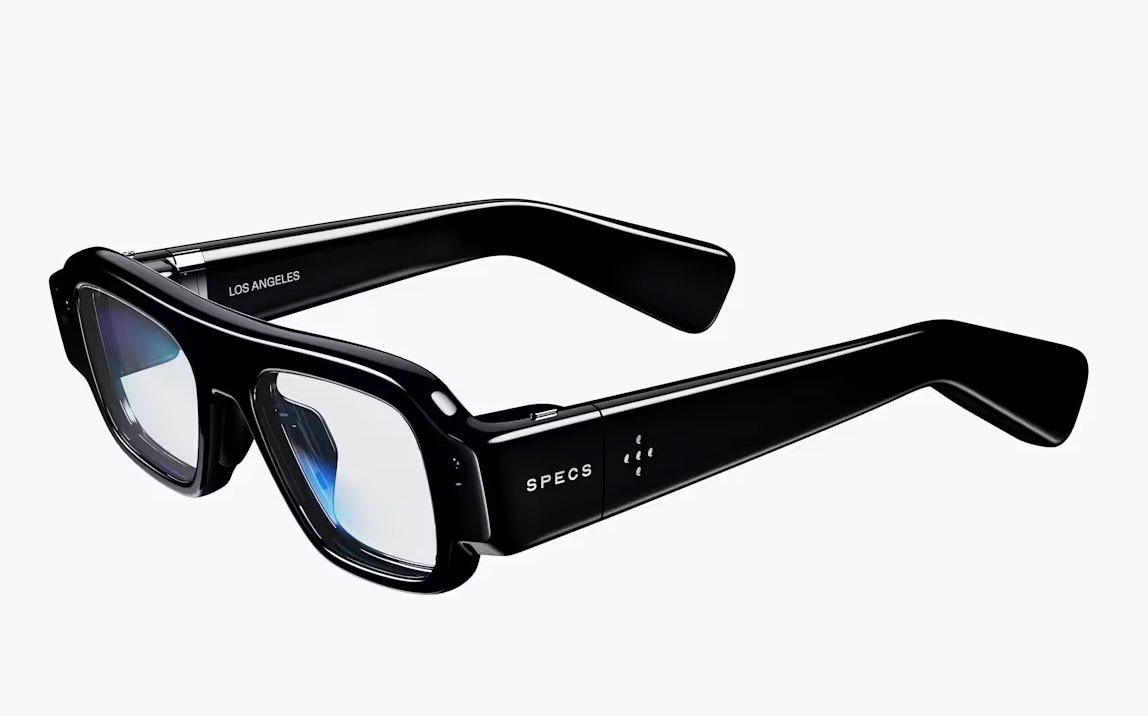
Snap’s consumer AR glasses, the Specs, arrive this year, and for artists working in this space it’s the thing we’ve been waiting on. Until now, building AR has mostly meant building for other XR people: conferences, demo tables, ninety seconds of a stranger’s attention through a borrowed headset. Consumer glasses mean regular people. Your mom. Someone on a train. Someone who has never heard the word “occlusion” and never needs to.
Suddenly AR has an audience, which means a lot more people are going to want to build for it. I've been thinking about what I'd tell someone starting from scratch today.
The honest answer isn’t to check out one particular program. I’ve watched enough AR tools appear and disappear to know that whatever I taught you this month would be half obsolete by spring. What survived every one of those transitions was never the software. It was understanding what AR is actually for.
Most people picture AR as a screen floating in front of your face. That's the least interesting thing it can do. What AR can do that nothing else can is read the room you're standing in and make it part of the story. The light. The floor. The wall behind you. The tree in front of you. Done well, the real world stops being the backdrop and becomes part of the story, and you get something that could only exist in that place, for that person, at that moment. That’s the magic trick. Everything else is a delivery mechanism.
So, I’m building an AR Creator Course. Not centered on one tool. This will teach the layer underneath, the evergreen stuff: how to think in 3D, how to make an interaction legible in the first three seconds, how to direct the eye in space, how to build an experience from concept to ship date.
It also feels like the right time to write it down. Years of figuring things out the slow way, mostly by breaking them, and almost none of it captured anywhere. If I can make someone else’s path a little shorter, that seems worth doing.
Because I believe XR is part of the evolution of storytelling. Which means it can’t only belong to engineers. It has to reach storytellers.
Which, dear reader, may be you. Is it?
If so, I’ve already started leaving things out for you. Three free pieces, no strings:
AR Design Checklist
·
Jul 10
A quick self-check to run against any AR project. Copy it per project, or just read down the list before you ship.
The course rolls out here, and a good chunk of it stays free. The deeper material, the advanced techniques, the project files, will be available for paid subscribers. Stay tuned. The first lessons will be dropping next week.
So, yeah. That is what is going on in my world.
I still don’t have a word for what I do. I’m increasingly convinced I don’t need one. The soup is doing what soup does, and the work I care about has never come from picking a lane. It’s come from picking up something I didn’t know how to use yet and asking what I could make with it.
If that’s how your brain works too, you’re in good company here. Come sit in the primordial soup with me. It’s warm.
And, surprisingly tasty.
With curiosity,
Heather
No posts
Comments
Nothing yet. Say the first thing.
Sign in to join the conversation.