
Dear Friends,
Many of you know Dr. Chelsey Richardson, DNP, as a Nurse Practitioner on our clinical team. She brings both depth of knowledge and genuine compassion to the work she does with patients every day.
In this piece, “You Are Not Your Genetics: The Biology of Hope,” Chelsey tackles a question many people quietly wrestle with — especially after watching a loved one battle chronic illness:
Am I destined for the same outcome?
She unpacks the science of epigenetics in a way that’s both accessible and empowering, reminding us that while genes set the stage, our daily choices help shape the story.
If family history has ever made you feel uncertain about your future health, I believe you’ll find this both clarifying and deeply hopeful.
— Dr. Turner
When you’ve watched a loved one walk through autoimmune disease, cancer, or another chronic illness, it’s easy to wonder if the same fate is waiting for you.
Am I destined for the same story? I have wondered the same, as autoimmunity runs in my family.
Thanks for reading! Subscribe for free to receive new posts and support my work.
Subscribe
The truth is—you are not defined by your genetics.
Genes may set the stage, but they don’t write the whole story. What matters most are the choices you make, the rhythms you keep, and the mindset that shapes how your body responds to life.
You are a living design—body, mind, and spirit—constantly shaped by how you move, what you eat, how you rest, who you love, what you think, and your faith.
Genetics sets the stage, but epigenetics directs the play.
(Epigenetics simply means how your body turns genes on or off in response to life.)
Your environment—things like nutrition, toxins, stress, sleep, love, and community—influences these switches every day.
Your body is always listening.
“Your genes may load the gun, but your environment pulls—or protects—the trigger.”
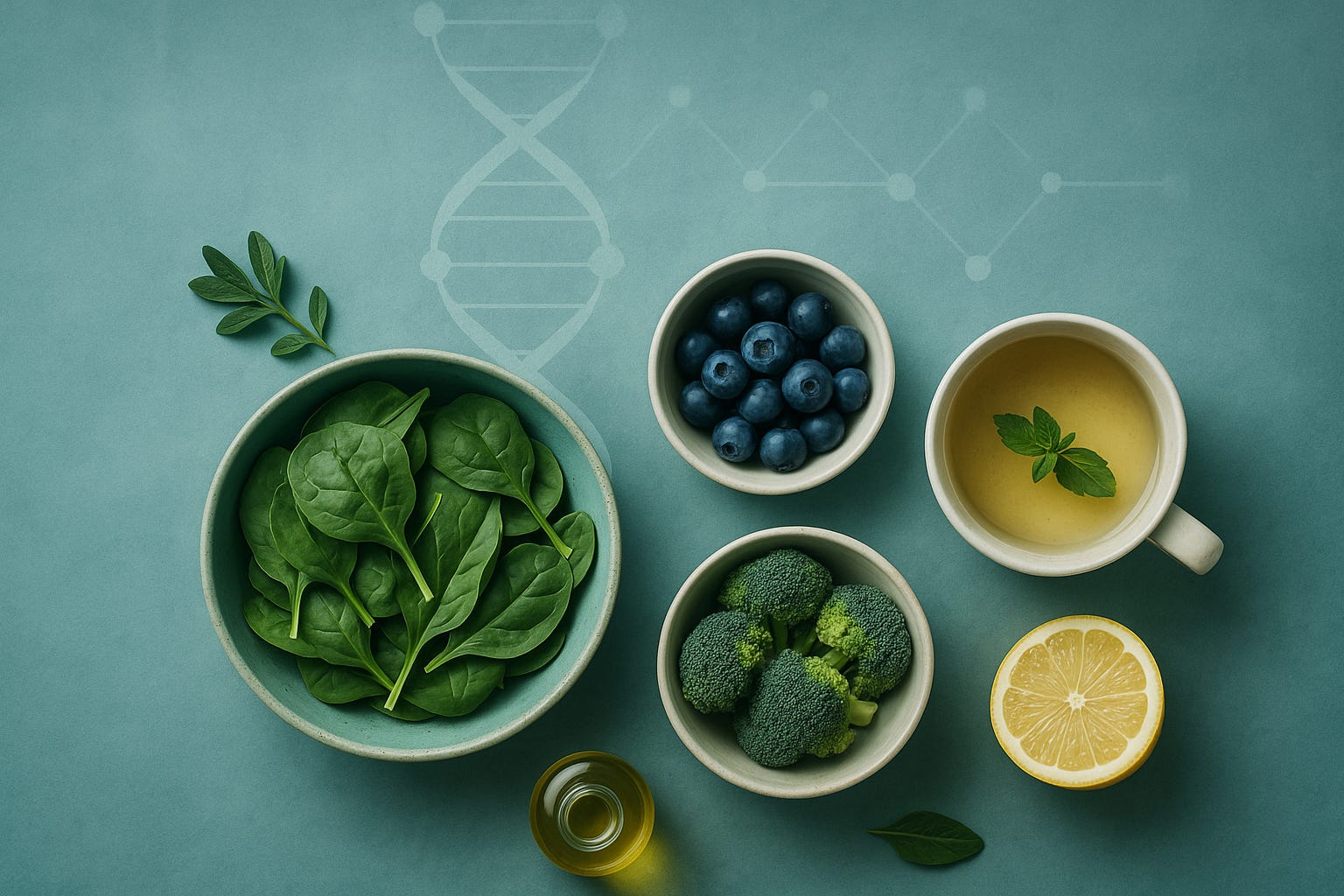
Cruciferous vegetables—broccoli, kale, and Brussels sprouts—carry sulforaphane and indole-3-carbinol, compounds that regulate enzymes involved in detox and inflammation.
Green tea, turmeric (curcumin), and resveratrol (found in grapes and berries) help quiet harmful genes and activate protective ones.
Methyl-donor nutrients—folate, choline, B12, and methionine—supply the building blocks for healthy DNA methylation.
Polyphenol-rich foods like blueberries, herbs, and pomegranates reduce oxidative stress and support gene balance.
These aren’t abstract ideas. Food is information—directing your very cells on how they will behave and express themselves.
If you look closely, you can see the fingerprint of design written into the language of life itself. DNA isn’t chaos—it’s code.
Four simple letters—A, T, C, and G—arranged in a way that directs every function of the human body.
Around that code are thousands of switches and modifiers, called epigenetic marks, that tell your cells when and how to respond. It’s a level of order that humbles even the most seasoned researchers.
From a faith lens, this is not random—it’s orchestration.The same precision that keeps your heart beating and your cells renewing is evidence of intention. Every feedback loop, every rhythm, every repair mechanism speaks of a Designer who built adaptability, not fragility.
Science calls it information.
Faith calls it wisdom.
Either way—it’s the signature of God.
And if you need proof that our genetic design was built to respond—not to stay static—just look at identical twins.
Some of the clearest evidence that environment shapes biology comes from identical twin studies. Identical twins share the same DNA, yet as they age, their health and even appearance can diverge dramatically.
Researchers have found twins who start life nearly identical, but by adulthood, one develops type 2 diabetes while the other does not. One twin may struggle with autoimmune thyroid disease while the other remains unaffected. Another pair might share the same genetic risk for breast cancer, yet only one develops the disease — often connected to differences in diet, toxin exposure, stress, or inflammation.
A landmark Nature Genetics study confirmed that identical twins raised in the same home still develop unique patterns of gene activity depending on lifestyle — things like sleep, exercise, stress, and food quality.
In other words, the same genes can create completely different outcomes depending on how they are “fed” by environment and behavior.
And when twins were studied after being separated at birth, the results were even clearer: shared DNA could not predict health, weight, mood, or even longevity.
Environment, mindset, and lifestyle played powerful roles in turning health-promoting genes on and disease-promoting genes off.
This is not theory — it’s the biology of hope.
Your genes hold possibility, but your daily choices decide the direction.
That same adaptive design is what makes your microbiome, hormones, and detox pathways so responsive to nourishment, rest, and environment. What we inherit is only the starting point…
We inherit more than DNA. We inherit our microbiome—the community of bacteria that begins to colonize us through our mother’s birth canal, breast milk, and early environment. This microscopic ecosystem influences digestion, immunity, and even mood.
But here’s the empowering truth: you may start with your mother’s microbiome, but you’re not stuck with it.
Every bite of food, every night of rest, every moment of stress—all of it shapes your gut community.
You can reshape it through:
Fiber-rich foods: vegetables, legumes, flax, chia
Fermented foods: sauerkraut, kimchi, kefir, yogurt
Colorful, diverse meals that feed different bacteria
Reducing alcohol, sugar, processed foods, and emulsifiers and glyphosate (AKA Roundup)
Managing stress—because anxiety and cortisol change gut permeability, diversity, and decrease your stomach acid
Limiting antibiotic use to only when necessary
The same goes for your body’s detox systems. Some people inherit slower detox pathways, meaning hormones and toxins linger longer—but those pathways can be strengthened.
Support your detox naturally with:
Cruciferous vegetables for phase II liver detox
Garlic, onions, and herbs to build glutathione
Beets, bitter veggies, lemon, and green tea to stimulate bile flow
Adequate protein for enzyme production
Hydration, sweating, and sauna therapy to support elimination
You might inherit a tendency—but that doesn’t define your future. Your body was designed to adapt and be resilient.
That’s the beauty of functional medicine: learning to work with your body, not against it, and strengthening what was once considered a weakness.
Sometimes what feels inherited is actually imitated. We take on not just DNA, but lifestyle rhythms—how those before us ate, rested, reacted, and coped.
Maybe your mom lived on Rice-A-Roni and buried her feelings.
Maybe your grandmother unwound each night with wine because she never learned to rest.
Maybe your dad worked until midnight, fueled by adrenaline and take-out.
These are the everyday patterns that quietly write themselves into our biology:
The Starbucks drive-through latte that becomes breakfast.
Sitting all day at a desk or ballfield, calling it “productive.”
The family gatherings that don’t feel complete without casseroles, rolls and baked treats.
The belief that busyness equals loyalty and rest is indulgent.
TV, news, and endless scrolling—binge-watching to numb the day instead of living in real life and engaging with loved ones.
Treating ourselves with dessert every night as a reward for our day’s struggle.
Calling five friends when stressed instead of pausing to pray.
People-pleasing or perfectionism that keeps cortisol high and peace low.
Over-giving and under-resting—passed down as “normal womanhood.”
Believing that boundaries are selfish or that joy must be earned.
The dads that “don’t like vegetables” and we’ve just accepted it as so.
Worshipping our children so completely that we set aside our own basic needs—and our relationship with God and spouse—in the process.
Some of these patterns began as moral drift or misplaced priorities. Others are simply unhealthy habits we’ve learned to accept as normal. Over time, they’ve become learned behaviors—modeled generation after generation until they feel like identity.
They shape cortisol, blood sugar, inflammation, and even gene expression, constantly forcing the body into self-preservation—a state it was never meant to live in for long. This ongoing strain often leads to fatigue, inflammation, and dis-ease.
And because God designed our bodies to adapt, we adapt—even to dysfunction. But that same design means change is always possible. Every time you choose nourishment over numbness, prayer over panic, rest over striving, movement over stagnation, you send your body a new message—one that says healing is possible.
That’s epigenetics in real life.
Awareness isn’t guilt—it’s grace. The moment you choose compassion over condemnation, you can honor where you came from without repeating it.
When you see your patterns clearly, they lose their power to define you. You become free to choose differently—for yourself, and for those who come after you.
This is how transformation begins: with the willingness to notice where growth and change are needed, and the courage to break the cycles that keep you stuck.
Taking an honest inventory is the first act of healing.
Start small—with one habit that has become ingrained but needs an overhaul.
Then build simple rhythms that remind your body—and your soul—what safety feels like.
(You can’t do all of this at once—and you’re not meant to. Small, steady shifts create real change without extra stress.)
Sleep deeply: protect your circadian rhythm.
Move often: walk, lift, stretch—movement flips on longevity genes.
Eat color: crucifers, berries, herbs, omega-3s, and clean proteins.
Support your gut: fermented foods, fiber, and fewer processed foods.
Reduce toxic load: clean air, filtered water, gentle home products.
Manage stress: prayer, journaling, therapy, or time in nature.
Cultivate connection: love, belonging, and joy calm inflammation.
Address trauma, fear, unforgiveness, and brokenness: what isn’t transformed is transmitted.
Support your unique genetics: targeted nutrition and testing.
Epigenetic hair analysis can reveal nutrient needs, toxin exposures, and stress patterns—a snapshot of how your genes are expressing today.
Your body is always speaking. It just needs someone to help translate what it’s asking for.
And yet, one of the most profound regulators of our biology isn’t found in food or movement—it’s faith.

Faith doesn’t just change our outlook—it changes our biology.
Prayer, meditation, and spiritual connection activate the body’s rest-and-repair pathways, lowering heart rate, calming inflammation, and supporting immune balance (Koenig, 2020).
Studies show that people who pray or meditate regularly have lower cortisol levels and stronger heart-rate variability—signs that the nervous system is shifting from stress to safety (Lehrer et al., 2020).
Regular worship or time spent in a faith community has even been linked with longer telomeres—the protective caps on our DNA that shorten with stress and aging (Hill et al., 2016; Koenig et al., 2016).
Practices like gratitude, worship, and forgiveness can influence gene expression in stress-response pathways, literally changing the way our bodies process fear, inflammation, and healing (Fredrickson et al., 2013).
Science calls this neuroplasticity and epigenetic modulation. Faith calls it renewal.
It’s a reminder that peace is not passive. It’s a physiological signal to the body that it’s safe to heal.
Every time you pray, breathe, rest, forgive, or give thanks, you raise your body’s frequency into the peace God designed for you—rewriting the chemistry of stress into the biology of hope.
Even with all we know, science still can’t explain the divine orchestration happening in your body every day. That mystery humbles me and reminds me that healing is both scientific and sacred.
You are not powerless. You are not your diagnosis. (More on the power of the spoken word another time.)
Take a quiet moment this week and ask yourself: Which patterns have I accepted as normal? What would it look like to nourish instead of repeat?
Awareness is grace—the gentle way God invites us to see what’s ready to be healed.
Healing isn’t about perfection. It begins when you slow down and listen—to your body, to God, and to what you truly need. Every time you breathe, pray, move, laugh, rest, or nourish yourself, you’re coming back into alignment with God’s divine rhythm.
You are fearfully and wonderfully made.
Your body is resilient, adaptable, and wise.
You are not your genetics. You are designed to flourish.
If this message resonated, I created a simple action guide to help you apply these principles in daily life.
“Genetics Isn’t Destiny: A Simple Action Guide to Support Healthy Gene Expression” includes practical steps for nourishment, gut support, detox pathways, and renewal.
👉 Download the free guide here
— Dr. Chelsey Richardson
Know someone walking through this season? You can share this post with them as a reminder that healing is possible.
If this message spoke to you, I’d love to hear your reflections in the comments below. And if you’d like more faith-rooted conversations about healing and design, you can subscribe to receive future posts.
Dr. Chelsey Richardson, an esteemed graduate of the University of Washington, holds a Doctorate in Nursing Practice and is a Board-Certified Family Nurse Practitioner. She is also an Institute for Functional Medicine Certified Practitioner (IFMCP) — the highest level of training in root-cause, systems-based care.
With nearly two decades in healthcare, Chelsey has served patients in hospitals, family practices, walk-in clinics, women’s health centers, and through telemedicine. This breadth of experience allows her to blend the best of conventional medicine with the integrative, personalized approach of functional medicine.
Her passion for holistic wellness began early. Growing up, she watched her grandparents brew kombucha, stock shelves with supplements, and consult a well-worn copy of Whitaker’s Guide to Natural Healing. Later, witnessing family members with autoimmune conditions struggle in the conventional system—and facing her own challenges with adrenal PCOS, acne, gut dysbiosis, low thyroid function, anxiety, and tendon injuries caused by a fluoroquinolone antibiotic—deepened her commitment to root-cause medicine. Having personally walked the road of complex health struggles, she understands what it’s like to search for answers. This lived experience inspired her to pursue advanced training in functional medicine, where she found the tools to restore her own health and now guides others to do the same.
Michael K. Turner, M.D., is a graduate of Stanford University, Harvard Medical School and The Mayo Clinic. He practices Integrative Medicine in his own national concierge practice, providing personalized approaches (including hormones, sleep, recovery, nutrition, supplements and exercise) to help people achieve their optimal state of health. Called “genuine”, “caring”, and “the best doctor in the world” by patients, he brings a high degree of empathy, trademark optimism, and a holistic approach to patient care. He brings a passion for excellence to everything he does. He believes in living and modeling a healthy, balanced lifestyle.
What would it feel like to be as healthy as you could possibly be?
You can connect with me at www.MichaelTurnerMD.com
No posts
Comments
Nothing yet. Say the first thing.
Sign in to join the conversation.