
By Dr. David Traster, DC, MS, DACNB
Co-owner, The Neurologic Wellness Institute
Boca Raton • Chicago • Waukesha • Wood Dale
www.neurologicwellnessinstitute.com
For decades, depression has largely been discussed through the lens of neurotransmitters. Serotonin, dopamine, norepinephrine, and, more recently, glutamate have dominated conversations surrounding the neurobiology of major depressive disorder. These neurotransmitter systems are unquestionably important, but the human brain does not function independently from the rest of the body. Every neuron requires energy. Every synapse depends upon adequate cellular metabolism. Hormones communicate continuously with the nervous system, and inflammatory signals generated throughout the body can influence how the brain functions.
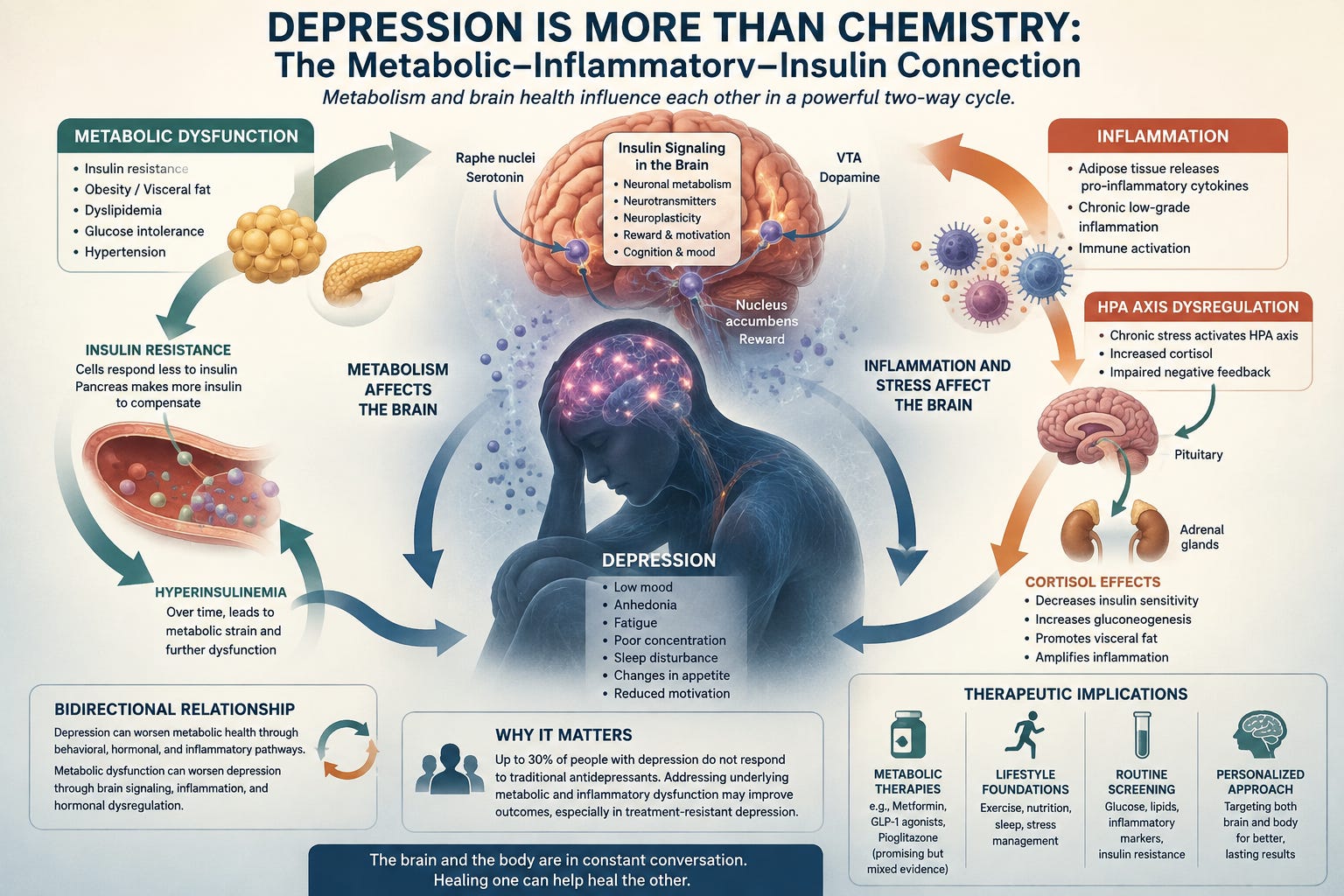
A growing body of research suggests that metabolic health may therefore be much more closely connected to mental health than we previously appreciated. A recent review published in Frontiers in Psychiatry examined the relationship between metabolic dysfunction, insulin resistance, inflammation, and major depressive disorder. The research raises an important clinical question: Could metabolic dysfunction be contributing to depression in certain patients, particularly those who do not respond adequately to conventional antidepressant treatment?
The answer appears increasingly complex, but the connection is difficult to ignore.
Most people associate insulin with diabetes and blood sugar regulation. Insulin is produced primarily by pancreatic beta cells and released in response to circulating glucose. Following a meal, insulin helps move glucose toward tissues where it can either be used for energy or stored for later use. However, insulin does much more than regulate blood glucose.
The brain contains insulin receptors, and insulin signaling participates in neuronal metabolism, learning, memory, synaptic plasticity, and other aspects of nervous system function. Insulin receptors are present within areas involved in mood and reward processing, including the raphe nuclei, amygdala, ventral tegmental area, and nucleus accumbens.
These regions also interact closely with serotonin and dopamine systems. This means that insulin should not simply be viewed as a metabolic hormone operating outside the nervous system. It is also part of the biochemical environment through which neurons communicate, adapt, generate energy, and regulate behavior. When insulin signaling becomes dysfunctional throughout the body, the consequences may therefore extend into the brain.
Insulin resistance occurs when tissues become less responsive to insulin. Initially, the pancreas can compensate by producing greater amounts of insulin. This may maintain relatively normal glucose levels for some time, which is one reason metabolic dysfunction can develop long before overt diabetes becomes apparent. Eventually, however, compensation may become insufficient.
Persistent metabolic stress can contribute to beta-cell dysfunction, hyperglycemia, and eventually type 2 diabetes. Insulin resistance is frequently associated with obesity, particularly visceral adiposity. Excess adipose tissue is biologically active and capable of generating inflammatory signaling. This chronic low-grade inflammatory environment can interfere with insulin signaling, which can further promote metabolic dysfunction.
The result can become a vicious cycle. Obesity promotes inflammation. Inflammation interferes with insulin signaling. Insulin resistance contributes to metabolic dysfunction, and metabolic dysfunction can promote additional fat accumulation and inflammation. The brain is participating in this physiology the entire time.
One of the most fascinating bridges between metabolic dysfunction and depression involves inflammation. Insulin resistance and chronic inflammation frequently coexist and can reinforce one another. Obesity itself can produce persistent low-grade inflammatory signaling throughout multiple tissues. Inflammatory cytokines can also communicate with the central nervous system. Some inflammatory signals can influence the brain across the blood-brain barrier, while inflammatory signaling can also occur locally through cells such as microglia.
Once these inflammatory pathways influence the nervous system, their effects can extend far beyond what we traditionally think of as “inflammation.” Inflammatory signaling can influence neurotransmitter metabolism, amino acid metabolism, neurotrophic factors, neurogenesis, neuroendocrine activity, and the neural networks responsible for regulating mood.
This provides one possible explanation for why chronic inflammatory diseases frequently coexist with depression. The relationship does not necessarily mean that inflammation causes every case of depression. Depression is extraordinarily complex and can emerge through many different biological, psychological, environmental, and social pathways. However, in some individuals, chronic inflammation may be one important physiological contributor.
Another major piece of this puzzle involves the hypothalamic-pituitary-adrenal axis, commonly called the HPA axis. The HPA axis is one of the body’s primary systems for coordinating responses to stress. When the brain perceives a threat to homeostasis, this system helps regulate the release of cortisol and other physiological responses necessary for adaptation. Problems can develop when this system remains persistently activated.
Chronic stress and depression have both been associated with alterations in HPA-axis function. Chronic inflammatory signaling may further interfere with normal feedback mechanisms controlling this system. Elevated glucocorticoid activity can then influence metabolism. Cortisol can decrease insulin sensitivity, increase gluconeogenesis, and promote abdominal adiposity. Visceral adiposity can subsequently increase inflammatory signaling and worsen insulin resistance.
Another cycle begins to emerge. Chronic stress can alter HPA-axis activity. Altered HPA-axis activity can worsen insulin resistance and visceral adiposity. Visceral adiposity can increase inflammation. Inflammation can influence the brain and further dysregulate the HPA axis.
Rather than thinking about depression, stress, obesity, inflammation, and insulin resistance as completely separate conditions, it may be more appropriate in some patients to think of them as interacting components of the same physiological network.
Comments
Nothing yet. Say the first thing.
Sign in to join the conversation.