
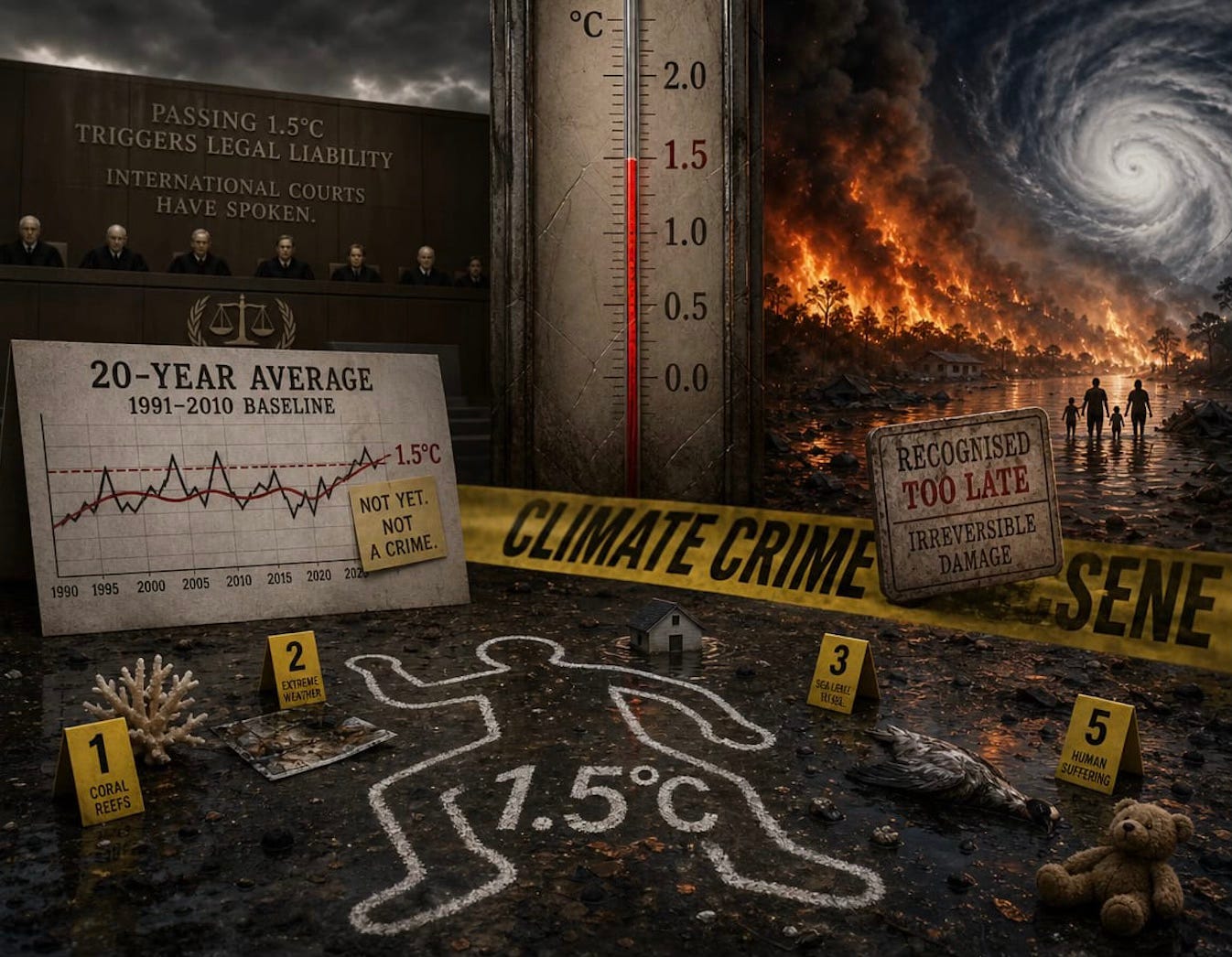
For nearly a decade, the Paris Agreement’s 1.5°C and 2°C temperature thresholds were treated primarily as political north stars—aspirational, voluntary targets designed to encourage incremental national ambitions. That era is over.
Through landmark advisory opinions from the world’s highest judicial bodies—most notably the International Court of Justice (ICJ) and the International Tribunal for the Law of the Sea (ITLOS)—those numbers have been stripped of their soft-law flexibility. They have been codified as objective, binding baselines under customary international law. Crossing them is no longer framed merely as a tragic political failure, it is increasingly defined as a trigger for international legal liability.
Yet, just as global jurisprudence acquires the teeth to hold high-emitting states accountable, a quiet accounting crisis threatens to undermine the entire architecture. International climate science relies on multi-decadal moving averages to formally declare when a threshold has been crossed. This statistical smoothing creates a decade-long enforcement vacuum—a legal immunity zone where states can claim compliance while real-world physical damages are being accrued.
The transition from voluntary pledge to statutory standard occurred through two major judicial developments. First, ITLOS unanimously established that anthropogenic greenhouse gas emissions constitute marine pollution under Article 192 of the UN Convention on the Law of the Sea (UNCLOS).12 Because the oceans absorb the vast majority (89%) of excess heat accumulation, failing to curb emissions to stay within Paris-aligned pathways places states in direct breach of their statutory duties to protect the marine environment.
Shortly after that, the ICJ addressed the core mechanics of state responsibility.3 The Court ruled that states have a binding duty of due diligence to prevent transboundary environmental harm under customary international law. Crucially, the Court removed much of the discretion states previously claimed when designing their Nationally Determined Contributions (NDCs), emissions reduction policies developed by the signatory states of the Paris Agreement, updated every 5 years.
Under this updated standard:
NDCs must strictly align with the best available science—specifically Intergovernmental Panel on Climate Change (IPCC) pathways targeting 1.5°C.
Customary law applies universally. Even if a government formally withdraws from the Paris Agreement (like the US), its legal obligation to prevent dangerous warming remains intact.
Failing to exercise due diligence constitutes an Internationally Wrongful Act4, triggering the Law of State Responsibility, which requires offending states to cease harmful conduct and provide financial reparations for attributable loss and damage.5
While the legal theory is now robust, its practical application hits a major hurdle: how we actually measure global temperature and warming.
Under standard IPCC and World Meteorological Organisation (WMO) protocols, a “breach” of the Paris Agreement is not defined by an individual hot month or a single anomalous year (such as 2024). To filter out internal climate variability—like El Niño-Southern Oscillation (ENSO) cycles, the scientific consensus requires a ‘multi-decadal’ global mean surface temperature average.
However, the Paris Agreement text doesn’t define precisely how many decades is meant by ‘multi-decadal.’ The IPCC AR6 Summary for Policy Makers published in 2023 states in a note: “Global warming (see Annex I: Glossary) is here reported as running 20-year averages, unless stated otherwise, relative to 1850–1900.” Checking the glossary, it states: “Global warming refers to the increase in global surface temperature relative to a baseline reference period, averaging over a period sufficient to remove interannual variations (e.g., 20 or 30 years). A common choice for the baseline is 1850–1900 (the earliest period of reliable observations with sufficient geographic coverage), with more modern baselines used depending upon the application.”6
However a different approach was used in December 2023 for the first Global Stocktake7, a report required by the Paris Agreement to track progress every 5 years, with the first in 2023. The report stated the temperature situation in one sentence: “Earth’s global average surface temperature in 2011–2020 was around 1.1°C higher than the pre-industrial average.” This suggests a 10 year historic average approach, not 20 or 30 years. It was also 3 years out of date, since they took the number from the last IPCC report, rather than the modern data sources.
Even if a period could be agreed upon, there is still a significant difference between a historic and a centred average approach. The Global Stocktake used a historic approach. The IPCC AR6 WP1 states “20-year running average”, but then goes on to infer a centred average whereby the temperature for a specific year uses 10 years historic and 10 years future trend as the average.
However both a 10 year historic and a 20-year centred average require ten years of data after a given point to confirm the mid-point temperature. Science faces an inherent lag: we cannot formally confirm that we have crossed 1.5°C until roughly a decade after the physical reality has occurred.
Looking at the most up to date data trend (figure 1), the differences are clear. 2025 was either 1.12°C on a 20 year historic average, 1.30°C on a 10 year historic average, or 1.5°C on a centred average projecting forward the current 45 year polynomial trend. That’s a big difference because of the rapid rate of increase. In a more stable climate there would be hardly any difference, but that is clearly no longer the case.
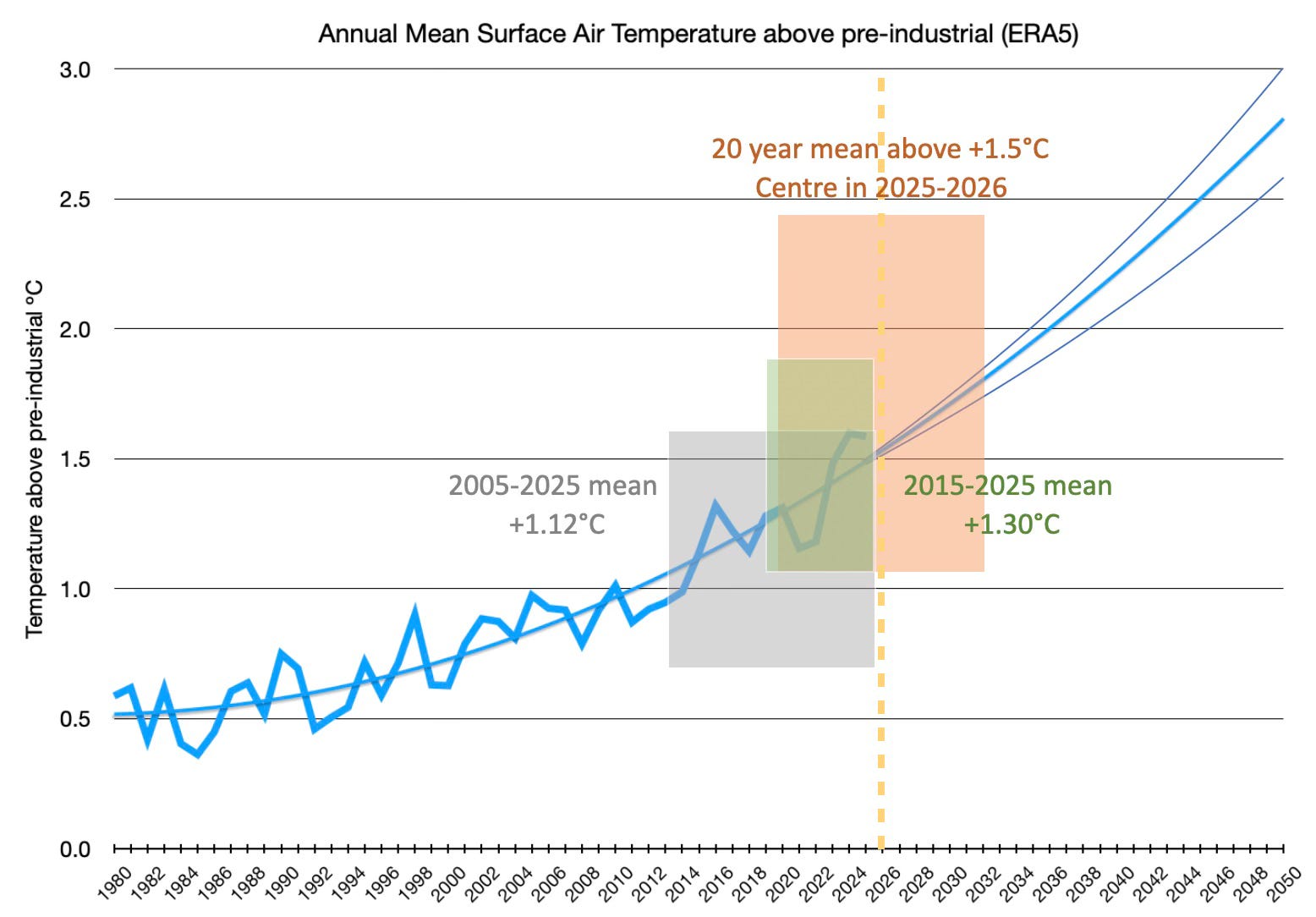
The next bone of contention is how the future should be treated; linearly, but over what period; polynomially; model based on emissions pledges; model based on current policy; include or exclude likely tipping elements… Agreement from a legal perspective is unlikely.
This statistical delay creates a dangerous mismatch between environmental physics and legal accountability. Since it was used in the case in the Global Stocktake, it’s fair to assume a 10 year historic average will be used in the future, but based on data from the last IPCC report (hence 2020 data in the 2023 stocktake). The next IPCC report, AR7 may be available in time for the 2028 stocktake, but the method that employs is anyone’s guess at this stage.
Meanwhile the planet actually sails through 1.5°C on its way to possible 2°C by the time 1.5° is finally legally acknowledged.
Earth systems do not respond to 20-year rolling averages; they respond to real-time thermal stress and atmospheric carbon concentrations. Critical tipping elements, especially those that result in further GHG emissions or significant harm, such as the thaw of boreal permafrost, or the destabilisation of the West Antarctic Ice Sheet, can be triggered by acute, multi-year temperature spikes. By the time a 20-year average formally logs the breach, the physical feedback loops will already be self-sustaining.
It also creates a false impression that there is a ‘remaining carbon budget’ to stay below temperature thresholds.
This lag provides high-emitting states and corporate actors with a potent defence in court. When sued by climate-vulnerable nations, youth groups, or NGOs for failing to cut emissions, state defence teams can point to the multi-decadal metric and argue that the Paris Agreement has not technically been breached yet. This allows states to justify ongoing fossil fuel licensing during the exact window when rapid decarbonisation is physically required. A position not helped by repeated claims that there is still a remaining carbon budget for 1.5° which is clearly not the case.8
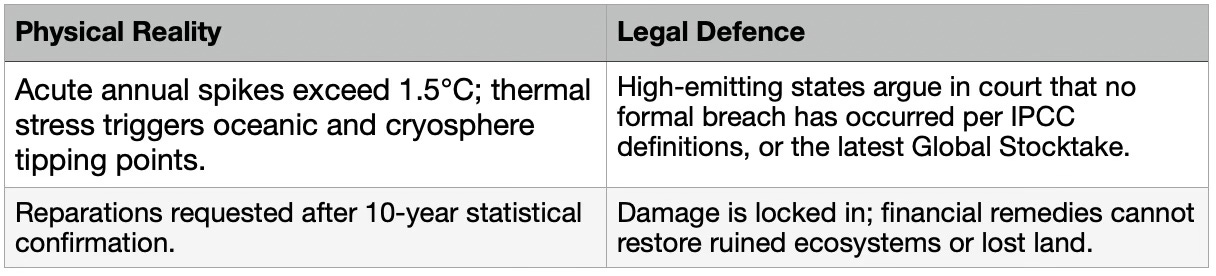
Triggering the breach makes responsible states liable for damages and reparations, but if these are un-justly delayed by a decade or more, those real-world damages, caused by the realty of 1.5°C will go unanswered.
When international courts finally confirm a breach a decade late, the Law of State Responsibility will apply to a landscape of permanent loss. Financial compensation cannot restore melted glaciers or submerged low-lying island territories. The measurement lag converts proactive legal prevention into post-mortem accounting.
Despite the statistical delay, domestic courts are increasingly becoming the arena where this tension is fought out. Litigants are using the ICJ and ITLOS findings to challenge national policies using real-time scientific indicators rather than waiting for retrospective confirmation.
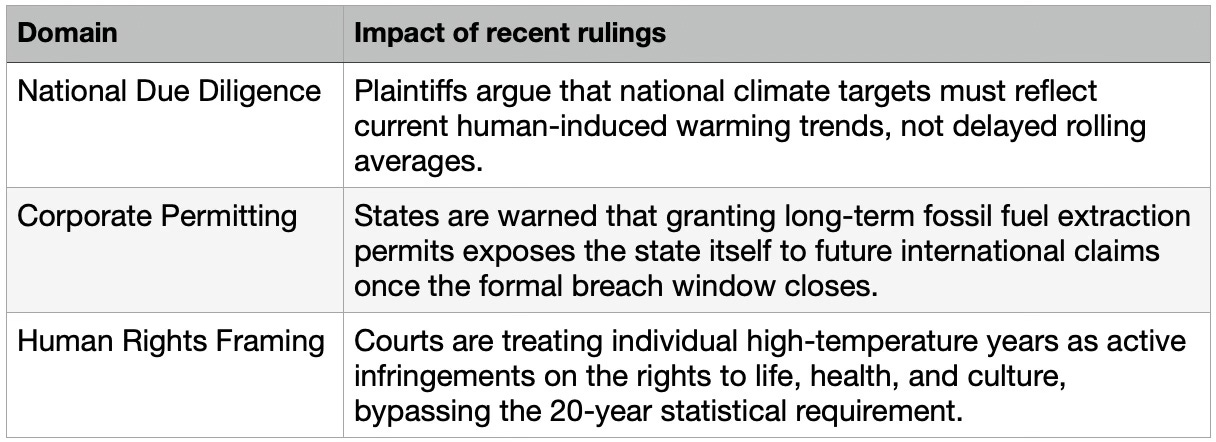
To prevent the Paris Agreement’s legal teeth from being blunted by this statistical lag, both scientific and legal communities need to refine how climate compliance is assessed.
Courts should not rely exclusively on long retrospective averages to evaluate whether a state is fulfilling its due diligence obligations. Instead, legal accountability could be tied to real-time indicators of human-induced warming—such as tracking atmospheric greenhouse gas concentrations, Earth’s Energy Imbalance, radiative forcing, and annual carbon emissions against IPCC-aligned pathways.
If a state’s current emissions trajectory is mathematically incompatible with staying under 1.5°C, and lets face it, that includes just about every state on the planet, the breach of due diligence is occurring now, regardless of when the 20-year temperature curve catches up with reality.
International jurisprudence has established a vital precedent: temperature targets are binding legal boundaries, and violating them carries real consequences under international law.
However, law is only as effective as the metrics used to enforce it. If international institutions allow multi-decadal smoothing to delay the formal recognition of threshold breaches, they grant high-emitting nations a temporary legal free pass precisely when action is most urgent.
To give global climate law real power, we must measure the crime in real time—before the damage becomes irreversible. This should be discussed and agreed at the next COP meeting, adopted by the IPCC (preferably ahead of AR7 and the 2028 Global Stocktake) and ratified by the courts. We no longer live in a world defined by averages, but in a world defined by standard deviations. The science needs to adapt to it in order to protect both humanity and the ecosystem we utterly rely on.
If you found this article interesting or useful, please tick the ❤️ button as it helps the algorithm point more people in this direction and gives us feedback on what subjects are most useful. Thank you!
ITLOS, Request for an Advisory Opinion submitted by the Commission of Small Island States on Climate Change and International Law (COSIS), Advisory Opinion, 21 May 2024, paras. 178–180.
UNCLOS, 10 December 1982, 1833 U.N.T.S. 396 (specifically Article 192 on the general obligation to protect the marine environment and Article 194 on measures to prevent, reduce, and control pollution).
ICJ, Obligations of States in Respect of Climate Change, Advisory Opinion, 23 July 2025, paras. 224, 234–240.
International Law Commission (ILC), Draft Articles on Responsibility of States for Internationally Wrongful Acts (ARSIWA), 2001, UN Doc. A/56/10 (specifically Articles 1–2 on invocation of responsibility, Article 30 on cessation, and Articles 31 & 34 on reparations for harm).
International Law Commission (ILC), Draft Articles on Responsibility of States for Internationally Wrongful Acts(ARSIWA), 2001, UN Doc. A/56/10, Arts. 1, 30 & 31.
IPCC, 2021: Climate Change 2021: The Physical Science Basis (WG I), Chapter 1 & Summary for Policymakers (defining global mean surface temperature 20–30 year centered averages).
Comments
Nothing yet. Say the first thing.
Sign in to join the conversation.