
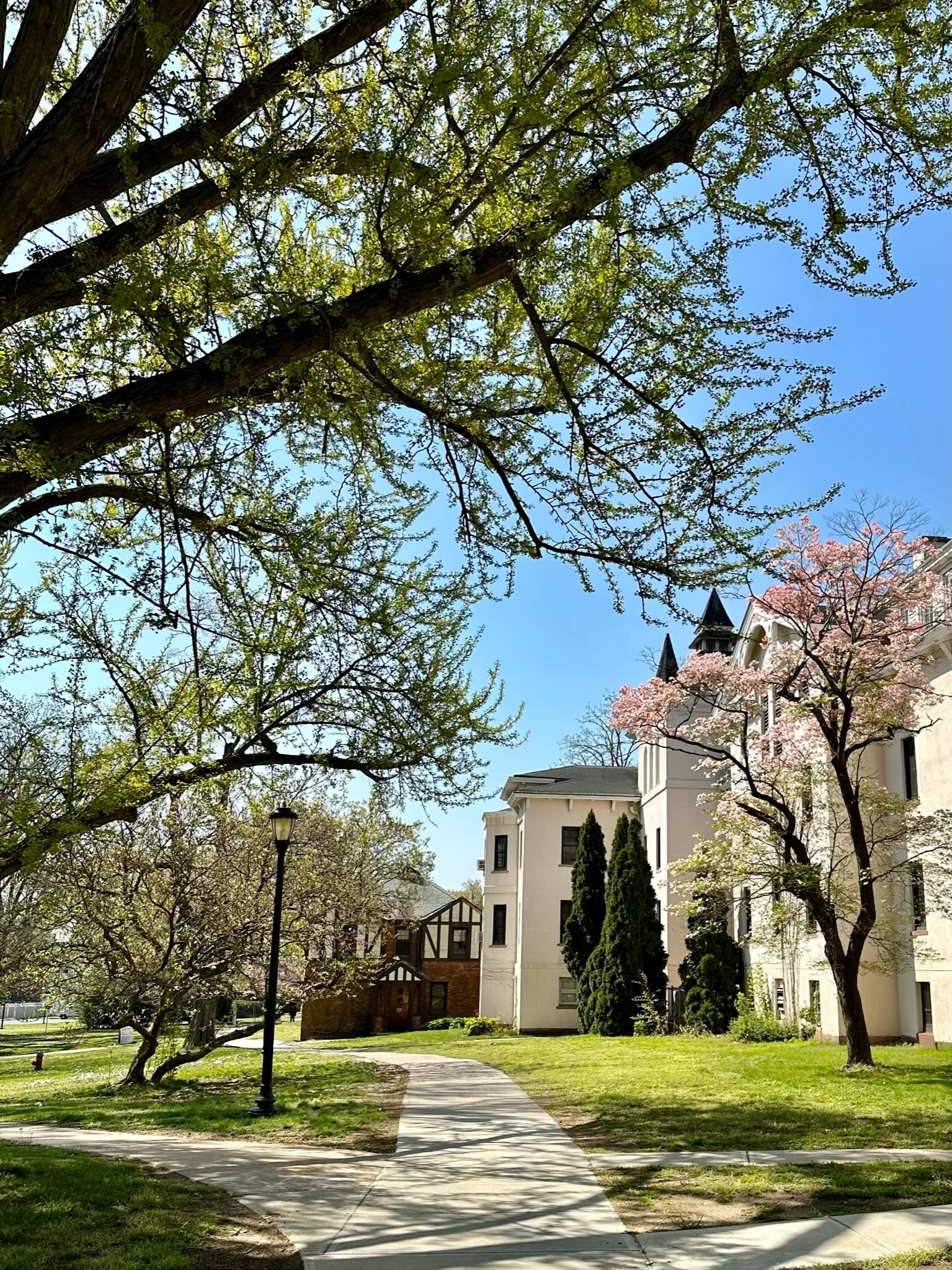
Spring in New England brings a different kind of light on my morning drive. Filtering through the bare branches in thin pale shafts. Green tinged and tentative, as the leaves hold back from fully unfolding. Fragile blossoms appear overnight and fall just as quickly, crushed underfoot into a faint sweetness and decay on wet pavement after spring rain. Stone walls line the gray roads, holding their boundaries the way they have for centuries. Dark with the stain of winter moisture that has not yet dried. The season announces itself and then gingerly retreats. Something is gathering. The fullness awaits.
Many years ago during the spring of my third year in medical school, I was enthralled by the cycle of life in my obstetrics and gynecology rotation.
I met a woman. I do not remember her name. I remember the desert city of Beersheva baked in summer heat. The sand-dusted streets. She arrived for her appointment in a pickup truck. Her husband behind her. His white keffiyeh pressed against the leather of his jacket. His weathered face tight with worry he was trying not to show. She stood tall and statuesque, with the kind of bone structure that commanded a room. Now the sharp angles of her jaw, the hollows beneath her bones, told a different story. Her once bright eyes were dimmed. She had been losing weight for months and nothing had made sense.
We quickly went from the clinic to the operating room. Somehow, I stood in front of her opened abdomen and our team immediately understood. The cancer had migrated and proliferated and colonized her interior in order to survive. It too, was a living thing. Cancer cells were ruthless and indifferent in their fight for survival. We rushed out of the cold sterility into the warm hallway. My blue shoe covers slid across the cool white tiles. Still in my gown. Hands clenched. Heart beating furiously. Working to rearrange myself into something professional. Her husband was standing near the wall. When the doctor approached him, he reached out both hands, took the doctor’s hand inside his, and kept thanking him. His knuckles were rough and brown. He would not let go.
What is he thanking us for? I wondered.
Her condition deteriorated fast. I visited her a few times after the surgery. She lay in the bed with the same elegance that she sat in the clinic. Her dark clothing and hospital gown incongruous against the quadruple occupancy hospital room. Frail curtains in compartments. No privacy. No dignity. Her eyes tracked the ceiling with patience. Her family filled the corridor outside. The sounds of their presence were on a different register than the rest of the hospital. The light was fluorescent and unsparing. Stripping everything down to something real.
I had come into medical school believing I would learn medicine and become the kind of physician who looked into a person’s eyes and brought comfort to their suffering. That was the story I carried about myself. Curious. Empathic. Someone who would see the human being beneath the diagnosis.
What I did, seated at the side of that woman’s bed, was freeze.
I did not speak her language. I did not know her world. I had been taught to look for flowers on the nightstand, for creased photographs, for a tattoo on a forearm, the small artifacts of a life that remind you that a patient is a person. Her room held none of those things, or rather, it held things I did not know how to read. And so I stood there, performing attention while doing almost nothing with it. I wrote in my notes. I nodded at the attending. I moved on to the next bed.
Towards the end of my rotation, I asked my professor about her. She was in the intensive care unit.
You should visit her. She probably remembers you.
Again, I froze. I filled with a paralyzing dread. My throat closed over itself.
There was no way I could walk into that room and remain intact. The grief that had been accumulating for weeks. For her four small children. For her husband’s calloused, grateful hands. For the cruelty of a body turning against itself. All of it was sitting behind my composure, close enough to feel its prickly heat. I had been trained to treat this as a liability.
Toughen up. Thicken your skin. Emotion is unprofessional. The life of the patient depends on you. Your fallibility is a mortal threat to their safety.
So I did not go. I told myself I had an exam. I told myself I was not ready. It took me years of research to realize that I was not protecting her. I was protecting myself.
Medicine fragments us deliberately. We are taught to stand on one side of an invisible line. Objective, expert, certain, and above the fray. And we are taught to exile everything else across the boundary. Vulnerability—the trembling human signal that we are genuinely moved by what we witness.
Medicine teaches us to depersonalize. To unquestioningly follow the hierarchy that rewards efficiency over emotion. The structures that make certain patients more likely to be seen as problems to be managed than people who deserve to be seen, valued, and made to feel worthy of our care.
But this framing also lets me off the hook.
I kept circling a truth. I was the doctor in the mirror. I had two hands and a fragile yet mighty heart.
I have spent much of my career studying the human cost of medicine. When a patient senses that the physician across from them is performing composure rather than inhabiting it, something essential is lost. Trust cannot be manufactured from the outside in. It has to grow from something real. It needs sunlight and nourishment.
Recently, I spoke with a surgeon who practiced for decades. Generations of surgeons. An inheritance of medicine’s myth of worth through achievement, productivity as identity, and armor that had been worn so long it begins to feel like second skin. In their late midlife, they received a cancer diagnosis of their own. The antiseptic smells they had inhaled for decades suddenly felt poisonous.
Cancer was the best thing that could have happened to me.
Their voice steady and stripped of performance.
It gave me permission to be human.
There is a distinction worth making carefully here. Bringing our humanness to the bedside is not about burdening the patient with our unprocessed grief. It is not about centering ourselves in their suffering. Not about performing feeling for moral credit. It is something quieter and more demanding. It is about having done enough of our own healing work that we can sit across from another person’s pain and signal without theater, without words, that we too are finding our way through this complicated world. Always practicing. Never finished.
I could never go back to the Bedouin woman in the ICU. I could never mutter in Arabic,
Inshallah kul kwais
God willing. Everything will be okay.
I was afraid of cracking, of breaking. And it took me years to understand that the crack is where the light comes in.
The physician who has sat with their own grief without being consumed by it is the one most equipped to sit with someone else’s. The trust we earn is inseparable from the trustworthiness we must build inside ourselves. And trustworthiness means learning to be okay and not okay at the same time, simultaneously, without resolving the tension prematurely into performance.
I am learning. Slowly. To know myself from the inside rather than in opposition to something else. To ask who I am and what I carry. To honor it as a way of becoming more honest about what I bring into the start of each new day.
Grace feels like what happens when you stop needing the mirror to show something flattering and when you can smile at what is already there. The tenderness and the avoidance. The courage and the cowardice. All held together with an invisible twine.
Outside the window, the leaves are beginning to breathe.
And inside the hospital, we need to exhale, and see the next patient. Pronounce the next death. And sign the next birth certificate.
No posts
Comments
Nothing yet. Say the first thing.
Sign in to join the conversation.