
My father was afraid of the wrong things. He would not let me have a toy gun. Would not let me do the ordinary rough things boys do to learn their bodies. He hovered over those small dangers with a vigilance I did not understand until much later.
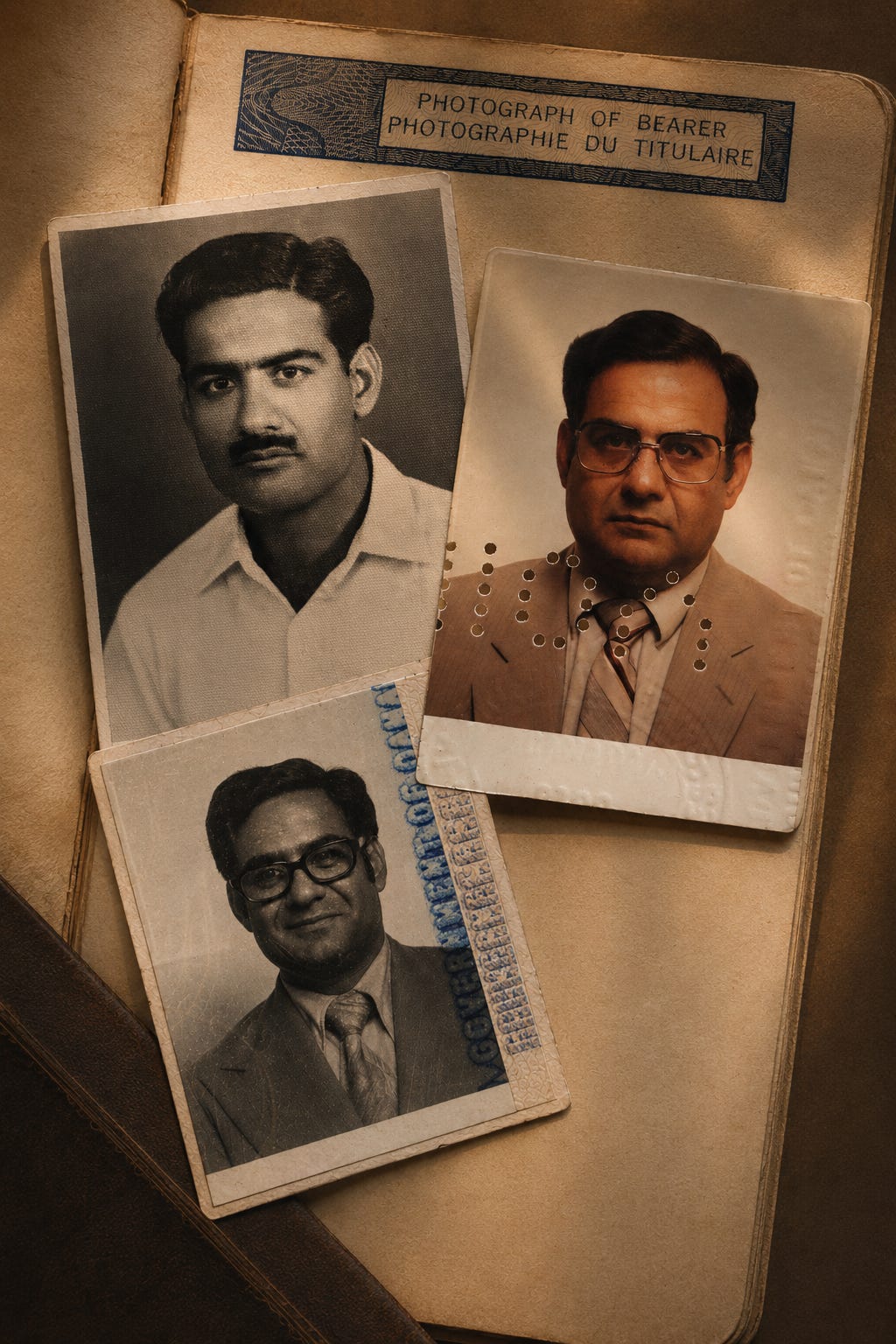
It seems so odd that a man who had crossed an ocean with nothing but his 21 year old body, who had watched everything fragile get broken, who had decided that if he could just control the perimeter, he could keep what he loved intact. And then, in the same breath, the same man who encouraged me to go to Israel for medical school. Alone. To a country at war with itself, surrounded by neighbors at war with it, a place where the news was always about bodies. I was nineteen. He drove me to the airport and did not cry, or if he did, it was after I was already on a silver plane in the sky above the New York skyline, where I could not see him.
His fears had no consistent logic except the logic of a man who had learned that ordinary life was more dangerous than extraordinary risk. Was it a certain kind of immigrant grief? Some belief that the spectacular will spare you and the mundane will kill you, because the mundane is where he lost things before.
There is an earlier version of me that was built entirely in opposition to him. Every choice a correction. Every softness I offered my children a repudiation of what was withheld from me. I thought that was healing. I thought that was the work.
Yet, at some point I began to realize that you cannot build a self out of negation. At least not a healthy fulfilled and content self. Otherwise you become a shadow of the wound. Instead of the mighty twisted scar that has healed. A version of yourself still organized the raw and bleeding flesh. Circling it. Distracted by the pain.
He was a man that can be present in a house and absent from every room. I charted the domestic territory. A small and thin child lurking in every corner. In clothes too big or too small. Limbs askew. Growing and stumbling and building and breaking and searching and never getting close enough to finding what I needed.
Later in my life I had become a doctor. I had an MD and a PhD but knew I had to make a choice. I had to ask what would become of my children’s memory of me.
I had become Tantalus. Condemned to stand in the river with water rising to my chin, dying of thirst each time I bent my head to drink. Fruit hanging heavy above me, pulling away whenever I reached for it. Surrounded by nourishment and unable to receive it. Surrounded by love and unable to rest inside it. That was the cruelty of it. It was unlike the cruelty of absence. It was the cruelty of proximity. My children were there, small and luminous and reaching for me, and still I remained elsewhere, stranded inside exhaustion, obligation, and some inherited script of manhood that taught me how to provide but not how to be present. An empty shell of a man.
I was a young father of young children and I was so spent with showing up at work that I realized that all that showed up at home was anger and distance. I was performing a version of fatherhood for the ghost of something I never fully knew. But I had a chance. I could notice. I could choose. There were no excuses. Even though I was never taught the language of repair I could teach it to myself.
I once had a patient who grew up in poverty. I saw him for years. From childhood to adulthood. He went through unimaginable trauma and still survived. He took his time to finish high school and made it through. After setback after setback, he was able to keep moving forward. Like with any good patient and any conscientious doctor, the time has come to say goodbye. And on that last visit he kept thanking me. Thank you. Thank you. Thank you.
His gratitude felt absurd to me. I told him plainly,
“You did it. It was all you. You were just kind enough to let me come along for the ride.”
And when I think about that I cannot help but choke up and wonder. About manhood and survival. About gratitude and growth. And ask myself, how many fathers of how many sons talk about love?
It has been two years since he died. And the grief has not resolved. It has migrated. It has found new corners and crevices to make itself at home. There are times that u have processed his absence and then my son looks at me a certain way or my daughter needs something I try to give and suddenly I am nine years old and standing at the edge of a vast and frozen terrain of silence. Waiting. Lonely. Cold and unwelcome. Lost and uncertain.
When you sit with it long enough, grief turns from accusation into testimony. Death is liberating. I can tell his story now and I am not protecting him when I do this. I am not excusing him. I am trying to understand the wreckage well enough not to rebuild it.
They say everything you love is made from borrowed light…
I look back at old passport photos. Creased and smooth squares with his signature below his face in faded and frayed blue ink. I try to imagine what is there beneath his expression. What was he thinking? Did have any clue who I was or who I would become? Who I am still becoming?
The lighthouse in my mind is not salvation. It is not the light that guides you safely home. It is the thing you return to when you need to see how far you have come, how much water is between you and where you started. You comb it not for answers but for bearing.
My father burned his boats in ways he could not control and ways he chose, and I could not always tell the difference, and maybe he could not either. I used to think that was abandonment. Now I think it was also just a man poorly matched to the life he was living, trying to find the one that fit.
The difference is I know it. I can name it. I do not have to wreck everything to move.
I have spent a long time trying to be the opposite of what he was. And I have succeeded, mostly, in ways that matter. But I have also had to learn that being my own person is not the same as being his correction. My children do not need me to be a repudiation. They need me to be a person. They need to see that pain is survivable, that love is imperfect and still real, that you can carry loss without becoming it.
I can see it from afar. The fog, the water, the silence. The long waiting. I look out at the wreckage and I do not curse it anymore.
I tell the story honestly, which is to say with love, which is to say as a son who finally stopped waiting for his father to become someone else and started, instead, becoming himself.
No posts
Comments
Nothing yet. Say the first thing.
Sign in to join the conversation.