
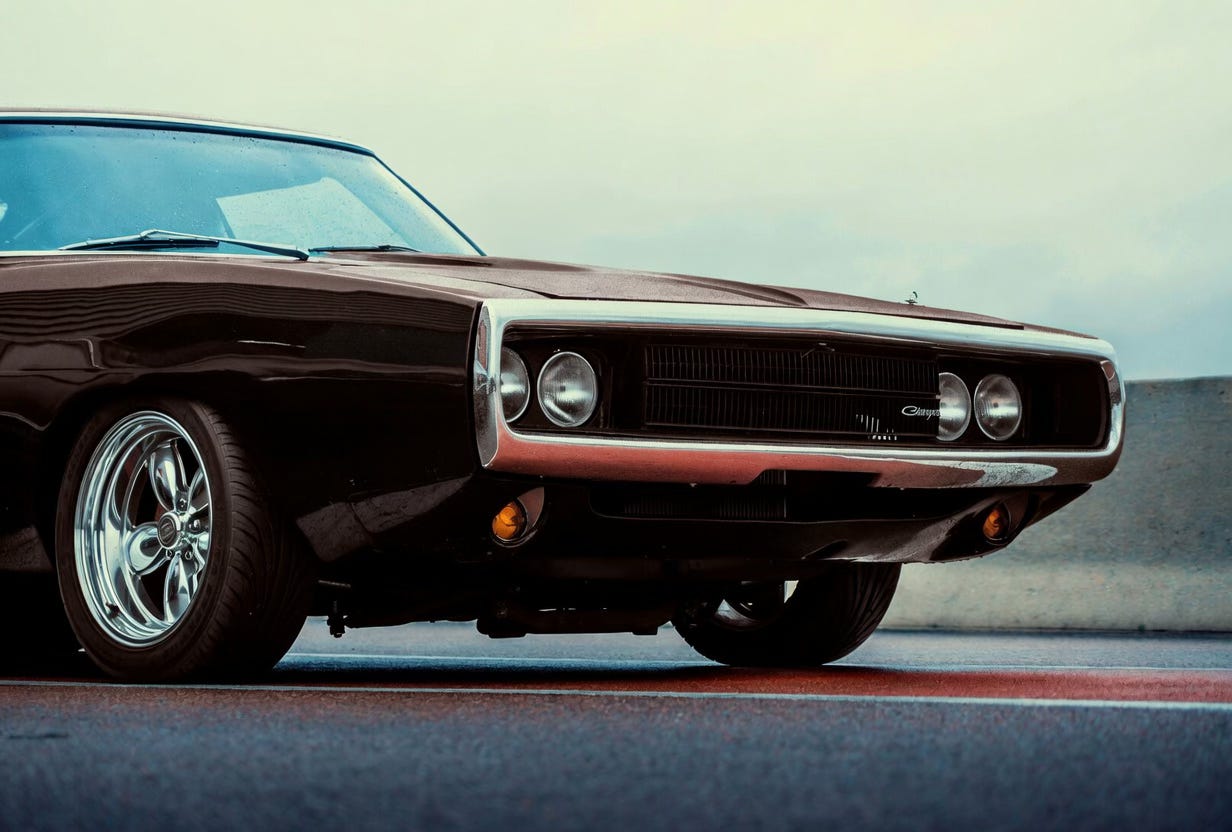
The first car I remember was a dark brown Dodge Charger. An ancient relic of the late seventies. Brown like mud in the backyard. Worn and soft upholstery. It was a symbol of masculine energy. Marketed dominance that faded away during the gas crisis of the late seventies. He drove with both hands on the wheel even though the road was straight and empty. No radio. Just silence. Bouncing up and down with suburban Toronto moving past us in monochromatic grey.
Then something would shift. Someone’s name would surface and he would react. He would offer a half-sentence observation that must have represented some wound. So and so must have forgotten where he came from. He only remembered my father when he needed something. That my father had done so much for some people that they would never know.
I never knew what to do with those moments. I was too young to understand them and too old to pretend I had not heard. So I looked out the window and watched the houses go by and let the silence come back between us. Sometimes it would feel like the most natural thing in the world. The two of us driving through the city in that dying muscle car, close enough to touch, each of us entirely alone.
There is an extensive literature on intergenerational inheritance. Somewhere in the dense and inaccessible research on epigenetic, attachment theory, family systems, and intergenerational trauma, is a simple story of a child and a parent with the long shadow of unresolved grief passing through time and across memory. I have spent my career as a psychiatrist naming this process in people’s lives and helping them trace the lines of pain and hurt from the past into the present. To help people project their aspirations into the future instead of their fears and insecurities.
Yet, I have been reckoning with a different realization. That I am never outside the concept of inheritance. I am always inside it.
My father was a man who felt everything and showed little. He had been taught by history and circumstance. The trauma of partition. Displacement and violence for a child of ten. Concepts and trauma that were difficult to name and process. His childhood was spent in boarding schools far from his parents. Meanwhile, he wept openly at things that moved him. I can remember how his face would lose color and contort and how the sight of his messy and fragile emotions would produce a mix of tenderness and irritation. I was not old enough to know how this alchemy of love made sense in the moment. Why would I be irritated or annoyed? Maybe I was protecting myself. Learning to be absent and detached in the same way that he had. Present in body, yet sealed and concealed somewhere beyond reach.
Inheritance arrives without notice. It slips in through the gaps between said and unsaid. Lately, it has returned into my consciousness through a question that will never be answered.
Did you know?
Did you know that sometimes your bitterness left the residue that it did? That it slowly accumulated and built up over time to the point that your vanishing from this world made me begin to notice? That your silence felt like abandonment even though I know it might have represented incomprehension?
I am not sure he knew because I am not sure that I know or will ever know. And I have to start learning to be okay with the emptiness of ambivalence and uncertainty. I have to do the work to become the man that I want to be. Someone determined not to be what I inherited but something better and softer at the same time. Through showing up in certain rooms and certain moments in certain ways of embracing both silence and speaking.
The thing about the wounds we inherit from our parents is that the most lasting damage is rarely ever a singular terrible event. It is the chronic and quotidian weather of a household where certain emotions were permitted and others were not. In which a parent’s expression of emotion is the unspoken organizing fact of family life. The kind of thing that everything else arranges itself around including a child’s developing sense of what it means to inhabit their bodies and the world.
A child learns that feelings shape behavior. That pain is sometimes best ignored or converted into sterile composure to protect others from the uncomfortable yet full weight of our human selves. The child grows up and builds a life. They become someone who might help others understand their pain. Meanwhile, somewhere underneath the confidence and eloquence is a messy inheritance quietly building up and trying to find its way into the room.
In this context, we think of healing in modern mental health as a valorized idea. Something that inspires quotes and book titles and substacks. Healing as the capacity of holding inheritance without being controlled by it. Healing as speaking aloud that my parents gave me their wounds without permission. I choose to name this and chart a different course.
But healing itself is nothing like a quotable post. It is not linear. It does not begin and end. There is no magical morning you wake up and find yourself truly free of the past. And at the same time there are mornings where you might catch yourself and feel an echo of a memory and recognition that something different is happening and something different is also possible. Healing does not arrive with a moment of perfect clarity or singular moment of release. It feels like peace with a prickly edge. A settling that does not feel resolved and an ability to hold two things at once.
He loved me in the only language he knew. I am still his son in ways that surprise me. That is the edge. Not the wound. Not the unresolved grief. The awareness, the capacity to watch myself from a distance and recognize the language or the pattern or the moment and then make a liberating choice.
My father did not do that work. I do not know if he could not. I do not know if he chose not to. I just know how it felt. Perhaps he was weak. Perhaps no one handed him the tools. His boarding schools did not teach him emotional literacy and the immigrant experience did not leave any room for it. The loneliness of building a life in a country that never quite made him feel like he belonged. Did he have space to sit quietly and ask himself what he actually needed?
We do not choose our inheritance. We do not choose when the sun or the storms invade into the sacred and vulnerable space of a child’s life. We do not get to decide how we inhabit painful silence when we experience it or how we absorb the patterns of our parents’ emotions before we have language for what we are absorbing. But we can learn to name what we did not know. We can decide which parts of our inheritance we carry forward and how we define the meaning of these wounds for our future selves. In families shaped by migration and loss and the pain of being made to feel perennially unwelcome or inferior, this may be the most important work there is.
No posts
Comments
Nothing yet. Say the first thing.
Sign in to join the conversation.