
Each morning, I would gather my equipment. Gloves, a stretchy blue tourniquet, clear plastic tubes, the needle kit, alcohol, and gauze. I would slide them into the pocket of my white coat and walk quietly to the patient’s room.
A small knock. Shalom. Boker Tov. Good Morning. I would take small steps to the patient’s bedside and gesture them to give me their arm. I would gently hold their forearm while tying the tourniquet and wait until a vein would rise into the skin. Using the soft pad of my fingers, I would feel the vessel. Swab the skin with alcohol and hold it taught with one finger while I inserted the needle with my other hand.
Being slow would equate with more pain for the patient. I had to get a quick jab that makes it way into the cylinder of the vein. Look for a tiny crimson splash into the reservoir. Then, advance the cather into the vein.
This decisive moment was the moment of my greatest uncertainty. I would hope and pray that the steady stream of blood would continue without stopping. A thin, straight, and clear red line meant that everything was working as it should. If there was any interruption, I would have to stop, collect my thoughts, and figure out how to get back into the vein. If I messed up, it would mean more pain for the patient. It would mean self-doubt, lingering
inadequacy, and anxious avoidance. They would suffer because of me. Yet, my teachers keep reminding me. You have to fail in order to learn.
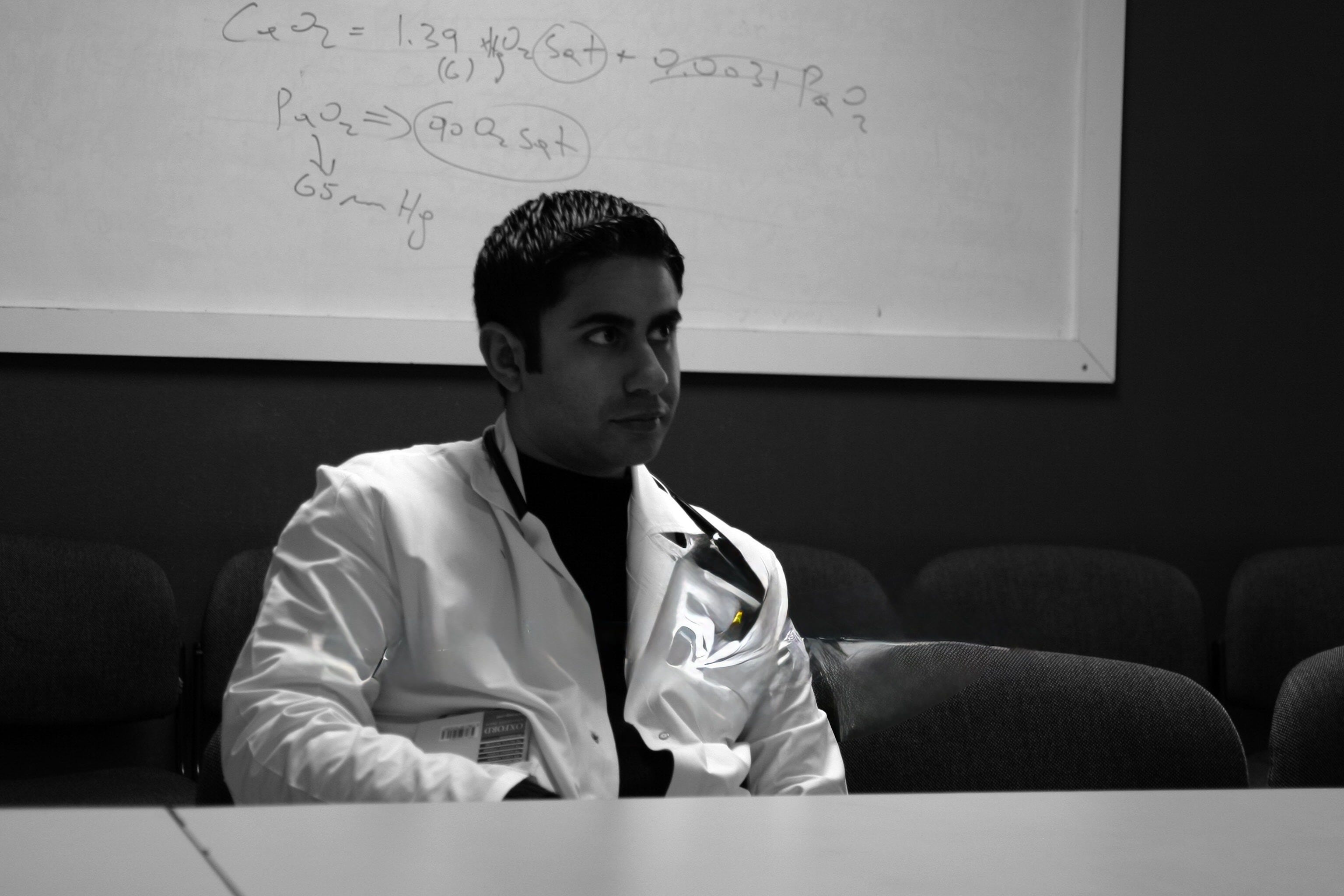
Once, on my surgery rotation, I had successfully inserted an IV, then bungled the retraction mechanism, pressing slightly too hard, pushing the needle through the cap, slicing halfway into my own fingertip. I held myself together long enough to leave the room without the patient noticing. By the time I reached the hallway, blood was moving down my finger into my palm.
I cleaned the wound. I told the intern. The protocol began. Two tubes from the patient, two tubes from me. Tests for dangerous diseases. Everything sealed in a biohazard bag. And then the part that was the most difficult to address…. I had to go back into that room.
This man’s blood had entered my body. I was the one who felt like I had violated something. I had failed him by trying to help him, and now he would be poked again, for more blood, because of me. What would he think of me. What did I think of myself.
The failure was real. The learning would come later, slowly, and I just had to muster the courage to go back into the patient’s room.
The sting of self-doubt does not disqualify you. The moment of greatest uncertainty was also the moment that required the most elegant and simple kind of presence. Confusing certainty with presence is one of the most expensive mistakes a professional can make. Yet, I spent years making it.
I had learned early that the room is a test and you pass the test by appearing not to need anything. I was good at this. I built something real on top of it. But the architecture was wrong. I was producing the appearance of grounded authority while running a continuous checklist:
Do they see me?
Do they trust me?
Have I performed well enough to earn my place?
The institutions I moved through rewarded that performance so consistently that it took years to distinguish the performance from the person.
Like so many immigrant children, I learned early that certain kinds of uncertainty are not available to me. A moment of visible doubt could be read as thoughtlessness in me, yet thoughtfulness for others. Self-doubt was danger, yet so painfully real. So you become someone who always appears to know. The performance starts to seem like it is working. You advance and find yourself standing in self-congratulatory rooms, and yet it feels profoundly misaligned and uncanny. Like wearing an itchy and oversized coat that was tailored for someone else.
And then the wound opens again.
I walk into a hospital room where someone I loved was dying. His thin yellow jaundiced skin taut over his lithe frame. I had to confront being a doctor and being a person broken open and raw. I had to hold them both. I had to confront the illusion that there was a zero-sum choice between being capable and being human. That staying present inside my own pain and staying present for someone else were incompatible.
How do we hold pain without performance? Not weaponizing suffering as proof of qualification. Not pretending that it does not exist so I can shrink myself for someone else’s comfort. Arriving as I am. Full. Messy. Shaped by love and loss. In service of something larger and more transcendent than anything on a list of publications or grants or awards.
We must practice to attain a particular kind of discipline. Our wounds do not chair meetings and our grief should not be something for anyone else to feel like they have to manage. There is a difference between being a leader who knows suffering and transforms it into depth, and a leader who leaks their pain and re-enacts it as harm. The first builds trust and the other extracts and exploits it.
I think about the medical students and residents I have worked with over my career. The pages at 3 am and the evening walks on shiny linoleum floors. The ones armoring up. Measuring their words. Reading every room for threat and trying to find something to latch onto. Someplace safe enough to actually learn.
And I think of me. Never knowing what to say and somehow trying to say it anyways.
Me in the hallway outside the patient’s room in one of the loneliest places I have ever stood.
Wondering if I can be someone who carries something real and keeps moving forward. Someone who is ambitious and tender and uncertain yet committed and steadfast to doing the work. Someone who knows that presence is not the same as performance.
Me in the boardroom. Learning to be a leader that can be grounded and inspiring. Driven and soft. Expert and still learning. Realizing the goal is not to rise above the difficulty but to walk into it and stay, steady enough that the people around you believe they are allowed to be whole.
Go back in anyway, I want to tell myself.
The wound can stay. You carry it differently over time, but it stays. And sometimes you might find yourself being the most senior person in the building and yet still feeling uncertain. Finding ways to fill the gap between the doubt and the doing.
No posts
Comments
Nothing yet. Say the first thing.
Sign in to join the conversation.