

I am often asked what I think about GLP-1s, and this was a question that recently came up in my coaching group.
Rather than giving the same answer to several people, I thought I would write a Substack telling the story of the long and frequently unsuccessful search for effective weight-loss drugs.
The problem with appetite and feeding it is part of our survival and trying to safely hijack these vital pathways poses problems even for the most innovative drug designers.
I also want to make it educational, with a slant towards quantum biology. There are so many drugs that I cannot include them all—unless there is a Part 2. I have put a big image at the end that listed all the drugs that I researched, how they work, if they work and what the main side effects were.
I cannot speak for those who live with obesity, but I know many people who do. It bothers them, although some pretend that it doesn’t. I am going to approach this from a historical and biochemical perspective and, by the end, let you make your own decisions.
Obesity has existed throughout human history, but our scientific understanding of it developed gradually.
Beginning in the Upper Palaeolithic era, between 25,000 and 35,000 years ago, we find some of the first representations of obesity in human figurines, including the Venus of Hohle Fels.

Diet and exercise have been recommended for obesity since at least the time of Hippocrates.
Ancient treatments were based on the belief that obesity represented an imbalance within the body.
Soranus of Ephesus, a second-century Greek physician, described obesity as a disease in which “the body keeps acquiring additional flesh beyond what is needed,” even when there were no other major symptoms.
Ayurvedic writings connected obesity with inactivity, overeating and the excessive consumption of sweet and fatty foods. They also recognised an association between obesity and the sweet-tasting urine of diabetes remarkably early in medical history.
The development of obesity drugs evolved through a series of discoveries, mistakes and regulatory lessons.
Early treatments included thyroid hormones, DNP and amphetamines. Later approaches targeted appetite, metabolism, neurotransmitters, digestion and hormonal signalling. Many drugs initially produced weight loss but were later abandoned because of toxicity, addiction, cardiovascular complications, psychiatric effects or limited effectiveness.
Let’s have a look
The 16th century was known as the “century of discovery,” and King Henry VIII showed what could happen when abundant food was combined with too little exercise. After Christopher Columbus arrived in the New World in 1492, products including tobacco and tomatoes were brought back to Europe, and tobacco began to be used for weight loss.
Nicotine is addictive, reduces appetite, increases energy expenditure as well as influencing the parasympathetic nervous system and is part of some Covid/Spike protein protocols.
It was observed long ago that stopping smoking is often associated with weight gain. Vinegar was also used as a weight loss aid, although diet and exercise remained the main approaches.
The discovery of leptin in 1994 was particularly important because it confirmed that body weight is strongly regulated by biology. No leptin drug has been made that was a success.
Mainstream medicine does not incorporate light and circadian biology into obesity treatments. Doctors working outside mainstream medicine—for example, Dr Jack Kruse, as you know—have done a great deal of their own research into leptin, the leptin–melanocortin pathway and the influence of light, magnetism and water on energy status and weight.
Three principles are important when designing or using treatments/medications and these also apply to anti-obesity medications:
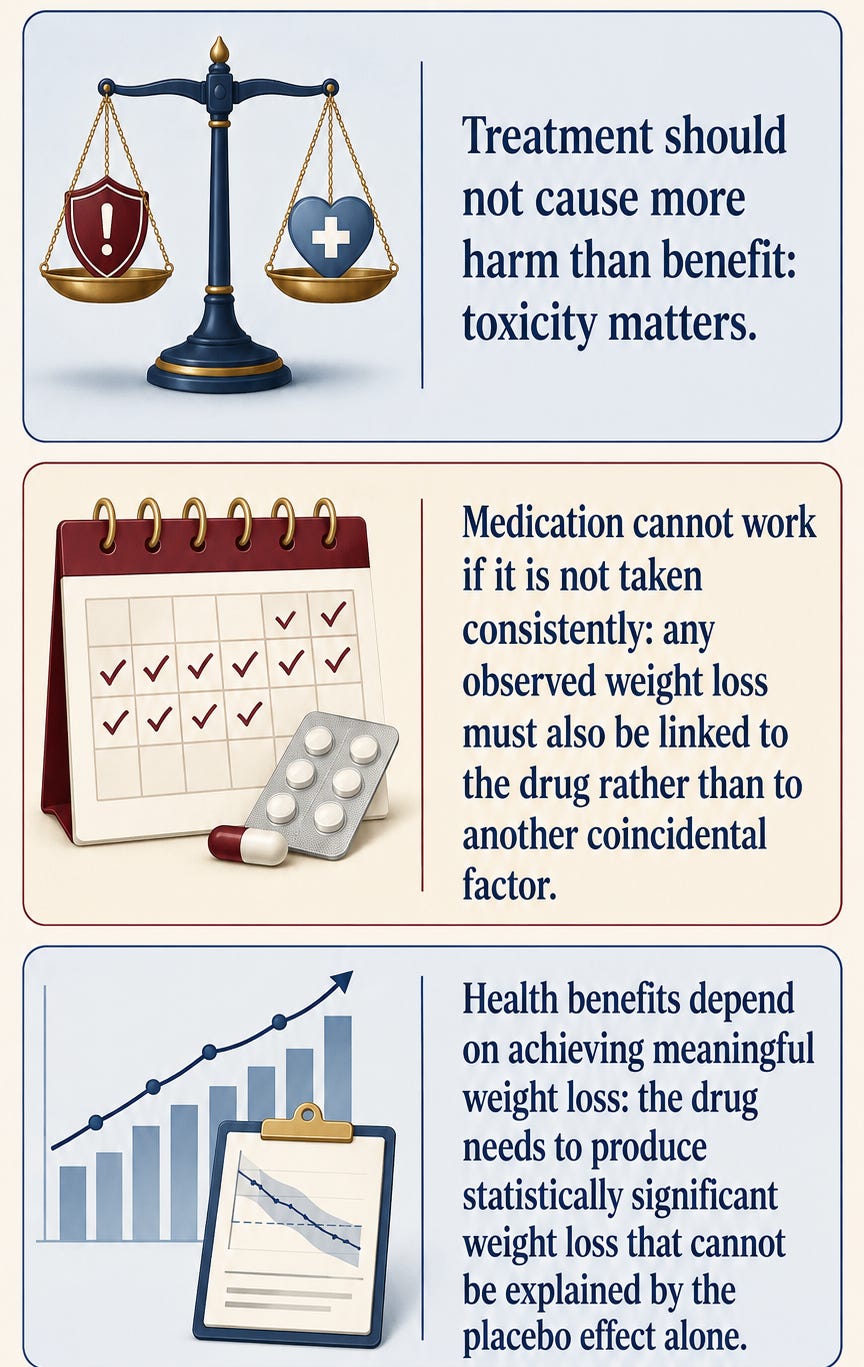
Thyroid hormone became the first drug used on a rational medical basis to treat obesity in 1893. Doctors had observed that people with myxoedema—a severe form of hypothyroidism—gained weight and that treatment with thyroid extract reversed this alongside their other symptoms.
Once doctors realised thyroid extract could raise metabolic rate, it became a popular weight-loss treatment. However, when given to people with normal thyroid function, it could create artificial hyperthyroidism, causing palpitations, sweating, insomnia, nervousness, muscle loss and strain on the heart.
Using thyroid extract discontinued as a treatment for obesity due to side effects.
Key reference:
Putnam JJ. Cases of Myxedema and Acromegalia Treated with Benefit of Sheep’s Thyroid. American Journal of the Medical Sciences. 1893;
Misuse of thyroid medications can also raise reverse T3 which is effectively a brake on thyroid function and weight loss.
I wrote about Reverse T3 and Thyroid in Depth In This Substack
2,4-Dinitrophenol (DNP) was originally used in explosives and munitions during the First World War. Factory workers in France exposed to DNP became unusually hot and lost significant amounts of weight.

Maurice Tainter and his colleagues at Stanford began investigating this effect in 1931, first in animals and then in people with obesity.
They treated 170 people—20 men and 150 women—with doses of up to 300 mg per day, alongside moderate dietary restriction. Treatment lasted an average of 88 days, producing an average weight loss of 17.1 lb (7.8 kg), or approximately 1.4 lb (0.64 kg) per week. Only five participants failed to lose weight.
In 1934, Tainter concluded:
“It can now be said that dinitrophenol is of definite value as a drug for treating obesity.”
However, he also recognised that DNP had a “razor-thin” therapeutic index, which means there is a very small difference between the dose that produces the desired effect and the dose that causes serious harm or toxicity.
DNP caused weight loss by uncoupling oxidative phosphorylation. Instead of using the mitochondrial proton (H+) gradient to produce ATP efficiently, energy was released as heat. This increases metabolic rate and fat burning, but it can also cause a dangerous and uncontrollable rise in body temperature, which cooked some patients from the inside!
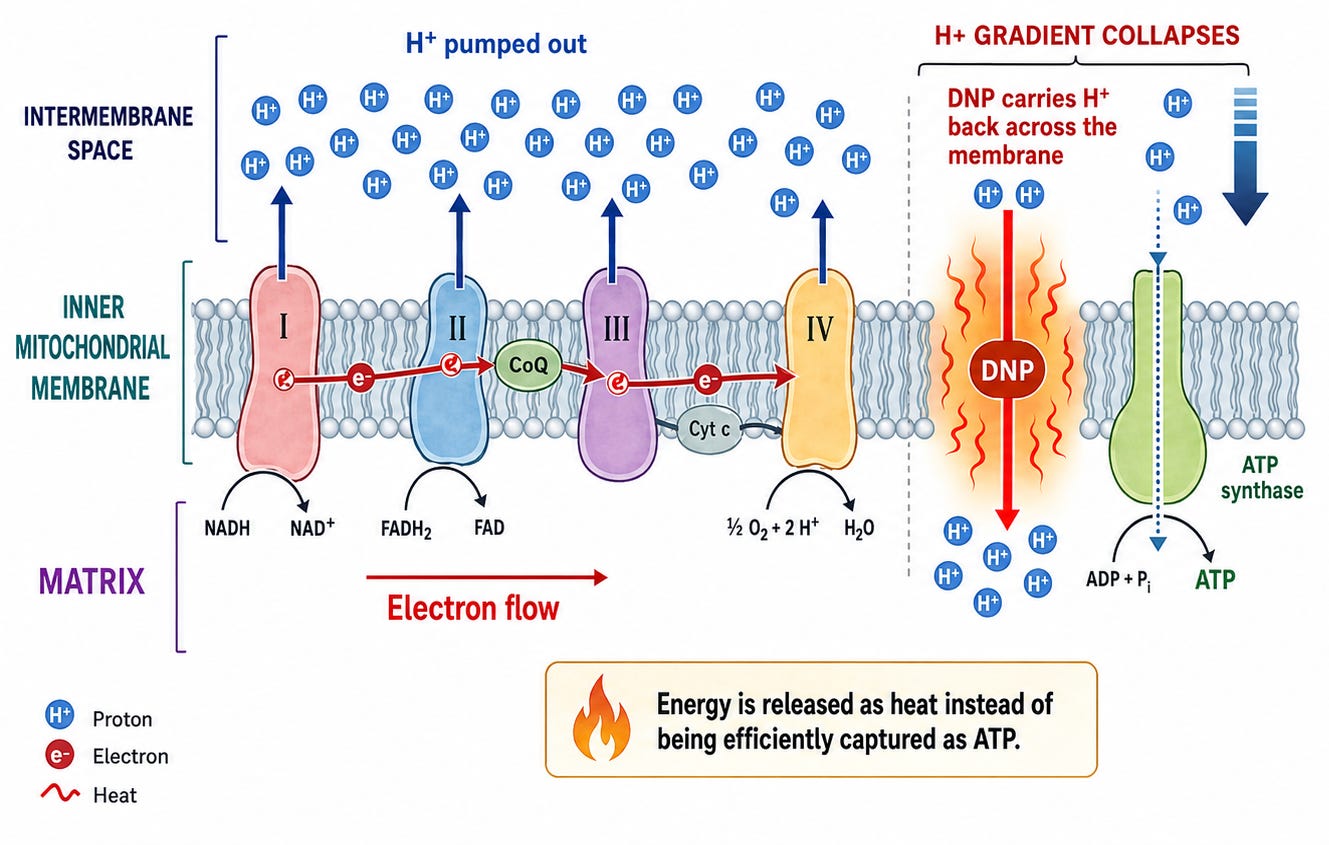
Cold exposure or cold therapy also causes uncoupling, but the mechanism is completely different to DNP. Cold exposure is natural and doesn’t cause overheating.
The other problem with DNP is that so many electrons rush down the electron transport chain in an uncontrolled way, some of these electrons escape and never make it to complex 4, forming uncontrolled free radical floods, causing oxidative stress, damage and swelling of the mitochondrial membrane. This can move the respiratory proteins—Complexes I–IV—further apart and damage the mitochondria, making more inflammation.
The opposite is true for cold thermogenesis, as cold exposure compresses the electron transport chain via the effect of water expanding, so the electrons get to complex 4 more quickly and less of them are likely to escape, which is how cold therapy is anti-ageing.
If you want to learn more about ‘Cold Therapy Myths & Truth’ see this Subsack Post
DNP was widely used during the 1930s, with an estimated 100,000 Americans taking it by 1934. Reports soon emerged of skin rashes, nerve damage, cataracts, blindness, severe overheating and deaths. It was judged too dangerous for human use and removed from the US market in 1938.
Key Ref: Grundlingh J, Dargan PI, El-Zanfaly M, Wood DM. 2,4-Dinitrophenol (DNP): a weight loss agent with significant acute toxicity and risk of death. Journal of Medical Toxicology. 2011;7(3):205–212.
DNP also has uses as a herbicide, as plants also have mitochondria as well as chloroplasts. Instead of cooking the plant, the DNP in essence causes the plant to starve to death from the metabolic demand, as plants do not have fat stores to draw on as mammals do.
For this reason, DNP was still in circulation, and it was forgotten about for about 50 yrs while other weight loss drugs took the stage and were then removed. DNP made two comebacks in the 1980s and again in the 2000s, but ‘Rainbow Pills’ probably caused the most deaths
Amphetamines or ‘Speed’ such as Benzedrine (amphetamine), Dexedrine (dextroamphetamine) and Desoxyn (methamphetamine) became widely used for weight loss because they suppressed appetite and increased alertness.
Amphetamines not only prevent neurotransmitter reuptake—they cause stored dopamine and noradrenaline to be released into the synapse and have a small effect on serotonin; the flood of neurotransmitters also makes people high.
Methamphetamine was prescribed as a weight-loss drug, particularly from the 1940s and marketed as Desoxyn. It was used as a last resort drug when other methods had failed.
Methamphetamine has an additional methyl group (CH3). This makes it more lipid (fat)-soluble, allowing it to cross the blood–brain barrier more rapidly and produce stronger central nervous system effects, making it more potent and more addictive.
However, they caused insomnia, anxiety, agitation, high blood pressure, rapid heart rate, palpitations and, at higher doses, paranoia and psychosis. Long-term use also lead to tolerance, dependence, cardiac problems, dental issues, misuse and addiction.
Amphetamines are tightly controlled drugs and no longer approved specifically for treating obesity. People still use amphetamines these days for parties, in ADHD medication(legal) and weight loss (bought illicitly). Amphetamines are one of the most studied compounds, so despite their issues they provided useful insights into biochemistry.
“Rainbow pills” were colour-coded combinations of several drugs prescribed together for weight loss. Instead of reducing adverse effects safely, doctors often added another drug to counteract or disguise the side effects produced by the first.
Some concoctions also contained corticosteroids, belladonna, glandular thyroid, extracts, DNP and digitalis(from foxgloves). Digitalis could itself cause nausea, which was sometimes regarded as useful because it reduced food intake, despite the small window in therapeutic dose and harmful dose
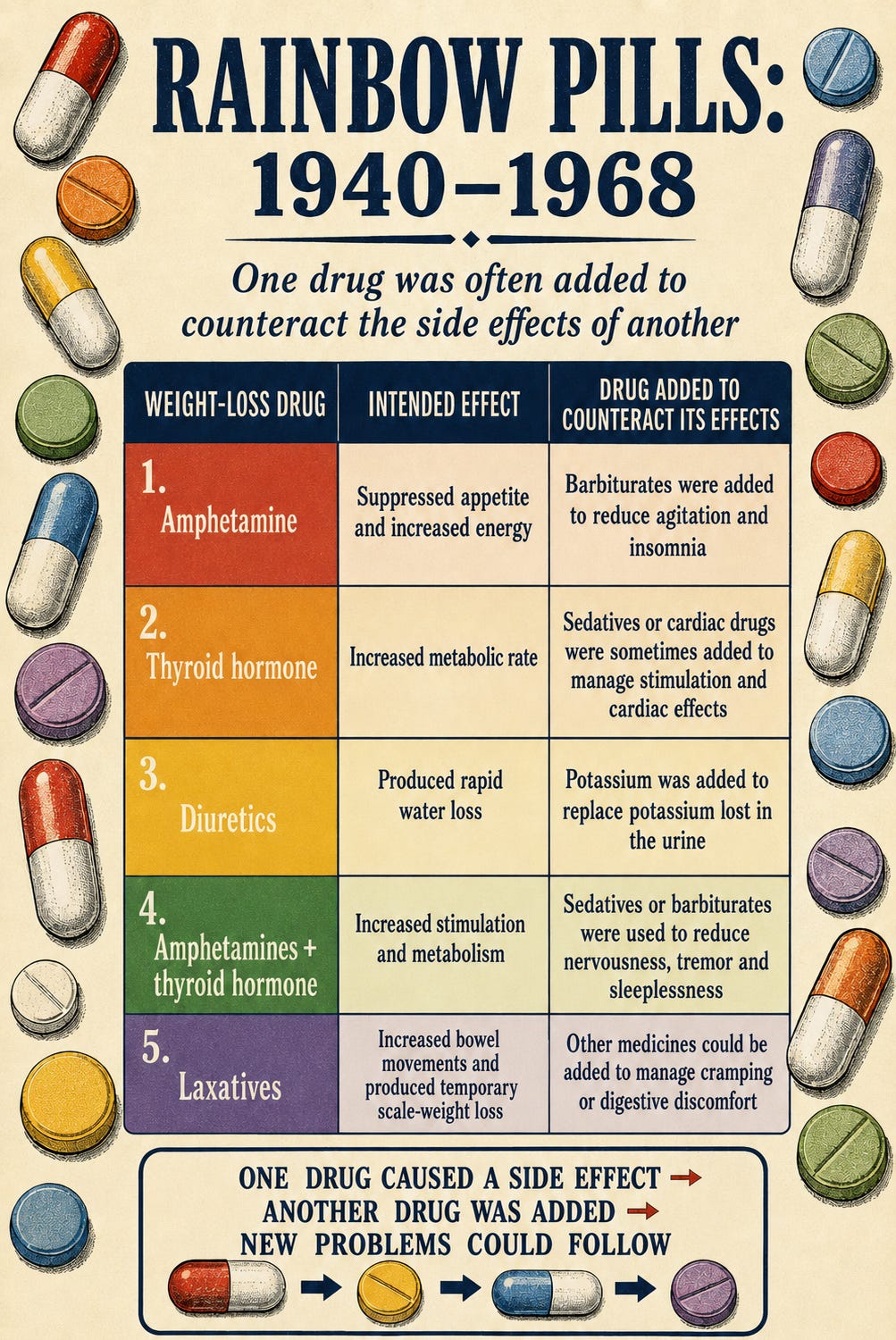
This created a dangerous prescribing cycle, which we see today with other medications:
One drug caused an adverse effect, another was added to suppress it, and further drugs were added to manage the new problems.
Deaths associated with these rainbow pills during 1967–1968 led to a US Senate investigation and tighter regulation of the weight-loss industry.
Key Ref: Cohen PA, Goday A, Swann JP. The return of rainbow diet pills. Am J Public Health. 2012;102(9):1676-86.
Phentermine, a chemical relative of amphetamine, was approved for weight loss in 1959. It primarily increases noradrenaline, suppressing appetite, but can also cause increased heart rate, raised blood pressure, palpitations, anxiety, insomnia and tremors. Unlike many early weight-loss drugs, it remains available and became one of the most widely prescribed because it is inexpensive and appears relatively safe when used appropriately in carefully selected patients.
Fenfluramine increased serotonin signalling and was later combined with phentermine as Fen-Phen. The combination produced substantial weight loss—one trial reported 15.9% after 32 weeks, compared with 4.9% on placebo—and prescriptions rose to almost four million.
However, fenfluramine’s metabolite activated 5-HT2B serotonin receptors on heart valves, causing abnormal tissue growth, valve leakage and pulmonary hypertension. After heart-valve disease was reported in 1997, fenfluramine and dexfenfluramine were withdrawn worldwide. Phentermine remained available because the damage was primarily linked to fenfluramine.
Deaths were reported in people who had taken Fen-Phen, particularly from pulmonary hypertension and complications of heart-valve disease.
One published case described a woman who took Fen-Phen for only 23 days and died from irreversible pulmonary hypertension eight months later.
Fen-Phen combo is an important lesson in off-target effects. A drug may act on one serotonin receptor to reduce appetite but also activate another receptor in the heart, producing damage that may not become apparent until millions of prescriptions have been issued

Some of the drugs I have listed you will have noticed target the dopamine, noradrenaline and serotonin systems, which as you know are regulated by light, especially UV light. Artificial light disrupts the dopamine system.
Sibutramine blocks the reuptake of noradrenaline, serotonin and dopamine. It produced nearly 12% weight loss at six months in one trial, but also increased blood pressure. It was withdrawn from Europe and the United States in 2010.
Side effects: increased blood pressure, non-fatal heart attack, stroke, cardiac arrest and cardiovascular death.
Rimonabant blocked CB1 cannabinoid receptors involved in appetite and the rewarding effects of food. However, concerns about psychiatric effects led the FDA to reject it and Europe to suspend it in 2008. A cardiovascular trial involving 18,695 people was stopped early because of increased suicide rates.
Side effects: depression, suicidal thoughts and increased suicide risk.
Cetilistat, (ATL-962), like orlistat or Xenical, is a gastrointestinal lipase (fat metabolising enzymne) inhibitor. Studies showed Cetilistat did produce a with a dose-related reduction in body weight and in hemoglobin A1c (lowers blood sugar). Side-effects have reduced the enthusiasm for this drug and Xenical as gave patients oily stools and sometimes explosive oily diarrhoea. However, Cetilistat, proved effective in vitro against COVID-19 , which may give it a new life and it will be back again.
Yuan S, et al. “Discovery of the FDA-approved drugs bexarotene, cetilistat, diiodohydroxyquinoline, and abiraterone as potential COVID-19 treatments with a robust two-tier screening system.” Pharmacological Research. 2020
At the moment, these weight loss drugs are what is all over social media, and there are the for and against, and it is up to you to make your own educated decision and not be pushed into something by an influencer, spouse or doctor.
The possible side effects are listed on the packaging, and risk of sudden vision loss as a side effect of semaglutide by Hathaway JT et al. 2024 is alarming, even if it is rare.
History does repeat itself, which is why I wanted to show you the history in this post to let you decide for yourself based on what has been going on for almost 100 years. Even if DNP has been around since the 1930s and made two comebacks, it is now regulated; many people have never heard of it, as it was technically the first ‘weight-loss drug’.
As you read the side effects and toxicity with the drugs I described came out several years AFTER millions of prescriptions were issued.
Decisions, especially to buy are not always logical as mostly they are emotionally driven or there is a perceived need. In the end people who suffer from obesity often opt for these drugs, which can be dangerous, but its best not to judge them and I leave people to it.
With many weight loss drugs, including GLP-1 treatment, rapid weight loss can include muscle loss and fat loss, muscle can be hard to gain back after a certain age, which leads to different problems. Bone density loss vary by drug and circumstances, but adequate nutrition—especially protein—and resistance exercise are commonly recommended to help preserve muscle and bone during weight loss.
Then, depending on how somebody became obese in the first place, there is deuterium to factor in as deuterium play a role in white fat production as well as numerous other issues when it is in the wrong place. Deuterium is not a problem in the blood, its when it gets into places where it causes problems.
Sudden fat loss while living a life indoors under artificial light is a problem for deuterium being dumped from the fat tissues and ending up in other tissues, causing harm.
This is a big issue for our friends who use GLP-1s and do not follow a quantum lifestyle.
We all have friends who use GLP-1s and some of them tell us and others keep it to themselves.
👉🏼Quantum Starter Kit Use Code: Substack For 10% Off
50 Slides, 5 Videos, Actionable Steps
"After this week, you'll never look at sunlight, water, food or your own body in the same way again. You'll begin to see biology through the invisible forces that organise life."
Comments
Nothing yet. Say the first thing.
Sign in to join the conversation.