
Just this week, I recorded some video for a new social media series — something I’ve worked really hard on, something I care a lot about — but as I was reviewing the footage… I started to doubt the whole project.
My “Doubt Thoughts” Greatest Hits album sounds something like this:
*This is too low quality... should I have booked a studio to record these?!?*
*Do I really know enough about this topic to be showing up as an “expert” here?!?*
*What if this fails?!*
Luckily, I’ve done a lot of work to help me deal with this incessant soundtrack — and as part of that work, I’ve learned to hook reminders to some of those hit singles.
“What if” is one of them.
I’ve trained myself to notice the fearful “What if” — to notice when that phrase shows up in my thoughts. It’s a hook now, because when I notice that thought, I’m trained to respond back with this: “Okay — what if?”
“What actually if?”
The answer is like, never catastrophic.
If the video series doesn’t do well… I’ll be safe. I’ll be okay. I can try again. The world won’t end. My husband will still think I’m cool.
So maybe… it’s all just not that serious?
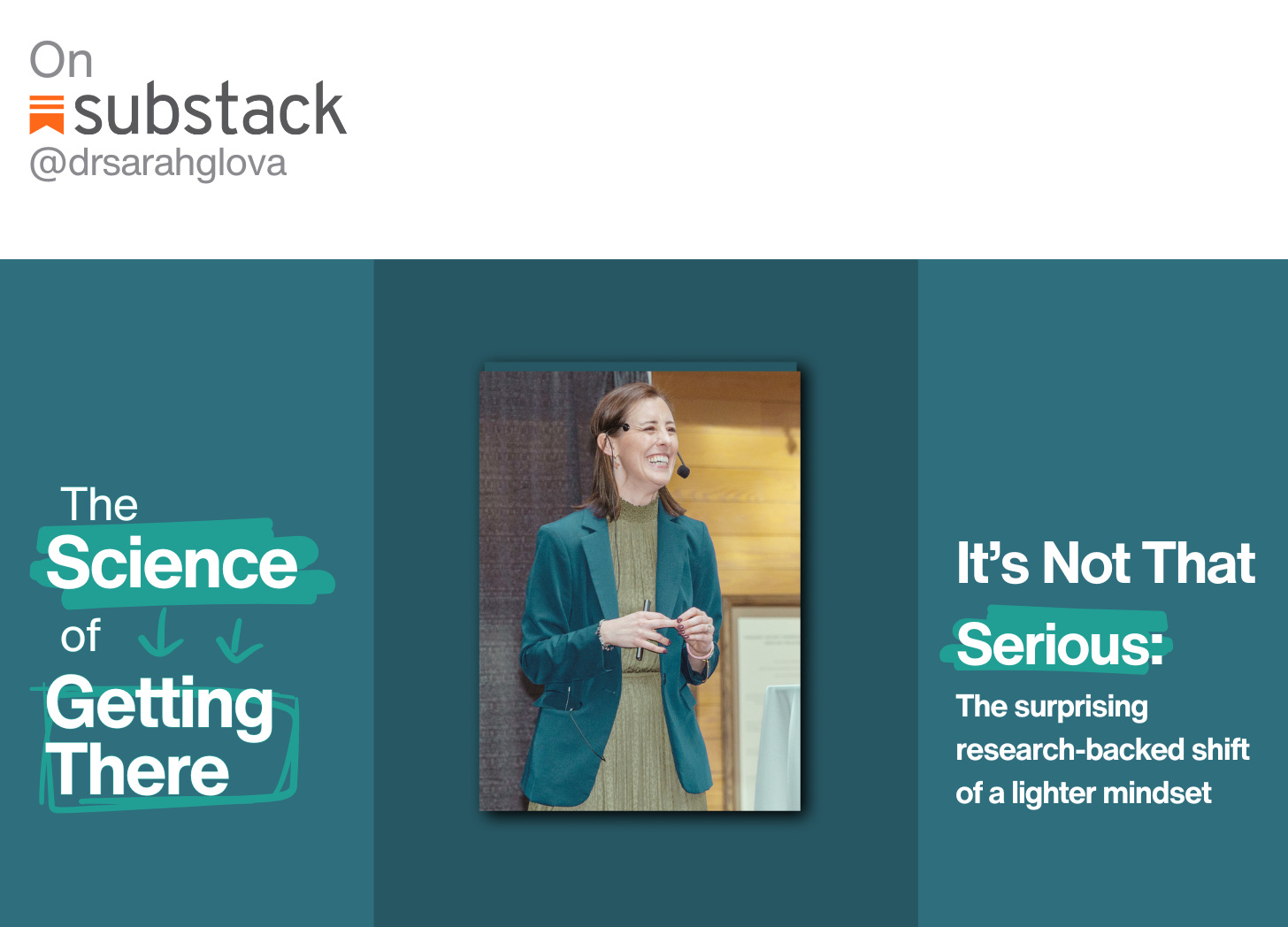
Sometimes, treating something seriously is the right answer. My problem, though, was that a few years ago, I was treating everything seriously. I was so dedicated to my work and my ambitions and my reputation — everything felt very, very serious.
Over time (so, sooo much time), I realized something essential: Everything can’t be the most important thing. And the way I was approaching things — as if everything was life-or-death serious — was burning me out and crushing my motivation.
So I had to learn how to hold high standards without holding everything in a death grip.
What started as a personal shift turned into a really cool research project. Because as I observed the benefits of a looser grip in my own life, I got curious about the research on this — what happens when we reduce the emotional load that we attach to our daily challenges?
My question was something like — can we lower our perception of the stakes without lowering our standards? What if a shift to “it’s not that serious” actually frees us up to care more about our work, just in a different way?
Turns out, the research backs this up big time.
And when we understand how the brain performs under pressure, then it makes sense that “lightening up” is actually super productive.
Because…
Studies on cognitive load and performance consistently show that high emotional pressure constricts our problem-solving abilities. The prefrontal cortex — that infamously important brain area that’s responsible for decision-making and flexible thinking — goes offline when stress spikes.
A small mental reset (“It’s not that serious”) could help us to reopen those pathways.
I love Teresa Amabile’s research on “The Progress Principle” here. (I have referenced this work so many times this year!)
It demonstrates that people make more progress when the environment encourages small, consistent movement rather than perfect, high-stakes effort.
Lower perceived stakes = more forward motion.
Kristin Neff’s work shows that people who practice self-compassion are *more* likely to take responsibility for mistakes, not less.
When failure isn’t catastrophic, we become more willing to engage honestly with our behavior.
Research in positive psychology suggests that even a hint of humor expands cognitive flexibility, lowers cortisol, and supports resilience.
A small shrug, a “well, learned so much” smile — they can be powerful tools to help us shift our physiology.
Okay, research is showing some pretty cool reasons to loosen our grip — so why don’t we?
Why are we taking everything so seriously?
Our default setting of taking serious things seriously could’ve come from a number of environments — like these:
school environments built on evaluation
workplaces built on urgency
cultures that prize “professionalism” over authenticity
social media ecosystems that equate visibility with vulnerability
hustle culture that equates time spent with productivity
I think it’s important to acknowledge that there are so, so (SO) many spaces encouraging this mindset. It’s not just us, y’all — it’s the water we’re swimming in, you know?
We’ve received lots of messages that reinforce how seriously we should be taking everything — and we’ll probably continue to receive those messages, if we keep trying to show up for our goals.
Therefore, maybe the best thing we can do as we work on big things is to give ourselves easy and quick ways to dial down the intensity.
My easy-and-quick strategy is The Shrug.
That’s right — the quick shoulder lift. The body language that says, “Whatever, it’s all good.”
That shrug doesn’t say “I don’t care” or “This doesn’t matter”; instead, it says:
This matters, but it doesn’t need to consume me
What matters most is that I’m trying
I can care deeply without catastrophizing
I can show up fully without expecting perfection.
Shrugging isn’t about lowering my ambition. It’s about loosening the emotional chokehold that prevents me from acting on that ambition. Because when I’ve got that death grip — I don’t want to step forward or hit “Submit” until I feel perfect.
Which is a perfect example of why a softer grip can actually expand my creativity.
When it’s not that serious, I can do it. I can try. I can care about it without needing it to be perfect. So, a step forward we go.
Later this week, I’ll hit “Share” on those video clips that I’m working on — not because they’re perfect, not because I’m confident that they’ll go viral, but because I’m committed to trying.
My goals are important to me, but they don’t define me. The best thing I can do for them, and for me, is not to take the “trying” part too seriously.
The next time something feels heavy — a meeting, a message, a post, a project, a presentation — pause and ask:
“What if this isn’t as serious as it feels?”
Take a moment to really dial in to this thought — lean into the physiological shift between “What if?!?!” and “Okay, well, what actually if?”
See what it feels like to shrink those stakes back to their actual size.
Part 2 — How to Tell When It’s *Actually* Not That Serious: A research-informed coaching guide with prompts, reframes, and questions that help you respond with clarity, not panic.
It’s a lesson I’m still learning — that we can hold ourselves to a high bar without making that bar a lethal weapon.
That we can be ambitious without being overly critical.
That we can lead, create, parent, present, write, and try — without pretending every moment is a referendum on our worth.
(Because it isn’t.)
Sometimes the bravest thing we can do is simply this: Let the moment be lighter than it feels.
You’ve got this. 🫶
No posts
Comments
Nothing yet. Say the first thing.
Sign in to join the conversation.