
In the twenty-five years since Lewis and Clark opened the Northwest territory, rough, hardy explorers and trappers roamed the vast extent. For those claiming that these early settlers were an evil oppression upon the Indians, they have much to explain about the following historical account.
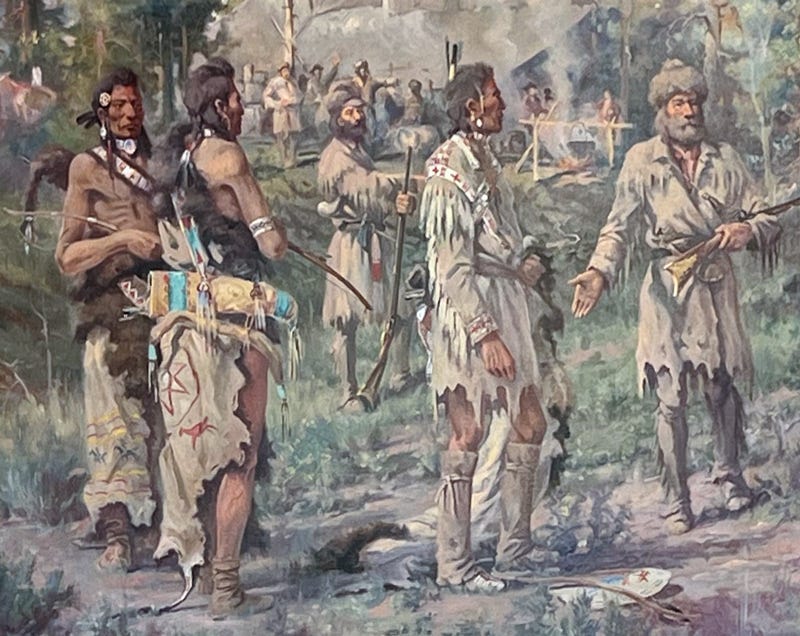
In 1831, four Nez Perce and Flathead Indians (from what is now Idaho) traveled 1,500 miles to the western trade outpost of St. Louis. Convinced that the white man’s God was superior to any spiritual truth they knew, they came to seek the source of the white man’s success. The four Indians were Black Eagle, Rabbit Skin Leggings, No Horns on His Head, and Man of the Morning. In fact, the portraits of Rabbit Skin Leggings and No Horns on His portrait have hung in the National Gallery of Art in Washington, D.C. for some time.
The Nez Perce and Flathead Indian tribes clearly associated the prosperity of the white man with what they referred to as The Book- the Bible. As they were unable to find the Bible in their language, the Indians departed from St. Louis with this message.
“I come to you over a trail of many moons from the setting sun. I came with one eye partially open for more light for my people who sit in darkness. I go back with both eyes closed. How can I go back blind to my people? I made my way to you with strong arms through many enemies and strange lands. I go back with both arms broken and empty. My people sent me to get the white man’s book from Heaven”.
“You took me where you allow your women to dance, as we do not ours, and the Book was not there. You took me where they worship the Great Spirit with candles, and the Book was not there. You showed me images of good spirits and pictures of the good land beyond. But the Book was not among them. I am going back to the long sad trail to my people of the dark land. You make my feet heavy with burdens of gifts, and my moccasins will grow old in carrying them. But the Book is not among them.
When I tell my poor blind people after one more snow in the Big Council that I did not bring the Book, no word will be spoken by our old men or by our young braves. One by one they will rise up and go out in silence. My people will die in darkness and they will go along the long path to other hunting grounds. No white man will go with them and no white man’s Book, to make the way plain. I have no more words”.
- -Appeal to General Clarke
Source: Henry Spalding
It is an observation of American history that, whether by fate or providential design, certain men and women have been raised up for a specific time and purpose. Unknown to the four Indian seekers, the response to their quest would impact their tribes for generations to come. That response was already unfolding five hundred miles away, in a small town in upstate New York.
Please feel free to share.
At age twenty-one, a young Marcus Whitman having insufficient funds to pursue the seminary, apprenticed himself to a local doctor in Rushville, New York. His aptitude for medicine was keen and, two years later, he entered the College of Physicians and Surgeons of the West District of New York and opened a practice in Niagara, Canada. But even after this success, he still longed to be a minister and he tried seminary again. However, this time he failed due to a prolonged illness. The contrast between success and failure guided him to pursue more medical training and Marcus reentered the physician’s college and achieved his Medical doctor degree. He once again established a practice and became well known as a very capable doctor as well as an upstanding elder in the local Presbyterian church.
Unknown to Marcus, reverend H.P. Strong from Marcus’ hometown of Rushville wrote the American Board of Foreign missions this letter in 1834.
“I write at this time to make known to you the request of Doctor Marcus Whitman. He is a young man of about 30 or 35, of solid, judicious mind, of, as I hope and believe, more than ordinary piety and perseverance, a regular bred Physician, has practiced several years with good success and credit. He is, in my opinion well qualified to act as a Missionary Physician. Although I know not that he thinks of it, yet I think he might, if thought expedient after a time, be ordained to advantage. He has been formerly in poor health but is now better, and thinks a station with our western Indians would be useful to him. He has thought of being a Missionary for some time past, and I think him better qualified to do good in that capacity than most men young men with whom I am acquainted.”
At first, the Missions board was reluctant to act due to Marcus’ history of poor health. However, after some time and several letters written on his behalf, the board appointed Doctor Whitman a Missionary Physician. The young doctor then married a previous acquaintance, Narcissa Prentiss, from Amityville. They were a well-suited match as they began their married life journeying west to a new life as missionaries. Four years after the Nez Perce and Flathead Indians journeyed to St. Louis, the Whitmans arrive at the home of the Nez Perce and Flathead Indians.
The Whitmans served the regional tribes for eleven years, teaching the Indians agriculture and medicine while they helped create a written language into which the Bible was translated. Over time, Doctor Whitman’s mission became well known on the Oregon trail as a natural destination for the sick and injured among the wagon trains headed west. As a consequence, in 1847 measles swept through the local tribes and the Whitmans worked ceaselessly to save as many as they could. However, by the fall, one half of the Cayuse tribe was wiped out. A half-breed named Jo Lewis from Maine fomented the distrust of eleven Cayuse Indians with the lie that the missionaries were secretly poisoning their patients. Despite their many years of work and their exhausting effort to save as many of the sick as they could, on November 29th, 1847, the Whitmans were brutally massacred.
What is recorded for us is that the seeds of these missionaries did not return void. Upon the Whitman’s burial, the very Indians that they served provided this brief eulogy.
“You are leaving us forever and my people. O my people will see no more light. My children will live only in a night that will have no morning. When we reach Walla Walla, I shall look upon your face for the last time in this world. But this Book in which your hands have written and caused me to write the words of God, I shall carry in my bosom ‘til I lie down in the grave.”
The original accounts of the early western expansion show that the pioneers were mostly devoted Christians that, unlike their humanist counterparts that would arrive latter, settled the early West as Christ’s contributors to all of mankind, fellow settler and Indian alike. The common perspective that these early settlers were Christians was captured in the following speech by President Warren Harding.
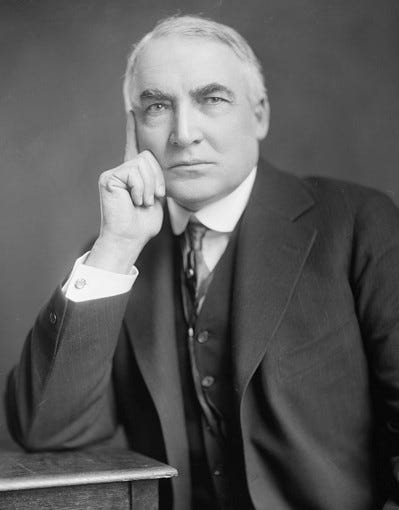
“… Never in the history of the world has there been a finer example of civilization following Christianity. The missionaries led under the banner of the Cross, and the settlers close behind under the star-spangled symbol of the Nation. Among all the records of the evangelizing effort as the forerunner of human advancement, there is none so impressive as this of the early Oregon mission and its marvelous consequences. To the men and women in that early day whose first thought was to carry the Gospel to the Indians- to the Lees, the Spauldings, the Grays, the Walkers, the Leslies, to Fathers DeSmet and Blanchet and DeMars, and to all the others of that glorious company that found that in serving God they were also serving their country and their fellow men – to them we pay our tribute; to them we owe a debt of gratitude, which we can never repay.”
In conclusion, there are three points to be made.
First, the broadly held perception that the early settlers (as a whole) exploited the Indians is false. The witness of settlers and tribes alike tell us the early settlers where Christians who saw the image of God in all men. Under the doctrine presented by Paul that all men are one under Christ Jesus, the early Christian settlers of the west benefited Indians. As a result, they were welcomed, trusted, and appreciated. This is the early west taken directly from its sources that rewritten history can only erase through the perpetuation of ignorance.
Second, that same history tells us that the cruel exploitation of the Indians would come from later, secularized generations of Americans - those who came to dominate American culture and politics that also declared Negroes sub-human and promoted the exploitation of slavery as justified institution.
Third, we have been taught that all Americans are guilty of the unethical treatment of Indians. Liberal educators are all too eager to falsely include the influence of Biblical Christianity with the exploiters. As Biblical Christians, our heritage took a different path, driven by our obedience to Christ. We should stand firm, reject the guilt laid upon us, and stand apart as our testimony that the values of Biblical Christianity makes a difference – and it always has.
This is Dr. Robert James, reminding you that a Heritage Lost is an Identity Stolen for Someone Decided Not to Tell you Who You Are.
Till Next Time, may God and liberty Bless.
Dr. Robert James
No posts
Comments
Nothing yet. Say the first thing.
Sign in to join the conversation.